It’s the not-so-new DUI that is becoming as rampant as are the increased incidences of Alzheimer’s disease in the world.
Are you enabling someone in your family by not having the difficult, yet necessary, conversation about driving safety? “She only uses the car to drive to the grocery store, eight blocks away.” Oh, is that all? Well then, nothing could possibly happen that might harm/kill her or harm/kill another innocent driver or pedestrian, or child on his bicycle zooming out of a driveway and into the street. Right?
In the attached article, Driving with dementia: the dangers of denial, I go into detail about the hazards inherent with driving under the influence of dementia, so I won’t repeat its content here, but I encourage you to take the time to give it a look-see. I’m readdressing this issue because of what I witnessed today:
A car making an unsafe switch of lanes, barely missing the huge SUV in front of which she maneuvered her car;
Then I witnessed this SUV – certainly not understanding the circumstances surrounding this affront to his driving – quickly passing the woman and doing the same to her as had been done to him – abruptly changing back into her lane with nary a few inches to spare between his back bumper and her front bumper;
Now I’m behind the impaired driver who stops suddenly at an intersection (we have the green) and she puts her left hand turning indicator on, only she’s not in the left hand turn lane – she’s in the through lane and she’s risking a multiple-car pileup by her actions. I could not move to the left or right to avoid her so I laid on the horn and fortunately, she proceeded straight ahead, not making her left turn;
Further down the road she managed to get into the left-hand turn lane and as I passed her, I clearly saw an impaired and confused woman in her 70’s who appeared unaware of where she was or where she was going.
I was in no position to follow her to assure that she was okay, but I did throw up a prayer that she would get safely to where she needed to be – without harm to anyone else as well – and that her family or someone close to her would do what was necessary to take away her car keys.
Denial about this issue doesn’t solve anything. Please make the decision today to remove the keys from a person who absolutely should not be driving because of his or her dementia.
I am very pleased to say that I am a subscriber of the only Seattle newspaper still in print – the Seattle Times. This newspaper writes and publishes varying opinions on local and global issues – even when one journalist disagrees with his or her fellow journalists or – dare I say – the Editors of the paper. A timely example of freedom of the press was displayed during the showdown between the aerospace machinists unions representing Puget Sound Boeing machinists (blue collar workers) and the higher-up Boeing management who replaced Seattle with Chicago as their ivory tower home base in the year 2001.
(Photo credit: Wikipedia)
Washington State Governor, Jay Inslee, asked for – and received – a special legislative session to present a bill that would award Boeing with delightful tax incentives to entice the company to continue the practice of building their airplanes in the greater Seattle area, a/k/a the Puget Sound region. This bill was passed but was contingent on the machinists agreeing to an extension of their current union contract period from 2016 to the year 2024. Additionally, the newly revised contract would not come close to resembling the current contract that both the machinists and the Boeing executives agreed upon when signed a few years back. If the union membership would vote “Yes” on this newly devised contract, Boeing would keep the 777X in Washington forever more. If the machinists voted “No” on the contract, Boeing leadership would approach other non-local Boeing sites – those not in Washington State. Now why would this Washington business want to give their work to another state’s economy? It’s all about the unions, baby.
Boeing leadership, and the major shareholders of Boeing stock, are sick and tired of machinists and engineers caring about – and fighting for – their rights regarding employee benefits. Shifting work to non-union locations means that the company doesn’t have to deal with the petty demands of their dedicated workers who are just trying to make a decent living now, while building a decent retirement for later. One of the major take-aways of the newly crafted contract is the cessation of the machinist’s pension plan, replacing it with a traditional 401(k) savings plan. Go ahead and say it – many people are thinking the same thing you are: “Shit! Companies all over the United States are ending employee pensions and cutting back. You SOB Boeing machinists should stop your whining and just be glad that you have a job!”
On November 11, 2013, the Seattle Times editorial staff printed their opinion of what the machinists should do: Vote Yes for the Boeing 777X. I encourage you to read the attached article because the Editors no doubt speak for a certain percentage of their readership who believed that the machinists should give up their current contract and take on a new contract – let’s call it Machinists’ ContractX. Danny Westneat’s “Squeeze play” opinion piece attached at the top of my article, speaks for a different percentage of the newspaper readership – many who work for Boeing – but also those non-Boeing people who understand that when employees are told to sacrifice and cut back on their benefits for the good of the company – everyone in the company should be a part of that sacrifice.
Let’s look at the facts and you can decide if the executives are sacrificing to the same extent as their employees. Boeing has been racking up profits with its stock exhibiting impressive numbers. When the markets closed on Monday, November 18th, the stock price was $138.36 per share. “If Boeing’s CEO, Jim McNerney, retires right now, he will get $265,575 a month. That’s not a misprint: The man presiding over a drive to slash retirement for his own workers, and for stiffs in the rest of America, stands to glide out on a company pension that pays a quarter-million dollars per month.” See Anguish many of us understand, by Danny Westneat dated 11/9/2013.
At play here are many emotions and opinions – both in the newsroom and in our living rooms. On the one hand, people are saying that the machinists ruined it for Washington State by not agreeing to replace their current contract in 2016 with the hastily revised one. This new contract came about as a result of the Governor and his legislators getting into bed with the Boeing executives and some of the machinist union leaders, to discuss in private what they felt was best for their employees. As a result, the squeeze was indeed put on the machinists and now they are being blamed for Boeing’s decision to look elsewhere for airplane production that would have provided guaranteed work for current – and future – Boeing employees in the Puget Sound region.
Let’s get back to the disgruntled people who say that Boeing employees should just be glad that they have a job. Boeing employees are highly skilled workers, and historically they have been paid salary and benefits commensurate to their skills – as is the case with Boeing engineers – many of whom have been with the company for decades. All the salary and benefit details were agreed upon by Boeing management and Boeing laborers at the beginning of their current contract – the contract for which the terms don’t expire until 2016. If the machinists voted “Yes” on the newly proposed contract, they would have eight years’ worth of financial takeaways for which they weren’t prepared at the 2016 contract end.
Based on what had been legally agreed upon, these employees had been managing their present lives and gearing up for their future lives, when all of a sudden they were presented with a different financial formula than the one promised in the contract upon which they based these financial plans. Then the rug was pulled out from under them and the people pulling the rug were those who will bank monthly pension amounts of approximately $300,000 at today’s rate. Where’s the sacrifice baby? What am I missing? Don’t forget, the aforementioned amount is just the pension amount – there are many other richly held benefits held by the executives. And even if $300k per month was all the compensation each executive were to receive in retirement, that’s $3,600,000 a year. Shouldn’t that leave some sacrificial wiggle room?
But the article I set out to write is about Freedom of the Press and the wonderful ability for one newspaper to express conflicting views while still being able to retain their jobs. Newspapers and other periodicals would do well to model the Times so that the reading public can read conflicting journalistic opinions in order to arrive at their own opinions on hotly contested subject matters…
A computer salesman dies and meets St. Peter at the Pearly Gates. St Peter tells the salesman that he can choose between heaven and hell.
First he shows the man heaven, where people in white robes play harps and float around. “Dull,” says the computer salesman.
Next St. Peter shows him hell: toga parties, fabulous food and wine, and people looking as though they’re having a great time. “I’ll take hell,” he says.
The salesman enters the gates of hell and is immediately set upon by a dozen demons who poke him with pitchforks. “Hey!” the salesman demands as Satan walks past, “what happened to the party I saw going on?”
“Ah,” Satan replies. “You must have seen our demo.”
A well-turned out man was driving his new BMW convertible. He had the top down, his right hand on the wheel, and his left arm hanging out the driver’s side window. With his IPod going full blast and singing at full voice himself, he didn’t notice that a rust bucket of a vehicle had pulled around to pass him and sideswiped the BMW in the process. The wealthy man pulled to a stop.
“My car!” he cried, “my beautiful car!”
When a policeman came by, the man told the officer about the accident. His car was a wreck, and it didn’t even have 50 miles on the odometer!
“You’ve got more to worry about than your car, sir” replied the officer. “You need an ambulance. Your arm is badly injured.”
The driver looked at his arm and cried, “My Rolex! My beautiful Rolex!”
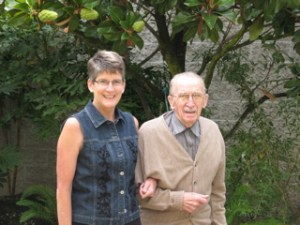
My father, on the right, with his brother, Armand, beside him.
My father, Don Patrick Desonier, born March 12, 1918 in Toronto, Canada is my Veterans Day hero. He was still living in Toronto when World War II broke out in the late 1930’s. A young man of approximately 21 years of age, my dad voluntarily signed up for the Canadian Army and served in the artillery division as a Second Lieutenant or – because the Canadian Army spoke both English and French – Sous-lieutenant.
My father was bi-lingual because his father was French Canadian – a descendant of French settlers in Canada. The correct spelling of our last name was Desaulniers, but when my parents and us three kids settled in the United States, my parents grew weary of the mispronunciation – and misspelling – of our surname, so in the 1950’s, mom and dad had our surname legally changed to its current spelling.
When my father died on October 13, 2007, many of his effects were distributed to my brother and sister, and me. I have some amazing black and white photos from WWII as well as a couple German handguns – both of which are locked in a wall-safe in our house. A couple years before my father died from complications of Alzheimer’s, he and I had a brief, but eye-opening discussion about his war service.
My father fought in France, Germany, and England and saw it all – I know this because I asked him. Our conversation went something like this:
“Dad, I have to assume that because you were in the artillery and served in several WWII hotspots, you were called upon to kill those who were designated as the enemy – right?”
“Yes, Irene. No one wants to take someone’s life, but when it’s a question of the enemy taking a bullet or you and your buddies, you choose the former.”
“So dad, you saw your buddies get severely injured and even killed – didn’t you?”
“Yes – that’s the way it is on the battlefield.”
I looked at my father, tears in my eyes, and for the first time in my life, I said, “Thank you for your service, dad. I appreciate all that you did to defend what was right during World War II.”
His response – and I paraphrase: “It’s just something you do, Irene, because it needs to be done. No one likes war, but thus far no war has ever ended on its own. Unfortunately wars don’t just peter out.”
Those of us Baby Boomers who have parents that fought in the earlier wars may not have considered what they endured before they started a family and got on with the rest of their lives. I hadn’t, but I’m grateful that in my late 40’s, I asked dad about his military service, and I thanked him for it.
A couple fishing and hunting stories. First the fish:
Said a fisherman after removing a tiny fish from his hook and throwing it back into the water:
“Don’t show up around here anymore without your parents!”
(Photo credit: Wikipedia)
A group of friends who went deer hunting separated into pairs for the day. That night, one hunter returned alone, staggering under an eight-point buck.
“Where’s Harry?” asked another hunter.
“He fainted a couple miles up the trail,” Harry’s partner answered.
“You left him lying there alone and carried the deer back?”
“It was a tough call,” said the hunter, “but I figured no one is going to steal Harry.”
Bloomberg Businessweek posted a provocative article, Sex Among Dementia Patients Spurs Call for Policies, that will no doubt get the attention of professionals, and family members alike. The attached article is well-worth the read, and I have a few comments of my own to add.
(Photo credit: Wikipedia)
I acknowledge that sexual activities most likely occur in every long-term setting out there. Consenting adults – even those with varying degrees of dementia – need touch and physical connection. I think it’s fabulous that in spite of the limitations brought about by cognitive impairment, human beings still maintain the desire to give affection, and receive affection. In some instances, affection may simply be expressed with hand holding or sitting next to someone, hip-to-hip. Or perhaps a hug and a kiss are involved. All of these actions are perfectly innocent without harm as long as all touching is consensual.
Some residents may express their need to give and receive affection with more intimate sexual activities, so if both parties are willing and able, I think intimacy is an important part of their well-being.
What about those patients who are already married to someone else?
(Photo credit: Wikipedia)
It takes an understanding and flexible spouse or partner to overlook the intimate activities of their cognitively impaired loved one. The commitment made between the two parties years ago is a commitment that still resides within the deep recesses of that person’s being – but it’s a commitment that can not be drawn upon and reaffirmed because of memory impairment. (I think it’s important to not assume that adulterous motivations are in play here.) Marriage itself may be a concept that is no longer understood by the patient, and as is oftentimes the case – the visiting spouse exists as a friendly visitor, not the wife or husband that the patient used to know.
I can’t predict how I would feel if similar circumstances came my way in the future – my husband and I have not fallen into the cognitive impaired category – yet. And you don’t have to agree with what I’ve stated above. The sentiments I have provided come from my own personal beliefs, and from the perspective of having both worked in long-term care in my past, and having had family members who have lived in long-term care housing.
One last thing: As dementia care specialist Teepa Snow stated in the attached article, “No matter what you do, somebody’s going to see you as wrong.” The issues of sex and intimacy touch many personal, religious, and ethnic biases and beliefs. There are no completely right or completely wrong answers. I’m simply thrilled that the long-term care industry has stopped pretending that geriatric sex isn’t happening, and that they are no longer treating it as a taboo subject. I take comfort in that fact.
As is customary each month, I am providing celebrations – some fiction, some non-fiction – that you might consider in November.
Maple tree on my street
Month: Aviation History Month; and National Novel Writing Month (very interested in the latter because I am still struggling to finalize my own novel)
Nov. 2: Book Lovers Day (I am an extreme book lover); and move your clocks back one hour when you go to bed today if you have been observing Daylight Savings Time)
Nov. 6: Marooned without a Compass Day
Nov. 8: Cook Something Bold Day (for some of you, that may simply be a peanut butter & jelly sandwich)
Nov. 11: Veteran’s Day (thank you everyone who is serving, or has served, your country in this manner)
Nov. 13: World Kindness Day (if everyone observed this holiday every day, there would be no need for wars)
Nov. 15: Clean Your Refrigerator Day; and America Recycles Day (makes sense to me)
Nov. 17: World Peace Day (see Nov. 13)
Nov. 21: Great American Smokeout (millions have quit so it must be possible – will this be your chance?)
Nov. 23: National Adoption Day (in honor of my sister, Mary, and her daughter, Kristina)
Nov. 28: Thanksgiving Day (which doesn’t have to be about food – it can be about feeling and expressing your gratitude)
Life as a Caregiver and Dealing With Stress Caring for Aging Parents – AARP. The attached article, written by Dr. Nancy Snyderman, chief medical editor for NBC News, shows us that even doctor-caregivers are not immune from the stress brought on by caregiving. A year after Nancy and her siblings moved their parents to live near her, Dr. Snyderman became “one of almost 44 million U.S. adults caring for an older friend or family member.”
My dad and I, five years before I became his caregiver; seven years before he died from Alzheimer’s.
Statistics show that caregivers tend to patients who are loved ones, an average of 20 hours each week – many times on top of part-time or full-time employment. Before long, Dr. Snyderman came to the realization that she had forgotten to check in on how she was doing. She gained weight, she slept only a few hours a night, and she experienced burnout – not unlike what many of us have felt as caregivers – or former caregivers – for family members.
In my article, Caregiver: put on your oxygen mask first, I address the importance of caring for yourself first, and the patient second. “No way,” you say, “my mom/dad/spouse come first; they need me!” You’re absolutely correct – they do need you, but if you get sick or disabled, you can’t be there for them. That’s why you need to place the oxygen mask on yourself first, and then on the person for whom you are providing care.
Most of us learn the hard way. We get burned out and emotionally or physically incapacitated, and then we start taking care of numero uno. Do yourself – and your loved one – a favor. If you’ve been ignoring the signs of stress that are enveloping you, stop being such a hero and start taking care of yourself. You will benefit from such care, and so will your loved one.
U.S. President Barack Obama meeting with Speaker of the House John Boehner during the debt ceiling crisis in 2011. (Official White House Photo by Pete Souza”) (Photo credit: Wikipedia)
So our elected officials – those who claim to represent us – seemed to have been playing games the entire length of the partial government shutdown while countless U.S. citizens were out of work and the economy lost $24 billion amid a cloud of uncertainty and unease. Here are a few quotes from late in the day, October 16, 2013:
Jay Carney, White House press secretary: “There are no winners here.” John Boehner, speaker of the House: “We fought the good fight. We just didn’t win.”
Those comments reminded me of a Joe South song. What follow are some snippets of the lyrics:
Oh the games people play now. Every night and every day now. Never meaning what they say now. Never saying what they mean…
And they wile away the hours in their ivory towers, till they’re covered up with flowers, in the back of a black limousine…
People walking up to you singing glory halleluiah, and they’re tryin to sock it to you, in the name of the Lord…
Look around tell me what you see. What’s happening to you and me. God grant me the serenity to remember who I am. Because you’ve given up your sanity, for your pride and your vanity. Turns you sad on humanity, and you don’t give a damn.
The biggest loss for Americans is their respect for their lawmakers. Senator Chuck Schumer of New York agrees, “It was not America’s finest moment.”
Within a half hour of the finalization of the U.S. government deal, I received a phone call from one of the political parties, asking for a monetary donation to assure that there will be better representation of that party in Congress during the next election cycle. I abruptly stopped the caller, “You’re asking me today of all days to give money to one of the U.S. political parties? I’m disgusted with both parties right now, so for you to ask for my money within minutes of the U.S. funding agreement being finalized, is extremely bad timing.” Then I hung up.
I’m ashamed of these knuckle heads for simply kicking the can down the road, instead of working together to come up with a lasting solution that will benefit their constituents – constituents who can not afford to play their silly games.
“Oh we make one another cry, break a heart then we say goodbye. Cross our hearts and we hope to die, that the other was to blame.” The Games People Play, by Joe South.
Ms. Froma Harrop’s Opinion piece, linked above, challenges all of us Baby Boomers to not surrender to the other groups coming up in the generational ranks.
Are you done at 61? Closing the door at 64? Barely alive at 75? Or are you skipping to my Lou at 82?
Come on everyone – don’t throw in the towel! As Ms. Harrop said in her Opinion piece, “there’s nothing noble about declaring oneself out of the game, whatever the game is.” I’m not saying that us Baby Boomers and older don’t have age-related changes – of course we do – but that doesn’t mean that nothing remains for us in the years ahead. In my recent blog article, A surprising fete by a Baby Boomer! I complained about a Florida reporter’s characterization of something that a 55-year old woman was able to accomplish – even at her advanced age. Click on the link to my article to get the full gist of my whining diatribe.
Circa 1960’s: my dad running a marathon in his late 50’s.
I am not advocating that you suddenly decide to beat 64-year old Diana Nyad’s swimming record, unless, of course you feel like doing so. I am advocating, however, that you explore what you’re able to do and capitalize on it. Start a new business, volunteer for organizations that you support, or just keep working at your current job as long as you still want to. Who’s stopping you? My former father-in-law turned 90-years old on September 18, 2013, and he still plays tennis and is still working at his commercial real estate development company. If Jimmy were to stop working, he’d probably collapse and die on the spot. Why? Because he enjoys being active and productive. So should you.
Don’t let the younger folks – anyone less than 50-years old – have all the fun! You can have fun too! I turned 60-years old this past May. I’ve always been an active person exercise-wise but most of that centered around taking lengthy neighborhood walks and gentle hikes. My exceptional and persistent daughter, Erin, decided I could do more. She purchased six sessions of Bar Method classes for each of us and presented it as my birthday/Mother’s Day gift. “It’ll be fun! Once you get there, I know you’ll love it.”
My daughter (the Bar Enforcer), me in the middle, and my sister Mary.
Very presumptuous on her part, but she was right! After six sessions, Erin dropped out (she has other mind-boggling exercises that she does) but I continued with the program. The biggest lesson that I learned through this process is that I can do more than I thought I could do. Bar Method is extremely difficult, but it’s not impossible. After the first six lessons, I was able to conclude that a) it didn’t kill me; b) it didn’t disable me; and c) I kicked ass! That’s right – I kicked ass. I am in a class of mostly 20-50 year olds, and I not only keep up, but sometimes I outlast the younger students. I go to class once a week and two to three additional times a week I exercise to the Bar Method DVDs at home – courtesy of my husband who installed a ballet bar in our exercise room. Thanks hubby!
If you lack confidence, go find some! If you’re hesitant to go it alone, find someone else with your same interests, and go for it together.
You are not done yet. To quote Ms. Harrop, “Every age group brings something to the party. And for every generation, the party’s not over until it’s over.”
The three-time crook felt a wave of panic come over him as he surveyed the jury in the courthouse. Positive he’d never beat the current murder rap, he managed to get hold of one of the kindlier-looking jurors and bribe her with his life savings to go for a manslaughter verdict.
Sure enough, at the close of the trial, the jury declared him guilty of manslaughter. Tears of gratitude welling up in his eyes, the young man had a moment with the juror before being led off to prison.
“Thank you, thank you – how’d you do it?”
“It wasn’t easy,” she admitted, “they all wanted to acquit you.”
Last week, a 55-year old woman who was participating in the Making Strides Against Breast Cancer walk in Ft. Lauderdale, FL amazed everyone, everywhere, when she became stuck on a drawbridge and hung on – standing up, spreading her hands and feet on parts of the bridge – for approximately a half hour until emergency crews were able to lift her to safety.
However, no one was as amazed as a local reporter, a woman in her early 30’s, who couldn’t believe her eyes; couldn’t believe the sight she was seeing; couldn’t imagine that someone of this participant’s age group could possibly succeed at this perilous fete.
What am I getting at? I wish I could find the news link again so that you could hear how incredulous this reporter was that someone 55-years oldcould possibly stand there that long. The emphasis of her report was on the woman’s age as the shocking detail – not that just about anyone hanging onto a drawbridge in the “Jesus Christ” position (as it was later described by those witnessing the fete) would have difficulty holding on for dear life while awaiting rescue.
Is 55-years old elderly? Is 55 the new 90?
Here I am, another old lady, managing to use a computer at my advanced age.
Am I overreacting? I’m 60-years old and I’m far from elderly, but imagine the shock of the aforementioned reporter if someone of my age was the one hanging on the bridge. That reporter would certainly hustle to get that 60-year old’s autograph, just so she could remember the amazing and surprising fete the ol’ gal had accomplished.
Okay, I’m done now; I’ll get off my soap box if someone would be kind enough to help me down.
I wrote the article below with an exhilaration that threatened to carry me into the air and cradle me on Cloud 9.
Donning silly glasses and cozying up to a bottle of bubbly that remains unopened.
Since that time, the children in Washington, D.C. have been battling it out on the playground, most not playing fairly, and all of them holding strong to an agenda that appears to be designed to promote their party, rather than their constituents.
I wondered aloud, “If thousands of national parks are closed, 100’s of thousands of employees are furloughed, and service members’ families are being robbed of benefits, what luck does the Alzheimer’s research money have of remaining designated for that cause?”
So I wrote an e-mail to the National Institutes of Health and asked them this very question. What follows is the automated response I received:
Due to the absence of either an FY 2014 appropriation or Continuing Resolution for the Department of Health and Human Services, no one is available to respond to your message. If you require immediate attention, please contact NIH Service desk at 301-496-HELP or via web http://itservicedesk.nih.gov/support.
Asked and answered.
September 25, 2013
NIH logo (Photo credit: Wikipedia)
In today’s news, the National Institutes of Health (NIH) announced that grants for research to discover therapies for Alzheimer’s disease have been awarded in the amount of $40 million from the Office of the NIH director, and $5 million from the National Institute on Aging.
In all the reading that I’ve done, I’ve discerned that the magic words when it comes to finding treatment and/or a cure, are “clinical trials.” The new funding of $45 million will advance the current research being initiated in the form of clinical trials, thereby offering hope to all of us who live long enough to be at risk for acquiring this disease.
With all the talk in the United States about insurance – the type used for health – I decided to provide insurance humor of a different type.
Customer: “I’d like to insure my house. Can I do it over the phone?”
Insurance agent: “No. I’m afraid a personal inspection is necessary.
Customer: “Okay, but you better get over here quick – the house is on fire.”
When Dan’s house burned down, his first phone call was to the guy who’d sold him his homeowner’s policy. “I need a check for the cash value of my house, and I need it as soon as possible,” he said firmly.
“I’m afraid it doesn’t work that way,” explained the insurance agent politely. “See, yours was a replacement policy, which means that we’ll be rebuilding the house exactly as it was before.”
“I see,” said Dan, after a long pause. “In that case, I want to cancel the policy on my wife.”
And now a joke that many of us Baby Boomers will be able to relate to: What’s the best thing about turning sixty-five? No more calls from insurance salesmen.
Monthly: Adopt a Shelter Dog Month; Breast Cancer Awareness Month; Cookie Month; Domestic Violence Awareness Month; National Pizza Month and National Vegetarian Month; which leads us to Sarcastic Month.
Daily (some of them anyway):
Oct. 1: World Vegetarian Day
Oct. 5: Do Something Nice Day and World Teacher’s Day (thank you Kirby and Kirstin!)
Oct. 7: Bald and Free Day (love you honey!) and World Smile Day
Oct. 9: Moldy Cheese Day
Oct. 11: It’s My Party Day
Oct. 12: Moment of Frustration Day (which I celebrate every day in traffic)
Oct. 13: International Skeptics Day (yah, right)
Oct. 17: Wear Something Gaudy Day, followed quite appropriately by,
Oct. 19: Evaluate your Life Day
Oct. 21: Babbling Day
Oct. 23: National Mole Day – I can’t believe these nuisance rodents get their own day
Saint Peter checks his dossier and not seeing the engineer’s name there, accidentally sends the engineer to hell. Once in hell, it doesn’t take long before the engineer becomes rather dissatisfied with the level of comfort in hell.
He soon begins to design and build improvements. Shortly thereafter, hell has air conditioning, flush toilets, and escalators. Needless to say, the engineer is a pretty popular guy.
One day, God calls Satan and says, “So, how are things in hell?”
Satan replies, “Hey, things are going great. We’ve got air conditioning, flush toilets, and escalators. And there’s no telling what this engineer is going to come up with next.”
“What?” God exclaims, “You’ve got an engineer? That’s a mistake – he should never have been sent to hell. Send him to me at once.”
“Not a chance,” Satan replies. “I like having an engineer on the staff, and I’m keeping him.”
God insists, “Send him back or I’ll sue!”
Satan laughs uproariously and answers, “Yeah, right. And where are you going to get a lawyer?”
The attached article appeared in the September 27, 2013 edition of The Seattle Times newspaper, and provides the public with information about a traveling exhibit, developed by the American Anthropological Association that inspires us to consider not just what race is, but what it is not. By the way, I changed the title of my article after fellow blogger, www.letstalkaboutfamily.wordpress.com commented on my article – see below.
The central message of the exhibit is that what we call races are not separate genetic or biological groups, but distinctions created by people, oftentimes to mistreat or isolate those they regard as different from themselves…But those distinctions come from emotion and prejudice, not science.
The writer of the article, Jack Broom, states: “In the enlightened Pacific Northwest of 2013, it may be tempting to think of racism as a thing of the past, or something that happened elsewhere.”
I live in a suburb of the Seattle area and have no doubt that racist thoughts run rampant through my local society – oftentimes with a fervency that should shock the sensibilities of everyone. I know I was shocked when I recently experienced the following:
I’m out to lunch with a female friend who characterized “oriental” people as being very abrupt. I told her that I took offense to her statement for several reasons: 1) I was pretty sure the term ‘oriental’ was replaced by the word, ‘Asian’ a long time ago; 2) how can she so readily characterize billions of people using one word: abrupt; and more importantly, 3) my daughter (biological, born in Anchorage, Alaska, whose dad, my ex-husband, is Chinese, born and raised in Hawaii) is half Caucasian and half Chinese and if push came to shove, she might be characterized as looking Asian. My friend’s response: “Really? I thought Megan (not her real name) was American?” God help us all.
How does one respond to that? Well, I did, but I’d like to keep this article G-rated.
Second example: my husband and I are in the market for a new bed so I did some preliminary in-store research last week at a nearby store that specializes in mattress sets. I told the salesman that I was looking for a fairly firm mattress so he proceeded to point out various mattresses for me to lay on so I could test the different degrees of firmness.
The last mattress he showed me was very firm. When I laid down on it, I told him that we wouldn’t be comfortable on such a firm mattress. His response: “That’s the mattress the Asians buy. For some reason, all my Asian customers buy that firmness. Must be a cultural thing.”
Ugh – I walked out.
The writer summed up what visiting this installation at the Pacific Science Center might show us: “…the exercise helps make the point that dividing people into groups may tell more about the people doing the dividing than those being categorized.”
The attached video, just 3 minutes long, showcases how very personal Alzheimer’s and other dementia are to those involved. The toll on the patient – measurable, as you will see in this Shapiro family video.
The toll on the family – especially those caring for a member with the disease – beyond measure. Imagine taking care of someone who has lost his or her faculties, who can no longer express themselves verbally, and who has become a shell of his former self. Can you imagine it?
Imagine you must, because I sincerely believe that the only way people will stand up and take notice and do something about this disease, is to wear the mantle of a loved one with the disease, and/or the mantle of the beleaguered caregiver.
If you can help monetarily, please do so: www.alz.org.
If you can help within your community to relieve the stress of a caregiver with whom you are acquainted, that support is equally as needed and valuable.
Whatever you do, please do something to make a difference.
Here’s what appears to be a true story from an Australian court case:
A lady about 8 months pregnant got on a bus. She noticed the man opposite her was smiling at her. She immediately moved to another seat.
This time the man’s smile turned into a grin, so she moved again. The man seemed even more amused.
When on the fourth move, the man burst out laughing, the woman complained to the bus driver and he had the man arrested.
The case came up to court. The judge asked the man, aged approximately 20 years old, what he had to say for himself, and the man replied,
“Well your Honor, it was like this:
When the lady got on the bus, I couldn’t help but notice her condition. She sat down under a sign that said, ‘The Double Mint Twins are coming’, so I grinned.
Then she moved and sat under a sign that said, ‘Logan’s Liniment will reduce the swelling,’ and I had to smile.
Then she placed herself under a deodorant sign that said, ‘William’s Big Stick Did the Trick,’ and I could hardly contain myself.
But, your Honor, when she moved the fourth time and sat under a sign that said, ‘Goodyear Rubber could have prevented this accident!’ I just lost it.”
That’s what happened to the woman who is the subject matter of the attached article by Danny Westneat of the Seattle Times newspaper.
1951: Marian Dahoney, a newly employed worker at an insurance company in downtown Seattle, opens her first and only bank account at the institution located within her company’s building. Name of the bank: Seattle First National Bank, later called Seafirst, a wholly owned subsidiary of Bank of America. These days, we all know the bank as megalithic Bank of America.
(Photo credit: Wikipedia)
2013: Now 85-years of age, with no steady income, other than her monthly social security check and a small retirement amount from her now-deceased husband’s employment at Rainier Brewing Company, Bank of America is penalizing her for not having very much money. The Advantage for Seniors account that she currently funds with her fixed income will be charged a maintenance fee of $25/month unless she keeps a balance of at least $5,000. Danny Westneat calls those fees hidden taxes on the poor.
Marian is of the generation that believes that customer loyalty and commitment means something. She could have jumped ship many years ago as other financial institutions provided incentives for new customers to walk the plank onto their boat, but she stayed with Bank of America for 62 years – feeling good about her commitment to one banking institution for her entire adult life.
Not anymore. Marian is being forced to pull her funds (she has less than $5,000 in the bank, otherwise she would not have received a letter notifying her that the bank would be charging her $25 per month in maintenance fees) and she is searching for a new banking institution that will show her some integrity by waiving minimum balance fees. Imagine the efforts required of this 85-year old woman to go through the process of abandoning ship. For you and I – it would be an inconvenience – for Marian, it’s a major effort.
Marian Dahoney thought that her 62-years of loyalty to Bank of America would have counted for something. Nope! It counts for nothing, because Bank of America is too busy nickle and dimeing those who are just trying to put a couple meals on the table each day in a house or apartment they hope not to lose, while paying monthly utility bills to maintain the house’s heat, electricity, and water.
Shame on you Bank of America – and any other financial institutions – for penalizing the poor for not having enough money to somehow keep your businesses afloat.
My father and my sister-in-law, both of whom have died from Alzheimer’s disease in the past five years.
According to the World Alzheimer’s report:
If dementia were a country, it would be the world’s 21st largest economy, ranking between Poland and Saudi Arabia. In the year 2010, the total world cost for caring for the dementia population was $604,000,000,000 (billion).
By 2050, in the United States alone, the costs for caring for the dementia population will be: $1,200,000,000,000 (trillion). That’s more than 1,000 x $1 billion.
Are you thinking of making any charitable contributions to a worthwhile organization before the end of the year?
and I’m as mad as hell about the millions of crimes that it has gotten away with.
Alzheimer’s and other dementias are unfair to the one diagnosed and to all those involved in that person’s life. The unfairness unfolds with the worst day of that person’s life – diagnosis of a disease for which there is no cure – therefore it is always fatal – and it is a disease where little progress has been made in treatment options.
Let me introduce you to two fabulous people who are no longer with us because this disease killed them. Yes, Alzheimer’s murdered them.
My hero – my father: 1918 – 2007
My father, Don, was born in 1918 in Toronto, Canada. He married my mother, Patricia, and they had three children. They became U.S. citizens in the late 1940’s/early 1950’s. My father was an extremely distinguished, courteous, humorous, and dedicated family man. He received his Alzheimer’s diagnosis on June 3rd, 2005 and I was there by telephone conference, having attended his initial neurological evaluation a couple weeks earlier. He died at approximately 12:10 a.m. on October 13th, 2007.
Nancy, an adoring daughter-in-law to my father, seated in front of her.
My sister-in-law, Nancy, was diagnosed with mixed dementia just a few months after my father died. Nancy was born in 1942 in Quincy, Massachusetts. She graduated from UCLA with a degree in flute performance and used those skills in many venues throughout her life. Nancy had three children from her first marriage – children of which she was very proud. Nancy was an extremely talented interior designer, opening her own design business in 1987 – the same year that she married my brother, Don. Nancy died from mixed dementia, that also included Alzheimer’s, at approximately 11:05 a.m. on July 4th, 2012. Just two and a half months later, my brother and sister-in-law would have celebrated their 25th wedding anniversary.
Saturday, September 21st, 2013 is World Alzheimer’s Day. One in every three seniors dies with Alzheimer’s or other dementia. If you do not die from Alzheimer’s, you die with it. From Alzheimer’s Association 2013 Facts and Figures.
Won’t you consider making a monetary donation in the hopes of capturing this murderer?
U.S. website for the Alzheimer’s Association: www.alz.org
Other countries have their own dedicated websites as well. Please find those sites through any search engine you would normally use, and let’s slap the cuffs on this criminal disease.
“Mr. Desonier, I think you can stop scheduling an annual colonoscopy from this point forward. You’ve been very diligent about this aspect of your health care for many years, but at your age, I think this procedure provides inconvenience and discomfort that you can do without.”
My dad was 84-years old when his gastroenterologist made that declaration. I never thought I’d say this, but that gastroenterologist is my hero. My father had one suspicious colonoscopy a decade or so earlier, and was advised to undergo that test every year to be certain that no cancer was present. If you’ve ever undergone this test – and you should have a baseline one after the age of 50 or earlier if you’re symptomatic – you’ll understand when I say that I’d rather have a root canal than have my colon flushed and probed every year. Here’s TMI for you: I’m 60 and had my first exam of that sort seven years ago and passed with flying colors. I’m on the ten-year plan so I have a couple years left before I hop on that table again. But I digress.
The above article will shock you to your senses as to how incentivized doctors are to keep prescribing outlandish medical procedures on their elderly patients. Most, but not all, such procedures benefit medical professionals and facilities and provide no benefit to the patients that undergo such procedures. Here’s a quote from the above article that is sickening in its implications:
(Photo credit: Wikipedia)
Medicare spends a quarter of its $551 billion annual budget on medical treatment in the last year of life. A third of Medicare patients undergo surgery or an intensive-care-unit stay in their final year (of life.)
The author’s 80-year old father had a “stroke-blasted” body and underwent the surgical procedure of having a pacemaker installed to correct a slow heartbeat that gave him no health problems. Medicare paid $12,500 for that procedure. Her father’s family doctor didn’t approve of the cardiologist’s decision to perform that surgery. Medicare would have only paid that doctor $54 for a medical consultation with the family to weigh the pros and cons of such a procedure.
What’s the lesson here? There needs to be a greater focus on slow medicine in the form of palliative care, rather than fast medicine that dictates quick consults and immediate – and oftentimes drastic – medical intervention that robs the elderly patient of living on his own terms, and dying when its the body’s time to do so.
With a focus on education – here’s this week’s Monday humor, starting with a Q&A and then on to three jokes:
Question: What’s the difference between ignorance and apathy?
Answer: I don’t know and I don’t care.
A young man hired by a supermarket reported for his first day of work. The manager greeted him with a warm handshake and a smile, gave him a broom and said, “Your first job will be to sweep out the store.”
“But I’m a college graduate,” the young man replied indignantly.
“Oh, I’m sorry. I didn’t know that,” said the store manager. “Here, give me the broom – I’ll show you how.”
My parents sent my brother through law school. He graduated. Now he’s suing them for wasting seven years of his life.
Which leads me to this last joke:
If law school is so hard to get through, how come there are so many lawyers?
The above public service announcement shines a spotlight on a disease that will affect you one way or another:
My father died of Alzheimer’s 10/13/2007. I’m on the left – it could happen to me; my brother is on the right, it could happen to him.
You may receive an Alzheimer’s diagnosis or I may receive an Alzheimer’s diagnosis
A loved one of yours may receive an Alzheimer’s diagnosis and you’ll be his or her caregiver
A good friend of yours; a neighbor; a coworker may receive an Alzheimer’s diagnosis
The point is – just as all of us know someone who has had, or currently has, cancer – all of us have some sort of connection to someone who has Alzheimer’s or other dementia.
None of us is immune to this disease that steals a person while their heart is still beating.
When your children attained the age wherein having “The Talk” about sex and other scary things became unavoidable, you simply jumped in and winged it – wanting to explain as much to your kids as they needed to know but trying not to lend any encouragement towards participation in said scary things. Didn’t you feel better once you checked that “To Do” item off your child-rearing list? I know I did.
My father in mid-stage Alzheimer’s.
“The Other Talk” is that which you need to have with your adult-sized children, regardless of how uncomfortable you – or your children – are about topics such as: illness, death, and finances. Acccckkkkk!
My mother and my daughter, circa 1977.
Or perhaps it’s the other way around. The adult children are broaching these difficult topics with their parents in the hopes that said parents will do something about these unavoidable issues. Regardless of who is on the receiving end of these discussions, they should be considered mandatory in every family.
Consider this scenario: Dad is dying of cancer and in a coma. Your mother has already passed on, and you have no idea what your dad wants. His cancer is inoperable and he’s having more and more difficulty breathing and he hasn’t had any nourishment by mouth since he went into a coma. Does he want breathing assistance? Does he want intravenous liquids and nourishment? Does he want pain medication to help him through the extreme pain that cancer causes, even if the medication hastens his death?
What’s a son or daughter to do? Wing it?
Let’s look at another scenario: Mom is in the advanced stages of Alzheimer’s and is unconscious more than she is conscious. There is no reversal possible of the debilitating effect this disease has had on her body: her doctor tells the family that their mother’s ability to swallow is greatly compromised, her breathing is becoming more and more labored, and she has shown no interest whatsoever in food or liquids. Her body is in the active stages of dying.
In this scenario, dad is still living and cognitively competent and he has told the family and your mother’s doctor that he wants every single measure possible to be employed to keep his bride of sixty-five years alive. You, however, have a copy of your mother’s living will/advanced health care directive – as does your father – which contains conflicting wishes to those of your father. Your mother wants no extraordinary measures employed – not a respirator, not a gastric feeding tube, no intravenous nourishment, nothing except for medication that will make her as comfortable as possible as she leaves this world. When your mother was fully aware and cognitively healthy, she had her wishes incorporated into a legal document, determined to take the responsibility of making such decisions out of her loved ones’ hands.
What’s a son or daughter to do? Follow mom’s wishes.
What a gift that is – carrying out your loved one’s wishes when she is no longer able to verbalize them. It would still be a gift if mom’s wishes were clearly spelled out that she wanted everything done to keep her alive as long as possible. The point is not what was decided that is important – it’s that the decision had already been made – a decision that remained in the hands of the patient/family member.
Both of my parents gifted me and my two siblings with documented specific wishes for their life and death. My mother unexpectedly died in her sleep on September 24th, 1994 at the age of 77 – something she had wished and hoped for her entire life – who doesn’t? My father died on October 13th, 2007 at the age of 89 from complications of Alzheimer’s and cancer. There was no guessing when it came to the time when us three adult kids rushed to his bedside. He was comfortable in his death, and we honored him by following his wishes for no intervention. Did I want my dad to die? God no. I wanted him to live forever; but none of us gets to do that, so I’m glad that my father was allowed to take his last breath and leave this world his way.
Humor on aging – this is for everyone out there, because the only way to avoid getting old is to not make it that far, or perhaps:
The secret of staying young is to live honestly, eat slowly, and lie about your age.
There’s one advantage to being 102 years old – there’s no peer pressure.
Andrew was a dutiful son who accompanied his dad to his regular checkups with the urologist.
“And how’s your urine flow, Mr. Gunderson?” asked the doctor when they were seated in his office.
“Fine, just fine, Doctor, and God helps,” quavered Gunderson cheerfully. “He turns the light on when I start, turns it off when I stop, and I don’t have to do a thing.”
“Oh, no,” groaned the son, as the puzzled urologist looked over at him. “Dad’s peeing in the refrigerator again.”
Red Pontiac Firebird (Photo credit: Wikipedia)
Just as the elderly woman was turning her Mercedes into a parking space at the mall, she was edged out by a red Firebird. “You’ve got to be young and fast,” jeered the teenaged driver as he jumped out from behind the wheel.
The woman reversed, revved her engine, and rammed the Firebird. As the Mercedes reversed and headed for the Firebird again, the teenager turned and gaped, then ran over and banged on the older woman’s window. “What the hell do you think you’re doing?” he screeched.
She smiled sweetly and explained, “You’ve got to be old and rich.”
 Are you enabling someone in your family by not having the difficult, yet necessary, conversation about driving safety? “She only uses the car to drive to the grocery store, eight blocks away.” Oh, is that all? Well then, nothing could possibly happen that might harm/kill her or harm/kill another innocent driver or pedestrian, or child on his bicycle zooming out of a driveway and into the street. Right?