Victories in Caregiving
 The above mini-article, This Magic Moment, by a fellow blogger, is magnificent in its message of hope, love, and connection.
Caring for a loved one with Alzheimer’s or other dementia, in this instance a spouse, is a difficult task and so very unpredictable. Sometimes the unpredictability brings heartache and extreme difficulty.
However …
sometimes the unpredictability results in a heart filled with renewed promise of goodness and beauty. Celebrating every victory that comes our way – regardless of how small some may think it to be – is reason to strike up the band, blow up the party balloons, and relish the joy that exists in that very moment.
Lighten up Mondays
A man is walking from the lake carrying two fish in a bucket. He is approached by the game warden, who asks to see his fishing license.
 The fisherman says to the warden, “I did not catch these fish; they are my pets. Every day I come down to the water and whistle, and these fish jump out, and I take them around to see the sights, only to return them at the end of the day.”
The warden, not believing a word of it, reminds him that it is illegal to fish without a license. The fisherman turns to the warden and says, “If you don’t believe me, then just watch.”
He then throws the fish into the water.
The warden says, “Now, whistle to your fish and show me that they will come out of the water.”
“What fish?” asks the fisherman.
Caregiver Coaching Services
via Desonier Caregiver Coaching Services.
Click on the link above to read about one man’s journey from spousal caregiver to professional coach of those who are caring for loved ones with Alzheimer’s or other dementia.

During my time of caregiving, (my father died in 2007 from complications relating to Alzheimer’s disease) I oftentimes sought out the advice of anyone I could get my hands on who might a) lighten the emotional load I was carrying; b) lead me in the right direction when looking for next steps in the caregiving process; and c) let me cry a river as I pondered whether I was doing enough for the one for whom I provided care.
Way back when I was enmeshed on my caregiving journey, I was not aware that this type of coaching service was available – perhaps it wasn’t. What speaks volumes to me is that the prevalence of Alzheimer’s and other dementia is such that more and more people seem to be adrift and searching for that beacon of light that might pull them safely to shore.
One thing I know for sure, however, is that if it takes a village to raise a child, it certainly takes at least that when trying to take care of a cognitively challenged parent, spouse, sibling, partner, or friend.
Lighten up Mondays
More than anything, a young man from the city wanted to be a cowboy.
 Eventually he found a rancher who took pity on him and give him a chance.
“This,” he said, showing him a rope, “is called a lariat. We use it to catch the cows.”
“Hmmm,” said the man, “and what do you use for bait?”
Two men went duck hunting with their dogs but were having no success.
“I think I figured out what we’re doing wrong,” said the first hunter.
“Oh, yeah? What’s that?” asked the other.
“We’re not throwing the dogs high enough.”
Advocacy for long-term care residents
Alternate Title: Give me a damn beer!
Lately I’ve read various blog posts mentioning that employees of long-term care (LTC) facilities are routinely disregarding the rights of their residents. What’s that you say? You didn’t know that when these older folks walked through the doors of a facility, thus giving up their cherished long-term independence, they actually gained rights that they never had before? Here’s some information that will benefit you and your loved ones. I’ll explain by way of providing a few examples:
- Charlie moves his mother into a facility and the head of Health and Wellness strongly suggests that he not visit her for awhile so she can adjust to living in a different environment.
WRONG! If mom wants her son to visit her, Charlie should ignore the “advice” of the H&W employee and visit mom as often, and as long, as he and his mom wishes. Logic: What do you think benefits mom most? The calming presence of her son who has been the only constant in her life, or the absence of any person or thing that would lessen the feeling of abandonment in a strange environment?
- June, who is confined to a wheelchair, is forced to go to an activity by facility staff. Apparently June’s family has asked staff members to make sure that June gets out of her room and socializes with other residents. On this particular day June would rather stay in her apartment and watch game shows on television.
Who wins this argument? June should because it’s her life, and neither staff, nor family, can force her to do anything. Logic: Doesn’t someone who’s lived at least 7 or 8 decades have the right to make decisions that are important to her? Yes – and that right is protected by law. Legal implications: June is reliant on others to transport her to and from places, therefore when she’s taken to the activity room against her wishes, the law considers that action as physical restraint because she is “stuck” in the activity room and in her chair, and not able to physically move herself elsewhere on her own steam. Additionally, the facility is guilty of coercion – forcing June to do something she doesn’t want to do.
- George joins his buddies in the dining room for lunch and orders a chili dog and a Bud Lite. When the meals for him and his buddies are served, George’s chili dog has been pureed and his beer has been substituted with a glass of iced tea.
 Dilemma: The server tells George that his doctor ordered a pureed diet because George almost choked on a roll at a nearby restaurant and he risks aspirating on his food. The server then tells George, and anyone within hearing distance, that his doctor also said George should not drink alcohol because of his diabetes.
Rights infractions: The server talked about a medical condition in front of his buddies by mentioning two medical conditions: George’s choking hazard and his diabetes. That’s a violation of his privacy rights. George is aware of the choking incident – and he is also aware that alcohol may not be such a good idea because of his diabetes – but he is making an informed decision to eat and drink what he wants, knowing all the risks involved. Solution: Oftentimes facilities are worried about liability in these types of situations – very understandable. To resolve such a concern, all that is needed is to conduct a “care conference” in which the health & wellness director, George, and perhaps his doctor by phone, discuss the risks inherent with George’s decisions. They can easily discern that George has weighed the pros and cons and that although he acknowledges that doctor’s orders have been issued, George decides to disregard said orders. Care conference notes should indicate the gist of the discussion; perhaps everyone in attendance signs their name agreeing that what is written in the notes accurately reflects the points covered in the discussion, and then everyone should be happy and no lawyers need to be involved.
I strongly suggest that you contact the long-term care ombudsman in your state should you have any inkling that your loved one’s rights are being neglected. Visit the National Ombudsman Resource Center (NORC) and join with them to advocate for your loved one. Everyone deserves to be treated with dignity, and certainly all of you would agree that all people should have a satisfying quality of life regardless of ones’ age and residential environment.
Final thought: put yourself in your loved one’s position … what would you want done on your behalf?
Submitted by Boomer98053, a retired Certified Long-Term Care Ombudsman.
Lighten up Mondays
He had hoped the situation would eventually resolve itself, but finally the good-humored boss was compelled to call Mr. Brown into his office.
“It has not escaped my attention,” he pointed out, “that every time there’s a home game at the baseball stadium, you have to take your aunt to the doctor.”
Mr. Brown looked incredulous, then responded,
“You know, you’re right, sir. I didn’t realize it. You don’t suppose she’s faking it, do you?”
Lighten up Mondays
Three sisters, ages 92, 94, and 96, lived together in a large, rambling house in Asherville, North Carolina. One night the 96-year old was drawing a bath for herself. She put her foot into the tub and paused. She shouted to her two sisters, “Was I getting in or out of the bath?”
The 94-year old sister yelled back, “I don’t know. I’ll come up and see.” She started up the stairs and paused. “Was I going up the stairs or down?”
The 92-year old sister was sitting at the pine wood kitchen table, having tea and listening to her sisters’ conversation. She shook her head and said, “I sure hope I never get that forgetful … knock on wood!”
She then shouted, “I’ll come up and help the both of you as soon as I see who’s at the door.”
Adult children who parent their parents
A LIFE BEYOND | SOUL BIOGRAPHIES.
The attached 7 minute film depicts a positive take on being an adult child-caregiver for ones mother. The same could have been filmed of a spouse-caregiver because the message is the same.
Please make every effort to watch this film straight through without distraction. I believe you will conclude – as I did – that what is depicted is beautiful beyond measure.
There is no denying that caregiving is extremely difficult. But there are certain opportunities inherent with the task that create a link between the carer and the one being cared for that might not have been possible without dementia’s onset.
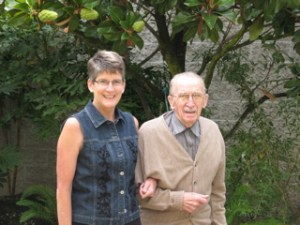
As the adult daughter most involved with my father’s care management, I can conclude that through all the difficulties of his Alzheimer’s journey, there was a certain richness to our relationship that might not have existed without the intrusion of Alzheimer’s in his and my life. I would have preferred that he had never suffered and died from this disease – don’t get me wrong – but I’m grateful for the deeper relationship that resulted from it.
I feel blessed to have been on the caregiving journey with my father. And my, oh my, do I still miss him.
Lighten up Mondays
Two jokes with the husband getting in the last word:
This man was out golfing with his buddies. He was about to putt when a hearse drove by leading a funeral procession. The man set down his club, took off his hat, and put it over his heart until the procession had passed.
“That was the most decent thing I’ve ever seen you do,” one of his friends said, to which the golfer responded,
“It’s the least I cold do; we were married thirty-two years.”
These guys rob a bank wearing gorilla masks. As they’re getting away, a customer pulls off one of the robbers’ masks to see what he looks like. The bank robber says, “Now that you’ve seen me, you have to die,” and he shoots the man dead.
The robber then looks around the room. Everyone is looking away or covering their eyes. “Did anyone else see my face?” An Irishman in the corner slowly raised his hand. The robber then asked, “You saw my face?”
“No, but I think my wife might have got a wee peek.”
No one is perfect
A big issue for small minds | Opinion | The Seattle Times.
Syndicated columnist Leonard Pitts Jr. had an Opinion piece in the January 19, 2014 Seattle Times Sunday newspaper. His article focuses on the cruelty that comes out of the mouths of people who feel they are obligated to point out the obvious to others. During and after her appearance on the Golden Globes, the exceptional 30-year old actress, Gabourey Sidibe, became the target of many anonymous, and sometimes identified, Twitter trolls who decided to remind her that she’s fat. One Tweet said she looked like the Globe in the Golden Globes; another stated that she missed the hour glass look by 10 hours.
Leonard Pitts questions when and how did this type of truly sadistic personal meanness become acceptable, even common place? “Everybody’s got something…some physical or emotional blemish measuring the distance from you to perfection.” So why do we think it’s any of our business to criticize someone else’s imperfection? Doing so is an act of judgment of someone about whom we know very little.

What happened to what Mr. Pitts calls “home training” that is supposed to teach us that there are just some things you don’t say to – or about – people in a public forum? Are these grown adults mimicking the behaviors from their upbringing, or did they just decide on their own to cut people to pieces, not caring a wit about the harm such cutting banter will have on the recipient?
Bullies – all of them.
Whether our “something” is shaped like the emotional scars of abuse, an eating disorder, physical or developmental disabilities, bad teeth, or a nose that is too big, too fat,or too small, no one has a right to inflict hurt on us by their words. Does hurting someone with words serve to downplay our own imperfections and/or personal issues? Does a person actually feel better after they’ve called someone a tub of lard, or uglier than sin, or dumber than a doornail?
I’ll leave you with Nobel Peace Prize winner, Eli Wiesel’s statement during an interview with Oprah Winfrey a couple years back. May it be a challenge to me, and a challenge to you.
As a human race, we must choose between: the violence of adults, and the smiles of children; the ugliness of hate, and the will to oppose it; inflicting suffering and humiliation on our fellow man, and offering him the solidarity and hope he deserves for naught.
Even in darkness, it is possible to create light and encourage compassion. Every moment of our life is essential; every gesture is essential. Our role in life is to give an offering to each other.
Lighten up Mondays
Two jokes involving a wife and her husband where the wife gets in the last word:
A woman was sipping a glass of wine while sitting on the patio with her husband when she said,
“I love you so much, I don’t know how I could ever live without you.”
Her husband then asked, “Is that you, or the wine talking?”
The wife replied, “It’s me talking … to the wine.”
A woman accompanied her husband when he went for his annual medical checkup. After the appointment, and while the husband was getting dressed, the doctor came out to the waiting room to meet with the man’s wife.
“Ma’am, I don’t like the way he looks.”
To which she replied,
“Neither do I; but he’s handy around the house.”
Come back for next week’s Lighten up Mondays where the husband gets the last laugh, and the last word.
What you hope for is worth the wait
Contemplating high hopes for the new year | Local News | The Seattle Times.
The Seattle Times newspaper has a Saturday column, Faith & Values, that spotlights a variety of religious denominations. One week there might be an article by a Catholic priest, another week, from a Rabbi, another, an Imam from the Islam faith. On Saturday, January 11th, the one who submitted her article is a minister with the Northwest Ministry Network (Assemblies of God), Jodi Detrick.
Ms. Detrick quotes several of the more well-known scriptures from the Bible that focus on hope, one of which is: “But hope that is seen is no hope at all. Who hopes for what they already have?” Romans 8:24
In my experience, I’ve found that there are many messages of hope out in the universe, and not all of them come from a spiritual text. Take Astronaut Mark Kelly’s response to Diane Sawyer on ABC’s 20/20 program a couple years ago. When talking about his wife Gabrielle Gifford’s chances for recovery from a gunshot wound to her brain, Diane Sawyer suggested that he was holding out too much hope for his wife’s successful recovery from the bullet’s onslaught. His response:
“You can’t have too much hope! That’s not practical!”
Isn’t that the truth? How limiting it would be to portion out a wee bit of hope, but not invest fully in that state of being. “In other words, it’s OK to be filled with anticipation for things that seem way out of sight and out of reach … Uncertainty is where hope does its best work,” says the columnist Jodi Detrick. Two years after the 20/20 interview, Gabrielle Giffords is doing “miraculously” better and she would argue that her day-to-day life is very complete, and very worthwhile. Thank goodness neither she, nor her husband, gave up hope!
“Hope outlasts disappointments. Not everything we hope for, happens, it’s true … Unrealized expectations can be an open door to new possibilities – options we hadn’t previously considered.” Jodi Detrick again. I agree with her statement because I’ve experienced those other possibilities. I’ve certainly couched my hopes and dreams to look a certain way, only to discover that the options I hadn’t previously considered managed to transform my hope into something better than I could have imagined.

Interestingly enough, the first hope that Jodi Detrick mentioned when she listed the types of dreams that hopeful people think about, was writing a book. I happen to be writing a book about the effects of Alzheimer’s on family caregivers and the ones for whom they are providing care – a project I started on December 29th, 2012. In the year since then, my novel has been through numerous edits – some of a substantive nature, and many that were grammar related. The mission for my book has always been to put a personal face on Alzheimer’s disease; to expand on the impressive, yet horrific, statistics on this fatal condition by making it more personal, and therefore more real.
One of my first “friendly editors” happens to have the same name as the protagonist in my book, Colleen. When Colleen read the very first draft of the very first 150 pages of my book, her first question was, “Who is your reader?” I insisted then, and I insisted for the past year, that my reader is the current or former caregiver, or the soon-to-be-caregiver who will find themselves amongst the millions of family members caring for a loved one with Alzheimer’s or other dementia. “But does the caregiver have time for the luxury of reading a novel? Or does the caregiver even want yet something else that reeks of the challenges they are currently facing?”
Crap. Of course not. But I kept on structuring the novel in my original – and stubborn – way. My second friendly editor was a coworker who was dying of cancer. Dennis wanted me to hurry up and finish my book so he could read it – “before it’s too late.” I gave him what I had. A week later I met with him and one of the constructive suggestions he gave me was, “You should be considering this novel as a textbook.” My response: “Dennis, I’m not writing a textbook. I’m not even writing non-fiction. I chose fiction as the genre because I don’t have any sophisticated initials that signify astute knowledge, such as: MD, PhD, MSW (Masters of Social Work), and the like.”
Dennis responded, “I do have a MSW and I think your novel should be required reading for medical professionals and others directly involved in Alzheimer’s care.” I continued writing, thinking that a textbook might be a secondary use for my novel, but it would primarily be a vehicle that provides hope and promise for those intimately involved on the Alzheimer’s disease journey. (Didn’t I tell you I can be a little stubborn?)
Fast forward ten months. I had lunch two weeks ago with a friend of mine, Gwen, and a woman who lives in the same apartment building as she. This woman, Liz, works for a company that provides a remarkable early-detection testing and monitoring system for those suspected of having mild cognitive impairment. I’m not here to promote the company, I’m merely providing the background of the person I met.
My friend, Gwen, brought up the fact that I was writing a novel about Alzheimer’s with a focus on the caregiver and patient journey. Immediately, Liz suggested that the founder of her company, who among other qualifications, has a PhD in Clinical Psychology, should read my manuscript. The Curriculum Vitae for each member of this company’s scientific advisory board contains more initials after their names than letters in the alphabet. These professionals know their stuff and most of it focuses on Alzheimer’s and other dementia.
I insisted that if the founder were to read my manuscript, Liz had to pave the way and do so without putting any pressure or sense of obligation on this very busy doctor. She met with him and that afternoon, Liz e-mailed me his contact information. Phew! Very long story, short, he is now in possession of the first 150 pages (the much revised version which I printed and overnighted to him) and he is taking it with him on vacation. What?!
Indeed, what? Also – what does this mean? Can I throw all caution to the wind and have even greater hopes that he and/or his advisory board will provide valuable input so that my manuscript carries more credible weight? Can I also wonder if my manuscript’s exposure to these professionals may segue into what my now deceased friend, Dennis, suggested it should be? Required reading? Whoa! The institutions of higher learning to which these professionals are attached, to name a few, are: Duke University Medical Center, University of Washington (Seattle) Medical Center and Memory Disorder Clinic, Stanford University School of Medicine, and UC San Diego School of Medicine.
I know what you’re thinking. “Aren’t you getting way ahead of yourself Irene? You could be setting yourself up for a huge disappointment.” My response to that is: Haven’t you heard? Hope outlasts disappointments.
And so I keep on hoping.
Rocking the boat on your life’s voyage
Forgive me, if you will, because I am going to start this blog piece by quoting some of the lyrics from Katy Perry’s song, Roar. You may not have heard of this popular singer or if you have, you may not follow her career, but one of her songs resonated with me and challenged me, so thus begins a few of the lyrics:
I used to bite my tongue and hold my breath; scared to rock the boat and make a mess, so I sat quietly, agreed politely. I guess that I forgot I had a choice; I let you push me past the breaking point; I stood for nothing so I fell for everything.
When was the last time you swayed in the wind of other people’s opinions and fearing ostracism, you swayed in silence even though you disagreed with those opinions being expressed around you? What did that feel like?
You held me down, but I got up, already brushing off the dust. You hear my voice, you hear that sound, like thunder gonna shake the ground; you held me down, but I got up; get ready ’cause I’ve had enough. I see it all, I see it now…
How long did it take to break the hold that your silence had on you? How much time passed before you got up and let your “you-ness” shine forth amongst the crowds – whether those crowds consisted of strangers or close loved ones? What did it take for you to divert from the ebb and flow of popular opinion and launch your own?
I got the eye of the tiger, a fighter, dancing through the fire; ’cause I am a champion and you’re gonna hear me roar. Louder than a lion, ’cause I am a champion and you’re gonna hear me roar.

The purpose of this open-ended article is to encourage some personal internal dialogue wherein you answer the above questions for yourselves and discern whether or not you’ve been stifling beliefs or opinions that define the essence of who you are, but which you’ve held to yourself because you don’t want to rock the boat.
What are you waiting for? The author, Eckhart Tolle would say that Now is all you have. You can’t go back and correct the past; it doesn’t exist anymore. You can’t rely on there being a future. All you have is the present moment, so do yourself a favor and stop denying who you are, and what you believe in. Take it from someone who knows – you’ll like and respect yourself a whole lot more when the real you starts living.
Lighten up Mondays
An older lady fell into the water, and not being a swimmer, she called for help.
A man jumped in to save her and grabbed her by the hair, but she was wearing a wig, and it came off.
He then grabbed her by the chin, and her false teeth popped out.
In desperation, the man yelled,
“Somebody help me save all of this woman that we can!”
Medical tourism – Alzheimer’s style
More Alzheimer’s patients finding care far from home | Nation & World | The Seattle Times. This article looks at the direction in which Alzheimer’s care may be shifting. There are currently 44 million Alzheimer’s patients globally with 135 million projected by 2050. Even now, Western spouses and family members are faced with an insufficient supply of qualified nurses and facilities, while other countries provide cheaper – and to some minds, better – care for those suffering from an illness for which very few effective treatments have been developed, and that is always fatal.

The treatment center that is the major focus of this Associated Press article is located in Thailand – the Baan Kamlangchay center. Additional elder care options in other countries are mentioned, such as the Philippines, Eastern Europe, Spain, Greece, and Ukraine. Cost is the driving force of those who are “exporting” (not my word) the elderly to these foreign countries. One gentleman from Switzerland brought his 65-year old wife to Baan Kamlangchay because the monthly cost for her Alzheimer’s care ($3,800) is a third of what he would pay in his own country and he states that the staffing ratios are far better, and the activities more engaging. In the Philippines, care is offered to Americans for $1,500 to $3,500 a month, compared to the average of $6,900 for a private room in a skilled nursing facility in the United States, according to the American Elder Care Research Organization.
Cost shouldn’t be the only consideration, however, when moving a loved one into Alzheimer’s or dementia care – and that applies to every country in which that care is available. What are the training requirements for those who will be providing this disease-specific care for your loved one? What type of governmental or social service oversight is in place to protect and advocate for the rights of those patients who can not advocate for themselves? The latter question becomes extremely relevant when the patients’ families are not around to observe care on an ongoing basis. In the previous paragraph I mentioned the man who brought his 65-year old wife from Switzerland to Thailand for care. He is now faced with the very difficult decision of perhaps leaving his wife of 41 years in the facility, and returning to Switzerland to carry on the rest of his life.
That’s a decision unbearable in its emotional implications.
What are your thoughts? Are you willing to become an expatriate should this medical need present itself in your life?
January 2014 Celebrations
January 1st brings a new year for us and new opportunities to get it right in 2014. Here are some celebrations you might want to dive into:
Month: National Bath Safety Month; National Blood Donor Month; National Hobby Month.
Week: 2nd week in January – Letter Writing Week – get out that stationery and pens and get to it!
- January 1: Happy New Year!
- January 2: Run up the Flagpole and see if Anyone Salutes Day (sounds like a horrific hangover action)
- January 3: Festival of Sleep Day, but not until after you’ve celebrated Fruitcake Toss Day
- January 6: Bean Day; and Cuddle Up Day (maybe it’s just me, but that doesn’t sound like a good idea)
- January 10: Peculiar People Day
- January 13: International Skeptics Day (I seriously doubt that)
- January 14: Dress up your pet day (I see people celebrating this event all-year round – scary)
- January 16: National Nothing Day
- January 17: Ditch New Years Resolutions Day (been there – done that already)
- January 18: Winnie the Pooh Day (birthday of author A.A. Milne)
- January 20: Martin Luther King Jr., Birthday
- January 21: National Hugging Day
- January 23: National Handwriting Day (see Week celebration above)
- January 24: Beer Can (or bottle) Appreciation Day; and Compliment Day (my readers, you’re looking fine today!)
- January 31: drawkcaB Day
And with that, I’ll leave you to pursue your goal of being the best you can be in 2014.
Lighten up Mondays
Here’s a somewhat risque joke for the last Monday of the year:
Sister Christen’s first post as a missionary was in a remote tribal area in East Africa. She realized that the first step in converting the heathen would be to teach them her language. She began her lessons with the tribal chieftain.

Leading him into the countryside, she pointed out a banyan tree and said, “Tree.” “Tree,” the chief repeated obligingly.
Next they came across a herd of monkeys, “Ba-boons,” explained Sister Christen. “Ba-boons,” he repeated. “Very good.”
The nun was quite proud of herself. At the riverbank they encountered a herd of hippopotami and she slowly spoke out the word, and the tribesman dutifully repeated, “Hip-po-pot-a-mus.”
Then, what should they encounter in the rushes at the water’s edge, but a couple making love. Blushing, the nun blurted, “Man on bicycle.”
Paying no attention, the chief thrust his spear into the man’s back.
“Chief, why did you kill him?” screamed the horrified nun.
“Him on my bicycle,” he explained with a shrug.
Driving Under the Influence of Dementia: Part 2
 I addressed some of the issues of Driving under the influence of dementia in an article I wrote in November 2013. Back then I hadn’t planned on writing a Part 2 for this article, but after a couple local incidents involving DUI of dementia, I must provide the following.
Yesterday afternoon in a suburb of Seattle (in Bellevue), an 89-year old woman with early stage Alzheimer’s left her house for her normal daily routine of going to her favorite pancake house, then to several retail locations. She never returned home last night and as of today, she is still considered missing. I hope the outcome of her case is better than that of another elderly person with Alzheimer’s who also went on a brief errand, but never came home. (Update as of 12/28/13 6:45 pm: this woman was found safe approximately 16 hours after she first left her home. She was found 20 miles away from home. Unfortunately, she wandered 20 miles away from her normal driving area.)
On Saturday, December 21, 2013, Joseph Douret left his Seattle area home (in Issaquah), to grab dinner. He was reported missing the next day by his wife who stated that he never came home the previous evening when he left to grab some dinner for the two of them. Mr. Douret, who was suffering from Alzheimer’s, was found dead in his vehicle on Christmas Eve. Police indicated that he appeared to have died of natural causes.
Taking away the keys to a vehicle – or getting rid of the vehicle as need be – are both very difficult tasks, but these are tasks that must take place if a loved one with dementia still has access to their automobile. “But he/she is only driving a few blocks to pick up a couple items; there’s no way he/she will get lost.” Unfortunately, what should be a routine drive can become a death journey because nothing is routine for the person with a brain addled by dementia. Nothing looks normal or familiar; the anxiety ratchets up several notches; panic sets in; and the countdown begins for that person’s last hours of life on earth. Even if the person is eventually found safe, he or she will have endured a very uncomfortable time emotionally and physically. The positive outcome of that incident, however, is that it will most likely be the catalyst that spurs people on to remove all driving options from their loved one.
Please make the decision today to take action and do the responsible thing on behalf of the person with Alzheimer’s or other dementia.
Lighten up Mondays
The week before a space launch, an astronaut tries to relax at an out-of-the-way pub. Unfortunately the bartender recognizes him and says, “You fellows at NASA think you’re something, going to the moon. But we’ve got a couple guys here who’ve been building their own spaceship out back.”
Reluctantly, the astronaut goes outside to look – the spaceship is a mess of beer bottles, cans and junk. “We’re planning to go to the sun,” boasts one of the spaceship builders.
“This thing will be incinerated before you can get close to the sun,” the astronaut warns.
“We got that all figured out – we’re going at night!”
Where do you find peace?
I’ve made a few edits to this article that I wrote in April of 2012. I’m re-blogging it because I know that the Holiday season may be joyful for the multitudes, but that is not always the case for everyone. I’m thinking of the reader who simply wishes this season would end and that a new year would begin…a new start that might herald in a smidgeon of much-needed peace. This one’s for you.

Do you find peace within the circle of your family; or does meditation or prayer, an inspirational book, or music fill your soul? Wherever the source – how do you keep that peace from slipping away?
Certainly when we’re exposed to sorrowful or earth-shattering news, any semblance of peace and calm seem to disappear, such as: acts of terrorism – both domestic and abroad; heartless school shootings; bigotry and hatred; and even devastating illness. How many times has your armor been pierced by such circumstances?
Too many to count. So how do we find peace amongst the chaos?
We can find peace in many small ways – probably the easiest way to do so is to acknowledge the beauty that surrounds us. It doesn’t matter whether you’re a creationist or an evolutionist, the beauty you see is the same. It’s always refreshing when I walk through my local plant nursery,
View original post 601 more words
Children: some of the most honest people I’ve ever met
Before children are taught by their elders to filter what they say, children simply say what’s on their mind. Sometimes their statements are inappropriate, but sometimes the statements are delightfully fitting.

The following entries are not original to me – I found them on another blog site – but I thought you would enjoy the humorous anecdotes that follow.
The scene: a classroom. The characters: a teacher and her students.
- TEACHER: Maria, go to the map and find North America.
- MARIA: Here it is.
- TEACHER: Correct. Now class, who discovered America?
- CLASS: Maria.
- TEACHER: John, why are you doing your math multiplication on the floor?
- JOHN: You told me to do it without using the tables.
- TEACHER: Glenn, how do you spell ‘crocodile?’
- GLENN: k-r-o-k-o-d-i-a-l
- TEACHER: No, that’s wrong.
- GLENN: Maybe it is wrong, but you asked me how I spell it.
- TEACHER: Millie, give me a sentence starting with ‘I.’
- MILLIE: I is …
- TEACHER: No, Millie … always say, ‘I am.’
- MILLIE: All right … ‘I am the ninth letter of the alphabet.’
I don’t know about you, but I think my son-in-law who teaches elementary school will probably get a kick out of the above dialogue.
Lighten up Mondays
When the brash young advertising executive arrived at La Coupole for his lunch appointment, he spotted Bill Gates at a corner table and went right over. “Excuse me for interrupting your meal, Mr. Gates,” but I know how much you appreciate enterprise and initiative. I’m trying to win over a very important account today – it could really make or break my company – and the clients I’m meeting with would be incredibly impressed if you stopped by our table at some point and said, ‘Hello, Mike.’ It would be an incredible favor, Mr. Gates, and some day I’ll make it up to you.”
“Okay, okay,” sighed Gates, and went back to eating his lunch. He finished and was putting on his coat when he remembered the young man’s request. Obligingly, he went over to his table, tapped him on the shoulder, and said, “Hi, Mike.”
“Not now, Bill,” interrupted the young man, “can’t you see I’m eating?”
Life everlasting – is it a good thing?
A recent NY Times article, On Dying After Your Time, poses many topics for discussion that must be addressed. I knew before I even started to read the article that readers will have varying opinions on the matter of extending life beyond its appointed time to die. These opinions will be based on ethics, biases, age of the reader, and religious beliefs, to be sure, but another factor that comes into play is the personal experience of each reader.
If the reader has watched a loved one perilously balanced in limbo with a ravaged-by-disease body and/or mind, that reader might lean towards declaring that too much is being done to artificially prolong life. In the past five years of my life, I have watched both my father and my sister-in-law die from Alzheimer’s. Who they were at the end of their lives didn’t come close to resembling who they were pre-disease. If the reader has had no experience with this aspect of life and death, that reader may feel more comfortable with the decision to throw every treatment possible at the patient with the goal of allowing that person to live as long as humanly – or scientifically – possible.
One of the issues presented in the NY Times article is the fact that as we live longer, there is an increase in the amount of chronic illnesses – a fact that certainly stands to reason. “This rise in chronic illness should also give us pause about the idea, common to proponents of radical life extension, that we can slow aging in a way that leaves us in perfectly good health…The evolutionary theory of senescence [growing old; biological aging] can be stated as follows: while bodies are not designed to fail, neither are they designed for extended operation.”
The author of the NY Times article is an 83 year old man who closes out the piece by stating, “We are not, however, obliged to help the old become indefinitely older. Indeed, our duty may be just the reverse: to let death have its day.”
If you haven’t yet formed an opinion on the matter of life-extension at all costs – I encourage you to do so before it’s too late. Life and death decisions are best made well in advance of the necessity of such decisions.
Lighten up Mondays
A preacher was asked to give a talk at a women’s health symposium. His wife asked about his topic, but he was too embarrassed to admit that he had been asked to speak about sex.

Thinking quickly, he replied, “I’m going to be talking about sailing.”
“Oh, that’s nice,” said his wife.
The next day at the grocery store, a young woman who had attended the lecture recognized the minister’s wife. “That was certainly an excellent talk your husband gave yesterday,” she said. “He really has a unique perspective on the subject.”
Somewhat surprised, the minister’s wife replied, “Gee, funny you should think so. I mean, he’s only done it twice. The first time he threw up, and the second time, his hat blew off!”
December 2013 Celebrations

Only 31 days left in 2013. Here are a few serious and not so serious dates to celebrate:
Monthly events: Bingo Month; and Write a Friend Month (a real, paper letter, not a Tweet, text, e-mail, FB post, etc.)
- Dec. 1: Eat a Red Apple Day; and World Aids Awareness Day
- Dec. 3: National Roof over your Head Day (definitely something for which to be grateful)
- Dec. 5: End of Hanukkah (Chanukah); and Bathtub Party Day
- Dec. 6: St. Nicholas Day
- Dec. 7: Pearl Harbor Day
- Dec. 8: National Brownie Day (yum!); and International Children’s Day (I’m happy for the children in my life)
- Dec. 10: Human Rights Day
- Dec. 12: National Ding-a-Ling Day (probably not the same intent as that from the song “My Ding-a-Ling” written and recorded by Dave Bartholomew; also covered by Chuck Berry in 1972)
- Dec. 16: National Chocolate Covered Anything Day
- Dec. 21: Humbug Day; and 1st Day of Winter (makes sense)
- Dec. 24: National Chocolate Day (I’m sensing a trend)
- Dec. 25: Christmas Day
- Dec. 26: Kwanzaa; and Boxing Day
- Dec. 27: National Fruitcake Day (do they drop them off tops of buildings?)
- Dec. 31: Make up your Mind Day (I will make up my mind not to have any New Years resolutions)
Olivia Wise – a 16 year old champion
I just supported Tribute Page. The attached link takes you to a page that spotlights a strong teenager who never let her brain cancer diagnosis bring her down.
Olivia Wise was diagnosed with cancer in 2012. She and her parents knew that this diagnosis could be a death sentence and even though she fought against the cancer, she never gave in to its antics.
When this young woman received the news that there were no more treatments available to her, she recorded a cover of Katy Perry’s song, “Roar” and on the same day, in that same recording studio in September of this year, she sang a song that she wrote at the age of 11 called, “Simple Girl.” Both songs are amazing in their import – especially if you consider the fact that Olivia had to struggle for each breath needed to complete each song. Both songs can be purchased on ITunes at 99 cents each.
The goal of recording “Roar” was that she wanted her family and friends to be left with her voice, singing a song that depicted who she was. She chose not to be identified as the cancer that ravaged her body. Olivia wanted people to remember her as a tiger, a fighter, and a champion. She wanted her loved ones to hear her roar long after she left this earth.
Olivia Wise died Monday, November 25, 2013.
Roar on, Olivia.
Disposable human beings
Feds: DSHS neglected disabled to cut costs, may owe $16M | Local News | The Seattle Times.
You can’t open a newspaper these days without reading about budget cuts to Federal, State, and City services. Memos are flying around these offices demanding across the board reductions or else!
The State of Washington figured out a way to save more than one million dollars and its Department of Social and Health Services is the brainchild of this impressive savings coup: deprive those with developmental disabilities the required services mandated by law that help them to function better in society. The required services include physical and occupational therapy, personal-care training, speech therapy, guided behavioral norms, job skills, and recreation.
Two dozen developmentally disabled residents of Lakeland Village in Spokane, Washington – a state and federally funded long-term care facility – were denied these services for two years – most likely causing irreparable damage to these residents. Let’s see – two dozen residents for two years – how many times was the law broken as a result?
41,231 times
How did they pull it off? They moved a couple dozen residents from the intermediate-care facility of Lakeland Village into its nursing facility which is cheaper because that part of the facility does not have to provide the specialized services that the developmentally disabled residents need. The relocated men and women received excellent medical care – most of which wasn’t called for – but they were deprived of all the quality-of-life services they needed most. This violation of federal law means that the facility received federal funds in error – funds that were meant to cover legally mandated services at the facility.
When the investigation was launched and DSHS was told to provide documentation for the time period in question, there was little evidence that the specialized services had been provided. In response, DSHS stated, “We didn’t make good documentation, or indeed, we didn’t provide some of them (documents).” It is thought that the reason the paperwork wasn’t found, is that it doesn’t exist.
The State tried to cut its budget by $1 million by fraudulently withholding required care services. The investigation continues while it is estimated that the federal government will penalize the State of Washington/the Department of Social and Health Services in the amount of $16 million.

But you and I already know that the biggest price has already been paid by the disposed of human beings.
Lighten up Mondays
Animals in the news:

The zoo built a special eight-foot-high enclosure for its newly acquired kangaroo but the next morning the animal was found hopping around outside.
The height of the fence was increased to 15 feet, but the kangaroo got out again! Exasperated, the zoo director had the height increased to 30 feet, but again, the kangaroo escaped.
A giraffe asked the kangaroo, “How high do you think they’ll build the fence?”
“I don’t know,” said the kangaroo. “Maybe a thousand feet if they keep leaving the gate unlocked.”
Baby Boomers remember 11/22/1963
Please answer the following two questions:
- What were you doing when President John F. Kennedy was shot? (West Coast Pacific Time for that was 10:28 a.m.)
- What did you feel as a result of his assassination – either right then and there and/or the days and weeks following?

I was in my 5th grade classroom at St. Bede the Venerable elementary school in La Canada, California, when suddenly, the school’s public address system came on in our classroom, broadcasting what appeared to be an urgent radio message. The Principal of the school gave no preamble to the radio broadcast, it simply became suddenly audible in our classroom. When I was able to focus, as a fifth grader, on what was being said, I recall hearing “The President of the United States has been shot; John F. Kennedy was shot during a motorcade in Dallas, Texas and is not expected to live.” (Or words to that effect.)
My teacher, Sister Mary Fahan told us kids to put our heads down on our desk and pray. It seemed so startling to me – it was a heavy moment for which us fifth graders didn’t have 100% understanding, but the young boys and girls in my classroom felt the heaviness of the moment anyway. Many of us were crying at the words coming forth over the speakers in our classroom – urgent and shocking words that stuttered from the radio announcer’s mouth.
School was dismissed and when my sister, Mary, and I were picked up by our mom, we climbed into her red and white 1957 Chevy Bel Air Nomad station wagon and joined our tears and fears with those of our mother’s.
Then for the remainder of November and into early December, it seemed as though the only story being covered on our little black and white (somewhat brown and white) television screen were the news updates and somber funereal activities inherent with the death of a President.
I recall that after I recovered from the initial shock of the incident, the impatience of a nine-year old took over due to the bombardment of constant television coverage that echoed around the walls of our house. I yearned for normalcy, and for me that meant a return to TV episodes of Lassie reruns and new episodes of My Three Sons. Perhaps what we experienced during that 1963 tragedy is not unlike what the children of the 9/11 era felt when their lives were invaded by the tragedy that marks their young lives.
Unfortunately, there seem to be enough horrific world events going on that each and every generation’s children will have memories about which they will reflect as they enter their older years; just as us Baby Boomers reflect on November 22, 1963 and all the other tragedies that have invaded our lives since then.

