21st Century Living
Lighten up Mondays
 Sorry to do this to you; here’s a blonde joke:
Lincoln, a young man, wanted to get his beautiful blonde wife, Lucy, something nice for their fifth wedding anniversary. He decided to buy her a cell phone. She was all excited, loved her phone and the husband explained all the features of the phone to her.
The next day Lucy went shopping. Her phone rang and it was Lincoln. “Hi honey,” he said, “how do you like your new phone?”
She replied, “I just love it, it’s so small and your voice is clear as a bell but there’s one thing I don’t understand.”
“What’s that, baby?” asked her husband.
“How did you know where I was?”
Lighten up Monday
An out-of-towner drove his car into a ditch in a desolated area. Luckily a local farmer came to help with his big strong horse named Buddy. He hitched Buddy up to the car and yelled, “Pull Nellie, pull!” Buddy didn’t move.
Then the farmer hollered, “Pull Buster, pull!” Buddy didn’t respond.
Once more the farmer commanded, “Pull Coco, pull!” Nothing.
Then the farmer nonchalantly said, “Pull Buddy, pull!” And the horse easily dragged the car out of the ditch.
The motorist was most appreciative and very curious. He asked the farmer why he called his horse by the wrong name three times. The farmer said, “Oh, Buddy is blind and if he thought he was the only one pulling, he wouldn’t even try.”
Caregivers: learning from our mistakes.
Caregivers, this one is for you. You are not perfect, you are not an angel, but you ARE a hero. Stop beating yourself up, acknowledge your limitations, and move forward. This article shines a light on some of the not-so-great moments that occur on the caregiving journey, and it offers alternative responses that will smooth the way for you.

“Once bitten, twice shy.” The Chinese and Japanese proverb has a variant: “One year bitten by a snake, for three years afraid of a grass rope.”

How does one who is as imperfect as myself apply this Proverb without writing an article that goes on and on into perpetuity? All of us can think of circumstances in which we fail to learn by experience and continue doing the same stupid/inadvisable thing over and over again expecting different results. As I said, my life is rife with examples, but this article centers around caregiving – especially as it applies to caring for someone with Alzheimer’s or other dementia. CAVEAT: I would never write on something about which I had not experienced. I’ve been there. I’ve done that. I’ve paid for my mistakes.
I’m so tired of my spouse/father/mother asking me the same question over and over again and supplying her with…
View original post 598 more words
Ending life on our own terms
Ending life on your terms | Opinion | The Seattle Times. by syndicated columnist, Froma Harrop.
Being prepared, well in advance of needing to be, will serve you well.
All our lives, we set out on new adventures having prepared for them to the best of our abilities:
- First day of school;
- The start of a new job;
- Preparing for a first date;
- Wedding preparations;
- Organizing a Holiday meal;
- Even something as mundane as putting together a grocery shopping list.

We know how to be at our best, and being at our best means painstakingly and carefully preparing for important events in our life. You didn’t personally have the option of preparing for your birth, but you do have the option, right now, to prepare for your death.
Carpe diem.
What does it mean to end our life on our own terms? This doesn’t have to be a controversial topic. I’m not talking about assisted suicide/right to die matters. What I am talking about, however, is the importance of each of us to spell out in painstakingly and carefully prepared language, all that you want done – or not done – when you are determined to have an irreversible fatal disease.
Death is such a taboo subject.
Why is that? None of us will avoid the inevitable, but many of us avoid laying down our wishes regarding that final time in our lives. The subject matter of the attached article relates to medical insurance companies reimbursing medical professionals for end-of-life counseling provided to their patients. I repeat, this counseling is not controversial. As Ms. Harrop states, “Critics of end-of-life discussions argue the doctors would ‘push’ patients to end their lives prematurely. Why would doctors do that? Where’s the financial incentive in losing a patient?”
The report Dying in America calls on Congress “to end the ‘perverse’ financial incentives that rush fragile patients into invasive medical treatments they’d prefer to avoid.” That being the case, it seems to me that counseling a patient about their dying wishes hurts, more than helps, the physician’s bottom line, so forget the nonsense about doctors encouraging patients to die sooner than later. That’s just hogwash.
“Meanwhile, there’s evidence that for some very ill people, a palliative approach may extend life longer than industrial-strength medicine.” And certainly ones final days without the poison of chemotherapy that has no prospect of curing a cancer, would be far more comfortable than if that therapy had been employed. “In a study of terminal lung cancer patients, the group that chose hospice care actually lived three months longer than those subjected to hard chemotherapy.” Again, that would be a more pleasant exit from this life than suffering the ravages of a chemo treatment that is not curative in nature.
“An end-of-life talk with a doctor spells out the options. Patients can use it as a basis for filling out an advance care directive – a form listing which treatments they would want or not want.” And let’s not forget that such a document only comes into play if the patient can no longer speak/express his or her wishes regarding their care. An advance care directive is a legal document and as such, spells out when it can be put in motion, and when it can not. If ever there’s a time when you can benefit from being a control freak, your final days is it.
This legal document is not just for the older population.
Once you’re considered an adult, you can decide what you want regarding your life. Don’t wait until it’s too late and someone else decides medical matters without your input.
Lighten up Mondays
Equal time for the male and female Baby Boomers out there:
A guy was reading his paper when his wife walked up behind him and smacked him on the back of the head with a frying pan. He asked, “What was that for?” She replied, “I found a piece of paper in your pocket with ‘Betty Sue’ written on it.” He said, “Jeez, honey, remember last week when I went to the track? ‘Betty Sue’ was the name of the horse I bet on.” The wife shrugged and walked away. Three days later he was reading the newspaper when she again smacked him on the back of the head. He asked, “What was that for?” She answered, “Your horse called.”
A wife was making a breakfast of fried eggs for her husband. Suddenly her husband burst into the kitchen. “Careful,” he said, “CAREFUL! Put in some more butter! Oh my gosh! You’re cooking too many at once. TOO MANY! Turn them! TURN THEM NOW! We need more butter. Oh my gosh! WHERE are we going to get MORE BUTTER? They’re going to stick! Careful. CAREFUL! You never listen to me when you’re cooking! Never! Turn them! Hurry up! Are you CRAZY? Have you LOST your mind? Don’t forget to salt them. You know you always forget to salt them. Use the salt. USE THE SALT! THE SALT!
The wife stared at him. “What in the world is wrong with you? You think I don’t know how to fry a couple of eggs?”
The husband calmly replied, “I just wanted to show you what it feels like when I’m driving.”
Lighten up Mondays
Last year I replaced all the windows in my house with those expensive double pane energy efficient kind. This week, I got a call from the contractor complaining that his work had been completed a whole year and I had yet to pay for them.
Boy, oh, boy did we have an argument. Just because I’m blonde doesn’t mean that I’m stupid. So I proceeded to tell him just what his fast-talking sales guy had told me last year. He said that in one year, the windows would pay for themselves.
There was silence on the other end of the line so I just hung up, and he hasn’t called back since. I guess he was embarrassed.
Very Inspiring Blogger Award
 Humbled, grateful, overjoyed! Not just because I was nominated for the Very Inspiring Blogger Award, but also because I’ve inspired someone, hopefully many someones. Talking to a wall is not a very gratifying experience; if my blog is merely an electronic version of that, I will have not reached my objective: to help, encourage, and lighten your load while on this aging journey. Thank you Kay for the nomination!
Kay Bransford of Dealing with Dementia nominated me for this award. If any of you readers have yet to follow Kay’s blog you need to get to it. I will nominate several bloggers for the same award, following the Rules provided below:
- Thank the amazing person who nominated you and provide a link to their website;
- List the rules and display the award;
- Share seven facts about yourself;
- Nominate 15 other blogs and comment on their posts to let them know they’ve been nominated. I failed at listing 15, not because the blogs I follow aren’t worthy, but because my blog-following count is a limited one;
- Proudly display the award logo on your blog and follow the blogger who nominated you.
Seven facts about myself:
1. I’m not ashamed to say that I’m a Baby Boomer and have been for awhile. Turning sixty was easy, however it got a wee bit more difficult at sixty-one …
2. I was born in Pasadena, California and have lived a great length of time in Los Angeles, California; Honolulu, Hawaii; Anchorage, Alaska, and the greater Seattle area of Washington State – my current and final home.
3. My favorite people – other than my loved ones – are anyone older than me – preferably senior citizens who’ve claimed that title for quite some time. This third fact about me directed most of my worthwhile adult career and volunteer pursuits: senior housing industry manager, Alzheimer’s Association caregiver support group facilitator, and Certified Long-Term Care (LTC) Ombudsman for the State of Washington.
4. I have posted over 480 articles on my blog since starting it in 2011.
5. I am currently writing a novel that focuses on the caregiving challenges faced by those who are the primary caregiver for a loved one. Through real-life stories, the reader will learn more about the disease and its effect on everyone it touches. My hope is that by putting a face on this disease – showing what it looks like in everyday life – more interest will be generated to prevent, treat, and cure Alzheimer’s disease, a disease that is always fatal, and for which all of us are at risk.
6. I have three daughters (one of my own and two of my husband’s) and two sons-in-law (one who married my own daughter and one who married my husband’s youngest.)
7. My family tree: I have two siblings, an older brother and sister. My father died from Alzheimer’s complications in October 2007 at the age of 89; my sister-in-law died of the disease in the summer of 2012 a few months before her 70th birthday9.
And that’s why I do what I do.
Nominees for Very Inspiring Blogger Award:
Mary Riesche Studios, Vacaville, California. This artist has drawn and painted since she could hold a pencil. She has tirelessly pursued her craft through every chapter of her life. She raised four children while her husband was in the military – living numerous places in Europe and the U.S. as a result – and that never stopped her from painting. When her four children were out of the house, she and her husband adopted a teenager from Russia, bringing the number of children to five. She’s a trooper, to say the least. It took her a while to have an empty nest. I hope you’ll visit her site to see a representation of the type of work she produces.
Catching Up to the Disease, by blogger, Don Desonier. The subtitle for this blog is Transitions in Dementia Caregiving. Don’s wife died of early-onset Alzheimer’s at the age of 69 on July 4th, 2012. This blogger knows something about being a dedicated, committed caregiver, and on top of that, he excelled at being the very present advocate for his wife of 25 years.
Dementia Poetry is an in your face journal of a daughter-in-law’s disease journey with her mother-in-law, in the form of extremely well-written poems. The subtitle for her blog is: The Politically Incorrect Alzheimer’s Poetry Blog.
Theresa Hupp’s blog, Story and History, is a moving journal of a family’s life covering past, present, and future. But that’s not all: Theresa is a fabulous, published author. I’d say I’m jealous, but friends, and that’s what I consider Theresa, don’t turn green with envy – at least they shouldn’t. Theresa, you nominated me for the Versatile Blogger Award in February of 2014, but I already received that award a couple years ago so I’m not going to claim it again, but I thank you profusely for nominating me.
Not My Original Plan, a blog written by a woman in her thirties who is the caregiver for her mother who has dementia. This is a very inspirational blog – how fitting for this award! – and I strongly suggest you check it out and follow it ASAP.
Not Quite Old, by blogger and author, Nancy Roman. The subtitle for her blog is Gracefully Aging with Resistance. The way Nancy writes – filled with extraordinary humor, will keep you engaged and wanting more.
Let’s Talk About Family. Lori’s blog family history starts with her mother’s failing health and death, and continues with her father’s life as a widower who eventually moves into an assisted living facility (ALF). Her blog is one that I never miss. You know how you can manage the notifications you receive so that you get a notification e-mail immediately, daily, or once weekly? Her blog is one of those that I receive immediate notifications – I can’t wait any longer! is the way I treat her blog. If you are not yet following Lori’s blog, get to it!
Jill Weatherholt, Pursuing a Passion for Writing, is a site that inspires me because while working full-time, she’s still committed to writing and what she writes is well-worth reading. Thank you, Jill, for being an online inspiration to this aspiring author. Jill started the blog to create a community for other new writers and shares her publication journey – something all wet-behind-the-ears writers need to read and be encouraged by.
10 Legs in the Kitchen is a fabulous cooking blog but a whole lot more. Stacy’s anecdotes add “meat” to every posting and provide humor and insight, not just darn good recipes. I met Stacy at a writer’s workshop in Seattle.
Yellow Mum Blog, by Wendy in the United Kingdom, documents the loss of her mother to cancer, ten weeks after diagnosis. What she writes is a journal, but in many respects, it is a guidebook for the rest of us in our grief.
A Swift Current, Letting our Parents Go, Hallie Swift’s blog is one to which many will relate. Whether your parent’s departure is a gradual one – such as is the case with Hallie’s mother due to dementia – or a sudden departure by way of a fatal accident, letting go is hard to do – oftentimes more painful that we believe we can handle.
Is your doctor an enabler?
 Consider the prescriptions in your medicine cabinet/pill-minder box. Is one of those medications something that your doctor renews over and over again for you? How about that something-or-other that seems innocuous enough because you take the lowest possible dose?
Are you like many of us out there who struggle to fall asleep? The anxiety of worrying about whether or not you’re going to fall asleep being a sufficient reason for your doctor to prescribe a benzodiazepine to help you along the way? When did you first tell your doctor about your sleep struggles and how many months or years have passed since he or she prescribed a measly dose of Ativan, Valium, Xanax or Klonopin?
Each time the refill runs out and you call your doctor to renew the prescription, does she do so, even without meeting with you in person to discern whether or not it’s still needed? Your doctor is an enabler.
Your doctor might be putting you at risk of developing Alzheimer’s disease. That itsy bitsy dosage you take nightly for months and years on end? It’s not a harmless prescription if it gives you a fatal disease – which Alzheimer’s is.
Now that you’re aware of the risk, make sure your doctor is aware and don’t let him or her poo poo that risk; instead, ask her to wean you off that medication so that you can have control over this one potential cause of developing a disease that you absolutely do not want to get.
You’re in charge, not your doctor. Don’t assume that her constant renewal of such medication means it’s okay. You’re an informed patient now; it’s time you took steps to remove this Alzheimer’s risk from your life.
Blogging Award: a very tardy response
 Did you ever get so busy that you received an award and didn’t go pick it up, and then you forgot that it was waiting for you? That’s me. Lori, one of my most favorite bloggers, has been writing her blog Let’s Talk About Family since December 2011. This fabulous person nominated me for the Best Moment Award in May of 2013. All I can say is that not “picking up” my award qualifies me for the Worst Moment Award, but I’ll try to make up for it with this post.
Lori’s blog family history starts with her mother’s failing health and death, and continues with her father’s life as a widower who eventually moves into an assisted living facility (ALF). Her blog is one that I never miss. You know how you can manage the notifications you receive so that you get a notification e-mail immediately, daily, or once weekly? Her blog is one of those that I receive immediate notifications – I can’t wait any longer! is the way I treat her blog. Thank you so much for opening up your life to us in the blogging world.
Rules for the Best Moment Award:
Winners post information about the nomination, thanking the person who nominated them, with their acceptance speech that can be written down or video recorded.
Winners have the privilege of awarding the next awardees (see below) The re-post should include a NEW list of people, blogs worthy of the award, and winners notify them the great news. Winners should also post the award badge on their own website.
What makes a good acceptance speech?
Thank the people who helped you along the way, be humorous if you can to keep the reader entertained and smiling. Provide inspiration that helps your story to touch the lives of others.
And here’s mine: I’m thrilled to be acknowledged as having something good to say from time to time. I don’t think I’m an excellent writer, but I do have lots to say and I’m quite willing to write up a storm. I’m the youngest of three siblings and the only one of us who has been involved in the lives of senior citizens – and everything that involvement implies – for close to two decades. I’ve always loved people older than me; I guess it gives me comfort knowing that I’m younger than someone else. My official responsibilities over the years involved: working in the senior housing industry both in the corporate environment and in assisted living/memory care facilities, being an Alzheimer’s Association caregiver support group facilitator, and a Certified Long-Term Care (LTC) Ombudsman for the State of Washington (an advocate for vulnerable adults living in LTC facilities.) I’m retired from active work but I am actively still involved in being an advocate for the vulnerable by writing my first novel – a project I hope to complete by end of this year. My novel focuses on the lives of family members who care for a loved one with Alzheimer’s or other dementia.
My nominees for the Best Moment Award are:
Kay Bransford, for Dealing with Dementia. The reason I enjoy Kay’s blog is best described by her blog’s subtitle: A family caregiver’s journey to deliver loving care with grace and humor. We all know there is absolutely nothing humorous about Alzheimer’s or other dementia, but humor can be found in the human interactions between caregiver and family member. If you look for them, you will find them. Kay, I’ll be posting my acceptance of a different award you recently nominated me for very soon. THANK YOU!
Dementia Poetry is an in your face journal of a daughter-in-law’s disease journey with her mother-in-law, in the form of extremely well-written poems. The subtitle for her blog is: The Politically Incorrect Alzheimer’s Poetry Blog.
Theresa Hupp’s blog, Story and History, is a moving journal of a family’s life covering past, present, and future. But that’s not all: Theresa is a fabulous, published author. I’d say I’m jealous, but friends, and that’s what I consider Theresa, don’t turn green with envy – at least they shouldn’t. Theresa, you nominated me for the Versatile Blogger Award in February of 2014, but I already received that award a couple years ago so I’m not going to claim it again, but I thank you profusely for nominating me.
Reflections on Dementia, Caregiving and Life in General is a must-read blog all the way from Singapore. This blogger takes care of her mother who has Alzheimer’s and vascular dementia. Her insights and her view of her world will engage you from the very first posting you read.
Lighten up Mondays
 A man and a woman had been married for more than 60 years: they had shared everything, they had talked about everything, and they had kept no secrets from each other, except the one. The wife had a shoe box in the top of her closet that she had cautioned her husband never to open or ask her about.
For all these years, he had never thought about the box, but one day his wife got very sick and her doctor said she would not recover. In trying to sort out their affairs, the husband took down the shoe box and took it to his wife’s bedside.
She agreed it was time to tell him about the shoebox. When he opened it he found two crocheted dolls and a stack of money totaling just under $100,000. This was her explanation. “When we were to be married, my grandmother told me the secret of a happy marriage was to never argue. She told me that if I ever got angry with you I should just keep quiet and crochet a doll.”
The husband was moved; he had to fight back tears because there were only two dolls in the box. She had only been angry with him two times in all those years of living and loving. He burst with happiness.
“Honey, what you said explains the dolls, but what about all the money? Where did it come from?”
“Oh, that’s the money I made from selling the dolls.”
Lighten up Mondays
A lady went to a psychiatrist complaining of a disturbing phobia. “Every time I lay down on my bed I get this terrible fear that there is something underneath it.”“I see,” responded the psychiatrist “That’s a common phobia that I am very qualified to treat, but it will likely take around 20 sessions.”
“Oh it’s just $80 a session, but trust me it’s well worth it.”
“How come I didn’t hear from you?”
Dead Inside
What a horrible title for an article.
It’s also a horrible concept, don’t you think?
But many with dementia are dead inside without any means of engaging with others in meaningful conversation. Heck, they might not even be able to talk to themselves: a practice I engage in quite frequently.
What an isolating state to be in: you’re there, but not there.

Fortunately, those with Alzheimer’s, dementia, or other cognitively restricting illnesses, have a chance to awaken their memories – and therefore their history – but not without the tools to do so. Alive Inside, the 2014 Audience Award winner at the Sundance Film Festival, is a one and a quarter hour documentary film that touts the benefits of personalized music therapy for those who are living dead inside.
Dan Cohen, social worker, Founder and Executive Director of Music & Memory, started this awakening project several years ago. Here is a description of the project, taken from the film’s website: “Music & Memory … promotes the use of digital music players with individualized playlists to improve the quality of life for elders, regardless of their cognitive or physical status … Dan has spent most of his career helping individuals and organizations leverage technology. Music & Memory operates in hundreds of long term care homes across the U.S. and abroad.”
Watch the 2.15 minute trailer on the provided Alive Inside website to witness a few of the individual awakenings spotlighted in the film.
Even if the film is not scheduled to appear in your area, you are still able to help awaken the millions of people in the United States and abroad by your participation in Mr. Cohen’s project. Whether it’s feet on the street or a click of a mouse to donate funds, each of you can become a part of these efforts.
Additionally, if you know someone, or are caring for someone with cognitive decline, put together a personalized database of music for that someone in a digital music storage device, then connect them to it with a set of headphones. You might be able to awaken him or her with that simple effort on your part.
Lighten up Mondays
Carla was well into her sixties when she went to her doctor complaining of nausea, exhaustion, and occasional cramps. After a thorough examination, the doctor sent her to the hospital for a battery of tests and finally confronted her with the results.
“Mrs. Barber, medically improbable though it may seem at your age, there’s no doubt about it, you’re pregnant.”
“Impossible,” she cried, and fainted dead away. When she came to, she staggered to the doctor’s phone, dialed her seventy-eight year old husband and screeched, “You’ve knocked me up, you randy old goat!”
There was a long pause at the other end of the line. Then a voice said, “And to whom am I speaking?”
The tethered caregiver

Imagine that you are the primary family caregiver for a loved one with dementia in your home. You have no time to yourself while in the house so how can you possibly find the time to leave your loved one alone to complete some pressing errands?
But you do leave the house and you do leave your loved one alone at home, because you haven’t figured out how to get someone else to do those errands for you, or you don’t know how to secure someone else to watch your loved one while you do the errands. I favor the latter option because a 24/7 caregiver absolutely must get out of the house and feed her soul while crossing items off her To Do list.
I went to Staples office supply store yesterday to pick up three items for my writing quest: a new thumb drive that I can trust to store my magnificent masterpiece of a manuscript; a new mouse pad because my right wrist and hand have worn out the previous one; and a ream of lined filler paper for taking notes and drafting new ideas.
Because it is currently back-to-school shopping time, Staples was crazy-busy yesterday. The checkout line was very long and directly behind me was a young mother with a shopping cart filled with supplies for her two school-aged children. An older woman with two items asked if she could please go ahead of her because she had a sick husband at home; the young mother graciously agreed to let her do so. When it was my turn at the register, I turned to the older woman and asked her to go ahead of me to which she responded, “Oh thank you so much, you see I have a situation at home and I need to get back quickly.”
Have any of you been there – done that?
Do you know someone who has?
The following advice goes to those of you who know someone in a similar predicament as the woman at the Staples store: be the respite that person needs. Don’t wait for them to ask for help – they won’t ask you; you must make the first move. Put yourself in that someone’s shoes and imagine racing through your errands, all the while freaking out wondering what’s going on in the house while you’re away: the person with dementia wandering away from the house or falling down in or around the house, turning on the stove or running the water without turning either off, or letting someone inside the house who should not be inside the house.
Now it’s your turn: imagine the worst-case scenario and apply it to this situation.
Now do something about it.
Other articles to inspire you:
Solo Caregiving; Helping an Alzheimer’s Caregiver; Caregiving: Grief, Guilt, Exhaustion, and Discrimination
Lighten up Mondays
Karma at work in heaven:
Three men died and went to heaven. Upon their arrival, St. Peter asked the first if he had been faithful to his wife. The man admitted to two affairs during his marriage. St. Peter told the man he would receive a compact car to drive in heaven.
Then St. Peter asked the second man if he had been faithful to his wife, and the man admitted to one affair. St. Peter told him he would be given a midsize car to drive.
The third man was asked about his faithfulness, and he told St. Peter he had been true to his wife until the day he died. St. Peter praised him and gave him a luxury car.
A week later the three men were driving around, and they all stopped at a red light at the same time. The men in the compact and midsize cars turned to see the man in the luxury car crying. They asked him what could possibly be the matter – after all, he was driving a luxury car.
“I just passed my wife,” he told them. “She was on a skateboard.”
Deathbed promises and how to fulfill them.
At the height of emotion, and in an effort to assure a loved one who is passing from this life, we sometimes make promises that prove difficult to fulfill. Let’s look at what it really means to honor ones promises in the example provided in this article that I wrote a few years ago.
First of all – take a deep breath and shed the mantle of guilt you’re wearing. Now let’s address your dilemma.
When your father was on his deathbed you made a promise to take care of your mother in her old age. Now she is at the point of not being able to care for herself and you realize that you’re absolutely not cut out for – nor are you capable of – taking her under your roof to provide the care that she needs. What’s a dutiful son or daughter to do?
I’m not advocating that you break your promise to your father but I am suggesting that you consider redefining what that promise looks like. You promised your father that you would take care of your mother and that’s exactly what you’re going to do. Taking care of your mother is not solely defined as moving her…
View original post 402 more words
Lighten up Mondays
Here are a few clever quotes: a couple with attributions, the rest anonymous. I thought you’d get a kick out of them.
“The difficult thing with quotes on the internet, is verifying them.” – Abraham Lincoln
A retired husband is often a wife’s full-time job. (Is that true wives of retirees?)
“Adults are always asking little kids what they want to be when they grow up because they’re looking for ideas.” – Paula Poundstone
We spend the first twelve months of our children’s lives teaching them to walk and talk and the next twelve, telling them to sit down and be quiet.
I am nobody; nobody is perfect; therefore I am perfect.
Atheism is a non-prophet organization.
Every time I find the meaning of life, they change it.
Have a note-worthy week y’all!
Pooped in your pants lately? How’d that feel?
I have a renewed fervency for promoting the quality of life for those considered vulnerable in our society: those who rely on others for their care. This renewed interest is reflected in the novel I am writing. The protagonist, Colleen, is on a mission to make sure that every aspect of her father’s Alzheimer’s disease journey is treated with dignity and respect – she won’t settle or stand for anything less. I wrote this article a little over a year ago. It addresses one aspect of a day in the life of people whose basic needs are routinely ignored.
Were you eating breakfast in bed at the time?
Or perhaps while sitting in the easy chair next to your bed, you tried your very best to ignore the urge to purge … but you couldn’t wait any longer for someone to assist you so you let it all out, leaving you in a shameful way, sitting in a mushy pile of excrement while a stream of urine puddled at the base of your chair.
Welcome to the life of a vulnerable adult living in a nursing home. From coast to coast across the United States skilled nursing facilities (SNF) are filled with adults needing the greatest amount of assistance with their activities of daily living (ADLs) – toileting is one of those ADLs.
The following true scenarios occurred recently at a nursing home in a Seattle suburb, and at a similar facility in a suburb of San Francisco.
(Photo…

View original post 980 more words
Lighten up Mondays
Sam heard all about the great service in the Sleep Fine Hotel so after dropping his luggage in his room, he excitedly headed down to the hotel lounge.
He was only there for a few minutes when a beautifully dressed waitress came over to him and asked, “Would you like something to drink?”
Sam took a deep breath, looked around at the beautiful lobby and asked, “What are my choices?”
The woman gave Sam a strange look and responded in an extra loud and drawn out voice, “Y-e-s and N-o.”
Downsizing our lives
Boomers need help dealing with their parents’ ‘stuff’ | Business & Technology | The Seattle Times. The attached article by Sacramento Bee reporter, Claudia Buck, provides sage and practical advice for those who are downsizing a parent’s belongings when said parents move into a senior housing environment, and for those who are dispersing the parental belongings after their death. Please read Ms. Buck’s article; it contains extremely useful information.
The following list gleaned from the article provides a few suggestions worth your consideration:
- When you set out to eliminate stuff from a residence, don’t get rid of the memories in the process. Once you’ve dispensed with the goods, you’ll never get them back again. My mother died in her sleep – no one in the family expected it or prepared for it. After the funeral event had passed and my brother and sister had returned to Washington and California, I remained to help my father with a massive downsize of his house. There were obvious sentimental items that were boxed up for later, but for the most part, we stuffed large Hefty bags with items and placed them into two piles: donation-worthy, and garbage. Not a bad idea, actually, but we didn’t pause long enough to properly discern what should have been kept. With both parents now deceased, us three adult kids have far too few tactile sentimental items in our possession.
- Creating a shadowbox of the most precious mementos. Having read the attached article, I’ve decided to create a shadowbox of the few items remaining from my parents’ lives so I can reminisce at the sight of them. One thing is for certain: containers full of sentimental nick nacks stacked in a closet do not honor a memory.
- If you absolutely know that some of the nicer items will not be enjoyed by your household, give them away or donate them so others can. Look at it this way, your and your parents’ legacies will live on in the lives of others. Not a bad consolation if I do say so myself.
-

My family in the 70s. I no longer have that red dress but I do have those earrings my mom is wearing. If at all possible, prior to any parent’s death, document the items that are meaningful to each family member. You’ll be glad you did. Within three months of my mother’s death, my father moved into an independent living senior community taking with him the bare necessities of furniture and kitchen items, as well as the aforementioned sentimental items that he and I had boxed up earlier. As he aged, he wisely decided that the next time each of us kids visited him, we would designate which items we would most like to inherit at his passing. Dad documented our wishes, and when he died all I had to do was retrieve the list from his files and distribute that which us three kids were interested in. Sure, conflicts can arise, but a little give and take go a long way towards preserving the value of each memory.
- Speaking of taking steps in advance, what about you? Do you have clothing you haven’t worn in more than a year and probably won’t wear in the years to come? How about household items for which you have duplicates? Is there any chance whatsoever that over the years you’ve acquired items that could be re-purposed, donated, or tossed?
I’d say with 100% confidence that you have belongings that you no longer use or need.
Donating to charity is very commendable because it’s always a good thing to provide for those who don’t have the means.
And just think of all the room you’ll gain in your closets once you’ve successfully downsized your life by adding to the lives of others.
Adjustment disorder: a long-term care facility side-effect.
I noticed in my blog statistics that an article I wrote about moving into long-term care has received a lot of hits the past few weeks. This article is practical for so many of you as your life’s journey goes through its twists and turns. Whether you are on the verge of moving into long-term care, or you’re helping an adult parent or other loved one with the process, please keep in mind that it’s not just the physical move that is cumbersome; the emotional transition is one that takes considerable adjustment.
Think of a moving/relocating experience you’ve had with all of its inherent tasks of purging of items, packing what remains, and leaving all that is familiar as you move into uncharted territory. In your new neighborhood you’re starting all over again to find: new friends; a new supermarket with the best deals; perhaps the best school(s) for your children; a new church; and new ties to the community. Not exactly an enjoyable experience. It took you some time to adjust to your new community and feel that you fit in, didn’t it?

Now imagine doing the same thing as someone who is at least 70 years old with failing health, no family nearby, and perhaps with a compromised cognition level. Vulnerable adults move into a long-term care (LTC) housing environment because of a condition, or combination of conditions, that make living independently no longer an option. Because of this…
View original post 754 more words
Long-term care (LTC) insurance policies: Rejection hurts.
This article bears repeating because many of you are considering your options regarding long-term care (LTC) insurance. Baby Boomers take notice: you may or may not need this insurance.
An insurance agent from a large, widely-known insurance company recently told me that 50% of all applicants for long-term care (LTC) insurance are rejected. Boy, with those statistics, it’s hardly worth pursuing, knowing that the hurt of rejection might be in your future.
John Matthews, Caring.com senior editor and attorney gives all of us a reality check:
“No one has a ‘right’ to buy long-term care insurance. That results in insurance companies refusing to sell policies to people they think are likely to collect on the policies soon, or who might collect for a long time. If an insurance company thinks the odds are that it might not make money on you, it won’t sell you a policy.”
WOW – that’s encouraging isn’t it?
While doing research for this article, I found the information provided by insurance brokers about LTC insurance was very enlightening. Apparently many LTC insurance companies…
View original post 150 more words
Solo Caregiving
I re-posted an article about caregiving teams and family dynamics within caregiving teams. I’m well aware that some caregivers have no family support system available to them. Solo caregivers, this one is for you. How to ask for what you need, from people you know.
My recent blog, “Caregiving: The Ultimate Team Sport” assumes the person providing care for a loved one has a wealth of family members upon which to draw for support. When that is not the case it can be difficult to find willing team members to provide that support. This article provides advice to the solo caregiver and to his/her friends, business associates, neighbors, and community contacts.
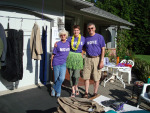 Garage Sale fundraiser for the local Alzheimer’s Association.
CAREGIVER: BE BOLD – ASK FOR WHAT YOU NEED.
Those people with whom you have contact probably know that you’re the only one carrying the ball when it comes to caregiving but they can’t possibly understand the degree of difficulty you’re experiencing. Assuming that to be the case, your friends, business associates, and neighbors may not feel the need to reach out to you with assistance. Now is the time to be very transparent with them…
View original post 486 more words
Family dynamics that hamper caregiving success.
This article on family relationships relates to yesterday’s posting: Caregiving: The Ultimate Team Sport. Smooth waters aren’t the norm when it comes to family involvement on the caregiving journey, as you’ll see in this posting.
A team is only as good as its members. If the playbook isn’t carefully followed, success is unattainable.
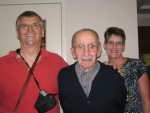 My brother, my dad, and myself in 2006 at dad’s care facility.
The scenario for this article centers around care for Mom. It doesn’t matter if Mom is still living at home and cared for primarily by one of her adult children OR Mom is living in a care facility receiving care for her day-to-day needs outside of the home. Either way the brothers and sisters of this caregiving team are in for the challenge of their lives. What follows is a simple, yet complex, listing of destructive traits that could get in the way of the family’s caregiving goal. All definitions are directly from the Oxford English Dictionary, 11th Edition, 2004.
- EGO. n. a person’s sense of self-esteem or self-importance. Brothers and sisters, please check your egos at the door. The…
View original post 543 more words
Caregiving: The Ultimate Team Sport
If you are a caregiver in need of a support team, I hope this reblog from an article I wrote in 2011 will provide suggestions that will work for you.
What’s a pitcher without a catcher? A quarterback without a receiver? A point guard without a center? Individuals – that’s what they are. They are not a team. Caregiving should never be an individual effort because quite frankly, one person can not do it all.
Take a deep breath; think happy thoughts; and do your best.

Whether the primary caregiver actually does hands-on-care or is the primary “manager” of a loved one’s day-to-day life, that caregiver needs all the support he or she can get. For the purposes of this article we’re going to assume that the loved one, Mom, lives in a long-term care (LTC) facility cared for by professionals. As with every sports team, there is a General Manager of the team – responsible for the overall smooth running of the team, and then there are the individual team members without whom there would be no support whatsoever. …
View original post 897 more words
Man-Words
Here’s a post that is sure to lighten your day, week, month and/or year. This blogger is an extremely good writer and her humor is something I wish I could pull off on my blog. Instead, I’ll post her humor onto mine.

Over my 63 years, men have said some memorable things to me.
So I present to you my
Man-Word Awards!
Best Pick-Up Line:
I go all the way back to 1969 for this one, I was hanging around at the end of my summer job shift with some other teenagers, and I was wearing my coolest Mod Squad outfit. It was a mini-jumpsuit. A short-short kind of onesie with long sleeves, a big collar and a hip-hugger belt.

And one of the guys remarked on my outfit. He said, “I like your get-up.What do you call it?”
And another guy that I didn’t even realize might like me said, “Mine.”
Now after forty-five years, I may not be as keen on a man declaring me as his possession, but at the time, I thought, “wow.”
Sweetest Line:
(This was not spoken to me, but reported to me)
My husband and…
View original post 410 more words
Lighten up Mondays
Sixteen year old Lisa nervously brought her most recent boyfriend home to meet her parents. Although Lisa was very fond of him, she was nervous about what sort of impression he’d make on her parents. You see, he was full of tattoos and had piercings all over his body.
“Mom,” said Lisa nervously, “I would like you to meet my boyfriend, Spike. Spike, this is my Mom.”
After a few minutes of small talk and pleasantries, Lisa’s Mom called her away to the kitchen and whispered, “Lisa, I don’t like him, he just doesn’t seem very nice!”
“Mom, pa-leeze!” retorted Lisa, “If he’s not a nice guy, how can you explain the forty hours of community service he does each week?”
Don’t take selfies in Auschwitz | Opinion | The Seattle Times
Don’t take selfies in Auschwitz | Opinion | The Seattle Times by Leonard Pitts, Jr. One would think that it is not necessary to publish rules or guidelines as to when or where it is inappropriate to immortalize your grinning mug via a selfie, but Mr. Pitts clearly indicates that such guidelines are necessary. His column, attached above, tells the story of an Alabama teenage girl who took a “sunshine smile” selfie at the place that has been memorialized as the largest concentration and death camp in the world: Auschwitz, also known as Auschwitz-Birkenau. (After much fanfare over social media and elsewhere, this young lady defended her action by stating that it was meant to honor her father – on the anniversary of his death – because he passed his love of World War II history on to her.)
Keep in mind, Mr. Pitts’ column is an Opinion piece.
I happen to agree with him.
It is my opinion that it is not appropriate to take a stupid-ass smiling, self-absorbed, thumbs up, V cooties sign above someone else’s head, sticking-out-your tongue selfie or photograph in the following incidents and/or places (this is just a partial list):
- Auschwitz: a place where 1.1 million humans were tortured and murdered;
- 9/11 Memorial: where nearly 3,000 human beings were killed by terrorists;
- Vietnam Veterans Memorial: where names of the dead – 58,286 as of Memorial Day 2013 – are memorialized, 1,200 of which are designated as MIAs, POWs, and others;
- At scenes of destruction such as someone’s neighborhood post hurricane or burning into non-existence from a forest fire (your selfie of non-involvement documenting your presence there is disrespectful to those who have lost everything);
- At evolving crime scenes, such as the one that took place outside of a New Jersey McDonald’s restaurant (Mr. Pitts wrote an Opinion piece on that incident as well, see attached link, to which I also agreed) where one female employee beat up another female employee and while no one intervened to stop the violence, they did take photos and videos and oohed and ahhed at the unfolding action; and finally,
- It is not appropriate to take a selfie in front of a corpse peacefully laid to rest in a coffin at a viewing service.
Which begs the question: did this Alabama teenager take a selfie in front of her father’s open casket (if a casket was used and if it was open)? I would bet that she did not. Why? Because it would be disrespectful, distasteful, and inappropriate. But I have a confession to make. My family is somewhat guilty of the latter.
My mother died on September 24, 1994 leaving my father a widow. Within 24-hours of her death, I and my two siblings arrived from out-of-state to support dad and help him with the numerous required tasks leading up to the funeral. Mom was cremated.
Because the entire family was present at the church funeral, including my sister-in-law and my adult daughter, someone suggested that we all stand around the urn (which sat on a table surrounded by six dozen pink roses at the front of the church) and have our picture taken.
At the conclusion of the service, our photo was taken. It is a very awkward photo, evidenced by the strained smiles on our faces. The inner dialogue went something like this, “Someone is taking a photo; you’re always supposed to smile for a photo; ergo, here’s my smile.”

But dad wasn’t smiling. He just lost his bride of forty-seven years; what’s to smile about? He stands there with an exhausted and grim look on his face, his left hand touching the top of mom’s urn: one last connection with her before the undertaker removes the container for appropriate storage.
I’m not showing you that funeral-day family photo because there’s no reason why you need to see that private family moment. More importantly, that photo op just didn’t feel right to me.
Maybe that’s a pretty good barometer from which to gauge the appropriateness or not of our actions.
Lighten up Mondays
“O.K. everyone,” said the female instructor to her attentive birthing class, “today, we are going to do an exercise to help you men sympathize with your partners.” And holding up an artificial stomach with an attached strap she adds, “What I have here is what’s called a pregnancy suit. This imitates the feeling of being pregnant.” Holding the pregnancy suit out to the class she asks, “Which of you husbands would like to volunteer to be the first one to try it on?”
“I will,” said one man, taking the suit and trying it on. “Gee, this isn’t too bad,” said the man strutting around the room, “I could easily get used to this.”
“O.K.,” said the instructor, and then she threw her pen on the floor. “Now I would like you to bend down and pick up my pen from the floor.”
“You want me to pick it up?” he asked hesitantly, “just as I would if I was pregnant?”
“Yes!” said the instructor.
“Honey,” said the man turning to his spouse, “do you mind picking up that pen for me?”
Lighten up Mondays
Lauren was frustrated. She had complained dozens of times to her daughter about her newest gag of kissing the bathroom mirror immediately after applying lipstick, to no avail.
Finally, one day after spending a half-hour scrubbing the mirror, only to find another kiss mark an hour later, Lauren had enough.
“Lizzy!” the mother hollered.
“What?” came her daughter’s reply from behind her bedroom door.
“I can’t find the toilet brush that I’ve been using to clean the bathroom mirror. Do you have any idea where it is?”
After hearing the gagging coming from behind the bedroom door, Lauren knew her days of cleaning kiss marks off of mirrors were over.
 Living: the ultimate team sport