Norcalmom writes a blog that tells it like it is when operating as the primary caregiver for a loved one. She has a full household, with children of varying ages, a mother-in-law with Alzheimer’s, a husband whose work schedule pulls him out of the home during many of the caregiving opportunities, and yet this daughter-in-law manages her household in ingenious ways.
Whether it’s purchasing and installing locks so her MIL doesn’t escape from the house at inopportune times (which, frankly, means any attempted escape from the house) or finding activities to occupy her MIL so Norcalmom can get things done, e.g., making dinner for the family, she puts on her thinking cap, listens – truly listens – to what may interest the oldest member of her household, and does what is needed to get the job done.
Her MIL is very much intrigued with sparkly things, specifically, glitter. In her eyes, if she spots specks of gold-colored glitter, it is not glitter she is feasting her eyes on it is the real deal: GOLD!
Please, click on the link provided at the beginning of this mini-post of mine, and feast your eyes on the treasure within.
Regardless of the outcome, always fall back on doing something for the common good.
I’m currently reading The Road to Character, a book by columnist and political pundit, David Brooks. I recently watched an interview of his with Oprah Winfrey and was so impressed with the subject matter, I purchased the book he was promoting.
Mr. Brooks talks and writes about the difference between Adam I and Adam II, the latter being the person who has lived a eulogy life, not the resume life of Adam I. You’ll need to read the book to understand the full contextual meaning, but what follows is just one of many elements that resounded with me. I provide this excerpt verbatim:
When a person gives a poor man shoes, does he do it for the poor man or for God? He should do it for God …
The poor will often be ungrateful, and you will lose heart if you rely on immediate emotional rewards for your work. But if you do it for God, you will never grow discouraged.
A person with a deep vocation is not dependent on constant positive reinforcement. The job doesn’t have to pay off every month, or every year.
The person thus called is performing a task because it is intrinsically good, not for what it produces.
You see, we’re not responsible for the outcome. Most of the time, we’ll never witness how our good deeds helped another person. If our motivation was only to observe first-hand the benefits such deeds might produce, we’d stop doing good in short order. We must exercise faith and hope that our actions are not wasted.
Your ability to discern your vocation depends on the condition of your eyes and ears, whether they are sensitive enough to understand the assignment your context is giving you. As the Jewish Mishnah puts it, “It’s not your obligation to complete the work, but neither are you free to desist from beginning it.”
All that we do with a clear conscience is good. We must not refrain from standing up and stepping forward. The good we do may be the beginning of a widespread process of well-being for others, or it may be the finishing touches on that which was started some time before you came into the picture.
It’s never too late to do good. Why resolutionize your intentions until next year? Start now.
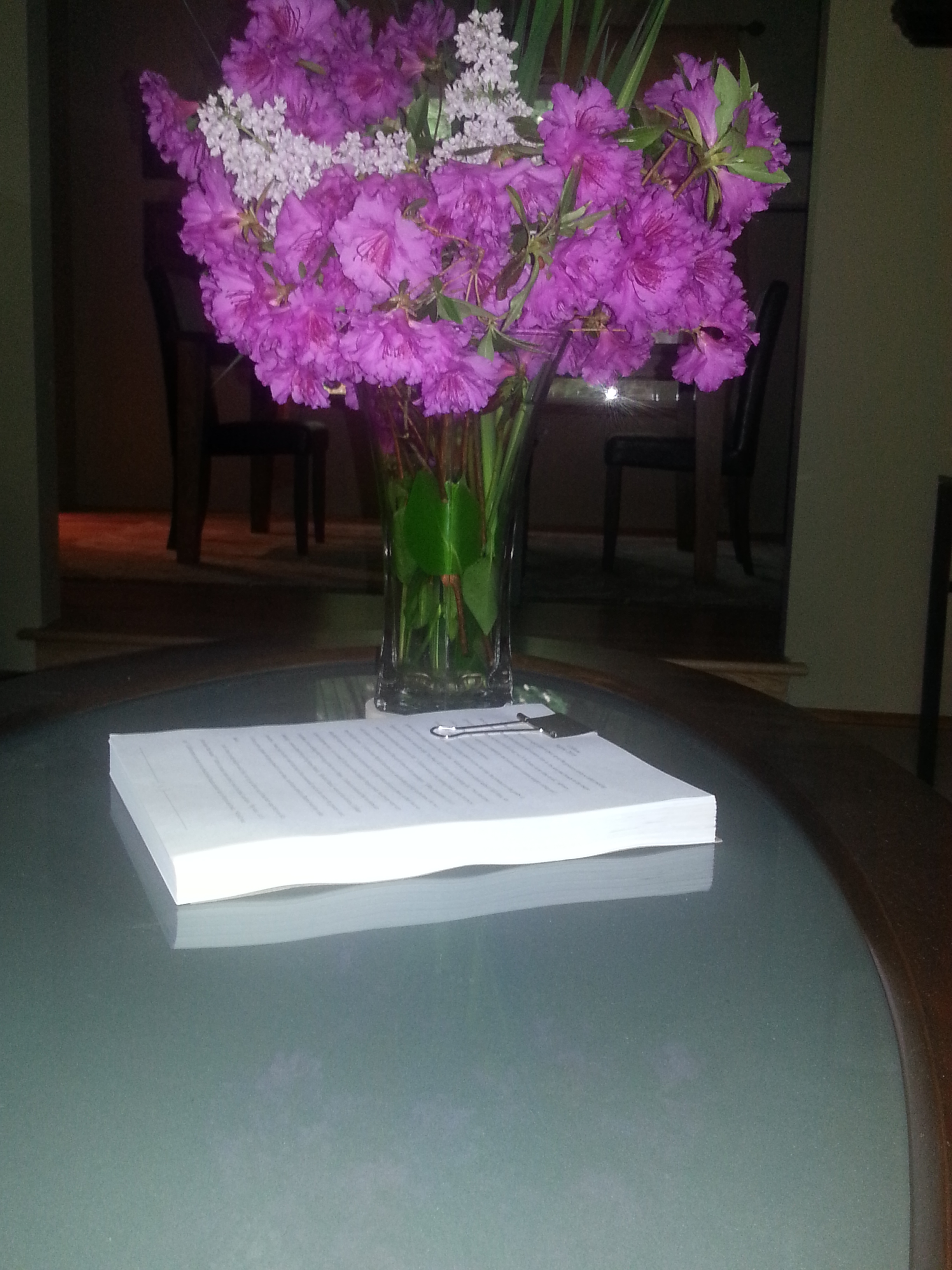
Having completed my second novel, currently titled BRIDGED BY BETRAYAL, I packed up all the research I used for my first novel, REQUIEM FOR THE STATUS QUO.
An early version of my 1st novel circa 2014
REQUIEMspotlights a family that struggles with the tangible and emotional elements inherent when battling a disease that is always fatal; a disease that gives you daily – if not hourly – reminders of its devastating effects.
I could not write about the fictional family’s journey without incorporating some of my own stories from my years as Dad’s caregiver. I also included other people’s stories as told to me through my work as an Alzheimer’s caregiver support group facilitator, and as a Washington State certified Long-Term Care Ombudsman. (Names and facts altered to protect those directly involved.)
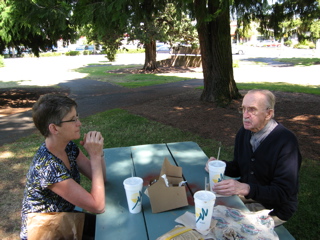
My Dad and I on a picnic, Spring 2005.
The research materials I packed away this past weekend consisted primarily of the caregiving journals I kept while being my father’s primary long-distance caregiver while he endured Alzheimer’s disease.
That research also included reams of paper I organized into multi-tabbed folders containing the various doctor’s reports and findings from the seven years of dad’s disease journey.
I was not prepared for the emotion with which I was blanketed when I pulled out the large waterproof chest that had resided in my writing space the past three years. Placing my research in the chest, shutting it, and returning it to its original under-the-stairs location was extremely difficult for me.
In a certain sense, I felt I had betrayed Dad because I wasn’t just packing up some paper, I was putting away the physical evidence of his seven year battle of brain function loss. Read the rest of this entry »
I had the privilege of facilitating an Alzheimer’s caregiver support group meeting this afternoon. For several years I facilitated my own caregiver support meeting but retired from doing so in 2013. Earlier this year I was the substitute facilitator for this same meeting and was so very impressed with the group of ladies I met then, a few of whom were in the meeting again today.
One of the gals, Georgina (not her real name) lost her husband to Alzheimer’s in January. She told the group that while her husband was still alive, the two of them were always invited to a Holiday gathering of friends – all married couples – to celebrate the Christmas season. She found out recently that she was not invited to this year’s event.
Quite frankly, she hadn’t yet thought about the Holiday party, thinking the invitation might be forthcoming but certainly wasn’t stressing out about it. Quite innocently, one of her friends mentioned the party in passing, saying, “Looking forward to seeing you at the annual Christmas celebration” not realizing that the host of the party had not included Georgina on this year’s guest list.
The latest AARP Magazine had a fabulous article providing helpful ways in which to make a caregiver’s life just a wee bit – or quite a bit – better. Here are a few tips for you to adopt in your life.
Bring her a low-maintenance houseplant
Take in his mail
Do yard upkeep, whether raking leaves, mowing the lawn, shoveling snow
When you’re heading out to buy groceries, ask him if you can pick some things up for him
Take her kids or grandkids to the park or to a movie
Stop by with a board game or a movie to watch – a perfect way to get his mind off things
Visit her with a pet that has a sweet disposition
Take his dog on a walk – maybe on a daily or weekly basis
Do some light housework or repairs: dishes, vacuuming, dusting, ironing, smoke alarm battery and light bulb changing, fixing a leaky faucet
Return her library books
Volunteer to stay at home to wait for the cable technician, repairman, etc. while he attends to other more pressing needs
Bring him a week’s worth of meals in freezable containers
Send her a greeting card on an ongoing basis. Who doesn’t love to receive real postal mail?
When visiting, let the person vent, without passing verbal judgment on what they may say
Do an item or two on her To-Do list – I promise you, her list is extraordinarily long
Offer to make a photo album with him, using photos that mean a lot to him and the rest of the family
Give him a gift card to a restaurant he may enjoy, or better yet, take him out to dinner
Help him decorate for the holidays
Drop off or pick up a prescription
Keep in touch with her, even after her loved one passes. Too often, the grieving one has more attention than she can handle immediately after someone dies, then when she could really use some TLC, no one can be found.
I’ve written several articles over the years about the importance of assembling a caregiving team when caring for a loved one – a team that doesn’t necessarily rely on family because not everyone has a participatory family when it comes to these matters. Of all the life-changes we encounter during our journey, caregiving is one of – if not the most difficult – speed bump to get over.
Caregiving: the ultimate team sport suggests how one might use the strengths of each team/family member to handle the varied needs during the caregiving journey.
Family dynamics that hamper caregiving success exposes the need to let go of stereotypes or childhood roles that don’t serve siblings well as adults. If ever there was a time to work together for the greater good – taking care of a family member with dementia or other terminal illness – this ranks right up there at the top.
Solo caregiving addresses the needs of the person who appears to be strapped with fulfilling all the roles needed for a successful caregiving venture. As the sole caregiver, you need not settle into those roles, not without the help of other, well-meaning individuals. Certainly, much relies on the neighbor, coworker, even casual acquaintance, but said entities are a resource from which much assistance can be found.
And here are several more articles for the caregivers out there – and those acquainted with a caregiver – to provide some wisdom and encouragement through the tough times: Read the rest of this entry »
Sure, it’s convenient and very utilitarian for our every-day use. As a writer, I benefit greatly from an online Thesaurus to use alternate words. Case in point, there’s gotta be a better way to say, “Colleen got angry (irked, vexed, indignant, apoplectic, choleric) when traffic made her late for her hair appointment.”
And among the many other reasons for which I use the internet, I count on it for quick access to a recipe for an I’m too exhausted to be creative meal on a Monday night or in the alternative, a restaurant that’s not too far away from home and can seat us at the last minute. Bottom line, I take full advantage of what the inter-web has to offer.
But the biggest reason I love the internet is that it reaches anyone who has access to any type of computer device – especially those in need of some sort of assistance when sorting out the difficulties of life. My need for a dining alternative pales in comparison to someone searching for help when caring for someone with a debilitating illness.
One of the blogs I follow: My Dementia Experience, is written by a woman, NorCalMom, who takes care of her mother-in-law. This delightful caregiver also has five children of her own. But NorCalMom jumped into caregiving with both feet in 2013 when Marie, her mother-in-law, moved in with her and the rest of her household because of Marie’s advancing dementia. Reading just one of this blogger’s posts will show an outsider what types of challenges NorCalMom faces on an ongoing basis.
As caregivers, and I’ve been one as well, we oftentimes “wing it” when it comes to handling the day-to-day, and shockingly acute, issues that occur during our caregiving journey. The unpredictable nature of Alzheimer’s or other dementia makes even the most mundane activities frustratingly impossible to handle with only a layman’s knowledge of providing care. For example, how does one communicate with a person who can no longer understand what is said to her and who can no longer respond cogently to questions proferred by their primary care person?
We’ve all heard the admonishment that we should lead by example. The intent of that statement focuses on providing good examples for not only our own children and grandchildren, but also our neighbors’ children, school students, and all other young people with whom we come in contact. The final increment of this Focus on Caring series suggests that adopting an attitude of caring is best started at an earlier age.
If we live in such a way that our words and actions positively influence the younger set among us, we are to be rewarded. But if our actions negatively influence children, we’ve done them – and the world – a grave disservice.
The article attached above from the Kindness Blog – a website that ONLY provides stories that focus on kindness – lists seven suggestions for effectuating kindness in children.
This week’s story is right out of a fabulous blog that I follow, The Kindness Blog. I’m submitting the story as it was written, in the 1st person, by the person involved.
I was in a really bad three-car accident a few years ago where a drunk driver ran a red light and hit another lady and me – the other lady died. This couple who had been leaving the Mosque across the street heard the accident happen and came running to help. It was cold out and I was just sitting on the side of the road shivering and cold. Read the rest of this entry »
The proposed Recognize, Assist, Include, Support, and Engage (RAISE) Family Caregivers Act would require the development of an integrated national strategy to provide resources for under-served family caregivers in the United States. If you are not currently a caregiver for a loved one, you most likely will be, and no doubt you know of someone who is already an unpaid caregiver (as opposed to a hired caregiver) for a person in their family.
Many families, even those with young children, find themselves thrust into the role of caring for a loved one when they least expect it and can ill afford to. Caregiving for a child or an adult with disabilities, or caring for an adult with a debilitating illness, has become the norm for many in the United States and abroad.
These caregivers “prepare meals, handle finances, manage medications, drive to doctors’ appointments, help with bathing and dressing, perform complex medical tasks and more – all so loved ones can live at home.”
Keep in mind, the above tasks are those they were already performing for their own household, tasks that multiplied exponentially with the increased needs of their disabled or ill family member. Add a job outside of the home to all of that, and you have to wonder how these overworked and over-stressed heroes manage at all! Read the rest of this entry »
On July 7, 2014, I wrote an article Spineless inaction: the bystander effect, an article that told the story of a female McDonald’s restaurant employee who was severely beaten by another woman. No one called 911, no one tried to intervene, but everyone within a block of the beating took cell phone video of the attack. That, my friends, is an example of spineless inaction.
I’m going to counter that horrific example with a rewarding one out of Buffalo, New York.
Darnell Barton, a bus driver in Buffalo, New York, was on his multi-trip route over a bridge on the expressway. Ahead of him, he could see a woman standing over the railing on the ledge; the intent of this woman was obvious to anyone who observed her. The entire episode was caught on the bus dashboard camera. Read the rest of this entry »
The above article provides a clear perspective of the challenges inherent with taking care of someone whose reality doesn’t come close to matching that of the caregiver.
Whether you are an unpaid caregiver – someone who cares for a friend or a loved one – or a paid caregiver providing services for which payment is received, you need to embrace the art of lying for your benefit, and that of the person for whom you provide care.
I feel so strongly about this matter, that over the years I’ve written several articles proposing one engage in the fine art of half truths, omitted truths, and out and out lying to save the day.
Here are two articles I think you will find of interest, articles that might just infuse you with the strength to take the low road from time to time:
I am again relying on Dr. Bernie Siegel’s wisdom, found in his book 365 Prescriptions for the Soul, for this post. The older I get, the more I’m faced with opportunities in which to witness tragedy in the lives of those with whom I come in contact. Even after all these years, I have to meditate on what a particular person’s tragic situation may mean to him or her so that when we meet in person or by phone, I’ll do and say the right thing. Here is Dr. Siegel’s take on the matter which I present verbatim:
Sympathy
Sympathy is not about feeling pity for the person who has experienced a significant loss or problem. Being “simpatico” is about being congenial, winsome, and pleasant. To be sympathetic is to connect with the other person so she does not feel isolated by her problem. If you fear experiencing the other person’s pain, then you will not be able to be sympathetic.
Just as sympathy is not about pity, it is not about denial either. It is about accepting and relating to the person. When you do you will experience a fuller life and a feeling of closeness with the other person. In the sharing of sympathy we learn, and so we move up, in a sense, as human beings.
Being a sympathetic person will also attract others to you. They come not to share wounds and complain, but for understanding. When we are alone in our world and questioning life, a sympathetic word or touch can change our experience and help us to survive. To be held in the arms of sympathy is a gift that creates true healing.
Soulution of the Day
Be sympathetic in your words and actions, you never know when you may need some sympathy yourself.
Applause. Please, please, please read the attached mini-article written by a 30-something year old blogger who is taking care of her mother who has Alzheimer’s.
I’ve written about how important it is to do good things, say nice things, and appreciate the people around you. There’s a group of people out there that could really use some of those good vibes: family caregivers. You encounter them everywhere you go. You may not know they’re caregivers, but believe me, if you build them up, rather than tear them down, you will have done a very good thing. You might be just the person she/he needs to get through a very trying day.
The next time you leave your house, set out to make someone’s day. Don’t rely on some other stranger to do it; it’s up to you.
And I’m writing about it again, but I’m going to let Dr. Bernie S. Siegel be my mouthpiece on this one because he addresses the importance of making a difference in the lives of others in this excerpt from: 365 Prescriptions for the Soul. Here’s the selection verbatim: Read the rest of this entry »
I like what I like. How many times have you been asked to choose between one thing and another, you choose the thing, and then you’re asked, “What made you choose that?” If you’re the mother of Not Quite the Plan‘s author, your answer is, “I like what I like.”
I love the example of this mini-dilemma found in the attached article. The blog author’s mother, I’ll call her Mrs. Mom, cuts to the chase; she doesn’t waste any time deliberating; she simply knows what she likes: she doesn’t like the cat that keeps jumping on her lap, but she does like fudge bars. Mrs. Mom has dementia. Perhaps because of her condition, the decisions she makes are far less complicated than they used to be. Her measuring rod: I like what I like.
Weighing the pros and cons is a very important step in the decision making process, but oftentimes we get hung up on the P & C list and fall into the paralysis by analysis quagmire. The list doesn’t have to be multiple pages long and it doesn’t have to be perfected before we take the first step. What’s the worse that could happen? Let’s look at the possibilities. Read the rest of this entry »
The attached New York Times article by Pam Belluck addresses the ambiguous loss experienced by men and women whose spouses are still alive, but not fully there. More specifically, it addresses the need for intimacy that still exists for the spouse without cognitive decline, and that can also exist for the spouse with the decline.
It is a well-known fact that advancing age doesn’t mean the end of desire for sexual intimacy. Whether in the privacy of ones home or in a long-term care housing situation, sex is alive and well. Even people with varying degrees of dementia maintain the desire for intimacy. What the above NY Times article so carefully exposes, however, is that sometimes the act of consent for such intimacy can be a subjective one when viewed by a third party. Read the rest of this entry »
My name is Irene. I am the author of the upcoming novel Requiem for the status quo.
Some of you know me as a family member, friend, or casual acquaintance. Others are familiar with me as the author of this blog, a writer who has posted hundreds of articles over the past several years. Still others know me because of my professional connections as a volunteer advocate for vulnerable adults living in long-term care (LTC) facilities, or because of my years as an Alzheimer’s Association support group facilitator.
I’m here to announce that in addition to being the family member/friend/acquaintance/volunteer/co-employee of the past and present, I am also the novelist who has something to say.
“Oh my gosh Irene, I didn’t realize your book was already published!”
It’s not, but I’m actively pursuing agent representation by contacting several agents per day until I no longer need to.
“Why should people be interested in your book?”
Because I have an engaging way of writing about Alzheimer’s disease – a disease that will affect each and every one of you because until a cure or vaccine is developed to eradicate it, this disease is here to stay. Whether a person’s diagnosis falls into the actual Alzheimer’s category, or into one of several other dementia such as: vascular, lewy body, frontal temporal, Parkinson’s, or dementia resultant from a traumatic brain injury (TBI), there’s no escaping its effect on the unpaid caregiver (that’s you and me) and the person being cared for (spouse, partner, mother, father, brother or sister).
And here’s a fact of which some of you may not be aware: Alzheimer’s is not just an older person’s disease; an increasing number of people are being diagnosed well-before the age of 60.
I hope you’ll watch the attached 4 minute video that chronicles a husband’s experience of moving his wife into a memory care facility.
This is not a decision that comes easily to anyone.
Think about it. You’ve spent decades living with the love of your life. Your days are structured around each other; the ebb and flow of all those hours are what you crave and enjoy.
You are faced with what will most certainly be an irreversible decision to leave your wife in the hands of others. You feel guilty, regardless of how well-informed and appropriate the decision. Read the rest of this entry »
When I’m an old lady and end up in a care facility, I sincerely hope my personality and attitudes don’t relegate me to the category of “that crabby old lady in Room 210.” Have you visited someone in a nursing home or hospital and had the distinct feeling that the patients were treated like numbers or medical cases? You know what I mean: “the urinary tract infection in 4A” or “the decubitis in South 6.” Wow, that’s a horrible thing to consider for myself: the history of all my years on this earth being characterized as a medical condition or an intolerable behavior resulting from that condition.
What about my history of being a pretty darn good mother/wife/business person/neighbor/community volunteer/friend? Doesn’t that person still exist within the body occupying that bed?
Let’s all take the time to read this poem that depicts such a scene. Gender-wise, this could be about a crabby old man as well. Read the rest of this entry »
I’m re-posting this article I wrote back in 2012 that discusses one of the many “first times” survivors go through after the death of a loved one.
My article contains a link to another blogger’s article in which he discusses the experience of his first Valentine’s Day without his wife. On a personal note, that blogger is my brother, a man who came through that period of his life a survivor. Although he still misses his wife who died of early-onset Alzheimer’s disease at the age of 69, he can now look back and relive the memories of the numerous happy celebrations they both shared throughout their almost 25-year marriage with gratitude and hope for the future.
This fabulous article really captures the essence of what those grieving need from those with whom they’re acquainted. It also helps those uncomfortable with the topic of death to understand that there are many ways to lighten the emotional load for the person who is grieving.
The 11th suggestion I would offer is this: If you’re with someone who has recently suffered a loss and you don’t know what to say; you feel any words you offer couldn’t possibly make a difference; offer a hug. Your sincere intentions will transfer to them and just might provide them with the assurance that you acknowledge their grief and want them to know that they are not alone. Thank you Howard Whitman for offering this article to us.
Editor’s Note: The following is an excerpt from Keys to Happiness, an anthology of articles published in 1954.
Most of us want to be helpful when grief strikes a friend, but often we don’t know how. We may end up doing nothing because we don’t know the right — and helpful — things to say and do. Because that was my own experience recently, I resolved to gather pointers which might be useful to others as well as myself.
Ministers, priests, and rabbis deal with such situations every day. I went to scores of them, of all faiths, in all parts of the country.
Here are some specific suggestions they made:
1. Don’t try to “buck them up.”
This surprised me when the Rev. Arthur E. Wilson of Providence, RI mentioned it. But the others concurred. It only makes your friend feel worse when you say, “Come now…
Dietrich Gruen, the author of the attached article, is a Green Bay Packers fan. My team, the Seattle Seahawks, beat his team in the game he references in his attached article. When I’m on the receiving end of a victory, I’m always cognizant of the fact that when I’m celebrating a win, there are those who are bemoaning a loss.
Well, let me tell you, the football field is a great equalizer, as was evident yesterday when the Seahawks lost the Super Bowl to the New England Patriots. It was a devastating loss, but it was not life-changing.
Sure, it may change some aspects of some of the Seattle team members’ lives, but it won’t alter what is truly valuable: life itself. With several hours separation between Seattle’s shocking loss and now, I’m able to re-categorize that loss as a speed bump. Read the rest of this entry »
This is NOT an article about football. Anyone who has a loved one for whom they provide care – whether hands-on or peripheral – knows all too well how unpredictable life can be with that 24/7 responsibility. We’d all like to think that special occasions and events are immune from medical emergencies and other disasters, but all too often that is not the case.
Welcome to the life of a caregiver.
I honestly didn’t think I had another football article in me but the unfortunate circumstances in my best friend’s life have proven otherwise. Read the rest of this entry »
As a child, do you remember being admonished to “play nice together” with your siblings or friends? Or perhaps you’re a grandparent who has encouraged your grandchildren to behave better with others by using that same phrase. I like it, and I think playing nice together needs to be a part of our daily life strategy. Read the rest of this entry »
This 2nd part in Ann Hedreen’s series about being an Alzheimer’s research subject will both make you cringe – ugh, lumbar puncture – and will make you proud to know that someone such as Ms. Hedreen exists in this oftentimes self-centered world in which we live. As someone whose father died from Alzheimer’s complications, I am most appreciative of her efforts. Although monetary donations are greatly needed, for me I find it far easier to open my wallet than to offer my spine for research. Not only did Ann offer her spine, she did it more than once.
Although being a control subject in Alzheimer’s research studies involves plenty of memory tests, there are neurological tests too. I was tickled with feathers, tapped on the elbows and knees, peered at with a penlight in my eyes. And there were psychological questions: On a scale of one to ten, do you usually feel life is worth living?
I was weighed and measured. I gave blood. I peed in a cup. My family tree was drawn, with special attention to anything that might be relevant: Grandma Cere’s Parkinson’s disease; Great Aunt Eine’s Alzheimer’s disease, which started in her seventies. I was approved for a lumbar puncture, more commonly known as a spinal tap, and a week later, I came back and curled up in a ball while two tablespoons of fluid were extracted from my spine with a long quivery needle: two…
In this particular instance, the thought of being a human guinea pig feels very, very comforting. Being able to help find a cure for Alzheimer’s that goes beyond monetary contributions sets up a legacy for many as a result of Ms. Hedreen’s extraordinary efforts. Ann Hedreen’s book is available on Amazon and at most retailers.
Here are two of the many things that scare me: having to change a tire all by myself (because I’ve never done it) and camping in bear country (because I have). Here are two of the few things that don’t scare me: taking pop quizzes and getting poked with needles. These slim categories of fearlessness make me a natural volunteer for Alzheimer’s research.
My mother grew up in Montana and nothing much scared her. She not only changed tires, she put chains on tires by herself, tying them together with shoelaces if they didn’t fit right, lying under the car in a snow storm. As for camping, after a twenty-year hiatus, she decided to try it again—solo, with four children in tow. We didn’t see any bears. The worst thing that happened was that we forgot spoons for our cereal. The best thing was being with Mom…
Alzheimers Research Funding Lags Other Diseases- Dementia – AARP. The January/February 2015 AARP Bulletin focuses on the prevalence of Alzheimer’s disease in America. The cover contains photos of fifteen celebrities who died from the disease. Some of those spotlighted may surprise you because their cause of death was not broadcast to the media.
What a shame.
It’s a shame that the stigma attached to the disease still manages to relegate Alzheimer’s to the closet. Cancer used to be that closeted disease – so much so that many years ago people shied away from even mentioning the word, preferring to call it “The Big C.” Before Alzheimer’s disease, cancer was the whispered disease but now the populous embraces each and every body part afflicted, even those considered of a private nature: breast, ovary, prostate, rectum. Read the rest of this entry »
The attached article from the Kindness Blog immediately caught my attention. Please take the time to click on the above link to discover nine easy ways to help an elder in your community. Whether that person is a family member, or a perfect stranger, the basic truth remains the same. As an advocate for the elderly I can’t help but encourage all of us to practice respect for those older than ourselves. Read the rest of this entry »
If you’re like me, you’re wondering how another year has slipped by so quickly. I’m sure there were a few of the 52 weeks that seemed to slog by, but all in all we can now look back and marvel at what we accomplished, or what others accomplished in our stead, during the past 365 days.
An accomplishment with which I’m happy is having authored this blog for the past three and a half years. I’ve provided this blog for you, but I’ve also provided it for me because I truly enjoy having the opportunity to share my experiences and my viewpoints; I hope in the process that I have encouraged, helped, and entertained you. From the start of Baby Boomers and More in 2011 to the end of 2014, I posted 520 articles. I’d be a very happy blogger if the quality of those articles surpassed the quantity because if I’m just talking into thin air without benefit to others, its hardly worth the space my blog occupies.
Here are links to the five most visited articles in the year 2014 based on WordPress statistics: Read the rest of this entry »


















 Living: the ultimate team sport