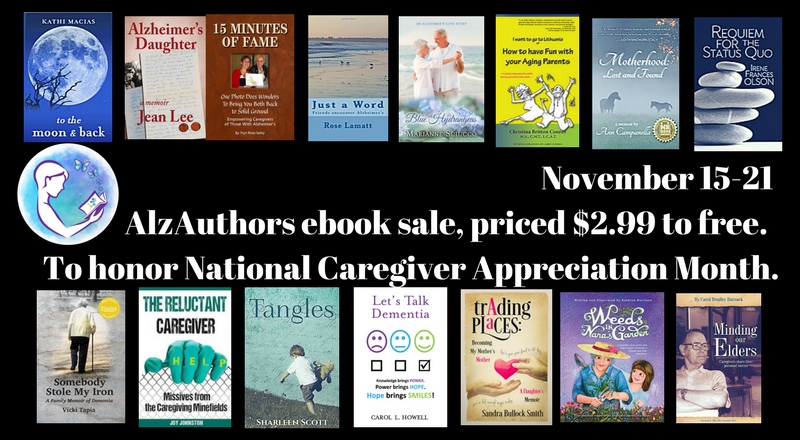
November is National Caregiver Appreciation Month, a time to recognize the long hours, sacrifice, and love all caregivers bring to the task of caring for a loved one with dementia or any long-term illness. In honor of their efforts, AlzAuthors is hosting an eBook sale and giveaway! This is a terrific way for caregivers who are looking for knowledge, guidance, and support to find carefully vetted books to help guide and inspire them every day.care
Consider this information from the Alzheimer’s Association:
In 2016, 15.9 million family and friends provided 18.2 billion hours of unpaid assistance to those with Alzheimer’s and other dementias, a contribution to the nation valued at $230.1 billion.
Approximately two-thirds of caregivers are women, and 34 percent are age 65 or older.
41 percent of caregivers have a household income of $50,000 or less.
Approximately one-quarter of dementia caregivers are “sandwich generation” caregivers — meaning that they care not only for an aging parent, but also for children under age 18.
Starting today through November 21st, you can take advantage of this excellent opportunity to check out some of our books at reduced prices, ranging from free to $2.99. We offer a variety of genres, including fiction, memoir, non-fiction, and children’s literature. Many of our books are also available in paperback and audio, so be sure to check them out too. As a matter of fact, my novel is available on Kindle for just $2.99 through November 21st and if you prefer a paperback copy, my publisher is offering it at half price on my publisher’s site. Check it outhere!
All books on the AlzAuthors website are written from a deep place of understanding, experience, knowledge, and love. May you find one – or two, or more! – to help guide you on your own dementia journey.
Click on this link, that takes you to the promo post on the AlzAuthors website, and then click on the individual book covers to visit the book’s Amazonpage.
According to the 2017 Alzheimer’s Association Facts and Figures research, there are more than 15 million Americans providing unpaid care for people with Alzheimer’s or other dementias. Some have assembled a team of family and friends so the responsibilities are evenly spread out, but that is not always the case. The solo caregiver manages—or tries to manage—everything on his own.
That’s where those who are on the outside looking in can become a caregiver’s hero.
OFFER TANGIBLE ASSISTANCE. We will never be wrong in assuming the caregiver needs help so rather than saying, “Call me if you need anything” we can ask, “What exactly do you need?” If we remember what we needed when we were on the mend from illness or surgery we should be able to come up with an endless list of concrete gifts of assistance.
MEALS. You need to cook for yourself and/or your household anyway so make a double recipe, pack that extra portion in a disposable dish, freeze it, and keep doing that for a week and deliver one full week’s worth of frozen meals to the caregiver who, receiving your food offerings, can look forward to not having to be creative in the kitchen at the end of the caregiving day. Engage others to sign up for this dinner on wheels program so the responsibilities are spread out amongst many.
ERRANDS. You’re running to the store for a few items; take the time to ask Sam if there’s anything he might need while you’re out. He may need a half-gallon of milk—and he might have needed it for the past several days—but embarking on that task proved impossible for him. With very little effort on your part you can make a huge difference in Sam’s well-being. Maybe the needed item is toilet paper; acquiring that for him makes you a genuine hero!
CHORES. The last task a time-strapped caregiver considers doing is housework or yardwork. You will not insult your friend or neighbor by offering to vacuum their house or clean their bathrooms. Or perhaps it’s a lawn that needs mowing or a flower bed, weeding; that sprucing up will provide the caregiver with a virtual—and literal—fresh view of their circumstances.
OTHER OPTIONS. Sam may turn down home improvement offers but he might say, “What I could really use right now is some help figuring out Nancy’s health insurance statements.” Or he might say, “My wife’s not much of a conversationalist anymore, I’d give anything to have an hour to talk with someone who is. Could you stop by later today for a visit? I’ll even talk politics if it means having someone else to talk to.”
WHAT I KNOW FOR SURE. The family caregiver has so much going on physically and emotionally, offers of assistance can be the salve that gets them through each day.
Grief: Your caregiving friend is grieving the loss of a person who is still with him. Unlike the sudden death of a family member, the Alzheimer’s caregiver suffers the prolonged loss of their loved one—oftentimes called ambiguous loss—because although physically present, the person with dementia is continuously leaving their loved one.
Exhaustion. Physical, emotional, and spiritual exhaustion sneak up on the solo caregiver and they are killers. The solo caregiver must put their needs above those of the one for whom they are providing care and sometimes they need you, the outsider, to help them prioritize those needs. Just like the airlines’ seatbelt instructions, the person meeting the need requires attention before the one requiring it.
BOTTOM LINE. You have so much to offer the time-strapped family caregiver; your gifts of kindness are more valuable than you could ever imagine.
Do you want additional insight into what caregivers with whom you are acquainted are facing? You can order Requiem for the status quo at Barnes & Noble and Amazon as well as all online and brick and mortar chain and independent bookstores. And if you have already read my debut novel, please consider leaving a review on the online retailer’s website of your choice.
Silent Storm: What We Remember, What We Forget, What We Discover A Novelist Meditates on Writing about Alzheimer’s By Marita Golden I didn’t choose. I was called. That’s how inspiration, art, and creativity work sometimes. I am often asked why I wrote a novel about Alzheimer’s disease. I am not caring for anyone afflicted with […]
I have held three author events since my novel’s release back in July and I have more planned before the end of the year. At the senior centers and independent bookstores where my events are hosted, each person attending is certainly there in support of my efforts, but more importantly, I believe their presence honors my father’s story, a story without a happy ending.
Here’s an excerpt from my novel that speaks of my fictional characters’ dilemma, but it also mirrors that which occurred in my real life experience with Alzheimer’s.
If it’s true that cancer is no respecter of persons, it is equally true that Alzheimer’s disease exhibits the same lack of respect. This disease is a murderer and I’m troubled by the millions of crimes it has gotten away with.
Alzheimer’s is also a robber, not only because it robs a person of his or her memories and future, but also because it exacts an emotional price that few can afford. To be sure, monetary costs are a challenging force to be reckoned with, but many family caregivers and their loved ones would no doubt conclude that the emotional toll on a person far surpasses even the costliest of care fees paid.
Until the person with Alzheimer’s or other dementia becomes blissfully unaware of the disease that is murdering him, he has a front row seat to all that is happening. My dad was the first to know when his senior moments became more than a quirk of the aging process. It grieves me to imagine what he went through when he was alone with his thoughts, witnessing first hand where those thoughts were taking him.
Yes, my father had a front row seat to the effects of a disease that is always fatal. Until he eventually became blissfully unaware, he lived with that fact every single day. If the caregiver thinks she or he has been dealt a bad hand in relation to Alzheimer’s, imagine if you possibly can how that hand plays out with the person diagnosed with the disease. I don’t know about you, but my imagination in such matters paints a picture I’d rather not see.
My very real reward for writing my novel is that my father is honored as a result of my efforts. Additionally, it is my sincere hope that those reading my novel and attending my author events manage to discover that they have a cheerleader in their corner…me.
Book Tree is a fabulous, quaint, neighborhood bookstore that truly excels at bringing the community together.
Here’s the content of their website’s About section:
BookTree is a vibrant gathering place for the exchange of ideas, and discussion of books and the literary arts. It is a place where all are welcome to continue their journey, expand their knowledge, feed their interests and further their education through books and literature. It is a place for families to find and enjoy the best of current literature. A place where our customers can hear local and traveling writers, authors and poets present their work.
BookTree is one of the few remaining independent bookstores on the Eastside that will be an important part of our city’s identity. It will be successful because of the generous support of our community who values a stand-alone retail bookstore.
BookTree is owned by 2 people who are passionate about the inherent value of books, reading, writing, listening and sharing diverse ideas, and viewpoints.
I discovered something shocking during the weeks that followed my novel’s release:
Alzheimer’s disease is still a secret.
I know; we’ve all certainly read about it, especially when a celebrity is diagnosed with the disease. Every once and awhile there might be an Alzheimer’s Association commercial on television…that is assuming we don’t fast forward through it or walk out of the room. Another reason we’re familiar with the disease is that it is happening to so many people with whom we are acquainted – whether intimately or tangentially.
But it’s still a secret. The very definition of the word speaks to its intent: adj. not known or seen or not meant to be known or seen by others; n. something not properly understood; a mystery. from the Concise Oxford English Dictionary
In many of my promotional posts and boasts for my novel Requiem for the status quo, I’ve indicated that my book tour would probably look more like a senior center tour than what is normally the route for authors: readings and signings in major and independent bookstores. That’s the tact I took, approaching numerous senior centers in Western Washington. 25% of those I approached booked my author event on their activity calendars. But when I approached a major senior housing community foundation to get on their speakers’ calendar, I was told the residents pushed back at the foundation’s previous efforts to enlighten and inform when they hosted those who spoke to the reality of Alzheimer’s disease and other dementia.
Craig Boyack, author and author supporter – yes, author supporter – conducted a radio interview of two of the characters from my debut novel, Requiem for the status quo.
Patrick Quinn, father of the protagonist, Colleen Strand, has recently been diagnosed with Alzheimer’s disease and he’s having a difficult time trying to figure out how not to be a burden to his daughter, Colleen. He’s friendly with the radio host, even joking about a part of the male body that withers and needs medicinal support and encouragement from time to time. (Don’t worry, it’s G-Rated, you have to read the context of the interview to fully appreciate the sense of humor this fine, eighty-four year old man exhibits, even in the midst of his disease journey.)
Jonathan Quinn, Patrick’s son, who’s not too keen on what has happened to the father whom he at one time looked up to. Yes, Jonathan is embarrassed by his father’s forgetfulness and seems to think his father’s challenges are all about him, Jonathan, instead of the person who has a front row seat to every twist and turn the plaques and tangles of his diseased brain takes. Jonathan is firmly implanted on the road to denial and sadly, it gets in the way of his relationship with his father.
The interviewer is a fictional character, Lisa Burton, a character in one of Craig Boyak’s novels. The interview takes place on her show, Lisa Burton Radio. This different way of interviewing an author, in this case, me, and spotlighting the author’s novel, is so ingenious, you will be taken aback by how effective Craig’s blogging methods are.
Please, read the interview, and when you’ve done so, I hope you’ll purchase my book from any of the many online and brick and mortar book stores out there, including Barnes & Nobleand Amazon. Be sure to shop around for the best price, you won’t be sorry you did. And for those of you with eReaders, the eBook will also be available at most online book retailers on, or about, July 27th.
Those family members who have had, or who currently have, a family member or close friend with Alzheimer’s or other dementia, you are my hero.
You took on the task of showing your love and compassion by signing up to become a family caregiver which at its best is a learn-as-you-go, long-term commitment. Your efforts make a difference in the life of your loved one. They may not be able to express their appreciation for all that you do, but please know that the essence of who they are acknowledges your kindness.
Your name and/or identity may be lost to them, but you are still a vital part of their lives, and your friendly and loving demeanor goes far toward affirming them and making them feel valued and loved.
Thank you for all that you have done, continue to do, and will remain doing in the future. It is an honor to be in your company.
Requiem for the status quo was released by Black Rose Writing on July 20th. You can order Requiem at Barnes & Nobleand Amazon as well as all online and brick and mortar chain and independent bookstores. Be sure to shop around for the best price, you won’t be sorry you did. And for those of you with eReaders, the eBook will be available at most online book retailers on, or about, July 27th.
On December 29, 2012, I first sat down to write that novel.
On the day of the fifth anniversary of my father’s October 13, 2007 death, I decided to write a novel inspired by my caregiving experiences as his Alzheimer’s care manager. I was certain novel writing would be a huge undertaking because up to that point, I had never written fiction. Because of the enormity of said project, I figured I would wait until the beginning of the following year – you know, a fresh start and all.
But the universe had other plans. My December 29, 2012 horoscope was what the universe used as the catalyst to get my attention. More than that, it shocked me into action. The horoscope so alarmed me, I cut it out of the newspaper, typed it out in large font, and after writing my novel’s very first page, I framed all three to memorialize the outstanding coincidence of what my Taurus-scope said. Here, for your enlightenment, is its wording:
Now’s perfect to start a new writing project; no need to wait until next year. Put down your thoughts without worrying about form, one word at a time.
I showed the horoscope to my husband and if it at all possible, he was more shocked than I at the horoscope’s content. He left me alone the remainder of the day, knowing the horoscope meant business, and so did I. I closed the door to my office, sat at my computer and started typing.
I didn’t know what I was doing. As I mentioned earlier, I had never written fiction. At that point, my personal blog, Living: the ultimate team sport was filled with 100s of non-fiction pieces, most of which centered around aging, long-term care, as well as numerous posts about Alzheimer’s disease, other dementia, and the caregiving struggles faced by families. But to write prose – with dialogue!!!!! – was beyond my skill set, and remained to be for quite some time.
The short of the long of it is that Requiem for the status quo was not the first title for the novel, there were many, the first being Have we met? Aren’t you glad I changed it to its current one? Not only were several titles tried on but my magnum opus went through many rewrites, most notably and importantly, the first draft contained a whopping total of 140,000 words. You see, I had a lot to say and I just kept typing until I had nothing more to add.
That’s an excellent way to get thoughts down on paper, but the first draft is by no means the final product that is pitched to agents and publishers. My now published novel is less than 68,000 words. Yes, lots of cutting and slashing took place over the years, to the point where not only am I proud of the finished product, but a publisher is also proud of it, Black Rose Writing.
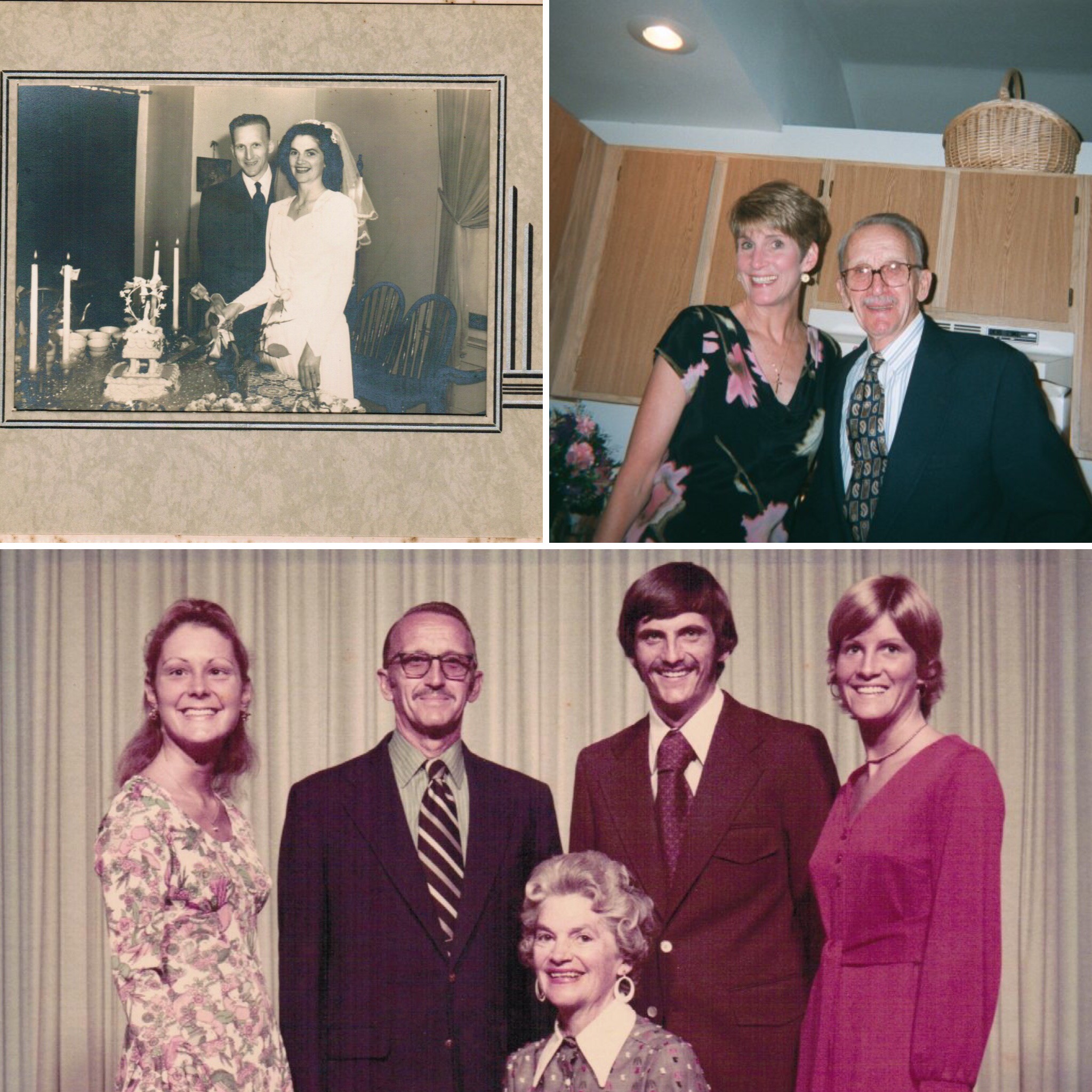
I will close this post by providing glimpses of my father to you over the years. I hope you enjoy this montage that includes, from top left: My mother and father’s wedding day, 1947; my wedding day 2000 (my favorite photo of my dad and I); and the Desonier family circa 1971.
To celebrate my own book’s July 20th release, a book that’s about Alzheimer’s disease and other dementia, I am tooting the horn of other authors who have done the same, a few of whom I know personally.
There’s a high degree of sadness surrounding this list because almost without fail, those authors who have written memoirs, story collections, fiction, and non-fiction books have done so because of their own personal Alzheimer’s journey.
Ann Hedreen,Her Beautiful Brain – A Memoir. Ann lives in Seattle, Washington, and has provided valuable support to me through my own publication journey. To quote Amazon.com:
Her Beautiful Brain is Ann Hedreen’s story of what it was like to become a mom just as her beautiful, brainy mother began to lose her mind to an unforgiving disease.
I can not imagine the struggle Ann endured while being a new mother whose time and energy was already spread so thin when life happened to her and her household, in a manner hardly believable to so many of us.
Collin Tong, Seattle journalist, Into the Storm – Journeys with Alzheimer’s, a compilation of true stories that starts with the very personal story of Collin’s caregiving journey with his wife, Linda. Collin’s support of my project, telling me not to give up when so many agents and publishers wouldn’t give me the time of day, inspired me to keep on keepin’ on. His story collection is amazing. Again, quoting Amazon:
In his compelling new anthology, Into the Storm: Journeys with Alzheimer’s, twenty-three writers, journalists, educators, health practitioners, social workers, clergy and other family caregivers from across the United States share their intimate stories of caring for loved ones with Alzheimer’s disease and dementia.
Each of the twenty-three stories are gems that you do not want to miss. I know you will be as impressed as I was by each and every one of them.
The next entry contains numerous authors and their books, found in one central location: AlzAuthors. The purpose for their site states:
We are AlzAuthors. In some way, each of us who have come together on this site have been affected by Alzheimer’s Disease/dementia. We share our experiences to bring knowledge, comfort, and understanding to others on this journey.
Click on this link to the AlzAuthors Bookstore to discover a wealth of informational and engaging books that will meet the needs of those who are caring for parents or grandparents, spouses or partners, those living with Alzheimer’s and dementia, fiction books, books for children and teens, and those offerings that provide helpful information for one and all.
3rd Act Magazine, not a book, but a publication addressing the third act of one’s life, usually heavy on those of us who are Baby Boomers. This publication has so much to offer its readers. I, for one, am pleased that the subtitle of their magazine reads, Aging with Confidence. You got that right! You’re not done with us yet; we have so much to offer the world that is spread out before us.
And yes, all of the above-mentioned projects prove that a lifetime of experience – the good and the not so terribly good – equates to having something to say, and not being afraid to say it. Which brings me to my part in that effort:
Requiem for the status quo is currently available at just about any bookstore you can walk into or find online. If a particular store doesn’t currently stock my novel, simply request that they order one for you and you should be able to get your hands on it in short order. You can order Requiem at Barnes & Nobleand Amazon. Be sure to shop around for the best price, you won’t be sorry you did. And for those of you with eReaders, the eBook will be available at most online book retailers on, or about, July 27th. Additionally, would you like your local library to carry my novel? Simply ask them; quite often they are quite willing to accommodate individual requests.
Requiem for the status quo is dedicated to my father, Don Patrick Desonier, who wore his disease with the dignity it did not deserve.
February 10, 2000, four years before diagnosisWriting a novel just for the hell of it isn’t what I did when, on December 29, 2012, I started to write REQUIEM FOR THE STATUS QUO.
First and foremost, I sat down at my computer because I had something to say about how Alzheimer’s disease affected my father. Additionally, having graduated from the unofficial school of family caregiving, I figured someone just might benefit from the good – and the not-so-good – ways in which I managed my father’s illness.
Now thirteen years after my father’s initial Alzheimer’s diagnosis, my novel will hit the virtual and brick & mortar shelves of bookstores. It will also make its way in person to a number of senior centers and senior living communities in my area. As an event on their activity calendars, I will read passages from my novel that might just ring a bell in the minds and hearts of those gathered to listen to what this Baby Boomer has to say. Maybe what I share will inspire them to purchase REQUIEM which I will gladly sell to them at a highly-discounted price. And once they’ve read my novel, perhaps they will share it with someone else, and so on down the line.
I had the privilege of being my father’s caregiver during his multi-year struggle with Alzheimer’s disease that ended with his death in 2007. Five years after his death, I started writing my debut novel, Requiem for the status quo, to be released by an independent publisher, Black Rose Writing, on July 20th. And now five years since I started my novel, Requiem will be available to everyone in less than 30 days. My debut novel was inspired by my father’s and my caregiving journey and is dedicated to the man whose later years was robbed by a disease that is always fatal. The book’s dedication reads: Dedicated to my father, Don Patrick Desonier, who wore his disease with the dignity it did not deserve.
I am in the very distinct and healthy position of understanding that realistically, as a debut author I cannot hope to be an instant and resounding financial success. But that’s okay, because for me it has never been about the money, but very much about helping those who are experiencing or have experienced an Alzheimer’s caregiving journey similar to mine. For that reason, most of my “book tour” will encompass senior centers in the region, as well as senior living residential communities where I hope to hold readings and sell my novel to seniors at a highly-discounted price. I know it is said that when trying to fill an auditorium, it’s all about getting butts in seats, but for me, it’s about getting books into laps.
And that’s what I’m going to do.
Requiem for the status quo is currently available for preorder at Black Rose Writing, enter discount code PREORDER2017 before July 20th for a 10% discount. You can also preorder Requiem at Barnes & Nobleright now, and Amazonwill be providing preorder opportunities in the days ahead. And for those of you with eReaders, the eBook will be available at most online book retailers on, or about, July 27th.
I’ve written several articles over the years about the importance of assembling a caregiving team when caring for a loved one – a team that doesn’t necessarily rely on family because not everyone has a participatory family when it comes to these matters. That was certainly the case for REQUIEM FOR THE STATUS QUO‘s Colleen Strand while taking care of her father, Patrick Quinn. She sought help from her brother but that was not something with which he chose to be involved.
REQUIEM, my debut novel, is now available for pre-order from my publisher, Black Rose Writing. You will receive a 10% discount with code PREORDER2017 if purchased before its release date of July 20th. Additionally, in the days ahead, both Amazon and Barnes & Noble will be offering a pre-order option leading up to the novel’s release. Ebook options will be available at most online book retailers as of July 27th.
Of all the life-changes we encounter during our journey, caregiving is one of – if not the most – difficult speed bumps to get over.
Caregiving: the ultimate team sport suggests how one might use the strengths of each team/family member to handle the varied needs during the caregiving journey.
Family dynamics that hamper caregiving success exposes the need to let go of stereotypes or childhood roles that don’t serve siblings well as adults. If ever there was a time to work together for the greater good, taking care of a family member with dementia or other terminal illness ranks right up there at the top.
Solo caregiving addresses the needs of the person who appears to be strapped with fulfilling all the roles needed for a successful caregiving venture. The solo caregiver need not settle into those roles, however. The help of other, well-meaning individuals, can lessen that daunting task. Certainly, much relies on the neighbor, coworker, even casual acquaintance, but said entities are a resource from which much assistance can be found.
Here are several more articles for the caregivers out there – and those acquainted with a caregiver – to provide some wisdom and encouragement through the tough times:
REASON ONE: You don’t have to know someone with Alzheimer’s disease to benefit from this novel. Let’s face it, when you pick up a novel wherein cancer, murder, courtroom drama, homelessness, financial devastation, or horror are part of the storyline, you don’t put down the book because none of those issues have personally affected you. I mean, when was the last time you picked up a Steven King novel and said, “Man, this is totally irrelevant to me, I’ve never been terrorized by a car named Christine, nor have I ever attended a prom where a girl named Carrie exercised her supernatural powers to ruin the evening for most everyone in attendance.” And even though no one – as of yet – has ever lived Under the Dome, you would still be glued to the pages of that novel (not so much the TV version) to discern how it would all turn out.
When you pick up a novel, you find yourself getting involved with the characters. While you’re wondering how the book may end, you read on to find out what’s going to happen next. Or maybe your eyes are opened about matters for which you previously knew very little and then you can’t wait to see where the storyline leads you. REQUIEM FOR THE STATUS QUO satisfies all of those curiosities.
REASON TWO: You do know someone with Alzheimer’s or other dementia – whether tangentially or intimately. You might be hesitant to read yet another technical treatise or article about the devastating effects of the condition, but you still want to learn more while being entertained at the same time. Did I say a novel about Alzheimer’s can be entertaining? Yes, and I’ll tell you why. The definition of entertainment isn’t just giggles and laughs – as Steven King’s novels clearly demonstrate. According to Merriam Webster, entertainment is also something diverting or engaging. Without a doubt readers will be engaged in the story of the Quinn family from page one when the patriarch of the family, Patrick, finds himself in a very inconvenient situation while stranded on an extraordinarily busy freeway in Seattle, Washington. And you will cheer for Patrick’s daughter, Colleen, as she struggles to redefine normalcy while craving even one minute of status quo. And believe or not, you will find humor in some of the least desirable circumstances faced by a variety of characters who are members of “Club Alzheimer’s.”
REASON THREE: You read Still Alice, by Lisa Genova – maybe you even saw the movie – and you became very sympathetic to those who have faced, are facing, and will face the ravages that Alzheimer’s disease has on families such as yours and mine. And if you were fortunate, you also read the memoir, Her Beautiful Brain, Ann Hedreen’s account of the challenges she faced raising a young family and caring for a mother who was “lost in the wilderness of an unpredictable and harrowing illness.” There is much to be gained by reading various genres on the subject, and quite frankly, not enough is being published in the fiction and memoir genres.
As of this writing, there are more than 5 million people in the United States with Alzheimer’s or other dementia, and worldwide, more than 44 million suffer with the disease. Alzheimer’s disease is not going away. The more awareness and compassion we possess, the more capable we will be of helping ourselves, and others, through this protracted disease journey.
MARK YOUR CALENDARS …
REQUIEM FOR THE STATUS QUO a Black Rose Writing release, will be available July 20th, 2017.
REQUIEM FOR THE STATUS QUO, to be released July 2017, contains fictional characters right out of yours and my reality. If your life hasn’t been impacted by caregiving for a loved one with Alzheimer’s or other dementia, you are at least tangentially connected to someone who has been.
A parent’s senior moments transform into hair-raising episodes of wandering and getting lost at all hours of the day and night during varied seasonal temperatures that may very well threaten their lives.
The husband who was Mr. Fixit for all home repairs, big and small, no longer knows how to use a screwdriver, and becomes combative when challenged.
A sister’s successful writing career is derailed when she can no longer write coherently or understand the written word.
The middle-aged next door neighbor pounds on your front door demanding entry to his home and threatens to call the authorities if you don’t immediately vacate the premises.
Variations of these scenarios abound, and within those story-like confines exist the caregivers who have been thrust into a role for which they were not prepared, derailing their status quo – their normalcy – beyond recognition. These same caregivers had very full lives before their days became what has become the caregiver’s 36-Hour Day. Any down time they enjoyed prior to stepping into their ill-fitting caregiver shoes has been filled with doctors’ appointments, loved one-sitting, and putting out fires. Carefully crafted family and retirement plans are no longer feasible because life as the caregiver once knew it no longer exists.
REQUIEM will give readers an intimate look at a caregiver’s day-to-day reality while also endeavoring to provide hope for what lies ahead. To be sure, there are no happy endings, but promises of resolution and lightness spring forth in the least likely of places and during some of the most awkward of times. Whether you are a caregiver, a former caregiver, or know someone who is, REQUIEM FOR THE STATUS QUO will become a most cherished and often-read bookshelf addition.
No one wants to be a member of a club characterized by a disease that robs a person of their cognitive function and is always fatal. Unfortunately, as of this writing, 5 million Americans (many more million in other countries) are living with Alzheimer’s disease or other dementias. Here are a few more facts extracted from the most current Facts and Figures document published by the Alzheimer’s Association:
In 2016, 15 million Americans provided unpaid care for people with Alzheimer’s or other dementias;
That equates to 18.2 billion hours of care valued at $230 billion;
1 in 3 adults dies with Alzheimer’s or other dementia;
It kills more than breast cancer and prostate cancer combined;
Since the year 2000, deaths from heart disease have decreased by 14% while deaths from Alzheimer’s disease have increased by 89%;
Every 66 seconds, a person develops the disease.
My novel, REQUIEM FOR THE STATUS QUO, (Black Rose Writing publication, July 2017) spotlights one family’s experience in particular – the Quinn family – while also visiting other households affected by Alzheimer’s or other dementias.
Eddie and Katherine, a couple in their 40s. Katherine has a combination Alzheimer’s/Lewy Body dementia, a type of dementia that causes somewhat violent behavior and speech;
Frank and his son, Sean, the latter of whom suffers from a traumatic brain injury (TBI) incurred while on deployment in Afghanistan;
Victoria and George, a couple in their 80s, trying to crawl through the maze of George’s Alzheimer’s disease;
Rose and Sophia, sisters in their 50s, struggling with the effects of Sophia’s vascular dementia;
Donna and Kelly, partners in their 60s, experiencing the devastating effects of Kelly’s Parkinson’s disease and the dementia associated with her disease.
These are characters like you and I. They were living their lives the best they knew how, being good people and doing good for others, yet Alzheimer’s still managed to grab them by the throat and refused to let go.
The storyline is a difficult one but the way in which I have portrayed all of these precious people will touch your heart, and at times, your funny bone. No, there’s nothing humorous about the disease, but people will be people, and when they’re confronted with the impossible, they can find – or create – a bright side onto which they can find redemption and community.
I look forward to introducing you to my characters. Just a few more months before they’ll become a part of your life.
My sister and I as teenagers, and the rest of the familyMy novel, REQUIEM FOR THE STATUS QUO, contains a scene where Patrick Quinn – many years before his Alzheimer’s diagnosis – wakes up his high school aged daughters on April 1st and announces that local public high school students have the day off to honor April Fools’ Day. His daughters attend a parochial school – church based – and when they hear of said day off, they become incensed.
The girls get out of bed – anger seething below the surface of their drowsy bedheads – cross their arms, and they yell, “That’s not fair!”
Patrick agrees, April Fools’ Day is no reason to have a day off from school . . . then he claps his hands together, and barely stifling a laugh, he says, “Gotcha!”
That exact scene happened to my sister and I – thus the reason why I had to include it in my novel. My father had the keenest sense of humor – a funny bone that stayed with him even while the plaques and tangles in his brain leeched the very life out of him. As a family, we were very fortunate that his humor survived until the very end. That is not always the case, as readers will discover when they meet the other characters in my novel whose disease journey is far from cool, calm, and collected.
REQUIEM FOR THE STATUS QUO, release date: July 20 2017.
I’ll let you collect yourself, calm down, and come down to earth before I go any further with my announcement …
Okay, that’s enough time. REQUIEM FOR THE STATUS QUO is slated to most likely be published by the end of 2017, thanks to Black Rose Writing. I submitted my novel to them in October 2016, and received an e-mail on Tuesday, February 14th, stating that they feel strongly that my project will make a successful addition to their publishing house. The owner of the company further stated, “I am excited about adding an author with such high potential to the Black Rose Writing family.” I have been in contract talks with the independent publishing house the past several days, and I confidently signed with them this afternoon.
I suggest you go to their website to sign up for their newsletter to get free e-books, deals, and exclusive content. The opportunity to do so can be found at the bottom of their Home page.
REQUIEM FOR THE STATUS QUO is my first novel, inspired by the five years I spent as my father’s caregiver. Of my two completed novels, and one work-in-progress, this is the manuscript in which I have been most invested. I mean for gawd’s sake, REQUIEM is why I started on this anxiety-ridden writing journey back in December 2012.
All you writers out there know of which I speak when I say the road to publication is a pothole-filled one with Dangerous Curves, U-Turns, and Dead Ends that terminate many a writer’s quest to see their book in print.
I am pleased with all of my novels but late 2016 I recommitted myself – and redirected my energies – to getting REQUIEM published. I believe in the story and absolutely feel many current caregivers, and future caregivers, will discover themselves on the pages of the novel and realize their struggles are the struggles of many. They are not alone. Consequently they will find reason to hope, and even to laugh, when they read about Seattle, Washington’s fictional Patrick Quinn family.
So Don Patrick Desonier, this celebration centers around you, the father for whom I would embark on a caregiving journey all over again, just to have more time with you.
Now, if you’ll excuse me, there’s a bottle of tequila that’s waiting to be opened and enjoyed … it’s not gonna do it all by itself, ya’ know. I may not be available for awhile.
First of all, take a deep breath and shed the mantle of guilt you’re wearing. Now let’s address your dilemma.
When your father was on his deathbed you made a promise to take care of your mother in her old age. Now she is at the point of not being able to care for herself and you realize that you’re absolutely not cut out for – nor are you capable of – taking her under your roof to provide the care that she needs. What’s a dutiful son or daughter to do?
I’m not advocating that you break your promise to your father but I am suggesting that you consider redefining what that promise looks like. You promised your father that you would take care of your mother and that’s exactly what you’re going to do. Taking care of your mother is not solely defined as moving her into your home and taking care of all her basic needs until she dies. Very few people have the ability or the means to provide 24-hour care in their home. You made that promise with the best intentions and you can still honor your promise without dishonoring your father. Keep in mind that loving your mother doesn’t guarantee your success as her caregiver. Even adult children with a fabulous relationship with their parent struggle greatly in their efforts. And if your relationship with your mother is tenuous at best, try picturing the scenario of you as caregiver and her as recipient of that care. What effect will that have on her, you, and the remainder of your household?
Let’s clarify how best to care for your mother.
Why can’t caring for your mother mean that you’re honest enough to admit that you’re not the best caregiving option? Do your best to find the care alternative that will provide her an optimal quality of life, e.g. adult daycare, errand and housekeeping services, assisted living. Do the research and consult the experts to confidently fulfill your promise to your father by securing the best care solution for your mother. If that solution involves selecting an assisted living facility, there are many resources available to you that can make this move a successful one for everyone involved. As her son or daughter you will be able to lovingly help her transition into a residential location with like-minded older adults where she can receive the care that will fulfill the promise you made to your father.
Now imagine the NEW normal that your mother and your family can experience.
Your mother lives nearby in an assisted living residence. She has companions with whom she enjoys spending time. She receives three wholesome meals a day and when she, or you, feel like seeing each other, you’re just a short drive away! The time she spends at your house will be as a pampered visitor – not an inpatient (or impatient) relative. It’s probably difficult right now for you to see this as a viable option, but I think in time, you’ll find that everyone, including your father, will be pleased with the outcome.
I’m reblogging this article I wrote in April of 2013 because it comes up in my blog stats as being extremely popular to many of you out there. I can only conclude that it’s popularity remains high because there are so many caregivers in the world who are tangled up in a daily life that centers around those with Alzheimer’s disease or other dementia. I hope many more will be encouraged – and pleasingly challenged – by what I have to say in this post.
Walk in Their Shoes… Just for a Minute. The attached article contains encouraging advice that caregivers worldwide need to read, and re-read, from time to time.
Those of us who have been caregivers to loved ones with Alzheimer’s or other dementia know very well the frustrations felt when we come to the realization that we’re not sufficiently equipped to handle that which this disease presents us. We’re walking in caregiver shoes, fully incapable of walking in those of the person with dementia. If we could, we would shriek at what we see and experience.
So we get frustrated – understandably so. We raise our voices in anger – and feel guilty immediately thereafter. We complain to others about the one we’re taking care of – because we crave to be heard and understood by someone!
PET scan of a human brain with Alzheimer’s disease (Photo credit: Wikipedia)
Do not ask me to remember is a loaded statement and one which should give us pause. We know the person with dementia is not able to remember the previous five seconds, so why do we ask them to remember where and when they were born? Why do we think that repeating an answer LOUDLY AND WITH EMPHASIS will help the loved one remember this tenth time you’ve answered their same question? Why do we think they will understand our logical explanations about circumstances when their ability to understand anything requiring organization of thought is a function forsaken long ago by the brain that they’ve been stuck with?
Because we’re human – and we want order out of chaos, and we want the one for whom we are providing care to finally “get it.” And we want them to understand that this ain’t no cake walk for me so why aren’t you appreciating all that I do for you?
I’ve been authoring this blog, Baby Boomers and More, for five and a half years. Perhaps that’s a record for blog ownership, I’m not sure, but what I do know is that I thoroughly enjoy writing about matters of significance. I guess that’s why my blog has survived as long as it has: there are a heck of a lot of things going on in the world that fall into that category.
My website address remains the same: http://www.babyboomersandmore.com, but with a broader emphasis on life as it unfolds for all of us born within a certain year bracket:
iGen (after 2000)
Millennials (1980-2000)
Gen X (1965-1979)
Baby Boomers (1946-1964) and
The Greatest Generation (before the end of WWII).
Yes, there are many differences between the generations but we have one major characteristic in common: although as individuals we are strong in many ways, we still need each other to get to the finish line.
With that change in overall focus comes a new, primary blog identification:
Living: the ultimate team sport
If we consider all the people with whom we come in contact as being members of the same team, we will do all we can to support them. We’ll bolster rather than compete; we’ll pick them up rather than step over them as a means to an end; we’ll exhibit respect for each other’s talents while nurturing our own; we’ll not take advantage of weaknesses in order to falsely boost our own strengths. In short, we’ll stand by our teammates and want only the very best for them.
Another goal of mine: write more succinctly, at least after this particular post. 🙂 I know you’re all busy and have better things to do than read my oftentimes lengthy magnum opuses. I’m newly committed to being as succinct as possible, somewhere along the lines of an article I wrote on December 27, 2016: Don’t go there. Let’s face it, as a writer, I should be able to use an economy of words to get my point across to those who’ve chosen to follow me.
And one last thing: the header images you’ll see at the top of my blog (which will cycle through randomly) are from photos I took during a few of my hikes around the Pacific Northwest. Hiking is my passion, so I’m pleased to provide snapshots of views I have been privileged to see.
With that, I’ll sign off for now, so very glad to be a member of your team.
The longer our lifespan, the more likely each of us will need to be cared for. But one need not be elderly to require such care. Many illnesses strike without thought for a person’s stage in life.
Actor/comedian, Seth Rogen’s mother-in-law was diagnosed with Alzheimer’s in her 50s, an age that many consider to be the prime of life. The successful actor’s finances, plus those of several other family members, supported the care of which his wife’s mother was in need. In time, he, his wife, Lauren, and many others established Hilarity for Charity:
In 2012, Seth and Lauren (along with some amazing friends), created Hilarity for Charity. They later established the Hilarity for Charity Fund as part of the Alzheimer’s Association, through which monies raised are directed to help families struggling with Alzheimer’s care, increase support groups nationwide, and fund cutting edge research. Since its inception, Hilarity for Charity has raised more than $5 million to support these efforts.
One of the ways in which they provide this support is through caregiving grants that provide hours of home care for those struggling to survive the demands of a disease that is always fatal. Could you, or someone you know, benefit from such grants? Please avail yourself of the information provided on the Hilarity for Charity website.
When us kids would say something cruel about someone, my dad would offer the following: “It’s too bad everyone isn’t as perfect as us.”
Dad knew how to get through our childhood – and childish – brains, and in our later years, he continued to impact my life and that of my brother Don, and my sister, Mary.
Without a doubt, the combination of mom’s and dad’s parenting styles really and truly prepared us for adulthood and made us the well-rounded, caring, accepting adults I believe we’ve grown up to be. When Dad died from Alzheimer’s on October 13, 2007, a huge void was left in our lives.
My brother, the father:
My wonderful brother Don, and our dad in June 2005, a year after dad’s Alzheimer’s diagnosis.
Some would say that at 39 years of age, my brother got married later than most. What can I say? He found the love of his life, Nancy Satterberg, in 1987. I’m pretty sure up to that point, no one else qualified for the love Don had for his wife. My brother was, and is, an involved and loving part of his three stepchildren’s lives. Just the other day, his youngest son, who is preparing for his upcoming wedding, told Don that he always considered him as his second dad; not a stepdad, not a replacement for his biological father, rather, a second dad. Per and his siblings, Sten and Kirsten, were fortunate in that way. Don was also a caregiver for his wife who died from Alzheimer’s on July 4, 2012. He was the epitome of an involved, loving, attentive provider of care for the wife with whom he would have celebrated his 25th wedding anniversary in September of 2012.
My husband, the father:
Celebrating the evening he retired: April 28, 2016
Jerry has two daughters, Lainey and Kirstin, and lest you think he ever hoped and wished for a son rather than those two, you would be sorely mistaken. There were no gender limits when it came to actively participating in his daughters’ lives. Hell no! There were hikes, softball games, soccer matches, woodworking training…you name it, he shared his knowledge and interests with them and they benefitted greatly as a result. My husband’s reserved and unassuming manner camouflages the extraordinary love he has for Lainey and Kirstin. His care about their well-being, happiness, and health is evident in all that he does for them, and in the ways he thinks about them and talks to them. Unlike myself, who tends to be a bit overbearing and sometimes far too transparent, my husband exhibits strength and concern by the way he demonstrates his commitment and dedication to his daughters, to me, and to all those whom he considers dear to him. Jerry is a man of few words but when he speaks, every spoken word is worthy of your undivided attention. I’m the luckiest woman alive to have him as my husband.
Happy Father’s Day in absentia, Dad.
Happy Father’s Day fabulous brother of mine.
Happy Father’s Day Jerry – the man with whom I chose to spend my life on February 10th, 2000.
Older people are no different from any of us. People with dementia are no different from us. They all, we all, have the same feelings and needs.
They want to laugh and be silly, they want to be listened to and be taken seriously, they want to be reassured and loved, they want to love and be helpful, make a contribution, just like everyone else.
I learned that here.
It is my hope that all of us learn that same lesson so that whomever is in our lives, so that all those with whom we come in contact, we’ll be able to recognize ourselves in them and perhaps treat them with the respect for which all of us yearn.
Dedicated to unappreciated care partners worldwide. Thank you for all you do. Dear random person who sees my care partner from time to time and feels the need to point out s/he has bruises all over her/his body that look frightening and s/he has really declined a lot since the last time you saw her/him and…
Source: ON LABELS, ROLES AND MARRIAGE WITH ALZHEIMER’S This linked article does a fabulous job of putting a spotlight on the roles we take on when we become caregivers. Does our original role as: wife, husband, son, daughter, brother, sister, disappear when that role-shift takes place?
I’ve known numerous caregivers in my life. I was one.
A younger me with my dapper dad
Before I became a caregiver, I was a daughter. Was I still a daughter once my role as a caregiver became a 24/7 occupation?
It didn’t feel like it when:
I had to cut up my father’s food for him
I had to pack adult protective underwear when I took him on a walk in the park … just in case
I had to correct him for behavior unbecoming of an adult
I took him to a doctor appointment and spoke to the doctor on my father’s behalf
I tucked him in for a nap so I could get things accomplished without him being tethered to me wherever I went …
Was I his parent? Was I his caregiver?
No. I was his daughter. I took on a variety of roles during the years of my father’s decline with Alzheimer’s, but I was always his daughter. As a matter of fact, never had I felt more like a daughter than during the five years of his illness.
During one of my walks in the park with dad, on his last Father’s Day as it turned out to be, two young men rode their bikes toward us and as they got right up to us, one of the men said, “Happy Father’s Day, Sir.”
That young man saw a daughter and a father, not a caregiver and an old man.
Dad took his parenting role very seriously. By the time I was on my own, he had been actively mentoring and caring for me for twenty-one years.
Norcalmom writes a blog that tells it like it is when operating as the primary caregiver for a loved one. She has a full household, with children of varying ages, a mother-in-law with Alzheimer’s, a husband whose work schedule pulls him out of the home during many of the caregiving opportunities, and yet this daughter-in-law manages her household in ingenious ways.
Whether it’s purchasing and installing locks so her MIL doesn’t escape from the house at inopportune times (which, frankly, means any attempted escape from the house) or finding activities to occupy her MIL so Norcalmom can get things done, e.g., making dinner for the family, she puts on her thinking cap, listens – truly listens – to what may interest the oldest member of her household, and does what is needed to get the job done.
Her MIL is very much intrigued with sparkly things, specifically, glitter. In her eyes, if she spots specks of gold-colored glitter, it is not glitter she is feasting her eyes on it is the real deal: GOLD!
Please, click on the link provided at the beginning of this mini-post of mine, and feast your eyes on the treasure within.
Having completed my second novel, currently titled BRIDGED BY BETRAYAL, I packed up all the research I used for my first novel, REQUIEM FOR THE STATUS QUO.
An early version of my 1st novel circa 2014
REQUIEMspotlights a family that struggles with the tangible and emotional elements inherent when battling a disease that is always fatal; a disease that gives you daily – if not hourly – reminders of its devastating effects.
I could not write about the fictional family’s journey without incorporating some of my own stories from my years as Dad’s caregiver. I also included other people’s stories as told to me through my work as an Alzheimer’s caregiver support group facilitator, and as a Washington State certified Long-Term Care Ombudsman. (Names and facts altered to protect those directly involved.)
My Dad and I on a picnic, Spring 2005.
The research materials I packed away this past weekend consisted primarily of the caregiving journals I kept while being my father’s primary long-distance caregiver while he endured Alzheimer’s disease.
That research also included reams of paper I organized into multi-tabbed folders containing the various doctor’s reports and findings from the seven years of dad’s disease journey.
I was not prepared for the emotion with which I was blanketed when I pulled out the large waterproof chest that had resided in my writing space the past three years. Placing my research in the chest, shutting it, and returning it to its original under-the-stairs location was extremely difficult for me.
In a certain sense, I felt I had betrayed Dad because I wasn’t just packing up some paper, I was putting away the physical evidence of his seven year battle of brain function loss. Read the rest of this entry »
The latest AARP Magazine had a fabulous article providing helpful ways in which to make a caregiver’s life just a wee bit – or quite a bit – better. Here are a few tips for you to adopt in your life.
Bring her a low-maintenance houseplant
Take in his mail
Do yard upkeep, whether raking leaves, mowing the lawn, shoveling snow
When you’re heading out to buy groceries, ask him if you can pick some things up for him
Take her kids or grandkids to the park or to a movie
Stop by with a board game or a movie to watch – a perfect way to get his mind off things
Visit her with a pet that has a sweet disposition
Take his dog on a walk – maybe on a daily or weekly basis
Do some light housework or repairs: dishes, vacuuming, dusting, ironing, smoke alarm battery and light bulb changing, fixing a leaky faucet
Return her library books
Volunteer to stay at home to wait for the cable technician, repairman, etc. while he attends to other more pressing needs
Bring him a week’s worth of meals in freezable containers
Send her a greeting card on an ongoing basis. Who doesn’t love to receive real postal mail?
When visiting, let the person vent, without passing verbal judgment on what they may say
Do an item or two on her To-Do list – I promise you, her list is extraordinarily long
Offer to make a photo album with him, using photos that mean a lot to him and the rest of the family
Give him a gift card to a restaurant he may enjoy, or better yet, take him out to dinner
Help him decorate for the holidays
Drop off or pick up a prescription
Keep in touch with her, even after her loved one passes. Too often, the grieving one has more attention than she can handle immediately after someone dies, then when she could really use some TLC, no one can be found.
I’ve written several articles over the years about the importance of assembling a caregiving team when caring for a loved one – a team that doesn’t necessarily rely on family because not everyone has a participatory family when it comes to these matters. Of all the life-changes we encounter during our journey, caregiving is one of – if not the most difficult – speed bump to get over.
Caregiving: the ultimate team sport suggests how one might use the strengths of each team/family member to handle the varied needs during the caregiving journey.
Family dynamics that hamper caregiving success exposes the need to let go of stereotypes or childhood roles that don’t serve siblings well as adults. If ever there was a time to work together for the greater good – taking care of a family member with dementia or other terminal illness – this ranks right up there at the top.
Solo caregiving addresses the needs of the person who appears to be strapped with fulfilling all the roles needed for a successful caregiving venture. As the sole caregiver, you need not settle into those roles, not without the help of other, well-meaning individuals. Certainly, much relies on the neighbor, coworker, even casual acquaintance, but said entities are a resource from which much assistance can be found.
And here are several more articles for the caregivers out there – and those acquainted with a caregiver – to provide some wisdom and encouragement through the tough times: Read the rest of this entry »
 November is National Caregiver Appreciation Month, a time to recognize the long hours, sacrifice, and love all caregivers bring to the task of caring for a loved one with dementia or any long-term illness. In honor of their efforts, AlzAuthors is hosting an eBook sale and giveaway! This is a terrific way for caregivers who are looking for knowledge, guidance, and support to find carefully vetted books to help guide and inspire them every day.care
 According to the 2017 Alzheimer’s Association Facts and Figures research, there are more than 15 million Americans providing unpaid care for people with Alzheimer’s or other dementias. Some have assembled a team of family and friends so the responsibilities are evenly spread out, but that is not always the case. The solo caregiver manages—or tries to manage—everything on his own.
 My father was the inspiration for my novel Requiem for the status quo.
 I know; we’ve all certainly read about it, especially when a celebrity is diagnosed with the disease. Every once and awhile there might be an Alzheimer’s Association commercial on television…that is assuming we don’t fast forward through it or walk out of the room. Another reason we’re familiar with the disease is that it is happening to so many people with whom we are acquainted – whether intimately or tangentially.
 Craig Boyack, author and author supporter – yes, author supporter – conducted a radio interview of two of the characters from my debut novel, Requiem for the status quo.

 To celebrate my own book’s July 20th release, a book that’s about Alzheimer’s disease and other dementia, I am tooting the horn of other authors who have done the same, a few of whom I know personally.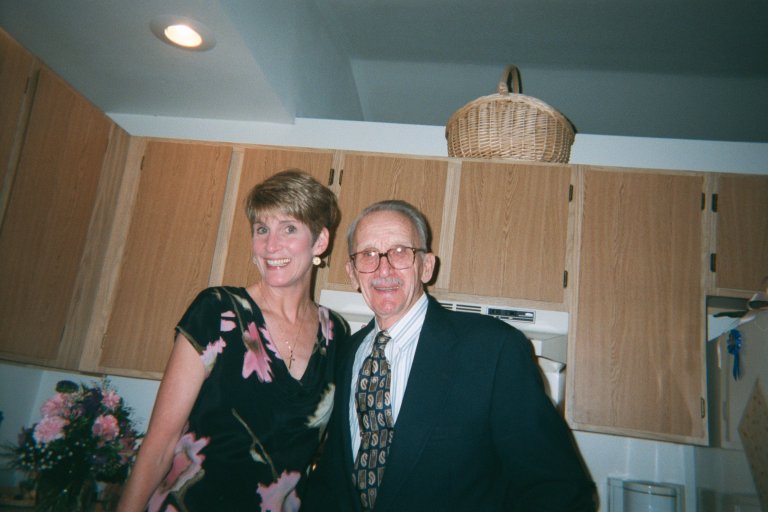

 I’ve written several articles over the years about the importance of assembling a caregiving team when caring for a loved one – a team that doesn’t necessarily rely on family because not everyone has a participatory family when it comes to these matters. That was certainly the case for REQUIEM FOR THE STATUS QUO‘s Colleen Strand while taking care of her father, Patrick Quinn. She sought help from her brother but that was not something with which he chose to be involved.
 REASON ONE: You don’t have to know someone with Alzheimer’s disease to benefit from this novel. Let’s face it, when you pick up a novel wherein cancer, murder, courtroom drama, homelessness, financial devastation, or horror are part of the storyline, you don’t put down the book because none of those issues have personally affected you. I mean, when was the last time you picked up a Steven King novel and said, “Man, this is totally irrelevant to me, I’ve never been terrorized by a car named Christine, nor have I ever attended a prom where a girl named Carrie exercised her supernatural powers to ruin the evening for most everyone in attendance.” And even though no one – as of yet – has ever lived Under the Dome, you would still be glued to the pages of that novel (not so much the TV version) to discern how it would all turn out.
 REASON TWO: You do know someone with Alzheimer’s or other dementia – whether tangentially or intimately. You might be hesitant to read yet another technical treatise or article about the devastating effects of the condition, but you still want to learn more while being entertained at the same time. Did I say a novel about Alzheimer’s can be entertaining? Yes, and I’ll tell you why. The definition of entertainment isn’t just giggles and laughs – as Steven King’s novels clearly demonstrate. According to Merriam Webster, entertainment is also something diverting or engaging. Without a doubt readers will be engaged in the story of the Quinn family from page one when the patriarch of the family, Patrick, finds himself in a very inconvenient situation while stranded on an extraordinarily busy freeway in Seattle, Washington. And you will cheer for Patrick’s daughter, Colleen, as she struggles to redefine normalcy while craving even one minute of status quo. And believe or not, you will find humor in some of the least desirable circumstances faced by a variety of characters who are members of “Club Alzheimer’s.”
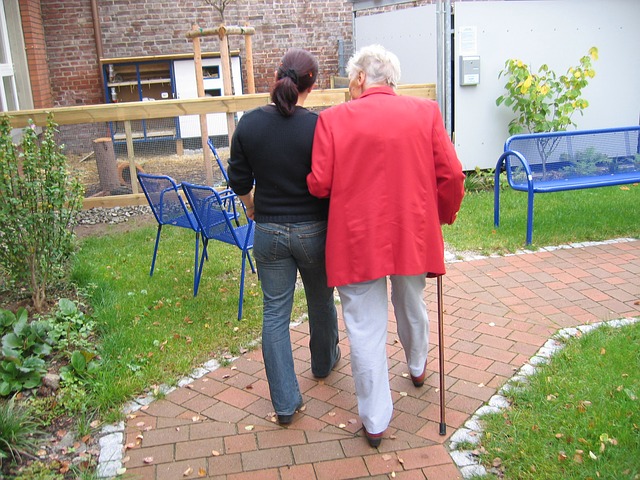 REQUIEM FOR THE STATUS QUO, to be released July 2017, contains fictional characters right out of yours and my reality. If your life hasn’t been impacted by caregiving for a loved one with Alzheimer’s or other dementia, you are at least tangentially connected to someone who has been.
 No one wants to be a member of a club characterized by a disease that robs a person of their cognitive function and is always fatal. Unfortunately, as of this writing, 5 million Americans (many more million in other countries) are living with Alzheimer’s disease or other dementias. Here are a few more facts extracted from the most current Facts and Figures document published by the Alzheimer’s Association:
 I’ll let you collect yourself, calm down, and come down to earth before I go any further with my announcement …
 I’m reblogging this article I wrote in April of 2013 because it comes up in my blog stats as being extremely popular to many of you out there. I can only conclude that it’s popularity remains high because there are so many caregivers in the world who are tangled up in a daily life that centers around those with Alzheimer’s disease or other dementia. I hope many more will be encouraged – and pleasingly challenged – by what I have to say in this post.
 I’ve been authoring this blog, Baby Boomers and More, for five and a half years. Perhaps that’s a record for blog ownership, I’m not sure, but what I do know is that I thoroughly enjoy writing about matters of significance. I guess that’s why my blog has survived as long as it has: there are a heck of a lot of things going on in the world that fall into that category.
 If we consider all the people with whom we come in contact as being members of the same team, we will do all we can to support them. We’ll bolster rather than compete; we’ll pick them up rather than step over them as a means to an end; we’ll exhibit respect for each other’s talents while nurturing our own; we’ll not take advantage of weaknesses in order to falsely boost our own strengths. In short, we’ll stand by our teammates and want only the very best for them.
 The longer our lifespan, the more likely each of us will need to be cared for. But one need not be elderly to require such care. Many illnesses strike without thought for a person’s stage in life.


Black, brown, or white.

 In the book A Different Perspective on Alzheimer’s and Other Dementias: Practical Tools with Spiritual Insights, author Megan Carnarius relayed a conversation she had with one of the employees she supervised in a long-term care facility who was moving out of state. Ms. Carnarius asked this young caregiver what she had learned from her job of four years. This is what she said,

 Norcalmom writes a blog that tells it like it is when operating as the primary caregiver for a loved one. She has a full household, with children of varying ages, a mother-in-law with Alzheimer’s, a husband whose work schedule pulls him out of the home during many of the caregiving opportunities, and yet this daughter-in-law manages her household in ingenious ways.
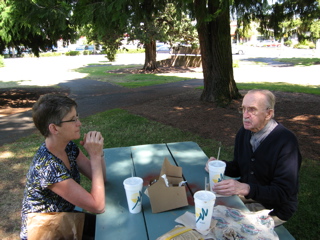
 The latest AARP Magazine had a fabulous article providing helpful ways in which to make a caregiver’s life just a wee bit – or quite a bit – better. Here are a few tips for you to adopt in your life.
 I’ve written several articles over the years about the importance of assembling a caregiving team when caring for a loved one – a team that doesn’t necessarily rely on family because not everyone has a participatory family when it comes to these matters. Of all the life-changes we encounter during our journey, caregiving is one of – if not the most difficult – speed bump to get over.
 And here are several more articles for the caregivers out there – and those acquainted with a caregiver – to provide some wisdom and encouragement through the tough times: Read the rest of this entry »
 Living: the ultimate team sport