Personal Struggles
Kindness Fridays
 My sister, Mary, is one of the kindest people I know. We are only eight months apart in age. You see, Mary was adopted by our parents after our mother suffered three miscarriages. Then, as oftentimes happens, once the adoption procedures commenced my mother got pregnant with me. Growing up, Mary and I always had each other as friends; we always had a playmate. People mistakenly thought we were twins; that’s how close we were, and still are.
So this wonderful, extraordinarily artistic sister of mine did something for me in response to my recent left eye cataract surgery. (See her website that spotlights some of her paintings.)
My siblings and I were raised as Roman Catholics. In our adulthood, we have followed different spiritual paths so that none of us follow the religion in which we were raised. With that said, however, Mary went to Mass the day after my eye surgery because she felt that our parents would also be there and would provide an added prayer boost to Mary’s intentions.
My sister feels very strongly about her connection with our long-deceased parents as prayer partners during Mass and has gone an additional time just this week with the intention that my left eye experiences 100% healing. She will also go next Wednesday so that my right cataract surgery that takes place the day before (April 17th) will be a complete success with no complications.
Mary has a very full and busy life with 5 children and 9 grandchildren. She volunteers every Tuesday morning to collect donated food from local grocery stores for her church’s lunch ministry. She is very attentive to her mother-in-law whose failing health requires a great deal of Mary’s and her husband’s time. She drives friends to doctor appointments, babysits her grandchildren…you get the idea. She’s busy, so adding yet another To Do to her growing list of responsibilities truly says a lot about her.
To be sure, we need more people like my sister who is the embodiment of kindness. Mary’s light shines in many places, near and far, a light that has landed on many over the years.
Kindness Fridays
This week’s kindness illustrates a lesson my maternal grandmother passed on to my mother, who then passed it on to me.
The best way to paint this picture is to assume you’re in the kitchen, you pull out a gallon of milk from the refrigerator, take it to the counter to pour yourself a glass of milk and the full glass of milk spills on the counter, over the edge of the counter, and onto the kitchen floor.
If another family member is in the near vicinity, that family member intervenes, tells the person who inadvertently spilled the milk to leave the kitchen, and the other family member cleans it up.
“But Mom, I spilled it, I should have to clean it up.”
“You didn’t do it on purpose, Irene. You already feel bad for spilling the milk, let me lessen your burden by cleaning it up for you.”
And that’s what happened throughout my childhood, and it’s what happens now in my adulthood. A little kindness goes a very long way…all the way from Grandma Conroy’s Edmonton, Alberta kitchen in the 1920s thru 1940s, all the way to mine in Redmond, Washington in the 21st-century.
Compare and Contrast: Good News vs Bad News
 Our extended family recently went through a very difficult time with one of our members diagnosed with a large brain tumor. That tumor was removed this past Monday, March 12th.
My husband and I had the privilege of keeping the spouse of this family member company at the hospital during the day’s nail-biting, angst-filled four-hour surgery. All of us, family and strangers with a loved one in surgery, were gathered in the same neurosurgery waiting room, a room where the surgeon meets up with families immediately after the surgery to deliver the exploratory news that summarizes the surgery and its outcome.
Approximately fifteen minutes prior to our surgeon’s meeting with us, another neurosurgeon met with a family fifteen feet away from us in the waiting area. Their news was not at all good. The only words I heard were, “I know you hoped this surgery would be the end of it but that is not the case I’m sorry to say.” The four daughters and husband immediately started sobbing. I felt I was an unwelcome observer because of the grief I witnessed.
Then my family member’s surgeon met with us and declared that he had removed all of the massive tumor from my sister-in-law’s brain and it was not cancerous. We were relieved and felt exhilarated but tamped down our excitement.
How can it be that in the course of a quarter hour’s worth of time, one family’s extreme happiness could co-exist with the other family’s extreme devastation?
I guess the answer is that life happens to all of us; sometimes it is good, and other times it is not. Very sobering, to be sure.
I am ecstatic that our news was good but very much aggrieved that the other family’s was not.
Kindness Fridays
 The other day, I discovered something about myself and about the way of kindness.
It’s really easy to be kind when life is going grand.
Clarification. The kindness gene resides within me, just as it does in you if you feed it and let it flourish. I feel absolutely honest saying that my pattern of thinking reflects the best of kindness one can imagine. At the very least, my intentions are pure.
With that said, however, when I’m feeling less than 100% – say, 25% – I have to work hard at not letting others be on the receiving end of that less than whole person that I’ve become. I’ve had a lousy night of sleep while also fighting seriously inflamed sinuses? Ugh, I must rein in my struggles and not take it out on the receptionist at the doctor’s office, or the supermarket employee. I sincerely don’t want to be responsible for ruining someone else’s perfect, gloriously, healthy, well-slept day. (Gawd, I’m envious of those who have been given the gift of sleep.)
All it takes is one look, one word – or the omission of a word – to spew miserableness onto someone else.
Kindness is a way of life for me but sometimes it threatens to take a break from the norm and that’s when it’s needed the most in the world. You see, I’m not the only person who has less than stellar days. I’d be self-centered to think I’m the only person the world takes a dump on now and again. Everyone in this world is vulnerable – everyone – and far too many are on the brink of giving up. We are all in this together, in good times and in bad.
I vow to not contribute to the latter.
Long-term care: squeaky wheels and raging forest fires
 Although now retired, over a twelve-year period I worked in long-term care (LTC) wearing three different hats:
- My first job in this industry was in the corporate office of a very fine assisted living and memory care company. In time, I decided to work in one of the company’s facilities so I could spend more time with the residents and families who chose our company for their LTC needs;
- When I left the company, I took several years off to care for my father who had Alzheimer’s disease. A few years after his death, I became a certified long-term care ombudsman for the State of Washington – an advocate for vulnerable adults living in LTC settings;
- Concurrent with my ombudsman work I became a trained Alzheimer’s Association caregiver support group facilitator, providing a listening ear to those on the caregiving path.
Given all that experience, I’ve seen and heard of many unfortunate and nasty occurrences where residents and patients were denied the basic rights each living person should expect to receive, especially those dependent on others for their well-being and quality of life.
I’m sorry to say that some nursing homes, assisted living/memory care communities, and adult group homes do not employ sufficient staffing to meet the needs of their residents. I can confidently say that the government agencies that oversee the LTC industry are also understaffed. When complaints are called in, those government employees have to apply grease to the squeakiest wheels and must turn their fire hoses on the most out of control fires in their case files.
That’s where you and I come in.
We must be the squeakiest darn wheels we can be so our complaint(s) are attended to.
We also need to be the hottest, most devastating fire imaginable so that our vulnerable loved one’s rights are respected.
 One grievous example. This is just one example of common issues that arise in LTC settings. The complaint process I mention later in this post provides a good starting point when issues arise.
Nursing home call lights are being ignored so that residents/patients are left to defecate and urinate in their adult sanitary garments on a routine basis. Not only is such an act demeaning to the poor soul with no option but to let go of his/her bodily wastes, but said wastes are sure to cause skin breakdown and a urinary tract infection that is not only extraordinarily painful but can also be life-threatening.
What does the family member/good friend do about this indignity? They need to complain vehemently to the administrator of said facility and when she/he does nothing or very little, family and friends contact the local area’s LTC ombudsman program. This website will direct you to ombudsman resources right where you live: National Long-Term Care Ombudsman Resource Center.
Your local ombudsman program will investigate, work with the facility’s staff, and if need be, get the full force of the law to come to the defense of those in need. State ombudsman programs are staffed by paid and volunteer employees, therefore their staffing levels are usually higher than many government agencies. These ombudsmen all receive the same extensive training required for such a vital role. Once you’ve reached a dead end at the facility, ombudsmen are your most active line of defense. They are passionate about what they do and they will ceaselessly advocate for you and your loved ones. Their proximity to appropriate resources and their intimate knowledge of residents’ rights laws makes them an approachable and viable alternative for the common man’s (yours and my) needs. Caveat: if you suspect criminal activities such as physical or sexual assault law enforcement needs to be immediately involved in the matter. Additionally, severe lack of care that endangers the lives and well-being of adults more likely than not will also require law enforcement involvement.
Adults in long-term care settings are a reflection of you and me. By that I mean they were once active and self-reliant adults, just like many of you reading this piece, but they now find themselves unable to fend for themselves and need you and me to step in for them. Imagine, if you will, being in their shoes, unable to speak up for yourself. If you or I ever find ourselves in a similarly vulnerable situation, wouldn’t you want an advocate to step in on your behalf?
Advocacy for vulnerable adults falls on all of our shoulders. You can make a difference in the life of your loved one. Won’t you please step up to become their most important advocate?
Kindness Fridays
2017 was a year of conflicting emotions for me. There were many good times. These two stood out: our grandson was born and my novel, Requiem for the status quo, was published. But there were also times I’d like to forget, and once my hip gets better after this past October’s bionic replacement, that will become one of the most forgettable events of the year.
Kindness, however, wins out and drowns out the not-so-pleasant occurrences that can cause stumbling blocks to our gentle psyche. So on this last Kindness Friday of 2017, I’m posting links to a few of my favorites in the hopes that while I’m encouraged by past Kindnesses, you can be as well.
June 30th, 2017: walk away from cruelty
April 14th, 2017: kindness trumps all
March 17th, 2017: courtesy on the road
March 10th, 2017: my husband’s perfect eyesight
January 6th, 2017: 1st Kindness Fridays – Mall kindness
Kindness Fridays
 Nicole Brodeur, a writer for the Seattle Times newspaper, posted this article about a Costco employee who always went above and beyond his normal duties to make the customers’ days better than when they arrived at the store.
Fifty-six-year-old Tom Goessman contracted polio as a child and got around in a wheelchair. While working at the Seattle Costco store, he used a standing wheelchair while validating each customer’s receipt before they left the store. But that’s not all he did. He would make a game of guessing the amount spent just by looking at the goods in a customer’s cart; more often than not, he was right on the money. He would also draw pictures on the customer’s receipt if that customer was accompanied by a child, something fun for the kids to look forward to.
But all of a sudden, Tom was no longer at Costco’s Seattle location; customers were more than a little concerned. The Seattle Times has a column titled, Asked and Answered which provides an opportunity for people to contact the newspaper with queries that are on their mind. Turns out, many Seattle Costco customers took advantage of that column to discern the whereabouts of their beloved Tom. The person who became the highlight of their Costco warehouse shopping trips was nowhere to be found.
After some research, the newspaper discovered he had moved to Glendale, Arizona after being invited to visit that state by one of Costco’s customers, a man whose son is also paralyzed and who thrives in the dry, Arizona weather. You see, Tom gets life-threatening infections each year because of his polio; the damp, Seattle weather being an aggravating factor. Tom spent some time in Arizona two years in a row and was pleased to discover that his infections became a thing of the past. So what did he do? He relocated to Glendale, Arizona, and took on the same job he held in Seattle.
When columnist Nicole Brodeur wrote her original article about Tom a colleague of hers suggested, “If you want to restore your faith in humanity, read the readers’ comments.” Ms. Brodeur knew how much vitriol can be included in readers’ comments and so doubted her colleague’s assessment.
The comments under an online news story are a saloon I step into with one hand on my holster. One person makes a valid, thoughtful point, but then two stools down, someone pops off with a sexist or racist comment. Someone else weighs in on that and one scroll later, a full-on brawl has broken out, the subject of the story long forgotten.
That was not the case for those readers who responded to her article. The comments were filled with positive stories about their interactions with Tom during their Costco warehouse shopping expeditions; they missed him so much! The kindnesses that Tom extended to busy Costco shoppers elicited more kindness, revealed in the shoppers’ recollections of their brief times spent with him.
It’s been said that hate breeds hate but I’m convinced just the opposite is true. Kindness generating kindness is what I’ve experienced time and again in my life; even the smallest of kindnesses can douse the flames of hatred.
And in the world in which we’re currently living, don’t you think it’s about time hatred was put in its place, once and for all?
Kindness Fridays
I’ll try to be brief with this week’s kindness. I have had a medical condition for the past three years that no doctor has diagnosed correctly. In September I went to a naturopath and based on my symptoms, she suggested a different type of doctor who specializes in what I most likely have.
My husband and I drove into Seattle to see this doctor on Wednesday of this week and within twenty minutes’ time, he easily made sense of what I’ve been experiencing, a condition that has caused my husband and I to cancel two vacations because of its acute nature. He clearly explained what was going on, was able to diagnose it and suggested treatments that will more likely than not improve my quality of life greatly. After one day of those new treatments, my body is adjusting and trying to function in a different way, and because it’s trying to do that, I didn’t sleep at all last night. I will aim not to be discouraged, however, knowing that once my body adjusts to this new treatment plan, I’ll be able to celebrate the start of a new quality of life.
Finally, a doctor who spent sufficient time with my husband and me who was able to apply his expertise to our situation, and provide hope and promise that I have not been able to enjoy for close to three years.
This week’s kindness celebrates this Seattle doctor with whom we met on Wednesday. This week’s kindness also celebrates the naturopath who got me on the right “path” to wellness without receiving financial benefit. She refused my insurance copay when I saw her back in September, not feeling it appropriate that she accept payment since she didn’t provide any measurable medical service to me.
That’s where she was wrong; her referral was one of the most effective treatments I have received for my condition up until this point.
Goodreads Giveaway: REQUIEM FOR THE STATUS QUO
 Those of you familiar with Goodreads know that authors give away tons of books on that site all year round. I figured, I’m an author, and I’m pretty generous, so I think I’ll give away some paperback books as well!
Go to Goodreads (you’ll have to be a registered user to participate) and enter my 6-book giveaway that starts today, December 1st, and runs through December 8th. It’s easy to register on Goodreads, you don’t even have to create a new user persona; you can register using your Facebook, Twitter, Google, or Amazon log-in information.
Once you’re a registered user, follow these steps:
- go to the Browse drop-down menu
- click on Giveaways
- towards right-hand side, click on Recently Listed
- filter by Print Giveaways – as opposed to Kindle Giveaways or All Giveaways
- and search for my novel, Requiem for the status quo.
Be certain to read the description of the giveaway that I’ve created. I want you to be clear on what it is I’m offering for free.
Goodreads does all the work in acquiring names and shipping information, they’ll notify me of the six randomly selected Giveaway winners, then I’ll send out a copy of my novel to six lucky winners within a week’s time.
You’ve got nothing to lose…what are you waiting for?
Kindness Fridays
Chivalry isn’t dead, nor is good ol’ everyday courteousness.
We had a full day this past Tuesday, the highlight of which was taking care of our grandson. In the afternoon, a new refrigerator/freezer was scheduled to be delivered but we received a call that it would be delivered a bit late…right around our dinner hour.
I decided we wouldn’t want to cook that evening because we’d be waiting for the delivery (happened just after 4:30 pm as it turns out) and we’d be getting it filled with all the food we had placed into numerous coolers earlier in the day with solid ice blocks to maintain the foods’ integrity.
While our grandson napped I slipped out of the house to pick up a pizza at the Take and Bake pizza place nearby, leaving Lucas in the very capable hands of his grandpa. I don’t yet feel comfortable walking and carrying our grandson so Jerry needed to be the one who remained at the house so he could pick Lucas up out of the crib if he woke up before my return.
I snagged a parking space right in front of the shop so I didn’t have to get out my disabled parking pass. I hobbled into the pizza place, paid the employee for our pie, and tried to juggle my purse, my cane, and the pizza all at the same time, failing miserably in my attempts to do so. The young man quickly got out from behind the counter and said, “I’ll take the pizza to your car for you.” What a relief, and what a kindness. He didn’t know my car was so close by; it could have been anywhere in the two-days-before-Thanksgiving crowded supermarket parking lot.
And that’s this week’s kindness story.
Rewarding Alzheimer’s family caregivers
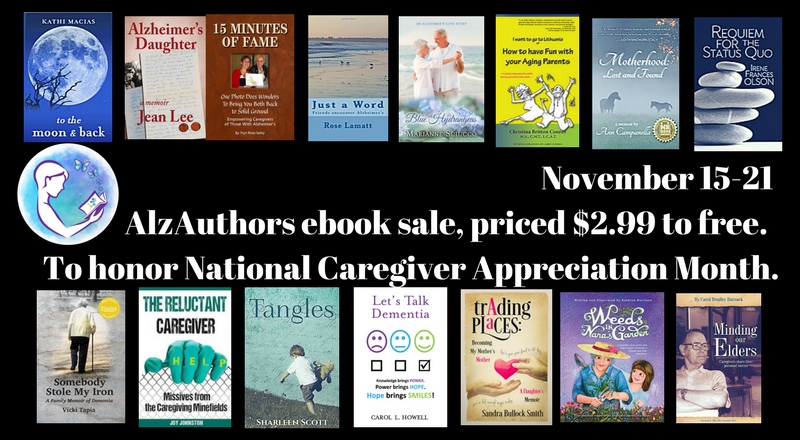 November is National Caregiver Appreciation Month, a time to recognize the long hours, sacrifice, and love all caregivers bring to the task of caring for a loved one with dementia or any long-term illness. In honor of their efforts, AlzAuthors is hosting an eBook sale and giveaway! This is a terrific way for caregivers who are looking for knowledge, guidance, and support to find carefully vetted books to help guide and inspire them every day.care
Consider this information from the Alzheimer’s Association:
- In 2016, 15.9 million family and friends provided 18.2 billion hours of unpaid assistance to those with Alzheimer’s and other dementias, a contribution to the nation valued at $230.1 billion.
- Approximately two-thirds of caregivers are women, and 34 percent are age 65 or older.
- 41 percent of caregivers have a household income of $50,000 or less.
- Approximately one-quarter of dementia caregivers are “sandwich generation” caregivers — meaning that they care not only for an aging parent, but also for children under age 18.
Starting today through November 21st, you can take advantage of this excellent opportunity to check out some of our books at reduced prices, ranging from free to $2.99. We offer a variety of genres, including fiction, memoir, non-fiction, and children’s literature. Many of our books are also available in paperback and audio, so be sure to check them out too. As a matter of fact, my novel is available on Kindle for just $2.99 through November 21st and if you prefer a paperback copy, my publisher is offering it at half price on my publisher’s site. Check it outhere!
One day at a time
Living one day at a time is a good philosophy to uphold regardless of what’s going on in one’s life. I would extend that sentiment to say, “Live each day one moment at a time.” It’s good to plan, set goals, even write a bucket list, but doing so addresses the future, not the present.
When I was admitted to a local hospital for hip replacement surgery, I knew that would be one step toward many that I would accomplish to attain complete recovery. I had no idea what accomplishments I would be able to celebrate or in what order they would appear, I simply knew I would eventually be able to move beyond my physical restrictions.
I was right.
 Walker. Yep, I held onto this piece of durable medical equipment (DME) like it was my lifeline…because it was. I learned how to use it while still in the hospital and once I got home I outfitted my own walker with a multi-pocketed pouch wherein I stored necessary items: water bottle, iPhone, iPad, tissues, snacks, so that wherever I landed, I was set. Two weeks post surgery I was able to retire the walker. What a lovely step in the right direction.
 Cane. Using my Hurrycane is liberating – I say is, not was, because it’s still attached to my person as a means of transportation. Today, November 6th, marks one month since my surgery and I am still nowhere near ready to retire this piece of equipment because I still need the support it provides. I’ve even learned how to use it as a pick-up-something-I-dropped-aid, as long as the dropped item is thicker than a piece of paper or bigger than the Vitamin D3 capsules I take every day but sometimes end up on the floor. I drop things often enough that my husband simply follows my trail of items to discern where I’ve been lately.
 Raised toilet seat. I know, there’s a visual all of you would prefer not to have, but early on in my recovery, it was a requirement that meant the difference between responding successfully to my most base urges, or…not, and that visual would have been far worse to contemplate. Fortunately, it served me well and I retired it three weeks post-surgery.
 Medications. Okay, this is a tricky one. I abhor having to take medications, whether over-the-counter or prescribed, but when your leg is sliced into, requiring major manipulations by the surgeon and his jolly helpers – not to mention sawing off sections of a bone that I would no longer need – a person is going to have lingering pain issues that need to be addressed, and this person sure does. I am a very slow healer; an 80-year old can have the same surgery as me and return to yoga or square dancing classes a mere two weeks after receiving their bionic hip. Not so, I.
So here I am, wishing I was further along in my rehabilitation but refusing to compare myself to others who appear to be better off post-surgery than I am. I can smile throughout my day and sleep well at night knowing I have one of the most effective rehabilitation tools a person could hope for: my husband. Jerry supports me physically and he supports me emotionally, the latter of which has been almost more important than the former. He recently held me in his arms on the couch while I bawled into his neck, saturating it and his t-shirt with my tears. On that particular day, I was tired of hurting. To be sure, pain is very taxing on one’s body and emotions – there is no separation between the two – so if my body is having a hard time, so is my psyche.
Is that a lose/lose situation? It can be, but if I remember to live one day or one moment at a time, I’ll be less inclined to allow fear and frustration to take root. Fear is based on the future: what if I never get better? what if the surgery didn’t work? what if I am never able to be as active as I want to be? what if I never stop hurting? All future-based.
When living in the moment I can celebrate my ability to:
- climb the stairs in my house two at a time instead of one;
- walk to the end of my driveway to retrieve the mail;
- get in and out of bed without assistance;
- bathe with very little assistance;
- dress myself;
- do more tasks in the kitchen than I was able to do four weeks ago; and
- hold my grandson and give him a multitude of smooches while he sits on my lap.
Regardless of how long it takes for me to get back to “normal” that time will come and when it does it’ll be right on time. In the interim, I’m going to acknowledge each moment as precious and not concern myself with that which has yet to occur.
Kindness Fridays
According to the 2017 Alzheimer’s Association Facts and Figures research, there are more than 15 million Americans providing unpaid care for people with Alzheimer’s or other dementias. Some have assembled a team of family and friends so the responsibilities are evenly spread out, but that is not always the case. The solo caregiver manages—or tries to manage—everything on his own.
That’s where those who are on the outside looking in can become a caregiver’s hero.
OFFER TANGIBLE ASSISTANCE. We will never be wrong in assuming the caregiver needs help so rather than saying, “Call me if you need anything” we can ask, “What exactly do you need?” If we remember what we needed when we were on the mend from illness or surgery we should be able to come up with an endless list of concrete gifts of assistance.
MEALS. You need to cook for yourself and/or your household anyway so make a double recipe, pack that extra portion in a disposable dish, freeze it, and keep doing that for a week and deliver one full week’s worth of frozen meals to the caregiver who, receiving your food offerings, can look forward to not having to be creative in the kitchen at the end of the caregiving day. Engage others to sign up for this dinner on wheels program so the responsibilities are spread out amongst many.
ERRANDS. You’re running to the store for a few items; take the time to ask Sam if there’s anything he might need while you’re out. He may need a half-gallon of milk—and he might have needed it for the past several days—but embarking on that task proved impossible for him. With very little effort on your part you can make a huge difference in Sam’s well-being. Maybe the needed item is toilet paper; acquiring that for him makes you a genuine hero!
CHORES. The last task a time-strapped caregiver considers doing is housework or yardwork. You will not insult your friend or neighbor by offering to vacuum their house or clean their bathrooms. Or perhaps it’s a lawn that needs mowing or a flower bed, weeding; that sprucing up will provide the caregiver with a virtual—and literal—fresh view of their circumstances.
OTHER OPTIONS. Sam may turn down home improvement offers but he might say, “What I could really use right now is some help figuring out Nancy’s health insurance statements.” Or he might say, “My wife’s not much of a conversationalist anymore, I’d give anything to have an hour to talk with someone who is. Could you stop by later today for a visit? I’ll even talk politics if it means having someone else to talk to.”
WHAT I KNOW FOR SURE. The family caregiver has so much going on physically and emotionally, offers of assistance can be the salve that gets them through each day.
Grief: Your caregiving friend is grieving the loss of a person who is still with him. Unlike the sudden death of a family member, the Alzheimer’s caregiver suffers the prolonged loss of their loved one—oftentimes called ambiguous loss—because although physically present, the person with dementia is continuously leaving their loved one.
Exhaustion. Physical, emotional, and spiritual exhaustion sneak up on the solo caregiver and they are killers. The solo caregiver must put their needs above those of the one for whom they are providing care and sometimes they need you, the outsider, to help them prioritize those needs. Just like the airlines’ seatbelt instructions, the person meeting the need requires attention before the one requiring it.
BOTTOM LINE. You have so much to offer the time-strapped family caregiver; your gifts of kindness are more valuable than you could ever imagine.
Do you want additional insight into what caregivers with whom you are acquainted are facing? You can order Requiem for the status quo at Barnes & Noble and Amazon as well as all online and brick and mortar chain and independent bookstores. And if you have already read my debut novel, please consider leaving a review on the online retailer’s website of your choice.
Meet Marita Golden, author of “The Wide Circumference of Love” — AlzAuthors

Silent Storm: What We Remember, What We Forget, What We Discover A Novelist Meditates on Writing about Alzheimer’s By Marita Golden I didn’t choose. I was called. That’s how inspiration, art, and creativity work sometimes. I am often asked why I wrote a novel about Alzheimer’s disease. I am not caring for anyone afflicted with […]
via Meet Marita Golden, author of “The Wide Circumference of Love” — AlzAuthors
Kindness Fridays
- Bionic hip
- Loss of independence
- Healthcare TLC
I received a new right hip this past Monday afternoon which rendered me fully dependent on the staff of a local hospital, Evergreen Health Medical Center in Kirkland, Washington. As a two-night inpatient at the hospital, I was reliant on staff for absolutely all of my needs.
If you can imagine everything you do during the course of a day requiring at least one medical person to provide intimate assistance, you can easily imagine all the tasks incumbent upon the nurses, certified nursing assistants(CNA), physical therapy personnel, food delivery staff, and even someone such as Barbara the housekeeper, at your beck and call.
My personality is such that I’d much rather be giving than receiving. Each time I pushed the nurse call button I carefully considered whether such a request was warranted: bladder full to rupturing, yeah, warranted; refill of my patient water carafe? Maybe I could wait and encumber the next person who walks into my room.
From the time I checked in for surgery at 11:30 Monday morning until I was discharged at 2:30 Wednesday afternoon, each person with whom I came in contact was fully dedicated to serving my needs. They noticed if my blankets were pushed asunder in my bed and straightened them comfortably around my body. When shuffling with my walker to the bathroom while wearing my backless hospital-issued gown they discreetly covered me up and made sure my dignity was kept intact.
Then there was the aforementioned employee who after knocking on my door said, “It’s just me, Barbara the housekeeper.” Upon granting the 60-something-year-old admission to my room, she said, “I want to be sure your room is clean and acceptable. You don’t need to do a thing, just lay there – and you (my husband) sit comfortably in the folding chair and I’ll work around you.”
I engage absolutely everyone I come across in conversation so it was quite natural for me to converse with Barbara the housekeeper. I asked her how long she had been working at Evergreen and it had been quite some time. “You must have seen lots of changes over the years.”
“Yeah, of course I have, but it’s good. I like what I do. I like all the people I get to meet over the course of a day.”
“I’m sure you’ve met those who, because of their circumstances, weren’t exactly the most friendly people you’ve encountered in your life.”
“Aw, sure, but you get that everywhere, not just in a place like this.”
True, so very true. As I’ve mentioned in past blog posts, each of us has a choice of whether to make or break someone’s day. I can tell you that there was not one employee at the hospital who broke my day, rather, each person made my stay there as palatable as it could possibly be. Mind you, the dings of call lights going off all day and all night from the nurses’ station directly across from my room weren’t the highlight of my stay, but those dings are far easier to accept when you realize that you initiated your share of call dings yourself and benefited from the responses of the dedicated medical personnel who had to answer such pleadings.
All in all, I’d have to say that if you have to go through the pain of getting a new and improved hip in order to lead a more comfortable life going forward, being treated with kindness during the process certainly renders the recovery far more appetizing. This former patient has no complaints whatsoever. She was treated like a queen.
Kindness Fridays
I kind of blew it this week, so here is me being very transparent with you.
Tuesday of this week was the day my husband and I had multiple appointments to take care of. After I spent all morning having pre-surgical tests completed at the hospital in preparation for my October 9th hip replacement, I raced home to grab lunch, did some writing business in my home office, and then set out again for another doctor’s appointment that was originally scheduled for 1:30 but my doctor’s office called earlier that morning to reschedule the appointment to 2:45. I wasn’t happy with that change but sometimes – all the time – you just gotta go with the flow.
The problem was, my attitude wasn’t flowing very well by the time I arrived at said doctor’s office at 2:35 pm when the front desk employee told me my appointment was not until 3 pm.
“No, when this office called me this morning to change my appointment time, they specifically said the appointment time was 2:45, there was no indication that 2:45 was the check-in time.”
“I’m sorry, but no, the check-in time is 2:45 for a 3 pm appointment.”
I knew getting all huffy wouldn’t change the current situation but I chose to be huffy – it really is a choice when we choose to be huffy and that’s what I chose to be at that particular moment in time. I’m sure the front desk employee wasn’t the one who called that morning to tell me of my revised appointment time but I guess I felt I had a right to be upset.
Don’t get me wrong, I didn’t yell, I didn’t accuse anyone of being incompetent or anything as brash as that, but I let my mood transfer to that poor unfortunate employee and it was selfish of me to do so. You see, being kind is a conscious decision we make, but not being kind is a decision we make as well.
Fortunately, I had to return the next morning for a medical test and the same employee was at the front desk. I explained that the previous afternoon when I was checking in for my appointment I exhibited a bad mood toward her and I wanted to apologize for it. She thanked me and added that she didn’t think I was in a very bad mood at all. But I’m still glad I apologized. The Universe gave me an opportunity to make things right, and this time I chose wisely.
Kindness Fridays
Community. That’s what this world needs: a unified body of individuals.
That doesn’t mean we all have to have the same political, social, or religious affiliation. What it does mean, however, is that we choose to live in unity and in support of each other.
Have you had the experience where you’re having a pretty darn good day and someone says or does something to you and your entire day’s direction is negatively altered?
In the alternative, have you experienced a bad day when someone says or does something to you and your entire day’s direction is altered for the better?
In the former, someone chose to live separate from you; chose to not recognize you as his or her fellow man; chose to harm you and widen the gap between the two of you.
In the latter, a kind-hearted person chose to come out of themselves; chose to join with a fellow survivor on this planet where division and hatred would seek to become the norm; chose to bridge the gap between the two of you.
My modus operandi is that I assume each person with whom I come in contact during my day needs my friendly words and actions in order for their day to improve. I believe in most cases I’ll be right on the money with that MO.
I mean, it sure couldn’t hurt, could it?
Honor thy father
 My father was the inspiration for my novel Requiem for the status quo.
I have held three author events since my novel’s release back in July and I have more planned before the end of the year. At the senior centers and independent bookstores where my events are hosted, each person attending is certainly there in support of my efforts, but more importantly, I believe their presence honors my father’s story, a story without a happy ending.
Here’s an excerpt from my novel that speaks of my fictional characters’ dilemma, but it also mirrors that which occurred in my real life experience with Alzheimer’s.
If it’s true that cancer is no respecter of persons, it is equally true that Alzheimer’s disease exhibits the same lack of respect. This disease is a murderer and I’m troubled by the millions of crimes it has gotten away with.
Alzheimer’s is also a robber, not only because it robs a person of his or her memories and future, but also because it exacts an emotional price that few can afford. To be sure, monetary costs are a challenging force to be reckoned with, but many family caregivers and their loved ones would no doubt conclude that the emotional toll on a person far surpasses even the costliest of care fees paid.
Until the person with Alzheimer’s or other dementia becomes blissfully unaware of the disease that is murdering him, he has a front row seat to all that is happening. My dad was the first to know when his senior moments became more than a quirk of the aging process. It grieves me to imagine what he went through when he was alone with his thoughts, witnessing first hand where those thoughts were taking him.
Yes, my father had a front row seat to the effects of a disease that is always fatal. Until he eventually became blissfully unaware, he lived with that fact every single day. If the caregiver thinks she or he has been dealt a bad hand in relation to Alzheimer’s, imagine if you possibly can how that hand plays out with the person diagnosed with the disease. I don’t know about you, but my imagination in such matters paints a picture I’d rather not see.
My very real reward for writing my novel is that my father is honored as a result of my efforts. Additionally, it is my sincere hope that those reading my novel and attending my author events manage to discover that they have a cheerleader in their corner…me.
The secret of Alzheimer’s disease
I discovered something shocking during the weeks that followed my novel’s release:
Alzheimer’s disease is still a secret.
 I know; we’ve all certainly read about it, especially when a celebrity is diagnosed with the disease. Every once and awhile there might be an Alzheimer’s Association commercial on television…that is assuming we don’t fast forward through it or walk out of the room. Another reason we’re familiar with the disease is that it is happening to so many people with whom we are acquainted – whether intimately or tangentially.
But it’s still a secret. The very definition of the word speaks to its intent: adj. not known or seen or not meant to be known or seen by others; n. something not properly understood; a mystery. from the Concise Oxford English Dictionary
In many of my promotional posts and boasts for my novel Requiem for the status quo, I’ve indicated that my book tour would probably look more like a senior center tour than what is normally the route for authors: readings and signings in major and independent bookstores. That’s the tact I took, approaching numerous senior centers in Western Washington. 25% of those I approached booked my author event on their activity calendars. But when I approached a major senior housing community foundation to get on their speakers’ calendar, I was told the residents pushed back at the foundation’s previous efforts to enlighten and inform when they hosted those who spoke to the reality of Alzheimer’s disease and other dementia.
Requiem characters’ radio interview
 Craig Boyack, author and author supporter – yes, author supporter – conducted a radio interview of two of the characters from my debut novel, Requiem for the status quo.
Patrick Quinn, father of the protagonist, Colleen Strand, has recently been diagnosed with Alzheimer’s disease and he’s having a difficult time trying to figure out how not to be a burden to his daughter, Colleen. He’s friendly with the radio host, even joking about a part of the male body that withers and needs medicinal support and encouragement from time to time. (Don’t worry, it’s G-Rated, you have to read the context of the interview to fully appreciate the sense of humor this fine, eighty-four year old man exhibits, even in the midst of his disease journey.)
Jonathan Quinn, Patrick’s son, who’s not too keen on what has happened to the father whom he at one time looked up to. Yes, Jonathan is embarrassed by his father’s forgetfulness and seems to think his father’s challenges are all about him, Jonathan, instead of the person who has a front row seat to every twist and turn the plaques and tangles of his diseased brain takes. Jonathan is firmly implanted on the road to denial and sadly, it gets in the way of his relationship with his father.
The interviewer is a fictional character, Lisa Burton, a character in one of Craig Boyak’s novels. The interview takes place on her show, Lisa Burton Radio. This different way of interviewing an author, in this case, me, and spotlighting the author’s novel, is so ingenious, you will be taken aback by how effective Craig’s blogging methods are.
Please, read the interview, and when you’ve done so, I hope you’ll purchase my book from any of the many online and brick and mortar book stores out there, including Barnes & Noble and Amazon. Be sure to shop around for the best price, you won’t be sorry you did. And for those of you with eReaders, the eBook will also be available at most online book retailers on, or about, July 27th.
Dementia caregivers: 21st century heroes
Those family members who have had, or who currently have, a family member or close friend with Alzheimer’s or other dementia, you are my hero.

You took on the task of showing your love and compassion by signing up to become a family caregiver which at its best is a learn-as-you-go, long-term commitment. Your efforts make a difference in the life of your loved one. They may not be able to express their appreciation for all that you do, but please know that the essence of who they are acknowledges your kindness.
Your name and/or identity may be lost to them, but you are still a vital part of their lives, and your friendly and loving demeanor goes far toward affirming them and making them feel valued and loved.
Thank you for all that you have done, continue to do, and will remain doing in the future. It is an honor to be in your company.
Requiem for the status quo was released by Black Rose Writing on July 20th. You can order Requiem at Barnes & Noble and Amazon as well as all online and brick and mortar chain and independent bookstores. Be sure to shop around for the best price, you won’t be sorry you did. And for those of you with eReaders, the eBook will be available at most online book retailers on, or about, July 27th.
Release day for Requiem for the status quo
Today is release day for my debut novel.

On December 29, 2012, I first sat down to write that novel.
On the day of the fifth anniversary of my father’s October 13, 2007 death, I decided to write a novel inspired by my caregiving experiences as his Alzheimer’s care manager. I was certain novel writing would be a huge undertaking because up to that point, I had never written fiction. Because of the enormity of said project, I figured I would wait until the beginning of the following year – you know, a fresh start and all.
But the universe had other plans. My December 29, 2012 horoscope was what the universe used as the catalyst to get my attention. More than that, it shocked me into action. The horoscope so alarmed me, I cut it out of the newspaper, typed it out in large font, and after writing my novel’s very first page, I framed all three to memorialize the outstanding coincidence of what my Taurus-scope said. Here, for your enlightenment, is its wording:
Now’s perfect to start a new writing project; no need to wait until next year. Put down your thoughts without worrying about form, one word at a time.
I showed the horoscope to my husband and if it at all possible, he was more shocked than I at the horoscope’s content. He left me alone the remainder of the day, knowing the horoscope meant business, and so did I. I closed the door to my office, sat at my computer and started typing.
I didn’t know what I was doing. As I mentioned earlier, I had never written fiction. At that point, my personal blog, Living: the ultimate team sport was filled with 100s of non-fiction pieces, most of which centered around aging, long-term care, as well as numerous posts about Alzheimer’s disease, other dementia, and the caregiving struggles faced by families. But to write prose – with dialogue!!!!! – was beyond my skill set, and remained to be for quite some time.
The short of the long of it is that Requiem for the status quo was not the first title for the novel, there were many, the first being Have we met? Aren’t you glad I changed it to its current one? Not only were several titles tried on but my magnum opus went through many rewrites, most notably and importantly, the first draft contained a whopping total of 140,000 words. You see, I had a lot to say and I just kept typing until I had nothing more to add.
That’s an excellent way to get thoughts down on paper, but the first draft is by no means the final product that is pitched to agents and publishers. My now published novel is less than 68,000 words. Yes, lots of cutting and slashing took place over the years, to the point where not only am I proud of the finished product, but a publisher is also proud of it, Black Rose Writing.
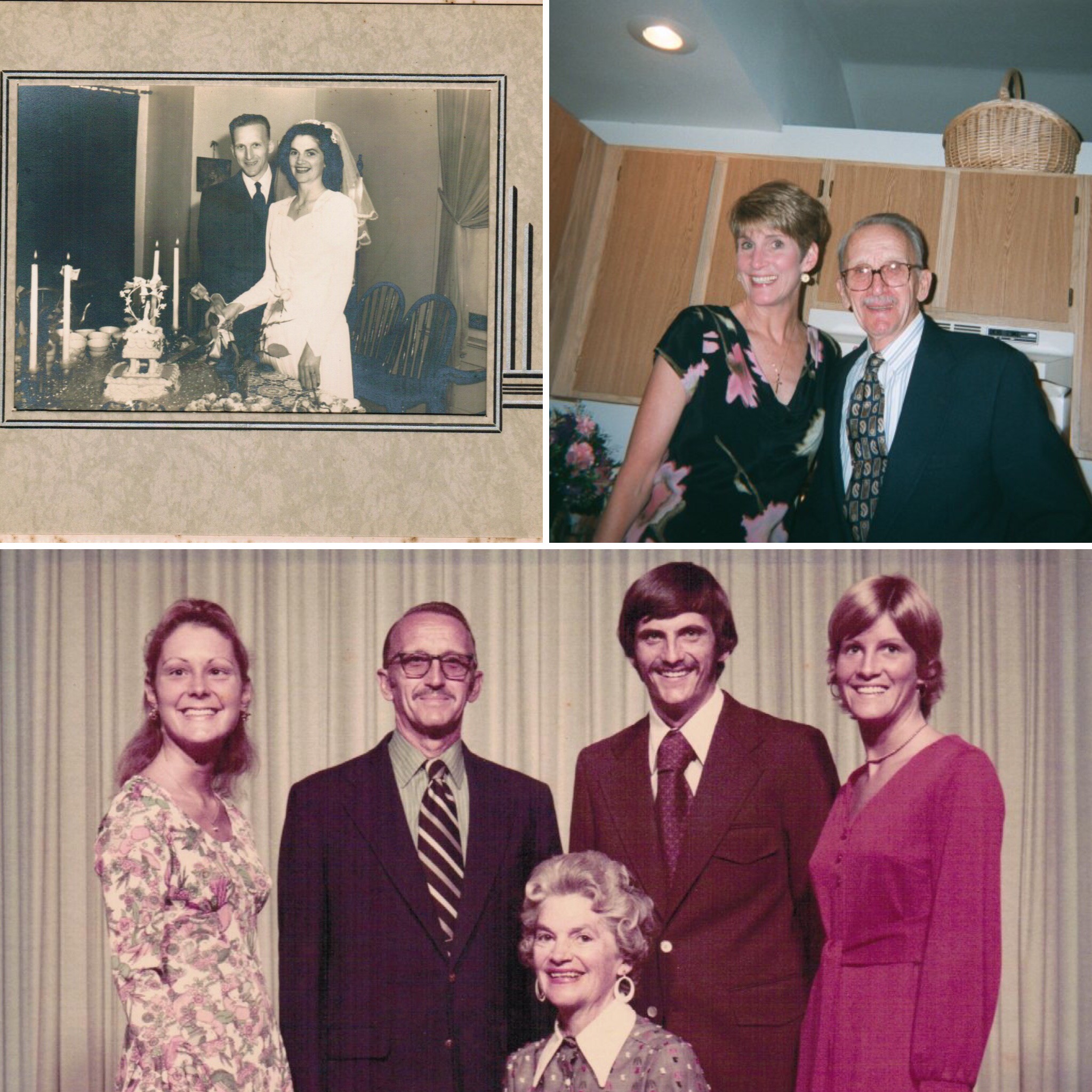
I will close this post by providing glimpses of my father to you over the years. I hope you enjoy this montage that includes, from top left: My mother and father’s wedding day, 1947; my wedding day 2000 (my favorite photo of my dad and I); and the Desonier family circa 1971.
Reader discoveries
 To celebrate my novel’s release, I held a giveaway on a Facebook readers group, A Novel Bee, and made some extraordinary reader discoveries.
I gave the members of that group 24 hours to leave a comment on my giveaway announcement if they wanted to be entered into my contest to pick one lucky (hopefully lucky) reader to receive a complimentary copy of my novel, Requiem for the status quo.
I received 37 entries, and a considerable percentage of those readers’ entries made mention of their own personal Alzheimer’s/dementia caregiving journey. Here are just a few of those comments:
- I am a geriatric care manager, can’t wait to read it!
- My friend just had to put her mom into a caregiving rest home because she could no longer handle her. She was becoming quite violent. It is a horrendous disease.
-
I love that you are writing inspiring stories! Many of us are or were caregivers and the hopelessness we feel when we dont see them getting better can be overwhelming. Your compassion is so sweet and much needed in todays world. Im really excited to find a new author I can enjoy!
- I would be honored to read this book, my father had Alzheimer’s disease. I want to tell you that the cover is totally amazing !!!!!
- I would love to win. My husband has Alzheimer’s/ dementia so it is if special interest to me.
Even as familiar as I am with the statistics for this disease – 44 million diagnosed worldwide as of this writing – it still astounds me to hear the personal stories associated with it. Like every terminal disease known to man, Alzheimer’s and other dementia are very personal diseases. The brain – the very essence of a person’s being – is the initial body part affected. What we say, how we behave, and who we are resides in the various, vital parts of our brain. Our brain is the grand traffic director of all things me.
It’s no wonder the very long goodbye associated with this disease is so devastating to the one diagnosed, as well as for the one caring for her or him. It’s very personal, isn’t it?
I am of the belief that family dementia caregivers are 21st century heroes. Additionally, all caregivers, not just those on a dementia caregiving journey are the best of the best. They are:
Ordinary people, doing the ordinary right thing, at an extraordinary time.
I am honored to be in your company.
Requiem for the status quo will be released by Black Rose Writing on July 20th. You can order Requiem at Barnes & Noble and Amazon as well as all online and brick and mortar chain and independent bookstores. Be sure to shop around for the best price, you won’t be sorry you did. And for those of you with eReaders, the eBook will be available at most online book retailers on, or about, July 27th.
Author Celebration: Books about Alzheimer’s disease
 To celebrate my own book’s July 20th release, a book that’s about Alzheimer’s disease and other dementia, I am tooting the horn of other authors who have done the same, a few of whom I know personally.
There’s a high degree of sadness surrounding this list because almost without fail, those authors who have written memoirs, story collections, fiction, and non-fiction books have done so because of their own personal Alzheimer’s journey.
Ann Hedreen, Her Beautiful Brain – A Memoir. Ann lives in Seattle, Washington, and has provided valuable support to me through my own publication journey. To quote Amazon.com:
Her Beautiful Brain is Ann Hedreen’s story of what it was like to become a mom just as her beautiful, brainy mother began to lose her mind to an unforgiving disease.
I can not imagine the struggle Ann endured while being a new mother whose time and energy was already spread so thin when life happened to her and her household, in a manner hardly believable to so many of us.
Collin Tong, Seattle journalist, Into the Storm – Journeys with Alzheimer’s, a compilation of true stories that starts with the very personal story of Collin’s caregiving journey with his wife, Linda. Collin’s support of my project, telling me not to give up when so many agents and publishers wouldn’t give me the time of day, inspired me to keep on keepin’ on. His story collection is amazing. Again, quoting Amazon:
In his compelling new anthology, Into the Storm: Journeys with Alzheimer’s, twenty-three writers, journalists, educators, health practitioners, social workers, clergy and other family caregivers from across the United States share their intimate stories of caring for loved ones with Alzheimer’s disease and dementia.
Each of the twenty-three stories are gems that you do not want to miss. I know you will be as impressed as I was by each and every one of them.
The next entry contains numerous authors and their books, found in one central location: AlzAuthors. The purpose for their site states:
We are AlzAuthors. In some way, each of us who have come together on this site have been affected by Alzheimer’s Disease/dementia. We share our experiences to bring knowledge, comfort, and understanding to others on this journey.
Click on this link to the AlzAuthors Bookstore to discover a wealth of informational and engaging books that will meet the needs of those who are caring for parents or grandparents, spouses or partners, those living with Alzheimer’s and dementia, fiction books, books for children and teens, and those offerings that provide helpful information for one and all.
3rd Act Magazine, not a book, but a publication addressing the third act of one’s life, usually heavy on those of us who are Baby Boomers. This publication has so much to offer its readers. I, for one, am pleased that the subtitle of their magazine reads, Aging with Confidence. You got that right! You’re not done with us yet; we have so much to offer the world that is spread out before us.
And yes, all of the above-mentioned projects prove that a lifetime of experience – the good and the not so terribly good – equates to having something to say, and not being afraid to say it. Which brings me to my part in that effort:
Requiem for the status quo is currently available at just about any bookstore you can walk into or find online. If a particular store doesn’t currently stock my novel, simply request that they order one for you and you should be able to get your hands on it in short order. You can order Requiem at Barnes & Noble and Amazon. Be sure to shop around for the best price, you won’t be sorry you did. And for those of you with eReaders, the eBook will be available at most online book retailers on, or about, July 27th. Additionally, would you like your local library to carry my novel? Simply ask them; quite often they are quite willing to accommodate individual requests.
Requiem for the status quo is dedicated to my father, Don Patrick Desonier, who wore his disease with the dignity it did not deserve.
I love you Dad.
The family caregiver’s hope quotient
 Each person reading this post has experienced a time when their hope quotient was at an all time low.
The definition of hopeless: 1) feeling or causing despair about something; 2) inadequate, incompetent.
When life happens, as it always does regardless of our preferences, we’re bound to find ourselves unable to manufacture even a modicum of hope to get us through the circumstances in which we find ourselves:
- The loss of a job and the financial repercussions resultant from that loss.
- Crimes against our body or our property.
- Relationship disruptions.
- The devastating diagnosis of a debilitating disease: cancer, ALS, Alzheimer’s disease.
Hope isn’t what a person feels when the rug has been yanked out from underneath them and their very existence as they knew it, maybe even just five minutes earlier, takes an irreversible turn.To be sure, that’s how quickly hope can take a nosedive. Equally as quick, we can not imagine we will ever feel happy again, nor can we imagine not being overwhelmed with how life has showed up. In an instant, our level of hope took a nosedive. Read the rest of this entry »
Kindness Fridays
I was reminded the other day about an extraordinary kindness given to me shortly after I moved to the Seattle, Washington area with my two cats, Kate & Allie, the summer of 1994.
I moved into my Kirkland, WA apartment in July, secured a job as a paralegal early August, and on September 24, 1994, I received a Saturday phone call from my father, telling me that my mother had died in her sleep the night before.
Other than my brother and his family who lived nearby, I had very few acquaintances that early in my Washington state residency. Those who have gone through this type of emotional disruption know that while dealing with the rawness of grief, other matters require immediate attention. For me it was getting together with my brother and his wife that same day, making airline reservations to Honolulu, Hawaii – where my parents lived – and notifying business associates of our need to suspend all work activities so we could gather around our father who had just suffered the loss of his wife of forty-eight years.
There was one detail that needed attention in my household: my two cats who would be left on their own for, what turned out to be, a two week period of time. What’s a person to do?
I had seen and said hello to my upstairs neighbor and her Great Dane a few times but as yet hadn’t truly met and gotten to know her. I traipsed upstairs, knocked on her door, but she was not home.
Back downstairs I wrote a note explaining my emergent situation, asking if there was any chance she could check on my cats daily, feed them twice a day and fill their water bowls, and empty their litter box. I told her I would be home all day preparing for the next day’s departure and she could either call me or come downstairs and knock on my door. After placing the note in the crack of her door, I went downstairs to finalize my packing.
An hour later, she knocked on my door, pulled me into a hug, cried with me, and gladly offered her assistance in my time of need. I returned two weeks later to find two very healthy and happy cats in my apartment. Turns out she didn’t just perform the perfunctory feeding and litter box tasks, she played with my cats, even buying additional cat toys to entertain them on a daily basis so they would receive the love and attention I would have normally paid them.
That started a delightful friendship of going on walks, spending dinners with each other, and sharing in each other’s lives. Tragedy ushered in a kindness that greatly improved my life going forward.
I found hope in the midst of tragedy.
Kindness Fridays
I’m really going in a different direction with this week’s post, so bear with me.
A person can’t live in this world without being personally offended or attacked for any number of reasons, whether founded or unfounded, countless times during the course of his life.
In this world, there exists those whose modus operandi is to criticize others, bring others down, make fun of them, even bully them. The person with that MO may have any number of “reasons” why he or she acts that way, but none of those reasons are justified, plain and simple.
What do we do when someone acts that way toward us? I know how we feel, we feel hurt and angry; we feel we must be on the defensive and maybe we even want to dish out the same pain, or worse, than what was inflicted on us. A defensive action, however, turns us into someone no better than the person who lashed out at us; we join their ranks.
When an unkindness is said or done to us, the higher road is to not respond in kind. By that I mean maybe it’s better we don’t go on the defensive, we don’t fight fire with fire. Oh, let me tell you, the base part of our character wants to let loose with our own brand of meanness, but each and every one of us has the ability to choose a contrary response. Each. And. Every. One. Of. Us.
Don’t get me wrong, I’m not suggesting you lavish the offender with peace, love, and happiness – there are very few of us who could pull that off – but what I am saying is that we can choose to stay silent. We can walk away – both figuratively and physically – and leave that person to wallow in the slime they just created.
 I learned long ago, that if someone yells at me and I choose not to yell back, their fire goes out. If I don’t feed their anger, it has nowhere to go but down. Quite frankly, my decision to walk away hurts that person far worse than any words I could ever spew back. I guess sometimes you just have to kill them with kindness.
Just. Walk. Away.
Writing to make a difference, one person at a time
First and foremost, I sat down at my computer because I had something to say about how Alzheimer’s disease affected my father. Additionally, having graduated from the unofficial school of family caregiving, I figured someone just might benefit from the good – and the not-so-good – ways in which I managed my father’s illness.
Now thirteen years after my father’s initial Alzheimer’s diagnosis, my novel will hit the virtual and brick & mortar shelves of bookstores. It will also make its way in person to a number of senior centers and senior living communities in my area. As an event on their activity calendars, I will read passages from my novel that might just ring a bell in the minds and hearts of those gathered to listen to what this Baby Boomer has to say. Maybe what I share will inspire them to purchase REQUIEM which I will gladly sell to them at a highly-discounted price. And once they’ve read my novel, perhaps they will share it with someone else, and so on down the line.
Is REQUIEM about Irene Frances Olson and her father, Don Patrick Desonier? Read the rest of this entry »
Kindness Fridays
For some, this may seem a trivial expression of kindness. For me, not so much.
When my husband and I aren’t hiking, we “hike” through the streets of our very hilly neighborhood. We have various walks that we take:
- The Wall – a very steep incline in a short period of time
- The Monster – a very steep incline over a longer stretch of time
- The Broadhurst (or Reverse Broadhurst) – a longer walk in an adjacent neighborhood, and
- The Broadhurst Monster – a steep hill in that same neighborhood
While on our walks, I lift up my hand in greeting to everyone who drives by, and without fail, the driver always returns the gesture. Sometimes the occupant in the car gives me a hand greeting before I can even lift my arm to do so.
“Yeah, but Irene, that’s not a very deep connection with someone; it’s just a throw-away gesture.”
Not to me it isn’t. It’s one way of connecting with people I might never meet. And besides, maybe the “hello” affects them just as positively as it affects me. What a great and simple gift that is.
My Alzheimer’s family caregiving journey

I had the privilege of being my father’s caregiver during his multi-year struggle with Alzheimer’s disease that ended with his death in 2007. Five years after his death, I started writing my debut novel, Requiem for the status quo, to be released by an independent publisher, Black Rose Writing, on July 20th. And now five years since I started my novel, Requiem will be available to everyone in less than 30 days. My debut novel was inspired by my father’s and my caregiving journey and is dedicated to the man whose later years was robbed by a disease that is always fatal. The book’s dedication reads: Dedicated to my father, Don Patrick Desonier, who wore his disease with the dignity it did not deserve.
I am in the very distinct and healthy position of understanding that realistically, as a debut author I cannot hope to be an instant and resounding financial success. But that’s okay, because for me it has never been about the money, but very much about helping those who are experiencing or have experienced an Alzheimer’s caregiving journey similar to mine. For that reason, most of my “book tour” will encompass senior centers in the region, as well as senior living residential communities where I hope to hold readings and sell my novel to seniors at a highly-discounted price. I know it is said that when trying to fill an auditorium, it’s all about getting butts in seats, but for me, it’s about getting books into laps.
And that’s what I’m going to do.
Requiem for the status quo is currently available for preorder at Black Rose Writing, enter discount code PREORDER2017 before July 20th for a 10% discount. You can also preorder Requiem at Barnes & Noble right now, and Amazon will be providing preorder opportunities in the days ahead. And for those of you with eReaders, the eBook will be available at most online book retailers on, or about, July 27th.
 Living: the ultimate team sport