I wrote the article below with an exhilaration that threatened to carry me into the air and cradle me on Cloud 9.
Donning silly glasses and cozying up to a bottle of bubbly that remains unopened.
Since that time, the children in Washington, D.C. have been battling it out on the playground, most not playing fairly, and all of them holding strong to an agenda that appears to be designed to promote their party, rather than their constituents.
I wondered aloud, “If thousands of national parks are closed, 100’s of thousands of employees are furloughed, and service members’ families are being robbed of benefits, what luck does the Alzheimer’s research money have of remaining designated for that cause?”
So I wrote an e-mail to the National Institutes of Health and asked them this very question. What follows is the automated response I received:
Due to the absence of either an FY 2014 appropriation or Continuing Resolution for the Department of Health and Human Services, no one is available to respond to your message. If you require immediate attention, please contact NIH Service desk at 301-496-HELP or via web http://itservicedesk.nih.gov/support.
Asked and answered.
September 25, 2013
NIH logo (Photo credit: Wikipedia)
In today’s news, the National Institutes of Health (NIH) announced that grants for research to discover therapies for Alzheimer’s disease have been awarded in the amount of $40 million from the Office of the NIH director, and $5 million from the National Institute on Aging.
In all the reading that I’ve done, I’ve discerned that the magic words when it comes to finding treatment and/or a cure, are “clinical trials.” The new funding of $45 million will advance the current research being initiated in the form of clinical trials, thereby offering hope to all of us who live long enough to be at risk for acquiring this disease.
The attached article appeared in the September 27, 2013 edition of The Seattle Times newspaper, and provides the public with information about a traveling exhibit, developed by the American Anthropological Association that inspires us to consider not just what race is, but what it is not. By the way, I changed the title of my article after fellow blogger, www.letstalkaboutfamily.wordpress.com commented on my article – see below.
The central message of the exhibit is that what we call races are not separate genetic or biological groups, but distinctions created by people, oftentimes to mistreat or isolate those they regard as different from themselves…But those distinctions come from emotion and prejudice, not science.
The writer of the article, Jack Broom, states: “In the enlightened Pacific Northwest of 2013, it may be tempting to think of racism as a thing of the past, or something that happened elsewhere.”
I live in a suburb of the Seattle area and have no doubt that racist thoughts run rampant through my local society – oftentimes with a fervency that should shock the sensibilities of everyone. I know I was shocked when I recently experienced the following:
I’m out to lunch with a female friend who characterized “oriental” people as being very abrupt. I told her that I took offense to her statement for several reasons: 1) I was pretty sure the term ‘oriental’ was replaced by the word, ‘Asian’ a long time ago; 2) how can she so readily characterize billions of people using one word: abrupt; and more importantly, 3) my daughter (biological, born in Anchorage, Alaska, whose dad, my ex-husband, is Chinese, born and raised in Hawaii) is half Caucasian and half Chinese and if push came to shove, she might be characterized as looking Asian. My friend’s response: “Really? I thought Megan (not her real name) was American?” God help us all.
How does one respond to that? Well, I did, but I’d like to keep this article G-rated.
Second example: my husband and I are in the market for a new bed so I did some preliminary in-store research last week at a nearby store that specializes in mattress sets. I told the salesman that I was looking for a fairly firm mattress so he proceeded to point out various mattresses for me to lay on so I could test the different degrees of firmness.
The last mattress he showed me was very firm. When I laid down on it, I told him that we wouldn’t be comfortable on such a firm mattress. His response: “That’s the mattress the Asians buy. For some reason, all my Asian customers buy that firmness. Must be a cultural thing.”
Ugh – I walked out.
The writer summed up what visiting this installation at the Pacific Science Center might show us: “…the exercise helps make the point that dividing people into groups may tell more about the people doing the dividing than those being categorized.”
The attached video, just 3 minutes long, showcases how very personal Alzheimer’s and other dementia are to those involved. The toll on the patient – measurable, as you will see in this Shapiro family video.
The toll on the family – especially those caring for a member with the disease – beyond measure. Imagine taking care of someone who has lost his or her faculties, who can no longer express themselves verbally, and who has become a shell of his former self. Can you imagine it?
Imagine you must, because I sincerely believe that the only way people will stand up and take notice and do something about this disease, is to wear the mantle of a loved one with the disease, and/or the mantle of the beleaguered caregiver.
If you can help monetarily, please do so: www.alz.org.
If you can help within your community to relieve the stress of a caregiver with whom you are acquainted, that support is equally as needed and valuable.
Whatever you do, please do something to make a difference.
My father and my sister-in-law, both of whom have died from Alzheimer’s disease in the past five years.
According to the World Alzheimer’s report:
If dementia were a country, it would be the world’s 21st largest economy, ranking between Poland and Saudi Arabia. In the year 2010, the total world cost for caring for the dementia population was $604,000,000,000 (billion).
By 2050, in the United States alone, the costs for caring for the dementia population will be: $1,200,000,000,000 (trillion). That’s more than 1,000 x $1 billion.
Are you thinking of making any charitable contributions to a worthwhile organization before the end of the year?
and I’m as mad as hell about the millions of crimes that it has gotten away with.
Alzheimer’s and other dementias are unfair to the one diagnosed and to all those involved in that person’s life. The unfairness unfolds with the worst day of that person’s life – diagnosis of a disease for which there is no cure – therefore it is always fatal – and it is a disease where little progress has been made in treatment options.
Let me introduce you to two fabulous people who are no longer with us because this disease killed them. Yes, Alzheimer’s murdered them.
My hero – my father: 1918 – 2007
My father, Don, was born in 1918 in Toronto, Canada. He married my mother, Patricia, and they had three children. They became U.S. citizens in the late 1940’s/early 1950’s. My father was an extremely distinguished, courteous, humorous, and dedicated family man. He received his Alzheimer’s diagnosis on June 3rd, 2005 and I was there by telephone conference, having attended his initial neurological evaluation a couple weeks earlier. He died at approximately 12:10 a.m. on October 13th, 2007.
Nancy, an adoring daughter-in-law to my father, seated in front of her.
My sister-in-law, Nancy, was diagnosed with mixed dementia just a few months after my father died. Nancy was born in 1942 in Quincy, Massachusetts. She graduated from UCLA with a degree in flute performance and used those skills in many venues throughout her life. Nancy had three children from her first marriage – children of which she was very proud. Nancy was an extremely talented interior designer, opening her own design business in 1987 – the same year that she married my brother, Don. Nancy died from mixed dementia, that also included Alzheimer’s, at approximately 11:05 a.m. on July 4th, 2012. Just two and a half months later, my brother and sister-in-law would have celebrated their 25th wedding anniversary.
Saturday, September 21st, 2013 is World Alzheimer’s Day. One in every three seniors dies with Alzheimer’s or other dementia. If you do not die from Alzheimer’s, you die with it. From Alzheimer’s Association 2013 Facts and Figures.
Won’t you consider making a monetary donation in the hopes of capturing this murderer?
U.S. website for the Alzheimer’s Association: www.alz.org
Other countries have their own dedicated websites as well. Please find those sites through any search engine you would normally use, and let’s slap the cuffs on this criminal disease.
“Mr. Desonier, I think you can stop scheduling an annual colonoscopy from this point forward. You’ve been very diligent about this aspect of your health care for many years, but at your age, I think this procedure provides inconvenience and discomfort that you can do without.”
My dad was 84-years old when his gastroenterologist made that declaration. I never thought I’d say this, but that gastroenterologist is my hero. My father had one suspicious colonoscopy a decade or so earlier, and was advised to undergo that test every year to be certain that no cancer was present. If you’ve ever undergone this test – and you should have a baseline one after the age of 50 or earlier if you’re symptomatic – you’ll understand when I say that I’d rather have a root canal than have my colon flushed and probed every year. Here’s TMI for you: I’m 60 and had my first exam of that sort seven years ago and passed with flying colors. I’m on the ten-year plan so I have a couple years left before I hop on that table again. But I digress.
The above article will shock you to your senses as to how incentivized doctors are to keep prescribing outlandish medical procedures on their elderly patients. Most, but not all, such procedures benefit medical professionals and facilities and provide no benefit to the patients that undergo such procedures. Here’s a quote from the above article that is sickening in its implications:
(Photo credit: Wikipedia)
Medicare spends a quarter of its $551 billion annual budget on medical treatment in the last year of life. A third of Medicare patients undergo surgery or an intensive-care-unit stay in their final year (of life.)
The author’s 80-year old father had a “stroke-blasted” body and underwent the surgical procedure of having a pacemaker installed to correct a slow heartbeat that gave him no health problems. Medicare paid $12,500 for that procedure. Her father’s family doctor didn’t approve of the cardiologist’s decision to perform that surgery. Medicare would have only paid that doctor $54 for a medical consultation with the family to weigh the pros and cons of such a procedure.
What’s the lesson here? There needs to be a greater focus on slow medicine in the form of palliative care, rather than fast medicine that dictates quick consults and immediate – and oftentimes drastic – medical intervention that robs the elderly patient of living on his own terms, and dying when its the body’s time to do so.
The above public service announcement shines a spotlight on a disease that will affect you one way or another:
My father died of Alzheimer’s 10/13/2007. I’m on the left – it could happen to me; my brother is on the right, it could happen to him.
You may receive an Alzheimer’s diagnosis or I may receive an Alzheimer’s diagnosis
A loved one of yours may receive an Alzheimer’s diagnosis and you’ll be his or her caregiver
A good friend of yours; a neighbor; a coworker may receive an Alzheimer’s diagnosis
The point is – just as all of us know someone who has had, or currently has, cancer – all of us have some sort of connection to someone who has Alzheimer’s or other dementia.
None of us is immune to this disease that steals a person while their heart is still beating.
When your children attained the age wherein having “The Talk” about sex and other scary things became unavoidable, you simply jumped in and winged it – wanting to explain as much to your kids as they needed to know but trying not to lend any encouragement towards participation in said scary things. Didn’t you feel better once you checked that “To Do” item off your child-rearing list? I know I did.
My father in mid-stage Alzheimer’s.
“The Other Talk” is that which you need to have with your adult-sized children, regardless of how uncomfortable you – or your children – are about topics such as: illness, death, and finances. Acccckkkkk!
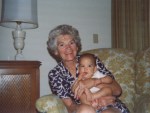
My mother and my daughter, circa 1977.
Or perhaps it’s the other way around. The adult children are broaching these difficult topics with their parents in the hopes that said parents will do something about these unavoidable issues. Regardless of who is on the receiving end of these discussions, they should be considered mandatory in every family.
Consider this scenario: Dad is dying of cancer and in a coma. Your mother has already passed on, and you have no idea what your dad wants. His cancer is inoperable and he’s having more and more difficulty breathing and he hasn’t had any nourishment by mouth since he went into a coma. Does he want breathing assistance? Does he want intravenous liquids and nourishment? Does he want pain medication to help him through the extreme pain that cancer causes, even if the medication hastens his death?
What’s a son or daughter to do? Wing it?
Let’s look at another scenario: Mom is in the advanced stages of Alzheimer’s and is unconscious more than she is conscious. There is no reversal possible of the debilitating effect this disease has had on her body: her doctor tells the family that their mother’s ability to swallow is greatly compromised, her breathing is becoming more and more labored, and she has shown no interest whatsoever in food or liquids. Her body is in the active stages of dying.
In this scenario, dad is still living and cognitively competent and he has told the family and your mother’s doctor that he wants every single measure possible to be employed to keep his bride of sixty-five years alive. You, however, have a copy of your mother’s living will/advanced health care directive – as does your father – which contains conflicting wishes to those of your father. Your mother wants no extraordinary measures employed – not a respirator, not a gastric feeding tube, no intravenous nourishment, nothing except for medication that will make her as comfortable as possible as she leaves this world. When your mother was fully aware and cognitively healthy, she had her wishes incorporated into a legal document, determined to take the responsibility of making such decisions out of her loved ones’ hands.
What’s a son or daughter to do? Follow mom’s wishes.
What a gift that is – carrying out your loved one’s wishes when she is no longer able to verbalize them. It would still be a gift if mom’s wishes were clearly spelled out that she wanted everything done to keep her alive as long as possible. The point is not what was decided that is important – it’s that the decision had already been made – a decision that remained in the hands of the patient/family member.
Both of my parents gifted me and my two siblings with documented specific wishes for their life and death. My mother unexpectedly died in her sleep on September 24th, 1994 at the age of 77 – something she had wished and hoped for her entire life – who doesn’t? My father died on October 13th, 2007 at the age of 89 from complications of Alzheimer’s and cancer. There was no guessing when it came to the time when us three adult kids rushed to his bedside. He was comfortable in his death, and we honored him by following his wishes for no intervention. Did I want my dad to die? God no. I wanted him to live forever; but none of us gets to do that, so I’m glad that my father was allowed to take his last breath and leave this world his way.
A fellow blogger whom I greatly respect, wrote the above article that tells a story of aging, loneliness, intuition, and follow through.
There is a holiday celebrated on September 28th called National Good Neighbor Day. In the above linked story, a good neighbor noticed that she hadn’t seen one of her neighbors in awhile, so she acted on her concern. The story that unfolds could be a made-for-TV drama! Concern drew her to investigate and her gut wouldn’t let her turn away.
I think all of us need to trust our gut more frequently, which I learned for myself back in July. I’ve attached an article I wrote on that experience called – coincidentally – Trust Your Gut.
No one is an island, entire of itself; every man is a piece of the continent. – John Donne
“Give me six hours to chop down a tree and I will spend the first four sharpening the axe.” – Abraham Lincoln
Luck doesn’t bring success, neither does lack of preparation. Here’s a personal account that hit me like the proverbial ton of bricks. This example is about exercise, but this article is not.
I started a new exercise regime in May called The Bar Method. Each one hour session “integrates the fat burning format of interval training, the muscle shaping technique of isometrics, the elongating principles of dance conditioning, and the science of physical therapy.” Let me just tell you that after the very first session, I realized how out of shape I was – evidenced a day later by my inability to get out of a seated position without using both hands braced on the seat for leverage, combined with much grunting, groaning, and “Oh my Gods!”
(Photo credit: Wikipedia)
Fast forward several weeks and I became a devotee who takes Bar classes twice a week at the studio, and four times a week I do interim supportive training in my mini home gym using a recumbent bike, weights (only 2 lb and 4 lb) and lots of push ups and planks. I quickly realized that if I do my part at home, I benefit even more from the Bar classes. Woohoo!
This past Thursday, I went to class having had a miserable night’s sleep the night before: couldn’t fall asleep, couldn’t stay asleep – you get the drill. Although I made it through the one hour class, I struggled greatly throughout and failed to receive all of the benefits. Without adequate sleep, my body was not armed with the stamina it needed to get the job done. You’d think that one lousy night’s sleep would not jeopardize the success of my workout the next day. Evidently that one factor nullified all the other preparations I had made in the days leading up to the class.
Alright, no more talk of exercise.
The point I want to make is that if you go into a task without all the needed preparation, you’re not prepared at all. It’s as simple as that.
What good is completing three of four steps of a presentation for a meeting, if all three rely on the fourth step that you didn’t complete? What a bloody waste of your time and that of everyone else at the meeting.
What kind of roof will a roofer be able to lay if he or she brings all the tools and most of the roofing materials, but no nails? “But I have everything else I need, don’t I get credit for that?” Nope!
Follow Abe Lincoln’s way of preparing for a task: you won’t chop down any trees with a dull axe.
Those of you in business of any type whether medical, construction, retail, food or travel industry, or any of the thousands of business types out there:
What are you doing to retain your customers?
The following incident occurred more than two years ago and serves as a good illustration of failed customer retention.
I moved to a suburb of Seattle in 1997 and became a client/patient of a local chiropractor. This Doctor of Chiropractic knew all there was to know about me structurally because she treated me for fourteen years. One of the issues of which she was keenly aware was my cervical spine (neck) discomfort. After much deliberation and procrastination, I finally decided to have it surgically treated. I had discussed my treatment options with my chiropractor at length throughout my time as her patient and she concurred that I might very well benefit from the C5/C6 disc replacement and fusion.
Xray of cervical spine – not mine (Photo credit: Wikipedia)
One week before my surgery I attended my chiropractic appointment and upon my departure that day I was wished well with the goal of returning for treatment once my neck fusion was completely healed.
Fast forward one year. During that year of healing I did not receive a phone call, nor did I receive a card; I received nothing resembling any indication that they valued my previous fourteen years of patronage. So I did something about it.
I wrote a very kind but professional letter expressing my disappointment in the management of this chiropractic office – a business that consists of one chiropractor and four staff members. I told her that I was offended at having been ignored. Here’s an excerpt from my letter:
I am offended by an apparent disregard for a patient’s longtime loyalty and patronage of your practice. In my mind, I felt that a provider of chiropractic care, which is so much more person-focused than traditional medical care, would value the patient/doctor relationship and reach out to this patient given the length of her patronage. That was not the case, so I have chosen not to resume treatment under your care.
You can be certain that I received a call within days of sending that letter, a call that went to voicemail while I was away from the house. The doctor fell all over herself gushing and oozing with regret while at the same time explaining her reason for doing nothing: “I wanted to protect your privacy.”
Come again? Does that mean you were disrespecting my privacy each time your office called to remind me of the 100’s of appointments I attended for fourteen years? No. You wanted to be certain I would show up. And how does sending a card to my home disrespect my privacy? It doesn’t. The excuse was weak and I stuck to my guns. Businesses need to realize that the least expensive and best marketing strategy involves word of mouth advertising. On the flip side, the least expensive and worst marketing strategy involves word of mouth advertising.
How much money have you lost because you ignored your customers?
Monica Guzman, Seattle Times writer and blogger, is going off the technical grid for a week – thus the article attached above wherein she analyzes our habits and impulses when it comes to us feeling the need to be instantaneously on top of matters. She’s not disconnecting from all technologies – she intends to watch television and might use a real camera – but she’s staying away from “the ones that know me.”
Ah, respite – what a delightful concept. Lots of us Baby Boomers equate respite to receiving some sort of relief from our caregiving tasks. For example, we might be taking care of a parent, sibling, partner, or spouse and we look for every opportunity for a reprieve from our caregiving chores – or at least weshould be. Please see my article Caregiver: put on your oxygen mask first.
Cordless Phone (Photo credit: Wikipedia)
Respite, however, also relates to resisting the compulsion to send someone a Happy Birthday greeting by sending an e-mail, or going to the honoree’s Facebook page, or sending a Tweet on the person’s Twitter feed – and instead, deciding to call that person for a conversation that lasts longer than it takes to type a 140 character greeting. OMG, MIK? (Oh my god, am I kidding?)
No – I’m serious. I could make it harder on you – and myself – by suggesting that we send a birthday card that would require us to purchase, write, post, and drop the card through the slot of a postal box. I think that would be a great idea, mind you, but that’s not what I’m proposing.
Rejoice in the fact that Facebook reminded you of that person’s birthday. (I know that you received sufficient notice not to miss that person’s birthday because truth be told – that’s how I remember many of my acquaintances’ birthdays each year.) But please resist the urge to send an instantaneous electronic greeting. Think of yourself – I know you can – and think of what it feels like to receive fun mail, such as a birthday card, or simply a “there’s no reason for this card” card. You liked that feeling – didn’t you? Now I want you to also think about how it feels when someone calls you to personally wish you happiness – just you and the person that called you. That’s a one-on-one attention connection.
Drop a note, make a call, but leave the 140 characters for some other important message, like:
I had a glazed doughnut and a cup of coffee for breakfast then washed my hair and can’t do a thing with it! Isn’t that just the worst thing ever?
Go ahead and count – there’s 140 characters there.
I’m posting this blog piece because it beautifully illustrates the ugliness of bullying practices that occur everywhere.
My opinion on bullies: whether they look like nerds, terrorists, or invisible men and women on the Internet – is that they are very insecure people. They are so insecure that they have to beat others down so that they can appear to be better and bigger than those they victimize.
(This is a resubmission of the article I wrote yesterday. I changed the title.)
In his book Eleven Rings: The Soul of Success author and NBA former coach, Phil Jackson, emphasizes the need for players to have a team mentality instead of a me-mentality. He took on the challenging task of asking Michael Jordan to reduce the number of successful shots he made in a game. Keep in mind, Michael Jordan was averaging 32.5 points per game at that point, almost single handedly winning games. The coach wanted other members of the team to get more involved in the offense, resulting in a team win – not just a MJ win. Phil Jackson’s explanation to Michael: “You’ve got to share the spotlight with your teammates, because if you don’t, they won’t grow.”
Chicago Bulls Michael Jordan and Phil Jackson 1997 (Photo credit: Wikipedia)
At first Michael expressed his lack of confidence in some of his players and his hesitancy to let them have the ball. Phil Jackson responded, “The important thing is to let everybody touch the ball, so they won’t feel like spectators. It’s got to be a team effort.” It wasn’t an easy sell – to be sure – but Michael Jordan went with his coach’s plan. That seems to have worked for him.
Now switch to a different sport and a different player: Alex Rodriguez, or A-Rod as he is now called – unless you live in Seattle where their former Mariner shortstop is called “Pay-Rod” because of his greed when leaving the Mariners for the Texas Rangers.
David Brooks, syndicated columnist for the Seattle Times, wrote an exceptional opinion piece: A-Rod: the perils of self-preoccupation. This columnist knows how to clearly paint a personality picture – or should I say, personality disorder? “One of the mysteries around Rodriguez is why the most talented baseball player on the planet would risk his career to allegedly take performance-enhancing drugs?” A-Rod’s self-preoccupation prevented him from successfully managing his own talent. The columnist’s theory about those who are self-preoccupied is explained like this: “Locked in a cycle of insecurity and attempted self-validation, their talents are never enough, and they end up devouring what they have been given.”
Where does that leave the little league baseball player in his or her quest to mimic the bigger-than-life champions (pun-intended) such as Alex Rodriguez? Emulating A-Rod, or McGwire, or Sosa – or any other player who allegedly cheated to improve his stats – sends the truly talented youth down the wrong path.
Where does that leave you and me? Each time we take a chance, put ourselves out there and dare to make something of ourselves, we run the risk of failure. As A-Rod’s former NY Yankee manager, Joe Torre, once wrote, “There’s a certain free-fall you have to go through when you commit yourself without a guarantee that it’s always going to be good…Allow yourself to be embarrassed. Allow yourself to be vulnerable.”
As a “trying to become a novelist” novice, I’m definitely in a free-fall. There’s no guarantee that the seven months of writing my novel (so far) will be picked up by an agent or publisher. It’s highly likely that the 103,000 words I’ve written (so far) will be criticized so horrifically, that no publishing professional will want to be associated with me.
But I’m doing what I love; I’m doing what I know I’m supposed to be doing; so I’m in that free-fall and praying for a soft landing. I could try to cheat my way to publication – but copying someone else’s work (other than quoting and crediting them) and characterizing it as my own is a steroid that I’m not interested in taking.
I want to be proud of what I’ve accomplished – not ashamed – and I want others to benefit from the honest work that I do.
It’s definitely not moose hunting season so I can’t come up with any reasonable explanation that even makes the smallest bit of sense in this recent moose abuse news article.
(Photo credit: Wikipedia)
The Seattle Mariners baseball team mascot, the Mariner Moose, was on-site at a Seattle area Boeing plant on “public safety day” when one of the Boeing employees reared back his fist and punched the moose in the snout. Mind you, the snout is quite padded and is certainly more than adequate at protecting the person behind the mascot moosona (not persona, moosona) but what brought on this moose abuse?
If the former NY Yankees’ mascot (1979 – 1981) Dandy, were still around, no explanation would be needed if someone had punched the Dandy. Seattle fans don’t like the Yankees, and I’m sure the feelings are mutual. But what did the Mariner Moose do in its illustrious mascot career to deserve such an assault? Everyone is treating this incident as humorous – everyone except the Boeing Company. A disciplinary action has been initiated to look into this employee’s amoosing behavior.
Here’s some fabulous news to report from a town called North Bend, Washington that’s located not far from where I live:
An inclusive camp for burn victims called Eyabsut (which means: to rise above anything), is a camp where “everybody is different here and every body is the same” says Camp Director, Jeanette “JD” Day, also a burn victim.
At this camp, no one stares at them because of the way they look; the children and adolescents feel normal; for one week a year they feel as though they fit in.
The camp is sponsored by the Washington State Council of Firefighters Burn Foundation. You can also find links to this foundation through your Facebook account. Camp Eyabsut almost died last year but a last-ditch fund raising effort kept it going and it’s now in its 26th year.
What an exceptional effort for some pretty exceptional human beings.
I like the above article and every single article that mentions some sort of steps moving towards diagnosis and treatment, even steps that are stunted right out of the block.
Stillness gets us no where. Although limited, at least this article discusses some progress towards shutting down Alzheimer’s and other dementias. During a time where very little good news is forthcoming relating to this disease, I’ll take anything – thank you very much.
We all have been granted a certain amount of intuition which sometimes tells us to do something and sometimes tells us not to do something. A brief definition of intuition is “immediate apprehension or cognition.” That’s exactly what happened to me today. The following is a success story in trusting my gut. This story is being told to encourage you to do the same thing – it’s not a story about me.
My husband had an errand to run today. He wanted to go to the local Woodcraft store just south of downtown Seattle. Sometimes he asks me to join him on these 100% man-errands and sometimes he doesn’t. Today he did ask me if I wanted to go with him and even though I felt rather tired, I gladly decided to keep him company. That’s the first step towards my gut being involved.
We live in a very rural part of a Seattle suburb and half the time we drive down Union Hill Road, and the other half of the time we take Redmond-Fall City Road. Today we chose Union Hill Road. That’s the second step towards my gut being involved.
At the top of Union Hill Road I noticed an elderly man walking along the side of the road (no sidewalks in this rural area) with something grasped to his stomach in front of him. It seemed odd that this elderly man would be walking along this road but not 100% odd – but I made note of it.
Two hours elapsed etween that incident and our return trip back up Union Hill Road. Approximately four miles from where we first observed the elderly gentleman 2 hours earlier that same elderly gentleman was on the side of the road, sitting on a boulder, holding a canvas bag in front of him. My husband drove past him and when we did I said, “That’s the fellow we saw two hours ago at the top of the hill!” We continued to drive up the hill and my gut was going berserk telling me to do something – that what I saw was not good. I finally said, “Honey, you need to turn the car around, I don’t feel right leaving that man behind. He’s been on the road for two hours and in this heat, he probably hasn’t even had a sip of water.”
We drove back down the road and only I got out of the car, not wanting to frighten the man by having two strangers, one of them male, approach him out of the blue. I said, “Hello” while I was still a few feet away so that I didn’t startle him and he could see me walking towards him. I crouched down to his level and asked him if he is okay. He thanked me and told me he was fine. I persisted. “My husband and I saw you taking a walk two hours ago on this same road and I’m concerned that perhaps you might be tired, or perhaps lost?”
He told me he planned to walk into our suburban town’s downtown area which would have involved a very dangerous twisty road in which walking and cycling are not the safest mode of transportation. I told him it wasn’t safe to walk the remainder of the road downtown. “I am visiting from China and staying with my daughter. I was hoping to find public transportation to get me downtown.” I explained that in this rural area there is no public transportation. I offered him my bottle of water, having cleaned off the spout prior to even getting out of our vehicle. He thanked me and patted his canvas bag indicating that he had some.
“I am resting because my foot hurts. I had hoped I would get public transportation downtown.” “It sounds as though perhaps you should go back to your daughter’s house but that’s several miles away from here. If we took you in our car, would you be able to tell us where your daughter’s house is located?”
He then pulled a piece of paper out of his pocket that had both English and Chinese writing on it. “This is my address. This is my daughter’s phone number.” “Shall I call her and ask her to pick you up? Is that what you would like me to do?” “Yes, please. You see I was hoping to find public transportation to take me downtown.” (I was beginning to see a repetitive pattern of conversation here.)
I went back to my car and called his daughter while he continued to rest on the boulder. I told her my name and that I was with her father and that it appeared he had been walking for some time and he would like her to pick him up. I wanted to make sure that the daughter came quickly so I told her I would wait with her father until she arrived. Fifteen minutes later, she pulled up with her mother, and both were extremely glad to have been reunited with the elderly gentleman. Gut trusted, a happy ending ensued.
I know you’re all wondering why the daughter hadn’t gone out in search of her father since at least two hours had transpired since he left the house. I don’t have an answer to that query, but I’m glad that:
my husband asked me to accompany him on his errand;
I gladly agreed to go;
we drove down Union Hill Road;
we saw the elderly man walking down Union Hill Road;
we saw the elderly man sitting down on the side of the road as we drove up Union Hill Road;
and I didn’t shut out the shouting of my gut instinct to check on the elderly man.
I also know you’re imagining all the horrible outcomes that could have happened instead of the good outcome that did transpire. Me too!
But the good news is: no bad stuff happened because I trusted my gut.
Fellow blogger, Don, talks about his caregiving journey with his wife in which he swore off getting sick because – quite frankly – he couldn’t afford to be sick when his caregiving duties required that he be healthy and available 24/7.
One could argue that just being worried about getting sick might make one sick, but fortunately, that was not the case for Don. Having read many of his articles, it appears that he knew what was required of him as a caregiver – the same thing that is required of all of you who are still on your caregiving journey: assemble a team, spread out the duties, and seek emotional and physical support in whichever form you need.
First and foremost, please read Don’s article attached above. After you have done so, I hope the three articles below will also prove beneficial towards providing direction on how one might assure a successful medical and mental health caregiving journey. When you take care of yourself, you’ll be better equipped to take care of your loved one.
Fellow blogger, Frizztext, posted a photo on his blog that is very powerful. You must look at it to see what I mean so please click on the above link wherein you’ll see the photo, and please look at this link to read a NY Times article about this young lady’s speech, delivered at the United Nations.
(Photo credit: Wikipedia)
Imagine, if you will, that a girl with a book is a far more impressive – and effective – weapon than a taliban hitman’s gun, shot at point-blank range. My oh my, the bullies of the taliban were so afraid of Malala, that they felt they had to eliminate her from the face of the earth.
This young girl just celebrated her 16th birthday. Unless you’ve been under a rock the past several months, you already know that Malala was, and is, on a crusade to bring education to all children in the world – especially the female half of those children – many of whom are not given that privilege. She, like so many of us world-wide, understand the importance of a good education. Her philosophy is defined in these well-spoken words:
One child, one teacher, one book, and one pen can change the world.
Here’s a peek into a story that was in the news lately in my neck of the woods. This story is from Oregon, not that far from us in Washington state:
Baby buys car while playing on parents’ cellphone is quirky enough to make it to this week’s blog news article. EBay is certainly a place where adults bid and pay for items they can’t do without, but this 14-month old little girl accelerated her EBay skills the other day.
Austin-Healey Sprite (Photo credit: Wikipedia)
Through some stroke of luck(?) this little tyke bid on a sports car, won the bidding war, and her parents then found out that they now owned the sports car. They explained the situation to the person auctioning off the sports car and were given a reprieve – but in the end, they decided to go ahead with the sale. Looks like this young lady has landed herself a sports car well in advance of her teenage years. She’ll be the envy of all her friends.
The attached article, written by a blogger in the UK, is straight-forward and thought provoking – it should be.
I live in Washington state, and I am glad that Death with Dignity is a legal option assuming all the legal requirements are met. This is a very personal subject matter, as is the choice that individuals will make to seize the opportunity, or to reject the opportunity. There is definitely a separate element of this option when the law is utilized for those with dementia. When is someone still capable of making the decision?
A non-profit in my state, Compassion & Choices of Washington, is an excellent resource for materials and information. They have even developed an Alzheimer’s Disease and Dementia Mental Health Directive – a first-of-its-kind directive that allows people – while still competent – to document their wishes related to who will provide their care, where care will be provided, how it will be financed, how to deal with difficult behaviors that may arise, and many other matters that both caregiver and patient face. Bless all of you who face this horrific disease that has no effective treatment, and certainly no cure.
I’m attaching the above article from a fellow blogger. He, like so many of us, find it difficult to fathom how anyone would take advantage of a vulnerable human being. The very unsettling fact, however, is that incidents of abuse of the elderly occur and are far too common.
Whether the abuse is instigated by family members upon the elderly in the privacy of their home, or by “professionals” in long-term care settings such as assisted living facilities, nursing homes, or group homes – it happens. Oftentimes such incidents go unchecked for months, or years, and are discovered only when a death occurs, or when someone with a conscience steps forward and complains to the authorities. Those being abused either don’t have the ability to complain or they fear that doing so will make matters even worse for them.
Worse? Residents fear that if they complain, they’ll be thrown out of the place in which they live – the place in which they receive the abuse. I know that you and I are quick to say, “Fantastic! What a great relief that would be if the person no longer lived with his or her abusers!” We say that because we have not experienced what they have experienced; we have not heard the threats and vicious statements directed towards these vulnerable human beings. These violated human beings don’t understand that abhorrent behavior is not normal because it’s all they’ve known.
These are older human beings who at one time were innocent children showing up on their first day of school; worried teenagers fretting over what to wear to the prom; young adults heading off to college and/or a career; husbands and wives, moms and dads … people just like you and me. Now they’re nothing but broken, barely alive bodies who have been treated worse than a junk yard dog.
Here’s another news story from the region in which I live. After reading my previous story and this one, you’ll think that all of Washington state is strange. It’s not, but some of the people are.
The morning of July 3rd, at approximately 6:45 a.m., a 14-year-old boy suspected of drunk driving was arrested in Bellingham, WA after crashing into four cars in the parking lot of an apartment complex. The youngster was trying to elude a State Trooper’s pursuit of him after the child was observed driving erratically and way under the speed limit.
Also in the car with him were two 12-year-olds, a 15-year-old and a 53-year-old man. All of them were extremely drunk, with the exception of one of the 12-year-olds.
I guess the sober 12-year-old wasn’t their first choice as designated driver. It’s unfortunate they chose the 14-year-old – he didn’t do a very good job because he was drunk. Fortunately no one was seriously hurt. The only person who disgusts me is the 53-year-old man. Way to mentor children, dude.
Alzheimer’s Disease: Your Questions Answered | PBS NewsHour. We need all the help we can get in order to make well-informed decisions about any caregiving journeys that might occur in our future. The attached article shows a snapshot of one adult daughter’s 24/7 caregiving journey with her mother.
Perhaps you’re saying that you don’t anticipate your parents requiring any caregiving assistance in their frail years (perhaps your parents have already passed so no need exists there.) Do you have any siblings? close friends? a significant other? If you answered “yes” to any of those designations, the possibility exists that you will be called upon – or you’ll volunteer – to be of assistance to someone who needs help with their activities of daily living (ADLs).
Taking care of a loved one is no easy task. It doesn’t matter how much you love the person, your patience and your abilities will be tested. I truly admire the subject of this PBS article. Rebecca Wyant is the full-time caregiver and guardian of her mother, Mary Wyant, who was diagnosed with Alzheimer’s at the age of 65. Mary moved in with her daughter in 2006, is now 74 years old, and Rebecca is in her seventh year of personally providing her mother with full-time care.
How does Rebecca do it? She thought she was prepared for the task but soon discovered that finances, and creative ways of managing her mother’s care, are dwindling resources. With that said, however, Rebecca states that she is the only person who can provide the care that she can. She agrees that professionals could provide the care, but absolutely no one could possibly care for mom as Rebecca can. That part of the video disturbs me a bit, and I’ll tell you why.
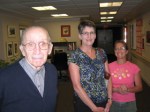
Dad, myself and one of his caregivers.
I was an Alzheimer’s Association caregiver support group facilitator for several years and heard the voiced concerns of those daughters, sons, and spouses, who carried a great deal of guilt on their shoulders for not being able to keep up with the care of their loved one. They did provide the care initially, and then found their abilities wanting – and their health declining. They eventually made the very difficult decision to place their loved one in an assisted care setting.
Here’s the story of “Constance” and “Robert.” Constance first came to my support meeting at the age of 80 having already taken care of Robert at home for the previous three years since his diagnosis. Constance’s health started to decline due to lack of sleep – Robert’s dementia had no respect for the clock. Added to that dilemma was the fact that she had no existence outside of her house. She was trapped! Her friends abandoned her, all the social activities in which she had participated fell by the wayside, but she refused to move her husband into an assisted care setting, even though she felt they had the finances to support such a move – many do not and have no choice but to provide 100% of the care. “No one can take care of Robert like I can. I would never do that to him – placing him in someone else’s care. That’s my duty as his wife; a duty I take seriously.”
Fast forward one year later, and Constance had no choice but to place Robert in an adult family home with five other residents; it was either that, or she would have been forced to relinquish her caregiving role because, quite frankly, she ran the risk of dying before Robert. Once she relocated Robert to a care home, the well-trained staff provided all the assistance Robert needed, and Constance could now have the sole role of being his wife. She visited him almost daily until the day he died one year later.
Constance admitted that she wished she had moved Robert to the adult family home earlier than she had because she realized that being a committed wife didn’t have to include caregiving that risked her own health. She relished her reprised role as his loving wife when she visited him – none of the other care staff could fulfill that role but her – and the staff did what they do best, providing all the care her husband needed.
This is the nugget I want you to come away with from my above commentary: guilt and obligation are normal emotions that might prevent you from making decisions that may very well be in your best interests and those of your loved one. Please believe that allowing someone else to take care of your loved one does not equate to you shirking your familial duties. It does, however, tell me that you know your limits, and you know what is best for your personal situation in the long run. Additionally, it shows that you value your long-standing role as a daughter/spouse/partner/sibling, more than any new role as a care provider. There’s something to be said about retaining your given role in a relationship.
Caveat: as I indicated above, finding affordable care outside of ones home is no easy task, and you may have no choice but to provide the needed care for your loved one. But if you are able to find trusted family or friends who can “spot” you from time to time so that you can enjoy a needed time of respite, please do so. You’ll be far more able to carry out your caregiving task if you take care of yourself first. See my article: Caregiver: put on your oxygen mask first.
Fellow blogger, Kathy, has been struggling with the challenge of living her life without her mom who died from pancreatic cancer several years ago. In the About section of her Blog, Kathy says: “On 12/4/2007 my dad said four words that would forever change my life. ‘Mom has pancreatic cancer.’ I lost my mom to this dreaded disease 348 days later.”
Learning how to live in the present while still mourning a death can be a very difficult matter. Oftentimes we have the need to keep a person’s memory alive by reliving the journey that lead up to the death; ruminating over the whirlwind of activity after the death; and getting stuck right there – either not willing to go beyond that, or simply not having the ability to do so.
The following are very valuable statements: “You’ll get over the sadness eventually. It’ll eventually hurt less. But you have to get beyond where you are, because that’s what your mother would have wanted.”
Those are very true and worthwhile words, but if we’re not ready to hear them, they provide little benefit – at least initially. Am I faulting the person making those statements when he or she did? Absolutely not. What I am saying, however, is that when we’re ready to truly hear those words, we will. We’ll then be able to believe those words, and we’ll be able to practice those words. It’s like having one of those moments that Oprah Winfrey calls, “An aha! moment.” That’s what appears to have happened to Kathy.
Has this ever happened to you? An acquaintance pours her heart out to you; asks for encouragement, advice, etc. and you provide compassion, suggestions, beautiful nuggets of advice, etc., and weeks, or months go by, wherein the acquaintance appears to be stuck in their dilemma, evidently ignoring your well-meaning words, and then – out of the blue – your friend calls you…(you fill in the blanks as to the situation – in this example, the person in need had been having relationship struggles)
Irene, you’ll never believe what just happened! You know I’ve been in a funk because of my relationship challenges, right? Just the other day I poured my heart out to someone on the bus and she suggested I do the following…
It turns out that this bus stranger told her exactly what you told her two months ago. Are you offended? Of course you are – it’s happened to me and I’ve wanted to say, “Well duh – where have I heard that advice before?” The key isn’t whose advice finally got through to her; the key is that the good advice finally got through to her. Time for me to swallow my pride, tamp down my ego, and celebrate this friend’s good news.
Lightbulb Moment (Photo credit: Wikipedia)
Kathy – I celebrate with you that the right words came at the right time for you, and you are now able to take steps towards living in the present. You’re learning how to celebrate your mother while still missing her greatly. Three cheers for Denise for saying what she did when she did, and three cheers for you for having the ears, and a good and ready heart, to hear it.
The last Father’s Day that I spent with my dad, Don Patrick Desonier, occurred on June 17th, 2007. That year had been a definitive year in my father’s decline from Alzheimer’s so I didn’t need to be prescient to know that his time to escape the disease was drawing nigh. (Additionally, it didn’t help that his inoperable prostate cancer had decided to grace his body – like it needed something else to assault it.) I would normally not leave my husband to his own devices on Father’s Day – he’s a terrific dad and deserves to be spoiled – but I knew his adult daughters would give him his due so I left our Redmond, Washington home and flew down to Medford, Oregon for this mid-June celebration with my dad.
We enjoyed a subdued Father’s Day breakfast in the memory care unit’s dining room. My father didn’t eat all that much but he seemed to enjoy the ritual of sitting with his fellow memory-impaired friends as smiles and congratulations circled the table.
Walking with Dad in 2007.
Those of you who are familiar with a memory care unit of an assisted living facility are also acquainted with the dearth of engaging activities therein, especially when your loved one can no longer participate in a meaningful way. Because of that dilemma, I always took my father “off campus” to take a walk at a nearby park. Mind you – his ability to ambulate was hindered, but we usually managed to walk the full perimeter, as we did that day. June in Medford, Oregon is H-O-T, but like many older people whose inner thermometer doesn’t seem to be working at full power – my father was dressed in a long-sleeved heavy cotton shirt buttoned right up to the neck, and an old standby wool cardigan – one of his faves.
Part way through our walk, I somehow convinced dad to at least take off his sweater, and to enjoy some hydration from the bottled water I always carried with me. Shortly thereafter, two 20-something year old men on bicycles approached on the path in our direction; they slowed down and before they passed us one of them uttered, “Happy Father’s Day, Sir!” Dad wasn’t quite aware of what they said but I reiterated their greeting, “Dad, they said Happy Father’s Day to you – isn’t that nice?” “Yes, Irene, it really was.”
Fast forward to June 16th, 2013; this adult daughter still remembers, and cherishes, the random act of kindness by those young men. It made my day in June 2007, and it’s made my day ever since. I’ve never forgotten your greeting, given to an old man who had certainly experienced many Father’s Day events in his 89 years. Thank you – bike riders at Hawthorne Park, on Main Street, Medford, Oregon. I hope you will always be on the receiving end of timely acts of kindness.
You are my heroes because you are ordinary people who did the ordinary right thing on June 17, 2007, making my dad’s last Father’s Day an extraordinary time.
Or perhaps while sitting in the easy chair next to your bed, you tried your very best to ignore the urge to purge … but you couldn’t wait any longer for someone to assist you so you let it all out, leaving you in a shameful way, sitting in a mushy pile of excrement while a stream of urine puddled at the base of your chair.
Welcome to the life of a vulnerable adult living in a nursing home. From coast to coast across the United States skilled nursing facilities (SNF) are filled with adults needing the greatest amount of assistance with their activities of daily living (ADLs) – toileting is one of those ADLs.
The following true scenarios occurred recently at a nursing home in a Seattle suburb, and at a similar facility in a suburb of San Francisco.
(Photo credit: Wikipedia)
A man who is fully reliant on mobility assistance pushed the call button near his bed to register a need for assistance. In this case, he needed to go “Number 1” and “Number 2” and had the audacity to require assistance while the staff was busy attending to other residents’ needs – but not his needs. When a staff person finally entered his room an hour later, she did so to simply indicate that she didn’t have time to take him to the bathroom so he should just go in his pants.
A woman equally as vulnerable needed the assistance of a staff person upon waking in the morning and – knowing that breakfasts were brought around to the rooms at 7 a.m. – the 91 year old started to press her call button at 6 a.m. hoping to have her morning pee prior to the arrival of her breakfast tray an hour later. That “luxury” was one that would not be afforded her; instead, a caregiver brought a breakfast tray to this patient in the seven o’clock hour and when the patient asked if she could receive help to the toilet prior to eating her breakfast, the employee told her to just go in her pants because no one had time to help her at that moment.
I can’t help myself – here’s another incident: A staff person helps a woman to the toilet first thing in the morning. The woman who is clothed in a lightweight nightgown finishes using the toilet and is ready to receive assistance back to her bed – but lo’ and behold, the staff person forgot to place the call button within close reach of the patient so she is not able to alert someone of her desire to go back to bed. Enough time has passed that by this time the patient is shivering and screams for help – screams that went unnoticed for a quarter hour. In desperation this elderly woman somehow managed to lean far enough forward to push over a metal trash pail which she then kicked repeatedly until someone finally arrived to see what all the commotion was about.
These stories don’t paint a very pretty picture do they? They depict a low quality of life that no one deserves.
What does Quality of Life mean to you?
Eating at fine dining establishments?
Having a clothing wardrobe that rivals the catwalks of Paris?
Driving in a luxury vehicle that provides amenities previously only found in limousines?
For most of us, quality of life boils down to leading a dignified existence in which we are allowed to take advantage of the basic necessities of life. For me, those necessities should include a safe living environment, sustenance, the inclusion of loving family and friends in my life, the freedom to make choices about matters that are important to me, and being on the receiving end of respectful behavior from those with whom I come in contact.
The most vulnerable among us should expect no less than those basic necessities, but “the system” isn’t working to guarantee those basics. Try to imagine, if you will, your own grandparent, parent, spouse, partner, or other family member in any one of the above scenarios. How comfortable are you with that type of day-to-day existence for them? You’re not comfortable at all – as a matter of fact you’re feeling a bit uneasy about this whole subject matter. I’m sorry to place doubt in your mind about the care your loved one is receiving but I’ll just bet that you need to get out of the comfort of denial you’ve been enjoying and into the eye-opening role of resident advocate.
Lack of caring = lack of care. Nursing home management is a tough job to do correctly, but I know it’s possible because there are some reputable and well-run facilities out there – not perfect by any means, but fairly acceptable. So yes, some nursing facilities employ stellar care staff but there are also those employees who just don’t give a damn. “I go to work. I go home after work. I get paid. What more do you want from me?” Caring – that’s what we want. You’ve chosen to work in this particular type of environment so don’t act like you didn’t know what you were getting into. Withholding proper care for those who have no recourse but to depend upon you is not only unfair, but it’s illegal. And how about answering these questions about your own aging prospects: Do you think you’ll somehow skip the journey into old age? Do you not realize that you too will be as old as the patients whose care is entrusted to you? What type of care will you hope to receive? Does it resemble any of the scenarios I’ve illustrated above – or are you under the impression that you’ll be at a “Champagne and Chandelier” type of place where you’ll be waited on hand and foot?
Not gonna happen.
This article just scratches the surface of the sub-standard care that can be found in nursing facilities. I only mention the toileting issue because it’s been front and center in my experiences with some of my acquaintances lately. One place to start getting some positive traction where these matters are concerned is the National Long-Term Care Ombudsman Resource Center where you’ll find links to advocacy programs in your state. Call those local representatives and report any concerns you may have about how your loved one is being cared for, or not cared for, in their nursing facility, assisted living facility, or group home.
If you act on behalf of your loved one, you’re also acting on behalf of everyone else in the facility because trust me – your mom isn’t the only one being neglected on her nursing home floor.
You’ll see that the title of my blog article is different from what is attached. This blog title reflects what my local Seattle Times newspaper printed as a heading for Leonard Pitts’ article concerning the May 2013 bloody attack on a British soldier. The Seattle Times title said it all for me.
Now keep in mind, we’re not talking about impotence for which the pharmaceutical industry holds the panacea. The impotence addressed in this must-read article by Mr. Pitts is that which comes about because of a lack of true power. Have you ever been bullied? I have – and it wasn’t until fourteen years ago that I came to the realization that those who bully are those without power; those who feel they must wear trappings that give the illusion of power; such as the trappings of abusive language, character disparagement, and small & large scale violence – destructive acts by anyone’s assessment.
Pulitzer Prize winner, Leonard Pitts, Jr., believes that “terrorism’s threat lies not in its power, but in its effect, its ability to make us appalled, frightened, irrational, and, most of all, convinced that we are next, and nowhere is safe.” Mr. Pitts provides an example of an acquaintance who, after 9/11, told him she would never enter a skyscraper again – as if each and every tall building in our country would be on the receiving end of an airplane attack. My god, think of those people who work in these buildings and who, if they maintained the same fear and naive determination as that woman, would throw our economy even further into the toilet because of their refusal to enter their place of employment – a very tall building.
I think the biggest weapon these flaccid terrorists carry in their arsenal is the world’s ability to instantly broadcast – and then repeatedly broadcast – these desperate acts of violence, and our desire to catch such acts on television, You Tube, blog videos and photos – the list of viewing opportunities almost endless.
“We cannot control what such people do. But we can control our reaction thereto” states Mr. Pitts. Please readers near and far, let’s not fuel the fire of violence with our cravings to see it played out before us countless times through instant electronic images. Let us fuel our empathy and strengthen our determination to turn our backs on the sensational by responding in such a way as to not “become the weapon terrorists use against us.” Let’s not give these weaklings any more power – because as stated in the Miami Herald piece, “the only power they have is the power we give them.”
Here’s a new category of posts in which I will provide a circumstance, and you can provide your potential response; similar to a television show in the United States for which I’ve seen ads.
Here’s the circumstance that I encountered today that has inspired this initial post:
I walked into my local grocery store today, and waited at the Customer Service counter to cash in my winning lotto ticket: $10 Woo hoo! (The Customer Service counter is just outside of the public restrooms.)
(Photo credit: Wikipedia)
As I waited for customer service, what did I see, but a male customer exiting the men’s bathroom, with a USA Today newspaper in his hands. It doesn’t take an advanced educational degree to discern what this customer had just done – in the bathroom, with a newspaper. By the way – USA Today is just one of many newspapers found on shelves approximately 20 feet inside the store’s entrance that one can pick up and purchase at checkout.
But that’s not all. This customer then placed the very same newspaper – no longer a virgin-clean newspaper – on one of the seldom-used checkout counters, gathered his shopping cart where he had parked it while he did his business in the bathroom, and then happily proceeded to do his shopping.
As luck would have it, this same gentleman was right in front of me paying for his groceries while I loaded up the checkout counter with my soon-to-be-purchased items. He walked away, I took my place at the checkout counter, glanced over at the seldom-used counter near the public restrooms, and there lay the USA Today, in all its tainted glory.
What would you do?
Postscript: A family member/reader suggested that the newspaper reader may have indeed already paid for the USA Today. I agree, that’s a possible scenario. Let’s take that thought a wee bit further, shall we? Perhaps the paper had been paid for and the newspaper reader left it on the checkout stand so that someone else may enjoy the day’s news, free of charge. (What a generous thought on my part.)
Even going with that wonderfully generous supposition, shouldn’t the next person on the receiving end of the free newspaper have been made aware of the previous owner’s potty antics e.g., perhaps the satisfied pottier could have placed a sign on the newspaper stating that this issue of USA Today had already spent considerable time in the men’s bathroom and therefore, in full disclosure, you have first right of refusal should you decide not to read a newspaper that has been in close proximity to someone’s morning duty?




 Living: the ultimate team sport