A recent NBC Nightly News story focused on the role of caregiving as adult children take on the parental role vacated by their parents.
Imagine, if you can, handling all that you normally do in your hectic life and adding between 20 to 60 more hours to your workload. Haven’t arrived at that point yet? Of this potentiality you can be certain – all signs point to that being in your future. Whether your involvement is characterized by general care for an aging family member, or specialized care for a family member with cognitive decline, caregiving is most likely a task to which you have not devoted much attention.
It is said that 1,200 people per day are diagnosed with Alzheimer’s or other dementia. Let’s re-categorize that statistic: 1,200 caregivers are created every day.
The new ad campaign, a joint project between AARP and the Ad Council, was created to address the impact of family caregiving with the graying of the population. This ad campaign seeks to provide resources for those who are thrust into this role for which they are ill-prepared.
“Although they often don’t identify themselves as ‘caregivers,’ more than 42 million Americans perform some form of consistent care for older or impaired adult relatives or friends, according to a 2009 estimate. It can range from paying bills, to driving Mom to doctor appointments, to more hands-on care such as bathing, and even tasks once left to nurses such as the care of open wounds.”
Taking a walk with my wonderful Dad in 2007.
And as many of us who have been in that caregiving role can attest, ones’ active role goes on and on when behind-the-scenes caregiving occurs, dealing with finance and insurance issues and the like during our alleged “free” time; a time when others are settling down to watch their favorite TV show or to read a good book.
This extraordinary AARP/Ad Council project is broader than another effort that is part of the new National Alzheimer’s Plan that can be found on the federal government’s website, www.alzheimers.gov. But both of these projects address the loneliness inherent with the caregiving task when so many caregivers feel, and become, isolated and adrift in an ocean of frustration and despair.
FINALLY some resources are being directed to the tidal wave of caregiving issues that Baby Boomers face. It may be too little too late, but it’s more than has been available up to this point. My hope is that the generation in which our children live will have sufficient resources to deal with us Baby Boomers because if our children think this caregiving task is going to jump their generation, they’ve got another thing coming to them.
And I apologize ahead of time for what awaits you.
I learned something today for the umpteenth time and it came from someone who died two days ago at the age of 54 as a result of a 14-year battle with benign, but aggressive, meningioma brain tumors. Kathi Goertzen underwent numerous surgeries; endured countless chemotherapy and radiation treatments; and sought out additional therapies in other countries. But these tumors mercilessly came back again, and again, and again. Nerves in her face were destroyed making it difficult for her to speak as clearly as she wished. Similar nerve impairment gradually affected her ability to swallow, and therefore, eat. And what makes all of those symptoms more notable, is that Kathi was the consummate news anchor at a Seattle ABC affiliate, Komo4 News. Kathi was on camera for over thirty years and even when she was no longer able to sit at the anchor desk, Kathi powered through as a field reporter both in the United States and abroad.
Giving up was not in Kathi Goertzen’s DNA. It became obvious to all of us – and I never personally met her, she was simply one of the news anchors I admired the most – that Kathi virtually defined the word “tenacious.” Throughout the years, Ms. Goertzen spent countless days in the intensive care unit (ICU) of local hospitals with her husband, two daughters, parents & siblings, and her Komo4 News family standing by her as the most supportive cheerleading team of its kind. And once she got over that bump in the road, she carried on in her media career, and as an extraordinary wife and mother – the latter which she considered her most important roles in life. A recent video tribute to Kathi, which can be found at the Komo4 News link, shows interviews with Kathi in which she said that she didn’t want people to feel sorry for her; she didn’t want all the attention that this unfortunate condition drew to her. And then there was this statement, paraphrased from the video tribute:
These tumors don’t define me. I won’t let them!
I immediately thought of the many times I let hardships and circumstances define who I am. Oh, it’s so easy to give in to the tendency to feel sorry for ourselves isn’t it? To pay more attention to the bad than the good. It’s scandalous to think that in my several decades of life I have given the hardship (whether it be chronic pain, relationships, job struggles and the like) the upper hand, thereby giving power to that which should have never been given purchase in my life.
Thank you Kathi for getting through to me on this very important issue: circumstances don’t define me, I’ve only ALLOWED them to do so.
The linked article, above, from a fellow Blogger is very much worth the read as it’s just one of many stories occurring around the world when loved ones – whether because of dementia or just advancing age – face the decision of whether or not to put down the keys to a vehicle that can cause untold damage to the driver, and all those in his or her path.
In my article, Driving with Dementia: the dangers of denial, linked here, I address this dilemma that many families encounter. I hope both of these articles provide you with helpful information so that you are able to make informed decisions centered around the dangers of driving with an age or disease-related impairment.
Why? Because at least 150 people attended my sister-in-law’s memorial service, held after she passed from complications associated with Alzheimer’s disease.
I know that the count of 150 is nothing compared to a stadium full of football, baseball, or soccer fans. But this 150 people showed up on Monday, the beginning of most people’s work-week, to honor my brother and his stepchildren, and memorialize a woman who impacted their world greatly.
How the day unfolded. Individual after individual arrived: some driving south from British Columbia, Canada, one person even flying in from Toronto, Canada, and numerous people driving north from California and Oregon state. At first it looked like those who set up the venue with numerous chairs had overcompensated in their attendance projections. That was not to be the case. By 2 pm, the scheduled start of the memorial service, additional chairs had to be set up. By 2:15 pm, some of us, most notably my brother, were sweating – not just because it was very hot on that particular Seattle, Washington day, but because the Officiant for the service had not arrived – and never did. But that’s not important.
Time for Plan B. I joined my brother outside just after 2 pm and I suggested that since the Officiant had not yet arrived, it was probably time to figure out Plan B. All the immediate family members sprung into action and the parts that would have been attended to by the Officiant were superbly handled by other family members. Even my brother – who had NOT planned on saying a word during the structured part of the service – walked to the front of the room and spoke beautifully about his wife’s journey to finally reach “home.”
Home is not just a structure with four walls. Quite a few times during my sister-in-law’s illness, she told my brother that she just wanted to go home. Now for those who aren’t familiar with Alzheimer’s or other dementia, oftentimes “home” means comfort, freedom, peace. That was the case with my brother’s spouse. She died on the American holiday, July 4th, also known as Independence Day. That day was her Independence Day, when she could finally flee to comfort, freedom, and peace, with a body – and mind – untethered by any restrictions.
Many blessings to my sister-in-law, my wonderful brother/spouse caregiver, Don, and all of the surviving family members. Monday, August 13th was truly a Celebration of Life and Liberty.
I would have been a wee bit less physically careless during the decades from 20 years old thru 40. Maybe the joints in my extremities wouldn’t complain as loudly and as often as they do now.
I would have certainly not believed that I knew everything there was to know at the age of 21. How many of you remember the well-deserved warnings from your parents, or even your peers, trying to steer you away from ill-advised decisions you were making at the time?
I would have chosen a different major in college instead of going with the subject matter at which I excelled most. It seemed like a no brainer to me: I’m a straight A student in the French language, so obviously that’s what I’m supposed to be studying during my university years. Haven’t used it since.
(Photo credit: Wikipedia)
I would have known that Peppermint Schnapps and beer do not go together…at the same time…many times over. I can only say that I am a living testament that I somehow survived those careless early 20’s irresponsible drinking bouts and learned my lesson BIG time.
I would have known that a rabbit coat – although fashionable at the time – was cruel beyond measure. It was inexpensive, it was warm while I lived in Alaska; what can I say, I thought I was making a fashion statement.
I would not have purchased a snazzy white 1979 Mustang with bright yellow & green racing stripes. Further confession: I didn’t really like it all that much. At least it wasn’t a convertible.
I could go on, and on, and on – pretty entertaining, aren’t I? But I’ll now turn it over to you to add your own Baby Boomer Lessons Learned comments at the bottom of this article.
This is such disappointing news to the Alzheimer’s community which at its heart includes those suffering with the disease and the family caregivers suffering right along with them.
As someone who in the past has been personally involved with this disease as a caregiver for my father, I have experienced elation at the start of new drug trials – and defeat when those trials failed. This disease just seems to be one that evades all goodhearted and extensive attempts to slow down the disease.
A cure? That doesn’t even seem to be on any horizon I’ll see before the end of my days. But this insidious disease can’t even be slowed down, for heaven’s sake, so that the patient and all of his/her family can enjoy a better, longer, and less-impaired life.
Will Shakespeare’s age-honored words, spoken by Polonius to his son Laertes in Act I of Hamlet, stand on their own – seemingly not needing any explanation whatsoever:
(Photo credit: Wikipedia)
“This above all: to thine own self be true, and it must follow, as the night the day, thou canst not then be false to any man.”
If Laertes were to be totally honest with himself, he would realize that his father may as well have told him to catch the wind. After all, to which ‘self’ are we to be true? Is it the one that shows up when we’re in a bad mood, or the one that is present when we feel humbled by our mistakes? Is it the one who speaks from the dark recesses of the heart when we’re depressed or upset, or the one that appears during those fleeting moments when life seems so fanciful and light?
Mr. Singer’s statement really gave me pause because so often, my “authentic self” is hidden away. By that I don’t mean that I’m being fake – I try as hard as I can to present an accurate image of who I am – but let’s face it, some days we’re out of wack and what comes forward on any given day, in any given hour, is just one aspect of the split personalities of our being.
I think all in all I’m a pretty decent person, and on my best days I’m far more thoughtful towards others than I am towards myself, but I am an imperfect being who has lived on this earth for 59 years so I’m quite sure that I’ve missed the mark more often than I would have wanted to. But as I reflected in my article, “The complexities and joys of feeling deeply,” I am VERY hard on myself and I tend to be less hard on others.
But not always – and therein lies the dilemma. If I go out of my way for 100 people in a single day – a virtual Mother Teresa wannabe – and get infuriated at a driver on the road who I have perceived as inciting a road rage anger that I pretend not to have, I have not been true to the person I was during the earlier part of my day. In this particular example, I would have been hearing a voice to which I submitted with feelings of anger and personal affront, instead of asking myself whether or not the voice is giving me good advice. Is that voice helpful? Probably not. There could have been higher/better ways to deal with that perceived slight. I can make a choice to be reactive – which is what the mind does – or lean way from the emotion – which is what the spirit and/or soul does.
With the imperfection that I embody, I will try to do the latter.
I love this blog posting from a fellow blogger who happens to live in Australia. Her blog web address is: www.restyleingyourlife.com. As implied in her Blog, there are so many maxims by which to live and I thoroughly enjoy receiving nuggets of wisdom from those maxims, be they a quote from someone famous, or a sentiment from an unknown. I’ve been keeping a list of quotes/sentiments on my computer which I call:
Quotes of Note.
Please read the article attached at the top of this post and if you feel the urge to read further, I provide just a few quotes that have great meaning to me in my quest to get better with age (where author is known, his/her name is noted):
Do the right thing. It will gratify some people and astonish the rest. – Mark Twain Also by Mr. Twain: The difference between the right word and almost the right word is the difference between lightning and a lightning bug.
Don’t be concerned with the consequences of choices other people have made. Worry only about the consequences of your own choices.
Believe you might be a light for someone else. Albert Einstein provided a similar sentiment: Sometimes our light goes out but is blown into flame by another human being.
Being helpless isn’t really a state of being. A person who feels helpless simply needs help – there’s a big difference.
Life doesn’t have to be about chasing butterflies. It can be about swatting flies with a smile on your face. (And God knows there are more flies than butterflies in the world!)
A few quotes/comments that line up with my life philosophy:
Do all the good that you can, in all the places you can, in all the ways that you can, at all the times you can, to all the people you can, for as long as you can. – John Wesley And perhaps the following comment can be the catalyst for following Mr. Wesley’s thought:A siren is the sound of a society taking care of its citizens.
And I’ll leave you with a few comical statements found in books I recently read:
Bless me Father for I have sinned. It has been forty-six years since my last confession. My how time flies.
The gym I belong to could more accurately be called my favorite charity.
And that’s it for now on this Friday in Redmond, Washington. See you soon!
The article above reflects what is offered by Pauline Boss in her book Ambiguous Loss. I highly recommend the above Alzheimer’s Reading Room article as well as Ms. Boss’s book for any spouse who is taking care of their wife/husband at home or if your spouse is already living in a dementia care unit.
The author, Pauline Boss, explains it this way: when a loved one dies, we mourn the loss; we take comfort in the rituals that mark the passing, and we turn to those around us for support. That doesn’t happen when a loved one is still alive, but the losing occurs nonetheless. And this period of loss may go on for years prior to the spouse’s final departure through death.
One of the statements that Ms. Boss introduces is that “it is o.k. to love a shell.” Anyone who is married to someone with dementia knows that, in essence, a shell is what their spouse becomes with advanced dementia. But if the “surviving spouse” is able to draw on the memories of their marriage, they find themselves able to love their spouse regardless of the disease. Unfortunately, the memories remembered are no longer shared memories; joint reminiscing no longer occurs. Your wedding anniversary passes without any acknowledgement by your spouse, and although that’s just one of the burdens during this long period of loss, it’s a difficult one to bear.
Caregiving is a difficult, 24/7 task. I honor you on your journey, and I hope you find comfort and direction in the above resources, as well as the resources that the Alzheimer’s Association provides.
You know how people sometimes say, “I’m tall, because I got all the extra height that no one else got in my family,” or “Everyone else got the smarts in the family – I got what was left over.”
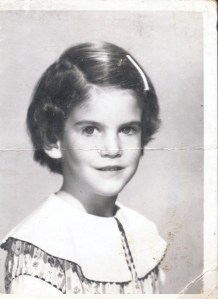
My kindergarten photo.
Well, for me, I think I received all the leftover emotions and feelings of every person born on May 18, 1953 because I have such deep feelings about all that goes on around me. I’m delighted that I’m sensitive, yet I’m aggrieved as well.
How does this trait manifest itself in my life?
I can’t readily clear my mind when disturbing global or local events occur because I’m wondering how those affected are doing.
How are the survivors of a mass murder handling the mundane task of waking up each morning and putting one foot in front of the other?
How does a mother carry on after burying her child who was killed in the same car accident she was in when, through no fault of her own, a semi-truck lost its brakes and careened into her little Volkswagen?
How can anyone claim victory when a bomb takes out some enemy insurgents, and in doing so, innocent men, women, and children lose their lives?
I know I’m no different than you. I’m certainly not special; many people experience feelings deeply. But sometimes for me, it gets in the way of rational behavior, manifested in the following way:
When I say something to someone, I rethink and rethink, and rethink yet again whether or not I said it the right way, or with the right voice.
Or knowing that I’ll be having an important conversation with someone, I might even practice saying what needs to be said prior to offering my thoughts to someone else – and God help me, sometimes I even write it down.
Arrrggggh! That was certainly something I inherited from my father – God rest his soul. In my eyes, my father had the quintessential talent of preparing his words in such a way as to make the greatest positive impact on others. Regrettably, it’s that attention to detail that sometimes gets in the way of spontaneity.
And sometimes, even when I’m convinced that what I’ve done or said is correct, I’m still very hard on myself, feeling that I’ve done or said something wrong, even when what I was trying to do was something right.
Maya Angelou has a wonderful saying that Oprah Winfrey often borrows:
“When you know better, you do better.”
Which I’ll take a step further:
When you do the best you can – with what you know – you’ve done the best you can.
I’ll take comfort in that statement and continue to be the sensitive, somewhat paranoid, person that I am. For the most part it has worked for me, but more importantly, I hope it has worked for others.
The senior care industry is a dangerous maze wherein even the well-educated and well-intentioned providers of care fail to put any “care” in their caregiving. Whether at an assisted living facility or at home with private care, the path of least resistance is oftentimes the one taken and the accompanying attitudes reflect such feelings: “Man, I just gotta get over this shift! These people are driving me crazy!” “I know, I’ll just stick her in front of the TV while I catch up on my Facebook posts/soap operas.”
Don’t worry everyone – I’m not saying that there are NO ethical, compassionate caregivers, there definitely are – but attention must always be focused on those who don’t provide stellar care because the vulnerable amongst us are at the mercy of their care people. Those hidden in a private home are the most susceptible. Why? Because there are very few sets of eyes observing the day-to-day happenings. At a facility, the existence of ongoing traffic – family members, visiting ministries, long-term care ombudsmen/advocates – provides some sort of monitoring that a private home does not and can not provide.
The attached article – link above – is quite thorough. Please take the time to review it.
A fellow Blogger, Frangipani Singaporenicum, submitted an excellent article, “Mom is Back,” about the hurdles experienced when her mother traveled by airplane back home after a visit with one of her daughters. Frangipani’s siblings weren’t fully aware of the breadth of their mother’s disease so they thought that the mother would be in good hands at the airport because they had arranged for an airport escort to get the mother to her airplane destination.
Unfortunately, what could go wrong did go wrong. “Frangipani’s” mother has mixed dementia, Alzheimer’s and vascular dementia, and found herself in unfamiliar surroundings when she became separated from the airport employee – a stranger in the mother’s eyes – who was supposed to assist her. Getting lost in an unfamiliar environment is something that comes quite naturally to those with any type of dementia. And as often happens when a person is lost, we try to get un-lost. That attempt brought her mother to another airline terminal where a kind gentleman, noticing her distress, found the assistance she needed to get on the correct plane at the right time.
Those of us who have children – and please bear with me while I make this comparison – know how easily a child can wander away from our purview. We make a quarter turn at the grocery store to get a box of cereal off the top shelf and “POOF!” our child is nowhere to be found. I’m very familiar with this feeling because it happened to me many years ago when my adventurous daughter wandered away – causing me near cardiac arrest – and was subsequently prevented from exiting the grocery store by a Good Samaritan grandmother who knew better than to let my daughter run out into the parking lot. “But I only turned away for a second!” That’s all it takes.
So too can a person with dementia wander away because of something that attracted him; or more likely, with your back to him, he didn’t recognize you any more and walked away to try to find you. “But how can I keep my eye on him at all times?” You just have to.
SOME TIPS OF THE TRADE.
(Photo credit: Wikipedia)
Public restroom challenges. If you or your loved one needs to use the bathroom, find one of the family bathrooms that now exist in many public places so that your environment is controlled, and everyone’s needs are met. Don’t think for a second that you can say to your husband, “George, you stay here while I run into the ladies’ room. I’ll just be a minute.” Be prepared to call security when you come out of the ladies’ restroom because in George’s mind, you disappeared, and the time frame of a minute means absolutely nothing to him. And forget about sending your husband into the mens’ room by himself to meet his potty needs. You’ll be waiting, and waiting, and waiting, and he just a) may not do his business; and b) may not come out on his own. If no family bathrooms are available, stand at the entrance to the public restroom and announce yourself: “Woman entering with husband who needs assistance!” You’ll find that those within will cover up what needs covering and not call security on you.
Medic Alert (Photo credit: Nikita Kashner)
Medic-Alert jewelry. The Alzheimer’s Association strongly recommends purchasing a Medic-Alert/Safe Return device which provides 24/7 emergency response service. At least if your loved one gets lost, they will be reunited with you sooner. This service is available in 50 countries, and in 140 languages. The service speaks for itself so please check the link attached to research the many benefits of this membership service that, quite frankly, brings priceless peace of mind and provides a healthy dose of safety for your loved one.
Now they see you – now they don’t. The examples cited above would not be complete if I didn’t add a personal experience from my days of being my father’s primary long-distance caregiver. My dad lived in a Continuing Care Retirement Community (CCRC) in Southern Oregon. When first diagnosed with Alzheimer’s he was very functional and remained in the assisted living apartment on campus that he had shared with his wife prior to her death in January 2007.
I stayed at a nearby hotel when I visited my father but spent most of the day with him on outings and/or spending time with him in his one-bedroom, one-bathroom apartment. At one point during an apartment visit, I announced to him that I was slipping into the bathroom, 10-feet away, and would be just a minute or two.
I was glad to have locked the bathroom door because partway during my “sit” dad was frantically jiggling the doorknob from the bedroom side of the door shouting, “Irene! Where are you?! Are you o.k.? What’s going on?!!” I was less understanding at the time and returned my own crazed shout of “Dad!!! Leave me be! I’m just going to the bathroom!!!” Knowing what I know now, I would have exited the bathroom and apologized for frightening him, and made every attempt to make him feel safe again. As Oprah Winfrey often says, “We do better when we know better.”
This unintended “peek-a-boo” event proved to me that my father did not have an understanding of the passing of time, but more importantly, that if he couldn’t see me, I wasn’t there. Back to the example of children, but this time, you’re the child.
You’re at play in your bedroom, having just left your mommy gleefully singing in the kitchen while she did the dishes. Your dolls are lined up on your bed, you’re engaging them in discussion, and all of a sudden you notice that mommy isn’t singing any more. You toddle out to the kitchen, and mommy isn’t where you left her!!! “Mommy! Where are you?! Mommy – I’m scared!!! Help me Mommy!!!!!” Your mother steps out of the adjoined laundry room and calms you down – “Irene, I was just five feet away; I didn’t go anywhere, I’m right here!” You run into your mommy’s arms and feel safe again.
Alzheimer’s and other dementia are very unpredictable diseases. What can be predicted, however, is that the onus will always rest on us to compensate for our loved one’s challenges. As I’ve mentioned in previous articles addressing dementia, we have the ability to adjust to the diseased person’s reality; not the other way around. It’s hard work for us, but it’s an impossible task for them.
Kind of like the movie “Network” in the iconic scene where the actor Peter Finch, as Howard Beale, says, “I’m as mad as hell and I’m not gonna take this any more!”
(Photo credit: Wikipedia)
What is often left out from that quote is the statement made just prior, “I’m a human being. My life has value.” I think some spouses in their 50’s through their 80’s decide that after decades of a somewhat dissatisfying, or perhaps an abusive, marriage they realize that they have a whole lifetime ahead of them and decide that they deserve better. In an article from the AARP June 2012 Bulletin, one of the reasons for a late-in-life divorce centers around the fact that longer lives mean more years with an incompatible spouse. And even though the overall divorce rate in the United States has decreased since 1990, it has doubled for those over age 50.
Jay Lebow, a psychologist at the Family Institute at Northwestern University says, “If late-life divorce were a disease, it would be an epidemic.”
Wow!!!! I had no idea! I’m fortunate in that my second marriage at the age of 47 is still one in which I am very happy now twelve years later. There are those, however, with whom I am acquainted who stick to the dictum of “in sickness and in health, until death do us part” even through an abusive relationship (verbal, physical or otherwise) and, because they’ve been in it for the long haul, e.g., 30 plus years, they feel that they have no choice but to stay.
Why do those with abusive spouses – both male and female – cling to their marriage?
As I mentioned above – one reason is certainly the commitment to vows that were made at the height of a romantic relationship. And there are other reasons. An excellent therapist with whom I am acquainted who leads support groups for the abused told me that over the years, as abuse has prevailed in the household, the one being abused adjusts to each added level or intensity of abuse and becomes acclimated to each added degree. Added to this unwarranted commitment to their abusive spouse, they fear the unknown, even though it may bring about an abuse-free life. And without the help of good friends and powerful resources, a spouse in an abusive relationship may not have the tools that will give them sufficient confidence to make a decision that will benefit them the remainder of their life.
Divorcing later in life can often result in less time to recover financially, recoup losses, retire debt, and ride the ups and downs of the economy.
Some Baby Boomers out there have relished the security that their spouse or significant other has provided them in the form of financial stability. They’re thinking that perhaps it’s worth putting up with this person with whom I am incompatible to guarantee a comfortable enough life until one of us dies. Well – certainly that is a factor – but I personally believe that an individual’s life contains far more value than any bank account can provide. If someone is feeling devalued in their relationship, they have short-changed the remainder of their life. And if someone truly craves, absolutely longs for greater self-worth, nothing will stop them from satisfying that need. I guess you have to look at the options and determine if you’re willing to go with it:
living in a mortgage-free home without financial concerns with someone who tears you down, or renting a one-bedroom apartment with thrift store furnishings, that frees you from a relationship that has prevented you from being your true, and valued self.
But who will take care of me in my old age?
A 2009 National Alliance for Caregiving/AARP survey found that 66% of caregivers were female, with women providing on average 22 hours per week vs. 17 hours for males. In a divorce situation, “older men may make out better financially than women, but they don’t fare so well at finding someone to take care of them when they’re older. They often don’t have alternative care networks the way women do,” says Andrew Cherlin, a sociologist at Johns Hopkins University. When asked who they will turn to when they’re older, single men often cite paid help – a pricey and somewhat difficult option to find. Some older divorced people have children or other family members who can assume the caregiving role, but not everyone does.
Gray divorce is occurring and there are certainly many factors to consider. I guess I’m of the belief that a bad marriage is not better than living alone. Whether you’re a Baby Boomer – or of any other generational group – only you can decide what you’re willing to sacrifice in order to obtain your sense of personal value. As far as I know, we’ve only been given this one life. This is not a dress rehearsal and there are no do-overs.
What a terrific article provided in the above link from the “Taking Care of Mom and Dad” blog site. The information provided in this article is valuable, and as Kelli mentioned on her blog, it’s not just specific to the state in which it originated, Oklahoma. The information provided is applicable everywhere because let’s face it – every caregiver pretty much needs the same questions answered and this site has many one-size-fits all solutions for all caregivers who are grasping to stay afloat on their caregiving journey.
This same website can also direct you to your own state’s valuable resources by clicking on the applicable section on the Homepage. It’s as easy as that! And don’t we all need something to be easy every once and awhile?
In the past year, I have lost two coworkers to cancer. Just recently another coworker left his job due to – you guessed it, cancer – so he could spend what remaining time he has with his family. These wonderful people were given a death sentence. They had a head’s up as to when their life’s end/deadline would occur.
Because I care for these people, I’ve been grieving and pondering what their remaining days and weeks were like.
What does one do when they leave their doctor’s office after receiving a fatal prognosis and a guesstimate of how much time remains for them? Of course the initial news floors them and their emotions run wild with rawness, sadness, fear, and maybe even extreme anger. But then they get home, hopefully surrounded by at least one loved one, and…then what?
Scrabble game in final stages (Photo credit: Wikipedia)
I know much discussion will ensue of an emotional, practical, and perhaps even legal manner. That goes without saying.
But do you then get out your bucket list and see if any remaining items can be checked off before time runs out?
Or how about a game of Scrabble? Does that seem too mundane and unimportant in light of life’s waning hours?
I’m not trying to be cavalier about this matter and I hope I’m not coming off as insensitive. I’m really troubled by even thinking about having such a prognosis and filling out my remaining days in a valuable way. And again, I’m thinking about my coworkers’ final days and wondering what those days were like for these stellar people. How did they manage?
Personally, I have a very realistic outlook on death – it’s certainly inevitable. I’ve accepted the fact that no one can escape it. And of course I have my preferences on the manner in which I die. For example, if I’m fortunate, I’ll follow in my mother’s footsteps when back on September 24th, 1994, she went to bed none the worse for wear, and never woke up again. Since no autopsy was done, we don’t know the actual cause of death but on this my family can agree – if we have the choice, we’d like to be taken by surprise – in as pain free a manner as possible. If I’ve left no statements unsaid, no deeds left undone, I’d rather not have a calendar in front of me crossing out each remaining day in my life.
How would I fill my days if, like my coworkers, I’m given a death sentence of a finite period of time?
I don’t have the answer, so if by chance you’ve been part of life’s final deadline with a loved one or close friend, what proved valuable to you and your loved one? How did you manage not to think of the remaining time every minute of every day?
In yesterday’s post, a Seattle Police Detective defined elder abuse as:
sexual abuse
physical abuse
financial exploitation
neglect
In Part 6 of Seniors for Sale: Placement perils and successes, Michael Berens, Seattle Times reporter, delves into the senior housing placement industry, focusing on one placement company that placed a client in a Tacoma-area Adult Family Home (AFH) with a history of safety and health violations – elder abuse – even a fatal event, but because the placement company had not done its research, it was not aware of the home’s previous infractions and kept placing unknowing vulnerable adults in the home’s care.
Many of these placement service companies operate state-wide and/or nation-wide, and believe that there is no way that they can help as many people as they do if they are required to visit each and every home/assisted living option available to the public that they are trying to assist. These companies are oftentimes characterized as Bed Brokers – an industry that is growing exponentially without much scrutiny or State controls.
CAVEAT: Just as in every assisted living situation – there are good senior housing options and there are bad senior housing options – so too there exist reputable senior placement companies, and not-so-reputable placement companies.
I personally think that these companies can be helpful to those looking for a senior housing option that suits their, or their loved one’s, needs. I caution those using these agencies, however, to understand that not every option out there is listed with placement companies. If a senior housing company does not choose to be listed with a placement service company, that option will not be offered, even if that particular housing option might be the verybest choice for some families: cost-wise, location-wise, and even service-wise.
In a news update, Michael Berens’ article, State gets tough on referrals for elder care, we see that attention is now being directed at these placement referral companies in the hopes that those they serve – vulnerable adults in need of some sort of daily care – are protected from those companies who are simply aiming to make a profit at the most vulnerable time in an elder’s life.
As I mentioned in previous articles found in my blog category, Senior Housing, there are numerous resources available for those looking for senior housing for themselves or a family member. Please go to that category and type in a search term in the space located on the right-hand side of the page to find the topic that interests you most.
Part 5, of Seniors for Sale: Hiding Harm: the human toll, is one example of the lack of reporting that goes on in some assisted living residential settings – in this case – an Adult Family Home (AFH).
When you watch the video link above, you’ll be shocked at how a particular accident happened – and its after effects on the victim – and you’ll be horrified at how long it took before it was reported to the police.
Perhaps this statistic will provide a partial explanation:
only 16% of all incidents of elder abuse are reported.
The Seal of Washington, Washington’s state seal. (Photo credit: Wikipedia)
Not only are many caregivers not reporting incidents of abuse that occur; surprisingly, family members fail to get beyond the denial stage when they discover that their loved one just might be in danger in the very location entrusted to his/her care. They can’t believe that the caregiving solution they found for their loved one has turned out to be disastrous in every way.
The police investigator for this case states the following:
We don’t tolerate domestic violence, but that’s not always the case with elder abuse.
The final episode of Seniors for Sale will be submitted tomorrow, Saturday.
What Needs to be Done? is the subject matter of Part 3 of Seniors for Sale. In this episode, the viewer is encouraged to do research about a facility, Adult Family Home or otherwise, prior to considering a move to that senior housing alternative. In my article, “Avoiding the pitfalls of selecting Senior Housing,” I provide helpful resources that everyone can use in order to find out:
if any complaints have been filed against a particular home;
if the State issued any citations, and the nature of those citations;
if the Long-Term Care Ombudsman office received particular complaints and the nature of those complaints.
The Seal of Washington, Washington’s state seal. (Photo credit: Wikipedia)
No one has to go into this housing search blind. Please view the very brief video provided in Part 3 of this Pulitzer Prize winning series by Michael Berens of the Seattle Times, then click on the attached article that I’ve provided for your assistance. Although the links I provided relate to resources in the State of Washington, similar resources exist nation-wide. Check with your State Ombudsman office or Department of Health and Social Services for your State’s equivalent.
The Great Seal of the State of Washington (Photo credit: Wikipedia)
The attached link connects you to Part 2 of 6 of this Pultizer Prize winning series written by Michael Berens of the Seattle Times. Please don’t give up hope. Once all 6 of these episodes have been provided – one per day – I will provide you with story outcomes and repercussions in the Adult Family Home industry in Washington State. Keep in mind – as I indicated in my first submission – although this horrific situation took place in the State of Washington, this type of abuse goes on in other states, and countries as well – whether in group homes, nursing homes, assisted living facilities or similar senior residential settings.
Are there stellar Adult Family Homes (AFHs) in Washington state? Absolutely. But of the 2,900 AFHs in the state, 446 of those were cited for major violations since 2010. The industry certainly was not regulated well enough to avoid such violations. That is changing.
My local newspaper ran an investigative report about the Adult Family Home (AFH) industry in Washington State. Depending upon where you live, a similar assisted living home may be called a Group Home.
The Seal of Washington, Washington’s state seal. (Photo credit: Wikipedia)
In Washington State, no more than 6 residents can live in an Adult Family Home. These “businesses” popped up all over Washington State over the past several years as entrepreneurs realized how much money they could make taking in residents and charging thousands for rent and resident care. At this writing, there are close to 2,900 AFHs in the state. Since 2010, 446 of those were cited for violations of health or safety standards. Caveat: there are many Adult Family Homes that are doing an extraordinary job, but it’s the bad ones that make the Headlines and that’s the way it should be.
June is Elder Abuse Awareness Month. I thought it appropriate to provide Michael Berens’ series, “Seniors for Sale” in six parts this week, but I provide it with a warning that this Pulitzer Prize winning expose can be very difficult to read, and watch. Nevertheless, awareness is key, so I hope all will benefit from his extensive work on this piece. Whether you live in the United States, Singapore, the United Kingdom, or elsewhere globally, abuse occurs world-wide and it’s the vulnerable adults in this world who are its targets.
Seniors for Sale – I provide this link to Part 1 of the series – “Ann.”
I know that all of us want to see an end to Alzheimer’s disease. Many of you have Alzheimer’s or other dementia, and even more of you are helping to take care of your loved ones.
Rarely has there been an opportunity to provide input in such an international forum. This survey can be completed around the world. It is not just intended for one country. The primary topic of the attached survey revolves around the stigma attached to dementia. You will be asked questions about how your loved one is treated, how you are treated as the caregiver for your loved one, etc. Your responses are entirely anonymous. You will not be asked to provide your name, nor a physical address, nor your e-mail address.
I hope you’ll consider filling out the online survey. It was VERY quick, so you need not spend a lot of time on the survey.
In an earlier article,“Retirement planning – its not what you think,”I talked about the planning required to have a quality of life after retiring from one’s job that relies on spending your time in a way that pleases you, and benefits others.
My closest friend, Sophia (not her real name), is in her 80th year of life and for the seven years that I’ve known her, Sophia has struggled with boredom, but not just boredom per se. Sophia wants to matter; she wants to make a difference; she wants to contribute to the world around her. In a recent e-mail to me, Sophia said:
“There are too many active Seniors roaming around the coffee shops and Malls wondering what to do next. Even my friend Walter, at age 97, felt a sense of accomplishment yesterday when he washed all the bed linens and remade the queen bed – this done using his walker, back and forth.”
(Photo credit: Wikipedia)
Sophia epitomizes the bored retiree that I discuss in my article, “Voices of the bored retirees.” We often think that when we retire we’ll be satisfied with being able to golf whenever we want; sleep in as long as we want; work in the garden whenever we like, and read all the books we’ve stacked up, but not had the time, to read. My father was one of those retirees who longed for the opportunity to be on the golf course as often as he wanted. A month post-retirement, he was bored with it all.
Another quote from my friend Sophia: “I really believe that much that we call Alzheimer’s is just a simple lack of interest in remembering what no longer matters. There is definitely a veiled space that occurs now and then when it is either too painful to remember, or not worth it to try. This, in addition to physical pain and boredom, can reach a kind of black hole.”
I know my friend very well, so I know that she doesn’t support that type of Alzheimer’s reasoning, but what she said really resonated with me. Too often we focus too much on what doesn’t matter, and far too little on what can matter greatly in our remaining years. Gerontologist S. Barkin believes that we have a responsibility to actively walk through our retirement (or Baby Boomer) years:
“What do we want to do for the remaining time in our life? We all should be mining our experiences and the wisdom therein to help with our present, and our future paths.”
Most of us, even when we’re enjoying the relaxation we so richly deserve in our retirement, truly strive to create a new purpose for our life. We want a reason to get up in the morning. We strive to contribute to the community around us.
Does the retirement age need to be raised in order for that to occur? Or can we be just as effective, and less bored, by cultivating a lasting purpose after we’ve entered the long sought-after retirement phase of our lives?
This article from a fellow blogger who happens to live in Singapore is very timely in that it discusses how a caregiver might sort out their thoughts when caring for a loved one with Alzheimer’s or other dementia.
I really enjoy this blogger’s way of writing about her journey – she’s a caregiver for her mother.
The attached article reflects the sentiments of Bob DeMarco, a son who took care of his mother Dotty for over 8 years during a difficult Alzheimer’s journey. He rarely complained – which is stellar, but not required – and now a few weeks after her death, he’s falling back on the memories and finding joy amidst the grief.
An insurance agent from a large, widely-known insurance company recently told me that 50% of all applicants for long-term care (LTC) insurance are rejected. Boy, with those statistics, it’s hardly worth pursuing, knowing that the hurt of rejection might be in your future.
John Matthews, Caring.com senior editor and attorney gives all of us a reality check:
“No one has a ‘right’ to buy long-term care insurance. That results in insurance companies refusing to sell policies to people they think are likely to collect on the policies soon, or who might collect for a long time. If an insurance company thinks the odds are that it might not make money on you, it won’t sell you a policy.”
WOW – that’s encouraging isn’t it?
While doing research for this article, I found the information provided by insurance brokers about LTC insurance to be very enlightening. Apparently many LTC insurance companies will accept you as an insured if you have had open-heart surgery, but will balk at covering someone who has arthritis. Why you may ask? I was told it is because the insured with heart issues will die before needing benefits whereas the person with arthritis will most likely become disabled and therefore cost the insurance company too much money in benefits payout.
Wow – that’s depressing, and somewhat maudlin, isn’t it?
I stand by my earlier article, Long Term Care Insurance Scares Me. Insurers are trying to sell a product for which so few are eligible. I thought I was scared before. Now that I’ve done my research, I’m petrified!
Please share your experiences trying to obtain LTC insurance. Whether you were accepted or rejected – we want to know. If you were rejected and appealed the insurance company’s decision – we REALLY want to hear about it.
I found the attached article very interesting and promising. Anyone who has been a family caregiver, or a professional caregiver, knows the seemingly insurmountable struggle to engage with someone who has Alzheimer’s or other dementia.
My work path in life always includes those with dementia so I will definitely look into this therapy. But let’s face it – as us Baby Boomers move onward into our future, we’re already looking for ways in which to brighten our memories when what we’re searching for may be on the tip of our tongue, but it refuses to jump off!
Moving Mom and Dad – Leaving Home is an article from the June/July 2012 AARP Magazine. Statistics on aging are astounding, and scary. “By 2020 some 6.6 million Americans will be age 85 or older.” That’s an increase of 4.3 million from the year 2000. Time to celebrate – right? We’re living longer – and in some cases – thriving in our older age. The reality of the situation, however, is that eventually we’ll need some sort of assistance with our activities of daily living (ADLs) that might require a move to a care facility of some sort.
The stories presented in the attached article describe family instances where emergent circumstances warranted an emergent decision to move a parent into some sort of care facility. The best case scenario, as this AARP article suggests is that you, “dig the well before you’re thirsty.” Nice sentiment – but not always possible.
I have written numerous articles for my blog that address the difficulties the caregiver, and the one needing care, go through when making the decision to choose a long-term care (LTC) facility for a loved one. Below are links to each of those articles. I hope they prove beneficial to you.
The attached article provides a wonderful starting point for those caregivers who know that the outcome of their loved one’s Alzheimer’s or other dementia is a certainty.
Preparation is key. We can never be fully prepared for the time when our loved one dies, but we would be wise to make some sort of plan while we’re months away from grief’s impact. I’m not talking about the legal planning that, hopefully, is already in place. I’m referring to the day-of-impact planning that will carry you through one of the most difficult times of your caregiving journey.
DEATH – not everyone is comfortable discussing this topic even though it is as certain as, well, death and taxes. Death to many is a taboo subject and dealing with its aftermath, a foreign concept. It stands to reason, therefore, that during your time of grief, some of your acquaintances may blunder their way through trying to help you. Use discernment in setting up your Emotional Support Team and PracticalSupport Team.
EMOTIONAL SUPPORT TEAM. You know the acquaintances upon which you’ve always been able to rely, so place them at the top of your plan’s contact list. These are people with whom you’ve shared all the personal intricacies of your life; they understand how you tick, and can oftentimes predict what you’ll need before you even know you need it.
PRACTICAL SUPPORT TEAM. These acquaintances fill in the gaps that will no doubt be made as you’re dealing with the “business” of dying. Some examples of tasks they may perform: picking up the grandkids from school; providing light housekeeping; picking up the dry cleaning; running to the post office for you. The list is endless but chances are you have a few friends who would relish the opportunity to help out in this way. They may not be strong in providing emotional support but excel at the “doing” type of support.
Grief is personal and there’s no set period of time that it’s supposed to last. Just as every person in this world is different from everyone else, grief is intimately personal for those going through it. If outside help in the form of grief support groups is available, look into churches, hospitals, hospice centers and the like who offer such groups. Have their number handy and don’t hesitate to call them. For the most part, you know what might help you most, but if you find yourself floundering and unable to function, do yourself a favor and accept the support that your dedicated friends offer. There’s no shame in doing so. Who knows, you may be providing that same support to them some day. What a wonderful way to return the favor.
More often than not, a senior citizen moving into a long-term care (LTC) facility is doing so under duress. “My kids said they’re not comfortable with me living on my own anymore. Well I’m not comfortable living in this old folks home!”
(Photo credit: Wikipedia)
Sound familiar? It should. I am a LTC Ombudsman in Washington State and I can’t tell you how often I hear residents who provide nothing but negative comments about their living conditions. Regardless of how good the building; regardless of how fabulous the food; regardless of all the fun activities in which the residents participate, they are still not happy because the overriding dissatisfaction of not being in control of where they want to live colors all that they do.
And I agree with them.
Losing control and losing independence – a natural outcome of getting older? Gosh, I hope not. For the most part, a person moving into a long-term care facility has been in charge of their life – managing finances, choosing when and where they want to drive in their vehicle, eating whatever they want, whenever they want – in short, doing whatever they damn well please! Suddenly someone else, regardless of how well-meaning, takes those freedoms away and those choices because they’re not comfortable leaving mom and/or dad alone in their own house.
In my article: “Adjustment disorder: a long-term care facility side-effect,” I talk about the difficulties that befall the elderly as they endeavor to acclimate to senior living. Think about it! Going from a schedule-free life to a regimented one is difficult – whether you’re a young adult going into the military, or a senior citizen moving into an institutional living situation. Both generations suffer greatly during this adjustment period but the adjustment takes longer when you’re in your late 70’s and upward. And don’t forget, if the senior citizen wasn’t the one making the decision – choosing to move out of her home and into a senior housing community – the adjustment period will take longer still.
How can the adjustment period be made easier?
As advocates for residents in long-term care living situations, LTC Ombudsmen emphasize and promote a resident’s right to make choices about pretty much everything that goes on in their new “home.” What a novel idea! Some of the choices that we know are important to residents are:
Choosing the clothes they want to wear.
Choosing what time they want to go to a meal. Even if the resident wants breakfast after posted dining room breakfast hours, the culinary staff must make reasonable accommodation and provide some sort of breakfast item for that resident.
Choosing which activities – if any – in which the resident wants to participate. No one should be forced to go somewhere against their will – that’s called coercion. “Come on sweetie, you’ll like it once you get there.” No!
If the resident is on some sort of care plan in the facility, the resident has the right to refuse care, even if it might be to that resident’s detriment. When she was living in her own home, she had that right – nothing’s changed – only her environment.
The resident can even choose to move out of the long-term care facility if she chooses. Don’t forget, it wasn’t her decision to move there anyway. Long-term care housing isn’t a prison – she can leave if she wants to, even if doing so goes against the wishes of the family, and against the advice of her physician.
The bottom line is that residents in long-term care facilities aren’t children who need someone else to make decisions for them. Granted – some residents with major cognitive decline may rely on others, such as a Power of Attorney (POA), to make decisions for them – but even then, that POA should be making decisions that the resident would have made if he/she were still capable of doing so.
Put yourself in your parent’s or grandparent’s shoes. How would you feel if your opinions, wishes, and rights were dismissed? Feels lousy, doesn’t it?
How in the world did I get lost driving to the supermarket – a route I drive at least once a week!
My words are getting all jumbled up and my sentences aren’t making sense.
What’s happening to me?
Are you one of the many people who started to take a medication to resolve a condition, or at least to make it better, only to end up with distressing – and life-changing – mild cognitive impairment?
How long did it take for you and your doctor to realize that this horrific change of condition was caused by a medication that was added to your health regimen?
What types of expensive, and grueling, tests did you go through prior to coming to that conclusion? Did any of you go through neurological testing?
And how long did it take for you to feel “normal” again once you took your doctor’s advice to either go off the medication or replace it with a medication that did not cause cognitive decline?
I am personally aware of several people who experienced cognitive decline after taking the Pfizer drug, Lyrica (pregabalin). This drug was originally intended for treatment of neuropathic pain and as an anti-seizure medication, but was approved for treatment of fibromyalgia in 2007. Additionally, cholesterol-lowering statin medications oftentimes cause the same cognitive outcomes. And with the Pfizer drug Lyrica, increased depression – even suicide or newly diagnosed depression – were directly linked to this drug.
As Baby Boomers, we’re entering a phase where, depending upon what ails us, we start adding prescription medications to our health regimen in an attempt to have a high degree of health and well-being.
We need to be completely aware of how a medication may affect us, but it’s unfortunate that most of our awareness is dependent upon the Patient Information Sheet provided by the pharmaceutical companies. These information sheets are sketchy, at best, and carry only half-truths, at worse.
Do you have similar experiences you can share? We’d like to hear from you because awareness, and education, will help us all.




 Living: the ultimate team sport