Since Baby Boomers and their family members face the possibility of arranging long-term care (LTC) housing for a loved one, or will be on the receiving end of long-term care, I am providing information related to what one can and should expect while living in a LTC setting. This will be a multi-part series wherein I provide a real-life scenario, and the Code of Federal Regulations (CFR) citation applicable to that scenario. Since I live in Washington State, I will also provide the applicable State statute, and I encourage those living in other states to do an internet search for “long-term care residents’ rights in your state” in order to locate your local laws. All scenarios assume that the resident in question is cognitively able to make his or her own decisions.
My kids aren’t the boss of me!
I’m so excited, my soaps are about to start and I have the whole afternoon to myself. I’m looking forward to seeing how they’re going to get rid of Sami. She’s been on Days of our Lives since she was a young teenager; that’s a long time in soap opera years. I’ll just wheel into my bedroom, get my knitting basket, and set myself up in front of the television.
All right, now I’m ready; it’s time to tune in!
There’s a knock at the door, drat, right when my first soap is about to start. “Come in!” Oh no, it’s that perky activity person. When they interviewed candidates for her job they must have had a perkiness contest as one of the criteria for hiring. I’ll see if I can get rid of her real quick-like. “Hello, Ruby, what can I do for you today?”
“What can you do for me? Don’t be silly, it’s what I can do for you that matters, Mrs. Tanaka. We’re showing a movie in the main living room that I’m sure you’ll like. It’s called, 101 Dalmatians, won’t that be great?”
A movie about dogs instead of my soap operas? Not going to happen. “That’s okay, Ruby, I’m happy just watching my TV shows. Maybe some other time.” Now I’ve gone and done it, Ruby looks baffled, not sure how to change the course of her task.
“Mrs. Tanaka, I was told to wheel you to the living room for the movie and not take ‘no’ for an answer.” She pulled a piece of paper out of her smock’s deep pocket and showed it to me. “Look right here. It says, ‘The family has requested that their mother not spend an inordinate amount of time in her room and that she attend at least four activities per week.’ It’s already Thursday and you haven’t even been to one event this week. We have to make up for lost time.” She bent over my wheelchair, unlocked the brake and positioned herself behind it.
“But I don’t want to see the movie, I want to watch television. I love my soap operas and today’s the last day Sami is going to be on Days. Please, I don’t care what my children have requested, I’d really rather stay in my apartment.”
Ruby leaned over, picked up my yarn and needles, and placed them in my knitting bag on the floor. “Come on, I’m sure you’ll like it once you get there.” Pushing with all her might, Ruby escorted me out of my room, thus bringing an end to all my plans for the afternoon. Those children of mine have no right meddling into my private life. “Ruby, whose opinion matters most: the person who lives at this assisted living facility, or those who don’t? This isn’t fair; don’t I have rights?”
Mrs. Tanaka was coerced to go somewhere she didn’t want to go; because she was confined to a wheelchair, her ability to stand her ground by refusing to attend an activity was compromised. Additionally, although this resident can get around her apartment in her wheelchair, wheeling herself long distances is very problematic for her; as a result, once in the living room she would require assistance to return to her room, rendering her a captive audience.
42 CFR 483.10 The resident has a right to a dignified existence, self-determination, and communication with and access to persons and services inside and outside the facility. A facility must protect and promote the rights of each resident, including each of the following rights:
(a) Exercise of rights.
(1) The resident has the right to exercise his or her rights as a resident of the United States.
(2) The resident has the right to be free of interference, coercion, discrimination, and reprisal from the facility in exercising his or her rights. See also, Washington State law: RCW 70.129.140
Mrs. Tanaka has the right to make choices that are important to her. She wanted to watch television – not attend a kids’ movie. Regardless of what her adult children want, Mrs. Tanaka’s rights trump theirs.
42 CFR 483.15 Quality of Life A facility must care for its residents in a manner and in an environment that promotes maintenance or enhancement of each resident’s quality of life.
(a) Dignity. The facility must promote care for residents in a manner and in an environment that maintains or enhances each resident’s dignity and respect in full recognition of his or her individuality.
(b) Self-determination and participation. The resident has the right to:
(1) Choose activities, schedules, and health care consistent with his or her interests, assessments, and plans of care;
(2) Interact with members of the community both inside and outside the facility; and
(3) Make choices about aspects of his or her life in the facility that are significant to the resident. See also Washington State law RCW 70.129.140
Note: there are even more legal citations applicable to the above scenario; a quick search of 42 CFR 483 on the internet provides all laws relating to long-term care residents rights. If you or a loved one need assistance regarding LTC residents rights, contact your local LTC Ombudsman office which can be located at the National Long-Term Care Ombudsman Resource Center.
Part 2 of this series will deal with the illegal practice of requiring residents to sign a Waiver of Liability prior to being admitted to a facility.
Think of how you feel with the title of this article: Your aimless life. Now discern how you feel with the statement, Purpose in life. There’s no comparison, right? If the word aimless made you feel lost or empty, there’s a reason. The Oxford English Dictionary, 11th Edition, 2004, provides the following definition of aimless: adj. without purpose or direction. Not much can go right with that way of living.
In contrast, let’s look at the definition of purpose from the same dictionary: n. the reason for which something is done or for which something exists.
One can conclude therefore, that a person without purpose has no reason to live. That’s downright depressing, but that’s the point.
The above article from a recent Seattle Times issue highlights the benefit of reduced medical costs when a person successfully defines their purpose in life. Instead of focusing on reduced medical costs, however, I’d like to look at the less tangible – but more important – benefit of being in good health as a result of living a purposeful life. It’s amazing to me that just living and carrying out ones life with intention equates to being healthier than if one lived without any meaningful direction.
When a person enters retirement there is an initial exhilaration in not having to go through the drudgery of an 8 to 5 work day. Quite frankly, it would feel darn good not having to do anything you don’t want to do. Eventually, however, you might feel like you’re just drifting through that time of your life. You need to have a reason to get up in the morning that surpasses the joy of lingering over the morning paper and sipping a cup of coffee.
Don’t get me wrong; I’m not saying that you’re supposed to line up a new job, hang up your retirement sweatsuit, and return to the employment drudgery from which you escaped. I’d never promote that idea but I will stand by my belief that unless you have direction, you’re not going to be as happy – and as healthy – as you can be. Purpose and direction will mean something different for each of you.
Fulfilling long ignored house projects that will assure you and yours a safe and comfortable place to live for years to come? Fabulous.
Try your hand at growing your own vegetables and sharing with your neighbors or a local food bank? Delicious.
Volunteering for an organization that aligns with your world beliefs? Go for it.
Become a freelance writer ? Sharpen your pencil and get started.
What matters is not what gives you purpose, rather, that you put feet to that purpose. If it satisfies your life and gives you an added reason to get up in the morning, you’ve received the benefit that a purposeful life can provide.
It’s really as easy as that. You have many years ahead of you, make them count for you and make them count for others.
And here’s something to consider, from the book The One Thing by Gary Keller:
Purpose may sound heavy, but it doesn’t have to be. Think of it as simply the ONE Thing you want your life to be about more than any other … Pick a direction, start marching down that path, and see how you like it. Time brings clarity, and if you find you don’t like it, you can always change your mind. It’s your life.
The attached article from Parade Magazine is a fabulous example of how a person can recreate their life – regardless of ones age, circumstances, or lot in life.
If you’re seeking a new direction in your life – or perhaps are in the process of recreating yourself – I’ve found that it’s easier to know which direction you should go if you’re already in motion. The world may have been created in a week, or zillions of weeks; either way, a lot of energy went into that creation and the world-in-process was not a stagnant one. As for you – you are never too old to try something new – as long as you’re willing.
Trial and error approach. I constantly look for ways to improve myself (a task that will always keep me busy) in an effort to increase my influence on the community around me. But if I wait around for some sort of change to occur, I’m going about it in the wrong way and believe me, I’ve experienced enough trial and error to write a book on the subject. The trial and error approach can work, however, if in doing so we discover what doesn’t work for us in our attempts to find what does.
Living or playing to your strengths. My life’s direction was greatly influenced by Marcus Buckingham, one of the world’s greatest authorities on employee productivity. He suggests that to make your greatest contribution, it’s best to play to your strengths most of the time. I have taken to heart Mr. Buckingham’s strong caution against veering off ones strengths path. After all, when I’m creating a new me, why would I choose to do the lame-o, same-o with all of its inherent dissatisfaction? That’s like doing the same thing over and over again, expecting different results. That has never worked for me, how about you? In addition to playing to my strengths, I try to play to my passions. As a person who’s not getting any younger, it makes sense that going forward I should avoid activities that drag me down and weaken me. Instead, I should run to those activities for which I am most impassioned and inspired.
Find your niche and go for it. I know what I like to do and what I’m good at so I try to consciously remain open to opportunities that directly relate to those strengths. I thoroughly enjoy working with an older population of adults but I know what part of that experience I’m able to do, and what I’m not able to do. In 2013, I retired from my work as a volunteer certified Long-Term Care (LTC) Ombudsman – an advocate for the rights of vulnerable adults. As an Ombudsman, however, I knew my limits on “clinical atmosphere” so during my ombudsman career, any involvement with the older population excluded my participation in a nursing home or hospital environment. Throw me in the midst of adults living in assisted living or dementia residential settings, however, and I will make new friends and earn the trust of everyone with whom I come in contact. Add to that, with my enjoyment and effectiveness as a public speaker, I used that strength to provide talks to professional care staff, and to residents & their family members, on what it means to protect the rights of seniors who are not able to protect themselves.
Recognizing an open door when you see one. We are constantly bombarded by information whether through social media, radio and television programs, or even mini-publications such as Parade Magazine. As we wade through all of that input, it’s helpful to be alert to what that input might be trying to tell us. Sometimes the information brings to light an opportunity that will utilize both our skills and our passions for the benefit of others. But I’ve discovered that not every door that opens is the right door. I have to be extremely careful when considering a particular opportunity, because sometimes I’ve sensed an open door through which I’ve thought I should walk, only to find that it was the wrong door for me. If I don’t look before I leap, e.g., research the project, consider all of its requirements, measure whether or not I’m able to fully commit, I won’t be doing myself, or those connected with the project, any favors. It is worth my time to weigh all options; to write a list of Pros and Cons; to ask trusted individuals for their opinion and then make an informed decision. If this new opportunity that I’ve carefully considered allows me to play to my strengths and my passions, everyone benefits and there are few, if any, casualties along the way.
What about you?
Each of you has a talent or a skill-set that can be used long after you’ve officially “retired” from the workforce. Think about it: you spent years as an employee or business owner using that talent – why put it to rest? Finding new ways to utilize your life’s work is good for you; it brings a fresh outlook on what you’re still able to accomplish, and equally as important, might prove beneficial to others as you stretch your wings in your efforts to make the most of your talents.
Several years ago I took a class with the ominous sounding title, Death and Dying. That was a topic with which I was very comfortable so I signed up for it and enjoyed it immensely. There were many things offered relating to wisdom gained as we age and how best to live before we die, but the following advice was the best of all:
Cherokee wisdom – Two Wolves
An old Cherokee chief was teaching his grandson about life… “A fight is going on inside me,” he said to the boy, “it is a terrible fight, and it is between two wolves.”
“One is EVIL: he is fear, anger, envy, sorrow, regret, greed, arrogance, self-pity, guilt, resentment, inferiority, lies, false pride, superiority, and ego.”
“The other is GOOD: he is joy, peace, love, hope, sharing, serenity, humility, kindness, benevolence, friendship, empathy, generosity, truth, compassion, and faith.”
“This same fight is going on inside you, and inside every other person, too,” he added.
The grandson thought about it for a while and then asked, “Grandfather, which wolf will win?”
How many of you have been hurt by something someone said to you without words?
To get you started, I’ll provide a couple personal examples:
Growing up, I was always taller than most kids my age; with my height, came big feet. Although I’m now in my early 60s, I still remember how it felt at approximately thirteen years of age when, while standing in line at a movie theater, an adult looked me up and down and then focused on my feet. She turned to her companion, nudged her, laughed, and held her hands apart, as though measuring the size of my feet. How do you think a gangly self-conscious young teenager felt about that situation?
As a manager for an assisted living/dementia care facility, I wore many hats – especially since the executive director of the facility was extremely ineffective as that building’s director. One day I found myself rushed beyond all measure and needed to get in touch with the Health & Wellness Nurse whom I knew was in the secured dementia wing of the building. I entered that wing at full-bore, with single-purposed intent, ignoring the dazed residents I passed in the hall, leaving a wake of distressed residents behind me. One of those residents somehow caught up with me and grabbed my arm, “What’s going on? Is there an emergency? Do we need to evacuate? Will you help us?” Shame on me. Without a word, I caused aggravation in someone who was the unfortunate recipient of my careless behavior.
How many of you have spoken volumes to someone without saying a word? Did you speak love, patience and comfort, or intolerance, annoyance, and anxiety?
I was recently encouraged to write about the power of words; not the power of words to heal, but the power of words to harm. Harmful words abound in many arenas, but this article only discusses such words in relation to those suffering from a serious medical condition.
Take it from me – and from others who have experienced the same reaction as me – there are certain “pithy little aphorisms” (a phrase from the article Where Words Fail, Washington Healthcare News) that should be avoided at all costs:
things could be worse
time heals all wounds
I know exactly what you’re going through
God won’t give you more than you can handle
Let me stop right there. In the article referenced above, the author, Fred Grewe, goes so far as to say that the above biblical platitude is sadistic in nature. Keep in mind, Mr. Grewe is a Board Certified Chaplain and he’s the one who considers that particular bible verse as such. The person who hears it wants to say, “Are you shi_ting me? You mean not only is my health failing greatly, but I’m also failing at what God chose to give me? Where’s the encouragement in that?” Let’s go on. Number 1 in the above list is true, things could be worse than wasting away in excruciating pain with no one there to comfort me in my last few days of life on this earth, but I’m having a hard time coming up with one at the moment; maybe you could come back to me in two weeks. Oh, wait, I’ll be dead by then. I’ll skip over number 2, it rarely brings comfort to the person who hears it.
Number 3 is a selfish, arrogant, misinformed, bullsh_t statement that couldn’t be true even if that very same person was suffering from the very same illness as the one to which that statement was made. Oftentimes, however, the follow-up statement goes something like this, “My dog had cancer too – it was horrible” or “I had the flu last week, I feel your pain.”
If you can’t say something truly encouraging, such as “You’ve got this” – which, by the way, is an effective, worthwhile three-word supportive comment – don’t say anything. That’s right, shut up. If your location prevents you from physically being with the person who is suffering to offer some sort of tangible help or encouragement – by all means, send them a card, but do so without saying something that will hurt or piss off the person who receives it. And consider this idea: a humorous card might actually be the best panacea for that person’s shi_ty day. I’m not suggesting you make light of a person’s suffering, but chances are they’d appreciate something that doesn’t mimic many of the sad, cookie cutter, greeting cards out there.
I say/preach all of the above not because I’ve done things perfectly in my sixty-one years of life – not by a long shot. But I am saying the above because I don’t want people I love, and the people you love, to be on the receiving end of some powerfully harmful words.
Being prepared, well in advance of needing to be, will serve you well.
All our lives, we set out on new adventures having prepared for them to the best of our abilities:
First day of school;
The start of a new job;
Preparing for a first date;
Wedding preparations;
Organizing a Holiday meal;
Even something as mundane as putting together a grocery shopping list.
Painting courtesy of Mary Riesche Studios
We know how to be at our best, and being at our best means painstakingly and carefully preparing for important events in our life. You didn’t personally have the option of preparing for your birth, but you do have the option, right now, to prepare for your death.
Carpe diem.
What does it mean to end our life on our own terms? This doesn’t have to be a controversial topic. I’m not talking about assisted suicide/right to die matters. What I am talking about, however, is the importance of each of us to spell out in painstakingly and carefully prepared language, all that you want done – or not done – when you are determined to have an irreversible fatal disease.
Death is such a taboo subject.
Why is that? None of us will avoid the inevitable, but many of us avoid laying down our wishes regarding that final time in our lives. The subject matter of the attached article relates to medical insurance companies reimbursing medical professionals for end-of-life counseling provided to their patients. I repeat, this counseling is not controversial. As Ms. Harrop states, “Critics of end-of-life discussions argue the doctors would ‘push’ patients to end their lives prematurely. Why would doctors do that? Where’s the financial incentive in losing a patient?”
The report Dying in America calls on Congress “to end the ‘perverse’ financial incentives that rush fragile patients into invasive medical treatments they’d prefer to avoid.” That being the case, it seems to me that counseling a patient about their dying wishes hurts, more than helps, the physician’s bottom line, so forget the nonsense about doctors encouraging patients to die sooner than later. That’s just hogwash.
“Meanwhile, there’s evidence that for some very ill people, a palliative approach may extend life longer than industrial-strength medicine.” And certainly ones final days without the poison of chemotherapy that has no prospect of curing a cancer, would be far more comfortable than if that therapy had been employed. “In a study of terminal lung cancer patients, the group that chose hospice care actually lived three months longer than those subjected to hard chemotherapy.” Again, that would be a more pleasant exit from this life than suffering the ravages of a chemo treatment that is not curative in nature.
“An end-of-life talk with a doctor spells out the options. Patients can use it as a basis for filling out an advance care directive – a form listing which treatments they would want or not want.” And let’s not forget that such a document only comes into play if the patient can no longer speak/express his or her wishes regarding their care. An advance care directive is a legal document and as such, spells out when it can be put in motion, and when it can not. If ever there’s a time when you can benefit from being a control freak, your final days is it.
This legal document is not just for the older population.
Once you’re considered an adult, you can decide what you want regarding your life. Don’t wait until it’s too late and someone else decides medical matters without your input.
Consider the prescriptions in your medicine cabinet/pill-minder box. Is one of those medications something that your doctor renews over and over again for you? How about that something-or-other that seems innocuous enough because you take the lowest possible dose?
Are you like many of us out there who struggle to fall asleep? The anxiety of worrying about whether or not you’re going to fall asleep being a sufficient reason for your doctor to prescribe a benzodiazepine to help you along the way? When did you first tell your doctor about your sleep struggles and how many months or years have passed since he or she prescribed a measly dose of Ativan, Valium, Xanax or Klonopin?
Each time the refill runs out and you call your doctor to renew the prescription, does she do so, even without meeting with you in person to discern whether or not it’s still needed? Your doctor is an enabler.
Your doctor might be putting you at risk of developing Alzheimer’s disease. That itsy bitsy dosage you take nightly for months and years on end? It’s not a harmless prescription if it gives you a fatal disease – which Alzheimer’s is.
Now that you’re aware of the risk, make sure your doctor is aware and don’t let him or her poo poo that risk; instead, ask her to wean you off that medication so that you can have control over this one potential cause of developing a disease that you absolutely do not want to get.
You’re in charge, not your doctor. Don’t assume that her constant renewal of such medication means it’s okay. You’re an informed patient now; it’s time you took steps to remove this Alzheimer’s risk from your life.
Did you ever get so busy that you received an award and didn’t go pick it up, and then you forgot that it was waiting for you? That’s me. Lori, one of my most favorite bloggers, has been writing her blog Let’s Talk About Family since December 2011. This fabulous person nominated me for the Best Moment Award in May of 2013. All I can say is that not “picking up” my award qualifies me for the Worst Moment Award, but I’ll try to make up for it with this post.
Lori’s blog family history starts with her mother’s failing health and death, and continues with her father’s life as a widower who eventually moves into an assisted living facility (ALF). Her blog is one that I never miss. You know how you can manage the notifications you receive so that you get a notification e-mail immediately, daily, or once weekly? Her blog is one of those that I receive immediate notifications – I can’t wait any longer! is the way I treat her blog. Thank you so much for opening up your life to us in the blogging world.
Rules for the Best Moment Award:
Winners post information about the nomination, thanking the person who nominated them, with their acceptance speech that can be written down or video recorded.
Winners have the privilege of awarding the next awardees (see below) The re-post should include a NEW list of people, blogs worthy of the award, and winners notify them the great news. Winners should also post the award badge on their own website.
What makes a good acceptance speech? Thank the people who helped you along the way, be humorous if you can to keep the reader entertained and smiling. Provide inspiration that helps your story to touch the lives of others.
And here’s mine: I’m thrilled to be acknowledged as having something good to say from time to time. I don’t think I’m an excellent writer, but I do have lots to say and I’m quite willing to write up a storm. I’m the youngest of three siblings and the only one of us who has been involved in the lives of senior citizens – and everything that involvement implies – for close to two decades. I’ve always loved people older than me; I guess it gives me comfort knowing that I’m younger than someone else. My official responsibilities over the years involved: working in the senior housing industry both in the corporate environment and in assisted living/memory care facilities, being an Alzheimer’s Association caregiver support group facilitator, and a Certified Long-Term Care (LTC) Ombudsman for the State of Washington (an advocate for vulnerable adults living in LTC facilities.) I’m retired from active work but I am actively still involved in being an advocate for the vulnerable by writing my first novel – a project I hope to complete by end of this year. My novel focuses on the lives of family members who care for a loved one with Alzheimer’s or other dementia.
My nominees for the Best Moment Award are:
Kay Bransford, for Dealing with Dementia. The reason I enjoy Kay’s blog is best described by her blog’s subtitle: A family caregiver’s journey to deliver loving care with grace and humor. We all know there is absolutely nothing humorous about Alzheimer’s or other dementia, but humor can be found in the human interactions between caregiver and family member. If you look for them, you will find them. Kay, I’ll be posting my acceptance of a different award you recently nominated me for very soon. THANK YOU!
Dementia Poetry is an in your face journal of a daughter-in-law’s disease journey with her mother-in-law, in the form of extremely well-written poems. The subtitle for her blog is: The Politically Incorrect Alzheimer’s Poetry Blog.
Theresa Hupp’s blog, Story and History, is a moving journal of a family’s life covering past, present, and future. But that’s not all: Theresa is a fabulous, published author. I’d say I’m jealous, but friends, and that’s what I consider Theresa, don’t turn green with envy – at least they shouldn’t. Theresa, you nominated me for the Versatile Blogger Award in February of 2014, but I already received that award a couple years ago so I’m not going to claim it again, but I thank you profusely for nominating me.
Reflections on Dementia, Caregiving and Life in General is a must-read blog all the way from Singapore. This blogger takes care of her mother who has Alzheimer’s and vascular dementia. Her insights and her view of her world will engage you from the very first posting you read.
But many with dementia are dead inside without any means of engaging with others in meaningful conversation. Heck, they might not even be able to talk to themselves: a practice I engage in quite frequently.
What an isolating state to be in: you’re there, but not there.
My daughter & I outside the Varsity Theatre, Seattle, after viewing the documentary.
Fortunately, those with Alzheimer’s, dementia, or other cognitively restricting illnesses, have a chance to awaken their memories – and therefore their history – but not without the tools to do so. Alive Inside, the 2014 Audience Award winner at the Sundance Film Festival, is a one and a quarter hour documentary film that touts the benefits of personalized music therapy for those who are living dead inside.
Dan Cohen, social worker, Founder and Executive Director of Music & Memory, started this awakening project several years ago. Here is a description of the project, taken from the film’s website: “Music & Memory … promotes the use of digital music players with individualized playlists to improve the quality of life for elders, regardless of their cognitive or physical status … Dan has spent most of his career helping individuals and organizations leverage technology. Music & Memory operates in hundreds of long term care homes across the U.S. and abroad.”
Watch the 2.15 minute trailer on the provided Alive Inside website to witness a few of the individual awakenings spotlighted in the film.
Even if the film is not scheduled to appear in your area, you are still able to help awaken the millions of people in the United States and abroad by your participation in Mr. Cohen’s project. Whether it’s feet on the street or a click of a mouse to donate funds, each of you can become a part of these efforts.
Additionally, if you know someone, or are caring for someone with cognitive decline, put together a personalized database of music for that someone in a digital music storage device, then connect them to it with a set of headphones. You might be able to awaken him or her with that simple effort on your part.
Imagine that you are the primary family caregiver for a loved one with dementia in your home. You have no time to yourself while in the house so how can you possibly find the time to leave your loved one alone to complete some pressing errands?
But you do leave the house and you do leave your loved one alone at home, because you haven’t figured out how to get someone else to do those errands for you, or you don’t know how to secure someone else to watch your loved one while you do the errands. I favor the latter option because a 24/7 caregiver absolutely must get out of the house and feed her soul while crossing items off her To Do list.
I went to Staples office supply store yesterday to pick up three items for my writing quest: a new thumb drive that I can trust to store my magnificent masterpiece of a manuscript; a new mouse pad because my right wrist and hand have worn out the previous one; and a ream of lined filler paper for taking notes and drafting new ideas.
Because it is currently back-to-school shopping time, Staples was crazy-busy yesterday. The checkout line was very long and directly behind me was a young mother with a shopping cart filled with supplies for her two school-aged children. An older woman with two items asked if she could please go ahead of her because she had a sick husband at home; the young mother graciously agreed to let her do so. When it was my turn at the register, I turned to the older woman and asked her to go ahead of me to which she responded, “Oh thank you so much, you see I have a situation at home and I need to get back quickly.”
Have any of you been there – done that?
Do you know someone who has?
The following advice goes to those of you who know someone in a similar predicament as the woman at the Staples store: be the respite that person needs. Don’t wait for them to ask for help – they won’t ask you; you must make the first move. Put yourself in that someone’s shoes and imagine racing through your errands, all the while freaking out wondering what’s going on in the house while you’re away: the person with dementia wandering away from the house or falling down in or around the house, turning on the stove or running the water without turning either off, or letting someone inside the house who should not be inside the house.
Now it’s your turn: imagine the worst-case scenario and apply it to this situation.
Attached is a very worthwhile read by blogger, Kathie Ritchie. The article includes her suggestions as well as those of caregiver adviser, Marie Marley. (Note: the links provided for Marie Marley appear to be broken, but Kathie includes Ms. Marley’s input within the body of her own blog article, making the content easily readable.)
Painting courtesy of Mary Riesche Studios
Additional articles that will provide information and suggestions to non-caregivers on how they can help their neighbor, co-worker, besieged family member:
The above will give you more than enough material to provide readers with helpful suggestions. If you don’t take the time to read the attached articles – and I sincerely hope you do – I’ll leave you with one suggestion that I hope you do follow:
If a caregiver doesn’t ask for help while on his or her caregiving journey, don’t assume they aren’t in need of your assistance. Offer specific assistance to them; don’t force them to come up with a suggestion on how you can help.
Examples: “I have some individual frozen leftover meals I’d like to bring over for your household, what’s a good time for me to drop them off?” or “I’m headed to the grocery store, what can I pick up for you?” or “It may sound crazy, but I enjoy working in the yard. I’ve completed my Spring yard cleanup, I’d like to come over and help you with yours.”
“My God, this is horrible; someone should really do something!”
That someone is you and me.
from “The Colors and Letters of Jen Elek and Jeremy Bert” (Seattle)
In the attached article from today’s Seattle Times newspaper, Pulitzer Prize winning columnist, Leonard Pitts Jr., poses a question that all of us should readily be able to answer. If you see someone in need of help, do you wait for someone else to do the right thing, or do you step in? Do you need to look to other people, watching the same emergency situation as you, to receive the correct “cue” as to what is required of you? No, each of us should assume that if I don’t help this person, no one else will. That’s what Martin Luther King Jr. encouraged us to do when, during one of his speeches, he relayed the story of the Good Samaritan from the Bible.
Pardon my paraphrase, but his message went something like this:
When I happen upon someone in obvious need of assistance, instead of hesitating and wondering what will happen to me if I render assistance, I should be asking myself, “What will happen to this person if I don’t stop and help?”
Some needs are obvious as detailed in one of the stories in Mr. Pitts’ article: Just outside of a New Jersey McDonald’s restaurant, a female McDonald’s worker was savagely beaten by a co-worker who was upset because the other woman gossiped about her. During the beating, no one stepped in to help. While the crowd exclaimed over what they saw – and even took photos and videos of the beating – the only person who came to this victim’s aide was her two-year old son who did what he could to get the mean woman off of his mommy. Not one person at this McDonald’s eatery called 911. I encourage you to read Mr. Pitts’ account to learn the outcome of this story.
Some needs aren’t as evident: in the heat of a summer’s day, you see an elderly man walking down the street when you leave the house to do some errands, and on your return trip a couple hours later, this same elderly man is sitting on a boulder at the side of the road – a bewildered look upon his face. That’s when you need to trust your gut. You say to yourself, “This isn’t right. This guy must be lost and most certainly could be dehydrated,” and so you pull over the car. I wrote an article last summer on this very subject matter, Trust your gut!, resultant from an experience that reinforced my belief that if something feels wrong, it is wrong.
Whether a need is obvious or not-so-obvious, you’re the someone who needs to step up to meet that need. Life is too precious to be an apathetic bystander.
R.B. Bailey Jr.’s blog comes close to being a one-size fits all website because of its inclusion of multi-facted and varied postings that attract the viewing needs of a broad population.
Check out and follow his blog as I started doing just the other day.
I hope you’ll visit – and even follow – his site. It deserves to be in your Favorites folder.
Two years ago today, my sister-in-law died from Alzheimer’s disease.
Four and a half years post diagnosis, Nancy Satterberg Desonier was liberated from the cognitive chains that stifled her creative and loving essence, and dramatically shut down her stately and classic physical body.
Another thing happened on July 4, 2012: Nancy’s caregiver husband, my brother Don Desonier, lost his bride of almost 25 years. Don didn’t feel liberated – he would have gladly continued on his wife’s disease journey as the supportive and attentive husband that he was – but he could celebrate the fact that this devastating disease was done robbing he and Nancy of a quality-filled life, and he could take comfort in the fact that his wife’s suffering had come to an end.
I celebrate Nancy today and the thousands upon thousands like her whose lives were cut short by Alzheimer’s and other dementia.
I also celebrate my brother Don and all the caregivers who provided loving support to a loved one who has passed from this disease. You are a hero to many, and you are a hero to me.
Alzheimer’s Foundation of America Teens (AFA Teens) brings hope that is sorely lacking from the Alzheimer’s medical community. The younger generation is doing something that many of us older adults are not: bringing more awareness to a disease that most of us have been exposed to, either peripherally or specifically. “AFA Teens, founded by a teenager, seeks to mobilize teenagers nationwide to raise awareness of Alzheimer’s disease, and to engage, educate, and support teens and their families.”
My family in the 70s. My dad died from Alzheimer’s, as did my brother’s wife.
As adults, we are affected because the person with the disease is our spouse, partner, sibling, or older relative. But what about the cousins, nephews and nieces, children, and grandchildren out there? Children and teenagers are also exposed to this disease. The challenges faced by teens who are actively involved with these relatives – living close enough to have frequent interaction with them – are challenges that adults have a hard time grasping.
“How come Pappy doesn’t recognize me any more?” “Why does mom always forget the things that are important to me – like my birthday!” That’s right; some teenagers have mothers or fathers with early-onset disease. What should be one of the most exciting times in their young lives is instead spent as a co-caregiver with their other parent. (I addressed this unfortunate family dynamic in my article, Alzheimer’s Heartache: young family members adjusting to a grandparent or parent with dementia.)
I strongly encourage you to visit the AFA Teens website. I know you will be encouraged by the efforts being made by these young advocates.
A NY Times article, When Advance Directives are Ignored, paints a frustrating picture of how and when the best laid plans can come to naught. I am an absolute, card-carrying advocate of Advance Healthcare Directives, also known as a Living Will. I am more concerned about people dotting their i’s and crossing their t’s while preparing their last healthcare wishes, than I am about what people want done – or not done – towards the end of their lives.
You see I couldn’t care less whether you wish to extend your life at all costs – allowing all heroic methods to be employed while on your death bed to take advantage of every second of life available to you – or you simply wish to be made comfortable with the usage of palliative measures while you transition from this life to the next. What does matter to me, however, is that you secure those wishes in a binding legal document while you’re still able to do so. (I am not a lawyer; I am a daughter whose mother and father gifted their three children by laying out their final wishes on paper years in advance of the end of their lives.)
I’ve written four articles addressing this topic in the past few years. I hope you will peruse them, especially if you’ve not yet taken steps to prepare for your exit from this life in the manner in which you choose.
The Longest Day. The attached article by Author, Ann Hedreen, can be found linked above, and you can find additional well-written articles on her blog The Restless Nest. Reader alert: Ms. Hedreen’s book, Her Beautiful Brain, will be released September of this year.
What was your longest day like?
Was it long, because it was fun-filled and absolutely fabulous, or was it long because the day was crammed with the most difficult and stressful experiences of your life?
Caregivers: you are heroes to all who understand the job that you’ve taken on as carers for your loved ones. You live the 36-hour day with all of its burdens and insurmountable challenges, while across the United States there’s much discussion – even controversy – over raising the minimum wage. In contrast, there you are earning no wage but working harder than you’ve ever worked before.
Loved ones with Alzheimer’s or other dementia: your disease-controlled days might seem to have no beginning or end; you go about your day trying to fulfill its challenges while perhaps being at the stage in your disease where you are still able to feel the frustrations of not grasping the how-to of tasks that prior to your diagnosis required no complex thought processes on your part.
Those who have yet to be intimately involved in the above-mentioned roles: look around you – you won’t have to look far – and then on this year’s longest day, Saturday, June 21st, do what you can to help the co-worker or neighbor who desperately needs your help but doesn’t know how to ask for it, or is too ashamed to admit that they can’t do it all.
When you offer help, please don’t leave it open-ended. Instead of saying to your neighbor, “Hi yah, Joe. Be sure to call me if you need anything,” be more specific so it’s easier for Joe to accept your offer, “Joe, when I get out my lawnmower this weekend, I’d love to swing by your place and take care of your lawn so you won’t have to.” Or how about, “Yah know, we’re always making more food than we can eat at our house so we just freeze the leftovers for another time. Can I come by later this week and give you a week’s worth of meals so you don’t have to concern yourself with what to fix for dinner?”
And then keep it up because your neighbor or co-worker’s life isn’t going to get any easier. Keep offering tangible ways in which to provide assistance and you’ll go a long way towards making the longest day – which is every day in the life of a caregiver – a bit easier to tackle.
A May 15, 2014 New York Times article, Alzheimer’s, a Neglected Epidemic by Ginia Bellafante, provides a keen look at a fatal disease that many still assume is one that only other people get. Maybe my coworker a few cubicles away from me or the neighbors down the street will have to deal with some sort of dementia, but not our household – right? You wish. Alzheimer’s is a world-wide epidemic and it’s knocking on your front door.
In 2010, Alzheimer’s was the underlying cause in 500,000 deaths in the United States.
Let’s look at another epidemic with horrific fatality totals. Remember the AIDS crisis? As of the year 2010, in thirty years’ time, AIDS was responsible for 636,000 deaths in the U.S. And yet Alzheimer’s – a very unpopular disease that is erroneously characterized as just an old person’s disease – racked up almost that many deaths in just one year.
Alzheimer’s isn’t just for geezers any more.
That’s the title of one of the chapters in my manuscript – a work of fiction that centers on the lives – patients and their family caregivers – affected by Alzheimer’s or other dementia. A couple of my characters are in their 80s but there are three characters ranging in age from early 40s to mid 60s whose disease journey began when they were no longer considered young – but definitely not considered old.
What will it take to push people out of denial and into activism?
In the New York Times article linked above, AIDS activist, Peter Staley, is quoted as saying, “The hidden blessing of H.I.V was that it hit a community, my community, a community of mostly gay men. We had a base of organizing that came out of Stonewall.” [1969 demonstrations by members of the gay community in response to a police raid at Stonewall Inn, in Greenwich Village.] And then he goes on to say, “Alzheimer’s hits old people. There is no real organized community beyond AARP.”
I’m not happy with Mr. Staley’s characterization of Alzheimer’s as an old person’s disease because it perpetuates a myth that is simply not entirely true. But I fully back his advice to all of us:
How does a large, affected community get the country to care? It means playing a strong inside game: These family members need to organize effectively; they need to find their allies in Congress; they need to show up with sick people in front of key members of health communities.
Right on.
Alzheimer’s struck my dad in his mid-80s and my sister-in-law in her early 60s – both now deceased.
If you have been bitten by a dog you’re in good company. I read the following statistics in the May 16, 2014 issue of the Seattle Times newspaper:
In 2013, 4.5 million Americans were bitten by dogs in the United States;
The above total includes more than 2 million children and almost 5,600 U.S Postal Service employees.
Gee, statistics for 2014 will include me in the number of Americans bitten in the United States. I seem to have greater potential for becoming part of those statistics than making a name for myself as a published author.
Future Margarita rewards for when my manuscript gets picked up.
The title for this article is my shameless attempt to keep my novel-writing in the forefront of everyone’s minds.
I’m pretty excited however – not by the dog bite episode of May 7th – but by the status of my manuscript. I’ve almost finished reading it through – for the zillion’th time – and thus far I’m pleased with the cohesiveness of the storyline. I’m still making edits in grammar and punctuation – semi-colons and hyphens/dashes are really stymieing me – but I’m hoping if I do my very best, a copy editor will do the rest. I am 100% certain that an agent will want to represent a book that throws a personal and touching spotlight on those who are living with Alzheimer’s and dementia. There’s not an agent or publisher out there who hasn’t been affected by this disease – either peripherally or specifically.
Please stay tuned as I will be providing updates in an effort to keep me on my toes, keep me honest, and get this d@*#mn book published.
Regardless of the industry you represent your goal must always be to deliver the best customer experience.
I have read and viewed many advertisements in which a company assures a future customer that their goal is to deliver the best customer service to each and every customer they serve. This is a very commendable goal in my eyes – a goal that must be reached by every provider of products and/or services. Whether I am a passenger on a multi-level cruise ship or a seaport’s rickety party boat;
Photo credit: Rob Owen-Wahl
whether I dine at a casual eatery or a popular Michelin 3-star restaurant; whether I am a guest at a Residence Inn or a resident at a senior citizen housing community, you must provide me with the best customer experience you can muster.
A couple months ago, I commented on a LinkedIn article that discussed one particular goal that should be considered by long-term care (LTC) providers, e.g., senior housing, assisted living, and memory care owners and operators. The particular goal stated in that article was to fill the buildings, attain high census, or as some industry leaders describe as putting “heads in the beds.”
My comment to this article centered on my work as a long-term care ombudsman (advocate for residents living in long-term care facilities). I explained that when a new General Manager was hired for any of the facilities to which I was assigned, I made a point of meeting her or him to explain my role as a resident advocate and to get to know a bit about this new person who was now in charge of 50 to 100 or more residents.
I asked one particular newbie what he felt was the greatest challenge as the new General Manager for this particular independent/assisted living community. “Fill up the apartments.” I suggested that a more appropriate goal might be to retain the residents he already has. I explained that retaining residents most likely means that he and his staff are doing the right thing in delivering the best care and customer service experience to each of his residents.
Retaining the residents he already has equates to fewer additional apartments to fill;
Retaining the residents he already has means satisfied residents who say great things about the building thereby attracting additional friends/acquaintances as future residents;
Family members of happy residents in LTC means happy adult children who will also spread the good news to others;
It stands to reason, therefore, that satisfied current residents are the best tool a manager can maintain in his marketing tool chest.
Dining room at my dad’s memory care facility.
I have retired from working in long-term care housing and from my advocacy work as a certified LTC ombudsman. I know first hand the pressure that employees experience each and every month to report the right numbers to the corporate office. The suits want the bottom line, baby, and if you can’t deliver the numbers they want and need, you’re outta there! (Just like all the losing pitchers the Seattle Mariners have gone through in the past ten years or so.)
I’m not saying that the Suits are only concerned about profit, but I will say that perhaps their focus needs to center more on the delivery of exceptional care for those who are entrusting the Suits with the lives of mom, dad, spouse/significant other, or sibling. Those family members want to be able to sleep at night knowing that their loved one is receiving the best care possible, the most nutritious meals known to man, and that their loved one is living in a safe environment staffed by employees who care.
All you have to to is deliver the best customer experience. Do that and the bottom line will take care of itself.
If you are a responsible dog owner who maintains control of your animal and does not allow it to leave your property without being under the control of a leash, you don’t need to read any further.
If your dog or dogs routinely leave your property and have access to any person walking near your property, then please pay attention to what I have to say.
I was bitten by a dog yesterday.
My neighborhood walking area.
I live in rural Redmond, Washington, a beautiful area providing many scenic areas for residential walks. Many dogs live in my rural neighborhood, and some of their owners have given these dogs carte blanche to freely run around the neighborhood – a neighborhood that has many children I might add. But I digress. Said carte-blanche-provided dogs don’t feel compelled to limit their pooping activity to their owner’s property, therefore when they roam the streets of my neighborhood and feel the urge to purge they do so and because they don’t have opposable thumbs they do not clean up their poop. Disgusting for those of us who enjoy walking through the neighborhood. But again, I digress.
Need I say more?
These same dogs whose owners disobey the local leash law have full access to any child, adult or older adult person they come across. Now to the point of my story. I am a prolific walker and there is no street in my rural neighborhood that I have not traveled. Yesterday afternoon I was minding my own business, enjoying a break in the rainy weather by taking a walk, when I turned onto 272nd Avenue NE, Redmond, WA 98053, when half-way down the block my walk was interrupted by two white-haired maltese-like dogs running out of their human’s property directly into my path. My normal modis operandi in these instances is to tell the dog “No! No!” or words to that effect, and casually continue on my way.
Not this time. These two dogs stayed at my heels, not letting me proceed on my own, bearing their teeth, barking like there was no tomorrow, and in a progressive show of defiance, one of them jumped up and bit me on the back of my left calf. Okay, now I’m mad. I’m screaming at these dogs to get away so I can leave the area, and they’re not buying it. Where’s their human? I guess the human was yelling for her dogs, although I couldn’t hear her over their barking, because one of them ran back onto the human’s property, leaving the other dog to continue on its terroristic rant at my expense. (Perhaps said dog has “small dog syndrome”?) Anyway, I was going to use my pepper spray on the remaining mutt but it was acting so vicious, I feared I would only aggravate the situation.
I finally heard a female human’s voice calling the remaining hairy terrorist, and that dog ran back onto the owner’s property. At this point I am approximately 25 feet way from the gravel driveway and did not see the human, nor did I want to exchange conversational pleasantries. I feared that if I walked back to the foot of the driveway to confront the human, her maltese-like dogs would consider me a threat and demand a pound of flesh from me. Instead I yelled, “Your dog bit me!” to which she replied, “Sorry.” She did not walk off her property to the street to see if I was okay. I walked slowly away, looking back to see if she would do so, and she did not.
The balance of my day: at the advice of my doctor’s office when I called to tell them about my dog bite – 3 puncture wounds on my calf, drawing blood – I drove to the nearest hospital emergency room to receive any treatment the ER physician deemed necessary. Fortunately no stitches were required and because there have been no confirmed rabies cases reported in King County – the county in which I live – in the past 30 years, there was no need for preventative rabies treatment. The physician did prescribe an antibiotic, however, should the dog bite become infected.
Come on people! Be responsible dog owners!
You owe it to the general public, and you owe it to your animals, to be responsible. To their animals you ask? Of course, because a complaint such as I filed with Animal Control, including photos of the injured leg, will initiate an investigation that might result in your dog or dogs to be removed from your house.
Bottom line: If you love Fluffy, you must protect Fluffy and all with whom he may come in contact.
Sue Monk Kidd, author of numerous books including the New York Times best seller (for two years) The Secret Life of Bees, was a recent guest on Oprah Winfrey’s show, Super Soul Sunday. The description of the show indicated that the author would be talking about her true calling as a writer. That got my attention, because I’m trying my darnedest to be a writer. Correction: I am a writer, I’m just not an author yet.
Perhaps you’re asking, “Do I have to have a calling?”
No, you don’t. I can only speak for myself when I say that I’ve known that I’ve had a calling for most of my adult life. I didn’t know what it was, but I knew I had one. I always seemed to be searching for the right project/job on which to spend my time. As an employee, and as a volunteer, I did my work superbly, always trying to be the best version of myself – and for the most part, I was.
But something was missing. I always felt that I hadn’t latched on to what I was called to do. I can describe how that felt by using Sue Monk Kidd’s experience when she switched from being a nurse to being a full-time writer. For her own reasons, Sue Monk Kidd felt “out of alignment” and she didn’t feel she was “in a place of belonging” as a nurse. She also described the time before she answered her calling as having “homesickness for (her) your home.” Then she made the decision to be a writer and this is how she felt, “there is no place as alive as when you’re on the edge of becoming” what you were meant to be.
Exactly.
Household garage sale to raise funds for the Alzheimer’s Association.
And she added that it takes lots of courage to get there – to activate the calling that you know is yours. Several years ago I found my niche – working with the elderly. For six and a half years, I worked in the senior housing industry. For five years after that, I volunteered as an Alzheimer’s Association caregiver support group facilitator, and another five years as a Certified Long-term Care Ombudsman for the State of Washington. Good stuff, and it felt right, and it was. But I had yet to use that wealth of experience in what I would define as my calling.
Confession: I’m a fairly decent writer.
Now hold on there, Irene, shouldn’t a calling be something at which you excel, some sort of skill that you’ve honed to perfection? In my case, the answer is no. Sue Monk Kidd validates what I mean. She said there are three things you need to be a writer: 1) have something to say; 2) have the ability to say it; and 3) have the courage to say it at all.
Ergo, I am qualified.
I believe in what I’m doing.
I am one and a half years into writing my first novel. It focuses on the lives of a group of adults who have Alzheimer’s disease or other dementia and the loved ones who are their caregivers. Woo hoo! All the work I’ve done in the past ten-plus years can be used in my calling! I excelled at all of those tasks, and some day I will excel at getting my manuscript published.
Some agent and some publisher out there wants to sign what I have to offer, and I believe that my degree of writing ability won’t get in the way of them doing so.
Have no fear all you agents and publishers who might have just read that last sentence. I am doing my best and I’m working hard at my craft. I’m not of the opinion that just because I feel I’ve found my calling I can just haphazardly go about my writing, not working as diligently as I have in the past.
I’m taking this calling seriously because the subject matter is a serious and personal one to me.
My advice to you the reader? Do what you know you’re supposed to be doing, and do it well. Whether you label that as a calling or a job matters less than if you believe in what you’re doing and are committed to it.
Caring for a loved one is a full-time job, as one of my fellow bloggers clearly illustrates in the attached article. Please read her article, especially if you’re not quite aware of how full the carer’s day can be.
My father died of Alzheimer’s 10/13/2007. I’m on the left, then my hubby, then my brother.
There’s a reason why the book, The 36-Hour Day (now in its 6th edition) is so popular with health professionals and family caregivers. The subtitle for the book reads, A Family Guide to Caring for Persons with Alzheimer’s Disease, related Dementias, and Memory Loss. As the former caregiver for my father who died from Alzheimer’s in 2007, I can verify that whether you are providing hands-on care or managerial long-distance care for a loved one, your job never ends. A normal day is a relative term that changes with every day or hour – or as is sometimes the case – every minute.
My article, A normal day, caregiving style, throws a spotlight on how a patient’s and caregiver’s life changes once a diagnosis has been delivered. The concept of normal is an ever-changing paradigm where the sand on the beach shifts so much, one can barely hold herself upright.
I celebrate all caregivers who manage this extraordinary task so well, and so devotedly. You are a hero to many.
Treatable Conditions that Mimic Dementia – AARP. I am so pleased that AARP published this article about false positives for Alzheimer’s disease. Because of the high incidence of Alzheimer’s disease and other dementia, we have all become very sensitive to any abnormal cognitive challenges in our lives. A few people have said to me, “I keep losing my keys. I forget where I place them. Do I have Alzheimer’s?” I’m not a medical professional but I have been trained by several in the profession. Teepa Snow, one of America’s leading educators on dementia, had this response to that type of question, and I paraphrase:
If you forget where you’ve put down your keys, you may not have dementia. If you forget what they are or what they’re used for, you could very well have dementia.
Several years ago I underwent extensive neurological testing due to troubling cognitive symptoms. Turns out, the cause was a medication I was taking. Once I went off the med, I was 100% fine.
The attached AARP article provides possible reasons for cognitive abnormalities that are not Alzheimer’s disease: medication, urinary tract infection (UTI), diabetes, thyroid, and depression to name a few. That being the case, even if you forget what the car keys are for, you still may not have Alzheimer’s or other dementia.
In my attached article, Medications: harbinger of cognitive decline? I address just one of the causes for a false positive Alzheimer’s diagnosis. Please read that article, to be sure, but also read the attached piece by AARP. You deserve to have peace of mind by finding out if your symptoms, or those of a loved one, are reversible. And by all means, be bold enough to demand that your treating physician rule out all other possible conditions before putting you through the grueling neurological testing that many physicians prescribe as first steps, rather than the last resort when determining the cause of a patient’s cognitive decline.
I wrote an article on April 6, 2014, entitled, Same sex marriage: we don’t have to agree. In that article I emphasized how abusive and intolerant we have become with our opinions, and how exclusionary we are setting ourselves up to be. If you think about it, the impetus for our very strongly held opinions is that we want to be right. If we are right, then the other person or group must be wrong. Damn that feels good!
American journalist and author, Kathryn Shuulz, spoke at TED a couple years ago, and the title of her 17 minute talk was: On Being Wrong. What Ms. Shuulz has to say is well worth all of you allotting 17 minutes of your day to watch this attached video. The gist of her message is that it’s a very big problem to have the feeling of always being right, and she explains why.
To begin with, she asked some of the audience members this question:
How does it feel to be wrong?
Their answers were: dreadful, embarrassing, thumbs down. She thanked them for their answers and then told them that they actually provided answers to a different question, that question being:
How does it feel to realize that you’re wrong?
You see, being wrong doesn’t feel like anything. We go along our merry way believing something or stating something, fully convinced that what we’re saying is right, so we’re not feeling what it feels like to be wrong. It isn’t until we discover that our strongly held opinion or belief is actually wrong that the dreadfulness and embarrassment creep in.
Many of us were raised to realize the importance of not making mistakes, or if we missed that lesson, we rapidly learned in school – and then in our working careers – that making mistakes is a big fat no-no.
But what about the statement: we learn from our own mistakes?
I can honestly tell you that I’ve learned far more valuable lessons from falling flat on my face than I’ve learned standing up on a self-righteous pedestal. Being wrong or making mistakes is not a defect. It’s a fact of life. St. Augustine would say it proves that we’re alive:
A friend from college found me through Facebook the other day and we’ve spent a couple days catching up with each other via e-mail because it has been decades since we’ve communicated with each other. I told Angie about my work with the elder-care community and I also mentioned that I’m a contributing writer for Grandparents Day Magazine (an Australian online publication), I have my own blog, and I’m writing my first novel. “Irene, did you major in English at the University?” “Nope, I majored in French. I write not because I’m an exceptional writer, but because I have something to say.”
As is the case today.
Danny Westneat of the Seattle Times wrote another brilliant column in such a way as to make you say, “Hmmmm.” What I mean is that at least for me, he opened my eyes as to how demanding some of our opinions can be. For example:
Whether you support same-sex marriage or you don’t, you have the right to say how you feel about it.
Six years ago, Mozilla CEO, Brendan Eich contributed financially to Proposition 8 in California – a proposition that opposed gay marriage. It was discovered that he had done so, and the newly installed CEO was immediately ousted. He had, however, been with the company since the 1990s, and as Danny Westneat pointed out, “There was no evidence his views against legalizing gay marriage had any effect on his various jobs at the company, including his treatment of gay co-workers.”
Putting a more local perspective on this same subject, Washington State’s 2012 Referendum 74 that would allow same-sex marriage in our state, had 5,700 names on the anti-gay-marriage monetary contributor list, including those from Amazon, Starbucks, T-Mobile, F5 Networks, Microsoft, and Boeing, to name a few. Many others were opposed to the Referendum and financially contributed against it: medical professionals, public-school teachers, a school superintendent, and a couple college instructors. The measure passed, with the voters split 53.7% to 46.3% of valid votes placed.
Is this where we’re gonna place those who don’t believe the way we do?
Isn’t that grand? Everyone was allowed to vote which ever way they wanted; a fabulous example of the right to believe/speak the way you want through the democratic voting process. But do or say something that might give ones business a bad reputation in the eyes of the majority – or even the minority – then by God, you’ve gotta go.
Where do we draw the line?
Personally, I passionately voted the way I wanted to vote regarding Referendum 74, and although I might disagree with those who voted differently from me, I respected their right to vote which ever way they wanted.
In his article, Danny Westneat talked about the fanaticism that the Boy Scouts exhibited by ousting a gay Boy Scout leader because of who he is, not because of his work performance. But the columnist added that the same fanaticism was displayed when the Mozilla CEO was ousted for what he believes.
If we are now requiring everyone to believe the way we believe; think the way we think; or vote the way we vote, aren’t we exhibiting a radical intolerance that nullifies our right to believe and speak as our conscience leads us?
I hope I never live in a world where someone figuratively puts a gun to my head to force me to think, believe, or vote the way they want me to.
Anyone who knows me, knows that would really piss me off, and it should make you pretty darn angry as well.
The New York Times article The Science of Older and Wiser by Phyllis Korkki, provides a scientific, yet personal, foray into the location of where wisdom resides.
The article also addresses levels of importance between the speed with which information is retrieved from one’s mind versus a life filled with meaning, contentment and acceptance. Speedy retrieval of information appears to belong to those who are younger than Baby Boomers while those who take longer to tap into a data-filled mind are us Baby Boomers or older for whom information retrieval falls second. Once that information is retrieved, however, it is used to gain insights and perspectives that form the basis for wise behavior and decisions.
Must everything in our lives function at breakneck speed? Consider these synonyms for fast, or quick:
speedy
swift
express
high-speed
immediate
expeditious
brisk
hasty (haste makes waste!)
from “The Colors and Letters of Jen Elek and Jeremy Bert” (Seattle-based artists)
We live in such a fast-paced world that we find ourselves snapping our fingers at how long it takes to make a cup of K-Cup (pod) coffee. We want it now! Now, I tell you! What’s taking so long? We will even pay extra when traveling by plane in order to use TSA’s faster Pre-Check security lane, and we’ll pay an annual subscription to Amazon.com to get free 2-day shipping for the plethora of things we purchase there.
But is faster always better than reflective contemplation?
Consider some definitions of wisdom provided in the above-attached article:
“True wisdom involves recognizing the negative both within and outside ourselves and trying to learn from it.” (Ursula M. Staudinger, The Berlin Wisdom Project);
Wisdom is characterized by a “reduction in self-centeredness.” (Monika Ardelt, associate sociology professor, Univ. of Florida, Gainseville);
If you are wise, “You’re not focusing so much on what you need and deserve, but on what you can contribute.” (Laura L. Carstensen, founding director of the Stanford Center on Longevity, California); and
An important sign of wisdom is generativity, which means “giving back without needing anything in return.” (Dr. Daniel Goleman, author of Focus and Emotional Intelligence, psychologist, science journalist.)
Given the descriptions for the word “fast” and the characterizations for the quality known as “wisdom”, what will your life’s main focus be as you graduate through the various stages of aging? Unless your later years involve being the fastest on the ski slopes, or the quickest person to complete the NY Times crossword puzzle, consider this element of successful aging: “(M)ost psychologists agree that if you define wisdom as maintaining positive well-being and kindness in the face of challenges, it is one of the most important qualities one can possess to age successfully.” (Phyllis Korkki, New York Times)
How readily do you bounce back when you’ve been cut off at the knees? when you’ve experienced a long streak of bad luck? when your hopes and dreams are just that: hopes, and dreams?
I am inspired to write this brief piece today because of an extraordinary act of resilience that I witness about this time each year.
Eleven years ago my daughter opened up a bridal party business that was very successful. She started the business in August 2003 and the Grand Opening of the store occurred in March of that same year. One of her vendors, a custom jewelry designer, sent her a live plant in celebration of her store’s opening. The sweet smelling floral plant was appropriately named, Bridal Veil (stephanotis floribunda).
I had the privilege of working at my daughter’s boutique from its inception, and then off and on when she needed extra help with the bridal parties. Approximately two weeks after her store’s opening, the Bridal Veil plant had come to its seasonal end so I took it home and planted it in my backyard, just underneath my kitchen window, cutting the greenery down to the dirt. And every year about this time, the Bridal Veil shoots break through the ground and seem to announce, “Spring is back and so am I.”
I am certain that you know people who have exhibited far more heroic and miraculous resilience than this silly plant’s arrival each year – so have I – but I still can’t help but be impressed and pleased, each and every year that it does. It has survived 100 degree (Fahrenheit) temperatures and 10 degree temps, not to mention a blanket of snow that manages to cover it when the snow starts falling around Washington State.
But each year, it comes back, and each year, I’m still surprised and as pleased as Punch! Definition: feeling great delight or pride.
Many of us would give up at the first degree of scorching heat and we certainly might throw in the towel when the snowflakes start to fly. I don’t want to be less resilient than the stephanotis floribunda.

 Think of how you feel with the title of this article: Your aimless life. Now discern how you feel with the statement, Purpose in life. There’s no comparison, right? If the word aimless made you feel lost or empty, there’s a reason. The Oxford English Dictionary, 11th Edition, 2004, provides the following definition of aimless: adj. without purpose or direction. Not much can go right with that way of living.
 Several years ago I took a class with the ominous sounding title, Death and Dying. That was a topic with which I was very comfortable so I signed up for it and enjoyed it immensely. There were many things offered relating to wisdom gained as we age and how best to live before we die, but the following advice was the best of all:


 Consider the prescriptions in your medicine cabinet/pill-minder box. Is one of those medications something that your doctor renews over and over again for you? How about that something-or-other that seems innocuous enough because you take the lowest possible dose?
 Did you ever get so busy that you received an award and didn’t go pick it up, and then you forgot that it was waiting for you? That’s me. Lori, one of my most favorite bloggers, has been writing her blog Let’s Talk About Family since December 2011. This fabulous person nominated me for the Best Moment Award in May of 2013. All I can say is that not “picking up” my award qualifies me for the Worst Moment Award, but I’ll try to make up for it with this post.


 Four and a half years post diagnosis, Nancy Satterberg Desonier was liberated from the cognitive chains that stifled her creative and loving essence, and dramatically shut down her stately and classic physical body.
 Another thing happened on July 4, 2012: Nancy’s caregiver husband, my brother Don Desonier, lost his bride of almost 25 years. Don didn’t feel liberated – he would have gladly continued on his wife’s disease journey as the supportive and attentive husband that he was – but he could celebrate the fact that this devastating disease was done robbing he and Nancy of a quality-filled life, and he could take comfort in the fact that his wife’s suffering had come to an end.
 You see I couldn’t care less whether you wish to extend your life at all costs – allowing all heroic methods to be employed while on your death bed to take advantage of every second of life available to you – or you simply wish to be made comfortable with the usage of palliative measures while you transition from this life to the next. What does matter to me, however, is that you secure those wishes in a binding legal document while you’re still able to do so. (I am not a lawyer; I am a daughter whose mother and father gifted their three children by laying out their final wishes on paper years in advance of the end of their lives.)
 What was your longest day like?
 When you offer help, please don’t leave it open-ended. Instead of saying to your neighbor, “Hi yah, Joe. Be sure to call me if you need anything,” be more specific so it’s easier for Joe to accept your offer, “Joe, when I get out my lawnmower this weekend, I’d love to swing by your place and take care of your lawn so you won’t have to.” Or how about, “Yah know, we’re always making more food than we can eat at our house so we just freeze the leftovers for another time. Can I come by later this week and give you a week’s worth of meals so you don’t have to concern yourself with what to fix for dinner?”


 I have read and viewed many advertisements in which a company assures a future customer that their goal is to deliver the best customer service to each and every customer they serve. This is a very commendable goal in my eyes – a goal that must be reached by every provider of products and/or services. Whether I am a passenger on a multi-level cruise ship or a seaport’s rickety party boat;
 My comment to this article centered on my work as a long-term care ombudsman (advocate for residents living in long-term care facilities). I explained that when a new General Manager was hired for any of the facilities to which I was assigned, I made a point of meeting her or him to explain my role as a resident advocate and to get to know a bit about this new person who was now in charge of 50 to 100 or more residents.


 I wrote an article on April 6, 2014, entitled, Same sex marriage: we don’t have to agree. In that article I emphasized how abusive and intolerant we have become with our opinions, and how exclusionary we are setting ourselves up to be. If you think about it, the impetus for our very strongly held opinions is that we want to be right. If we are right, then the other person or group must be wrong. Damn that feels good!

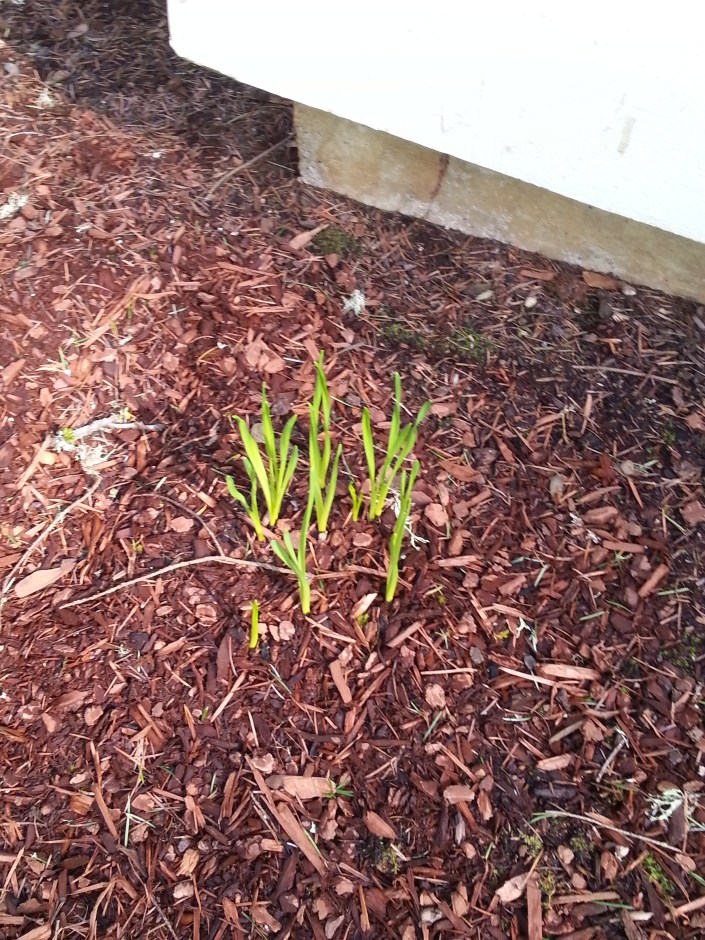 And every year about this time, the Bridal Veil shoots break through the ground and seem to announce, “Spring is back and so am I.”
 Living: the ultimate team sport