Katie Couric is redesigning her news career with a daytime talk show; and Jeff Probst of the “Survivor” television series has done the same. I guess you don’t have to be a normal non-celebrity middle class person to be bored or unsatisfied with life to have an excuse to recreate yourself.
But I’m not the only one who is currently redefining or recreating ones life.
I am personally acquainted with a 79-year old woman, a 64-year old man, and a 63-year old, 59-year old, and 36-year old woman, who are actively pursuing a transition from one chapter of their lives to the next. Personally, I feel that such a pursuit is good for the psyche; it brings a fresh outlook on what we’re still able to accomplish, and, equally as important, might prove beneficial to others as we stretch our wings – and perhaps even our comfort zone – in our efforts to make the most of our talents.
Does this mean that if a person spends decades in the same career they are less evolved or community-focused?
Hell no. I happen to be married to a wonderful man who has been with the same company since he graduated from college more than 30 years ago, and not only is he doing all he can, and then some, in his career, he also reaches out to others for whom his other non-job skills – and there are many – can be used. And boy do we need those dedicated employees in this world who are not only committed to their chosen career path but who also defy the odds – and improve the economic forecast – by staying with the same employer. I’m glad some of you are doing that, and doing it so very well.
I think I can credit, and thank, my limited attention span for the catalyst that keeps me on the look out for that “something else” that might be out there for me to do. Fortunately, most of the reboots I’ve experienced have worked out for the better. Not all of them are money-makers, but I can honestly say that they have all had a more positive than negative impact on the world around me. I’m the only one who has to account for whether or not I’ve been a “good and faithful servant” of this life that I’ve been given and I’m committed to keep trying until I get it right.
The exceptional article linked above focuses on the aftermath of losing someone for whom care was provided, and walking amongst the presence of that someone by virtue of their lingering essence; an essence that can not be bagged up and placed at the curb. Even the photos this blogger provides elicit clear images from when my parents died – thirteen years apart.
(Photo credit: Wikipedia)
My father took comfort in my mom’s presence for many days after September 24, 1994, the day his wife died in her sleep: her handbag draped over the handle of the kitchen door; her reading glasses placed all through the house where she might have ended up needing them; the unfinished grocery list for items she anticipated purchasing later that week; the laundry basket containing clothes she removed from her body in the days preceding her death, not knowing that a few days hence, she would not be the one to launder them. I admit to hugging the bedsheets that had been removed from my mother’s bed the morning after her death. I buried my face in them, inhaling that which remained of my mother, as these were bedsheets on which her last breaths were taken.
(Photo credit: Wikipedia)
When my father died thirteen years later, I collected some of his personal items that spoke to me: the crucifix that hung above his bed; the magnifying glass that he needed to read newspaper articles prior to losing his reading ability due to the insidious disease of Alzheimer’s; his favorite shirt – or was it mine? – that helped me to readily pick him out amongst the other residents in the crowded dementia unit dining room; and his worn out wallet containing items that even in the depths of his dementia, gave him a sense of importance and identity.
We all know that tactile items themselves don’t bring our loved ones closer to us. But these items act as surrogates for those who have passed, more or less serving as the catalyst that uncovers what matters to us most: the essence of the cherished being, and the memories that are not easily discarded.
A full-page newspaper ad for hearing aids, walkers, and safe bathtubs drew my attention the other morning:
“Seniors fear loss of independence more than death.”
My husband & I, still youngsters in our mid to late 50’s.
I agree with that catch phrase, even though the final act of death brings its own fear level centered around how it will occur or whether or not it will be painful. But the loss of independence creates greater fear in me because of what it could mean:
perhaps having to move out of my private residence;
having my car keys taken away from me and being reliant on others for all of my transportation needs;
being told what to wear, what and when to eat, and when to go to bed;
not being able to bathe privately; reliant on someone else to make sure I get the job done right;
speaking of which, needing assistance on the toilet OR having an alternate means of evacuating my bowels – ugh!;
you name it – anything for which I am reliant, dependent, or beholden to someone else, scares me half to – well – death!
But maybe that’s just me. Maybe I’m super sensitive to this issue because of my work with vulnerable adults in long-term care facilities. So I asked friends, family, and others with whom I’m acquainted what stands out as their greatest fear in their Baby Boomer years. Here is a summary of numerous responses to my query:
loss of independence which oftentimes involves chronic illness and/or dementia that drains the household finances;
loss of independence resultant from dementia as it seems to be prevalent in so many families;
loss of independence thereby putting the burden of care on my spouse;
loss of mobility;
flatulence!
I couldn’t resist listing the last response because it made me laugh while contemplating a subject matter that brings little humor to the table.
While taking a walk with a neighbor the other day, he concurred with the above, also adding that if a person had unlimited finances, loss of independence wouldn’t hurt as much: use of your own private driver, 24/7 caregiving in your own home, the best Chef money could buy so you’re not relegated to institutional “cuisine.” But you know, I’m not so sure that being able to afford all of the above would make me feel less dependent upon others than if I had a standard of living like most everyone else. Sure, the amenities are better, but the underlying cause for needing those amenities remains the same – the inability to do things for myself.
Now that we’ve all agreed that living an independent life is very precious to us – I know we understand more clearly why our parents or other loved ones fought the aging process every step of the way. I thought I was very empathetic to my father when he had to surrender his car keys. But now that I’m a wee bit older than I was at that time, I’m thinking I had no inkling of what my father went through as little by little he lost the independence he had enjoyed for eighty-some years.
But how can we prepare so as to avoid a complete loss of independence?
Well, if you find the magic formula, please let us all know. As for me and my household, I’m concentrating on the here and now in preparation for the future. Here’s my contribution:
Exercise like your life depends upon it – because it does. That doesn’t equate to running marathons or riding the Tour de France, rather, it’s participating in a variety of exercise options to which you know you can commit. What works for you – not what everyone else is doing.
Enjoy the food you eat but don’t be addicted to it. My husband and I have dessert every night and we use butter instead of margarine when we cook. Those are luxuries that we decided to enjoy while making sure that the rest of our diet is balanced and more healthy than not.
Speaking of balanced, we love our wine, so nightly, we enjoy a glass during those post-workday (and post-exercise) moments while we catch up on our respective days. Oh, and we also enjoy another glass as it goes so wonderfully with dinner, don’t you think?
Use your brain in ways that you don’t use it while at work. There’s still no fool-proof method of preventing Alzheimer’s or other dementia, but you’ll feel better about yourself if you continue to challenge what you know – and what you don’t know.
Seek peace amongst the chaos. In my article, Where do you find peace?, I explore both how to find peace, and how to keep that peace from slipping away. Rather than repeat what I previously said, I hope you’ll find time to read my “peaceful” article.
Now it’s your turn. What are you doing to avoid what many of us fear the most? I know many Baby Boomers would benefit from hearing what you have to say. We’re all in this together – regardless of how far from each other we live – so let’s work together towards attaining the goal of remaining independent as long as we possibly can.
Stumbled across these special occasions for September in a local, Seattle-area magazine. The ones with which I am familiar are written in bold print; the rest, not so much. So tell me – do these celebrations sound familiar to you, in your part of the world?
WHAT you say? It’s not Spring!!! Well, in Australia, September 1st is the first day of Spring so I’ve connected an article from a fellow Blogger in Australia to illustrate her thoughts on new seasons being a time for change – hopefully for the better! I hope you enjoy, I know I did.
Are there worse crimes? Of course. Sexual and physical abuse come to mind. But in this article the focus is financial exploitation.
(Photo credit: Wikipedia)
Here’s a headline, ripped from an August 26, 2012 Seattle Post Intelligencer (PI) article: “Son, wife fleeced dementia-stricken mom.” Here’s the good news – the son, Ivan Ljunghammar, and his wife, Deborah Jean, have been charged with felony first-degree theft. Here’s the bad news – this pair allegedly stole close to $513,000 dollars from Ivan’s 82-year old mother, facilitated by him being awarded control over his mother’s finances in 2007.
The victim and her husband (deceased) were very careful throughout their lives to make sure they had sufficient funds for when they truly would need them. They did an amazing job and as it turned out, those funds were needed. I guess her son and daughter-in-law figured they needed the money more. Added to that atrocity, the daughter-in-law knowingly hired a convicted felon to care for her mother-in-law. Who does that? The morally corrupt – that’s who. But I digress.
A desire for the parents’ estate compromises morality.
Although it’s true that strangers rob from vulnerable adults, family members do it more often than you can – or would care to – know. It’s the vulnerable adult with dementia who is most often targeted by strangers and family alike, and the family members who “legally” have access to mom and dad’s funds are the most hideous criminals. This family member becomes the Power of Attorney over finances and/or care needs for their mom and then abuse that “Power” by assuring mom that all is well and that she need not worry herself, all the while moving money away from mom’s accounts into their own.
Some financial exploitation is more subtle.
Moving mom or dad out of their current assisted living facility, in which the parents initially had carefully chosen to live, to a facility that is less expensive so that more money remains after mom and dad die. Holding back the daily care a compromised adult may need. Providing a bare minimum of personal belongings and clothing for their loved one – again, for the same reason. Do I sound harsh and judgmental? Gosh, I hope so. My work with the older population for the past 12 years has created a jaded view of how some family members respond to the needs of their parents. Thank goodness the percentage of good and loving family is greater than that of the bad and corrupt – but that does little towards softening the effects of a vulnerable adult’s emptied bank account when they need it most.
It’s unfortunate that media headlines are the primary thing that exposes elder fraud.
I know I personally don’t write about elder fraud enough in this Blog. My article, Financial fraud against the elderly: it’s a family affair, does draw attention to some of the examples I’ve addressed in this Blog entry, and I guess the more sensational occurrences of elder fraud will make this crime more visible. But I think the bottom line is that I want the impossible. I want our elders to be respected, not exploited, and I really want family members to grow a conscience.
A despondent woman was walking along the beach when she saw a bottle on the sand. She picked it up and pulled out the cork. Whoosh! A big puff of smoke appeared.
“You have released me from my prison,” the genie told her. “To show my thanks, I grant you three wishes. But take care, for with each wish, your mate will receive double of whatever you request.”
“Why?” the woman asked. “That bum left me for another woman.”
“That is how it is written,” replied the genie.
The woman shrugged and then asked for a million dollars. There was a flash of light, and a million dollars appeared at her feet. At the same instant, in a far-off place, her wayward husband looked down to see twice that amount at his feet.
“And your second wish?”
“Genie, I want the world’s most expensive diamond necklace.”
Another flash of light, and the woman was holding the precious treasure. And, in that distant place, her husband was looking for a gem broker to buy his latest bonanza.
“Genie, is it really true that my husband has two million dollars and more jewels than I do, and that he gets double of whatever I wish for?”
The genie said it was indeed true.
“Okay, genie, I’m ready for my last wish,” the woman said. “Scare me half to death.”
I read in the Seattle Times newspaper recently that a dragonfly, in its nymph stage, lives in the water for up to four years while it is growing & developing. When it finally emerges from its skin, it only lives a few months.
I know there are other insects who have an even briefer adult life, but this substantial insect caught my attention for one specific reason – although its post-nymph life is brief, it goes for the gusto during its brief time on Planet Earth.
(Photo credit: Wikipedia)
It’s believed that dragonflies have existed on Earth for approximately 300 million years – wow! – that’s older than us humans!!! I guess they’ve had a great deal of time to learn how to make their individual lives count. As nymphs, growing & developing under water, a special appendage on their head helps them to spear their food – small fish, other insects, yum! When full grown and ready to emerge, the dragonfly climbs out of the water, sheds its skin, and waits for its wings to dry before getting down to business.
By the time their wings are developed, they are considered full-grown adults and have only a few weeks remaining of their lives. Their primary goal during this winged stage is mating – so when you see two dragonflies flying through the air attached to one another, it is almost always a male and female mating. I guess they are able to fly while “distracted” because they can see nearly 360 degrees around themselves at all times – no obstacle will get in the way of these industrious bugs! And I can’t help but state that they present an entirely new definition of the mile-high club.
But this article isn’t really about dragonflies and their mating-in-flight capabilities. It’s about how you and I choose to live our lives because in the grand-scheme of things, our life span is just as short as an insect’s, if not – relatively speaking – shorter.
Considering how old the world is, even if we live to be 100, it’s still a drop in the bucket compared to the years that have preceded us, and the infinity that will carry on after us.
I wrote two articles on this Blog site about making the most of our lives – especially as we near retirement. Retirement Planning – it’s not what you think; and Creating the next chapter of your life explore whether “the rest of our lives” post-retirement will bore us and benefit few; or excite us and benefit many. This topic interests me greatly because I witnessed first hand what an unplanned retirement can look like.
A few months into my father’s retirement, my mother started to complain about my dad’s inactivity – phew, not fun! Before long – and in the midst of great boredom on his part – my father got the hint, climbed off his golf cart, and pursued volunteer opportunities with AARP. You see, he realized within a few months of retirement that he wasn’t satisfied not contributing to the larger community around him. The long and the short of it is that both my mother and father eventually established a state-wide volunteer program to help the elderly and low-income individuals with their annual tax returns. My parents recruited other like-minded retirees, put them through training, and by the time of my parents’ real retirement, this tax-aide program had helped more than a million people in the course of 20 years.
But that was them. That’s what my parents could do and enjoyed doing. We have to discern what an appealing retirement looks like for us. I don’t begrudge anyone a relaxing and enjoyable retirement – I’m all for it – but let’s not waste our previous employment skills by putting them on hold as soon as we leave our J-O-B.
My husband surprised me the other day when he stated that he’s already thinking about what he’ll do when he retires – four years hence. I’m thrilled that he’s already considering his options, and who knows? Maybe we’ll team up and do something meaningful to both of us, just as my parents did many years ago.
A recent NBC Nightly News story focused on the role of caregiving as adult children take on the parental role vacated by their parents.
Imagine, if you can, handling all that you normally do in your hectic life and adding between 20 to 60 more hours to your workload. Haven’t arrived at that point yet? Of this potentiality you can be certain – all signs point to that being in your future. Whether your involvement is characterized by general care for an aging family member, or specialized care for a family member with cognitive decline, caregiving is most likely a task to which you have not devoted much attention.
It is said that 1,200 people per day are diagnosed with Alzheimer’s or other dementia. Let’s re-categorize that statistic: 1,200 caregivers are created every day.
The new ad campaign, a joint project between AARP and the Ad Council, was created to address the impact of family caregiving with the graying of the population. This ad campaign seeks to provide resources for those who are thrust into this role for which they are ill-prepared.
“Although they often don’t identify themselves as ‘caregivers,’ more than 42 million Americans perform some form of consistent care for older or impaired adult relatives or friends, according to a 2009 estimate. It can range from paying bills, to driving Mom to doctor appointments, to more hands-on care such as bathing, and even tasks once left to nurses such as the care of open wounds.”
Taking a walk with my wonderful Dad in 2007.
And as many of us who have been in that caregiving role can attest, ones’ active role goes on and on when behind-the-scenes caregiving occurs, dealing with finance and insurance issues and the like during our alleged “free” time; a time when others are settling down to watch their favorite TV show or to read a good book.
This extraordinary AARP/Ad Council project is broader than another effort that is part of the new National Alzheimer’s Plan that can be found on the federal government’s website, www.alzheimers.gov. But both of these projects address the loneliness inherent with the caregiving task when so many caregivers feel, and become, isolated and adrift in an ocean of frustration and despair.
FINALLY some resources are being directed to the tidal wave of caregiving issues that Baby Boomers face. It may be too little too late, but it’s more than has been available up to this point. My hope is that the generation in which our children live will have sufficient resources to deal with us Baby Boomers because if our children think this caregiving task is going to jump their generation, they’ve got another thing coming to them.
And I apologize ahead of time for what awaits you.
The attached article, from the magazine, Seattle Met, is a stellar example of a therapy that is not medicinal or chemical, nonetheless, it’s a therapy that works. Imagine that – and without drugs???
Frye Art Museum, Seattle, WA (Photo credit: Wikipedia)
Viewing art at a museum and painting to express oneself afterwards. What kind of wackadoodle therapy is that?
It is a very successful therapy – that’s what! Here: Now is an arts enrichment program developed in partnership with the Frye Museum, Elderwise, and the regional Alzheimer’s Association, in the greater Seattle, Washington area.
The above article focuses primarily on the younger onset Alzheimer’s disease scenario, highlighting the experiences of Cathie Cannon and her partner, Sharon Monaghan, the latter who was diagnosed with this life-changing disease. As the author of the article, Ann Hedreen, states
Art – looking at it, talking about, making it – is powerful medicine, one that gives Sharon a way, however fleeting, to live peacefully in the moment, no remembering required. Even in its very name, Here: Now is about living in the moment.
So I’m going to let you discover the healing power of art, as told by those who can explain it far better than I ever could: Cathie and her partner, Sharon.
I learned something today for the umpteenth time and it came from someone who died two days ago at the age of 54 as a result of a 14-year battle with benign, but aggressive, meningioma brain tumors. Kathi Goertzen underwent numerous surgeries; endured countless chemotherapy and radiation treatments; and sought out additional therapies in other countries. But these tumors mercilessly came back again, and again, and again. Nerves in her face were destroyed making it difficult for her to speak as clearly as she wished. Similar nerve impairment gradually affected her ability to swallow, and therefore, eat. And what makes all of those symptoms more notable, is that Kathi was the consummate news anchor at a Seattle ABC affiliate, Komo4 News. Kathi was on camera for over thirty years and even when she was no longer able to sit at the anchor desk, Kathi powered through as a field reporter both in the United States and abroad.
Giving up was not in Kathi Goertzen’s DNA. It became obvious to all of us – and I never personally met her, she was simply one of the news anchors I admired the most – that Kathi virtually defined the word “tenacious.” Throughout the years, Ms. Goertzen spent countless days in the intensive care unit (ICU) of local hospitals with her husband, two daughters, parents & siblings, and her Komo4 News family standing by her as the most supportive cheerleading team of its kind. And once she got over that bump in the road, she carried on in her media career, and as an extraordinary wife and mother – the latter which she considered her most important roles in life. A recent video tribute to Kathi, which can be found at the Komo4 News link, shows interviews with Kathi in which she said that she didn’t want people to feel sorry for her; she didn’t want all the attention that this unfortunate condition drew to her. And then there was this statement, paraphrased from the video tribute:
These tumors don’t define me. I won’t let them!
I immediately thought of the many times I let hardships and circumstances define who I am. Oh, it’s so easy to give in to the tendency to feel sorry for ourselves isn’t it? To pay more attention to the bad than the good. It’s scandalous to think that in my several decades of life I have given the hardship (whether it be chronic pain, relationships, job struggles and the like) the upper hand, thereby giving power to that which should have never been given purchase in my life.
Thank you Kathi for getting through to me on this very important issue: circumstances don’t define me, I’ve only ALLOWED them to do so.
Why? Because at least 150 people attended my sister-in-law’s memorial service, held after she passed from complications associated with Alzheimer’s disease.
I know that the count of 150 is nothing compared to a stadium full of football, baseball, or soccer fans. But this 150 people showed up on Monday, the beginning of most people’s work-week, to honor my brother and his stepchildren, and memorialize a woman who impacted their world greatly.
How the day unfolded. Individual after individual arrived: some driving south from British Columbia, Canada, one person even flying in from Toronto, Canada, and numerous people driving north from California and Oregon state. At first it looked like those who set up the venue with numerous chairs had overcompensated in their attendance projections. That was not to be the case. By 2 pm, the scheduled start of the memorial service, additional chairs had to be set up. By 2:15 pm, some of us, most notably my brother, were sweating – not just because it was very hot on that particular Seattle, Washington day, but because the Officiant for the service had not arrived – and never did. But that’s not important.
Time for Plan B. I joined my brother outside just after 2 pm and I suggested that since the Officiant had not yet arrived, it was probably time to figure out Plan B. All the immediate family members sprung into action and the parts that would have been attended to by the Officiant were superbly handled by other family members. Even my brother – who had NOT planned on saying a word during the structured part of the service – walked to the front of the room and spoke beautifully about his wife’s journey to finally reach “home.”
Home is not just a structure with four walls. Quite a few times during my sister-in-law’s illness, she told my brother that she just wanted to go home. Now for those who aren’t familiar with Alzheimer’s or other dementia, oftentimes “home” means comfort, freedom, peace. That was the case with my brother’s spouse. She died on the American holiday, July 4th, also known as Independence Day. That day was her Independence Day, when she could finally flee to comfort, freedom, and peace, with a body – and mind – untethered by any restrictions.
Many blessings to my sister-in-law, my wonderful brother/spouse caregiver, Don, and all of the surviving family members. Monday, August 13th was truly a Celebration of Life and Liberty.
I would have been a wee bit less physically careless during the decades from 20 years old thru 40. Maybe the joints in my extremities wouldn’t complain as loudly and as often as they do now.
I would have certainly not believed that I knew everything there was to know at the age of 21. How many of you remember the well-deserved warnings from your parents, or even your peers, trying to steer you away from ill-advised decisions you were making at the time?
I would have chosen a different major in college instead of going with the subject matter at which I excelled most. It seemed like a no brainer to me: I’m a straight A student in the French language, so obviously that’s what I’m supposed to be studying during my university years. Haven’t used it since.
(Photo credit: Wikipedia)
I would have known that Peppermint Schnapps and beer do not go together…at the same time…many times over. I can only say that I am a living testament that I somehow survived those careless early 20’s irresponsible drinking bouts and learned my lesson BIG time.
I would have known that a rabbit coat – although fashionable at the time – was cruel beyond measure. It was inexpensive, it was warm while I lived in Alaska; what can I say, I thought I was making a fashion statement.
I would not have purchased a snazzy white 1979 Mustang with bright yellow & green racing stripes. Further confession: I didn’t really like it all that much. At least it wasn’t a convertible.
I could go on, and on, and on – pretty entertaining, aren’t I? But I’ll now turn it over to you to add your own Baby Boomer Lessons Learned comments at the bottom of this article.
This is such disappointing news to the Alzheimer’s community which at its heart includes those suffering with the disease and the family caregivers suffering right along with them.
As someone who in the past has been personally involved with this disease as a caregiver for my father, I have experienced elation at the start of new drug trials – and defeat when those trials failed. This disease just seems to be one that evades all goodhearted and extensive attempts to slow down the disease.
A cure? That doesn’t even seem to be on any horizon I’ll see before the end of my days. But this insidious disease can’t even be slowed down, for heaven’s sake, so that the patient and all of his/her family can enjoy a better, longer, and less-impaired life.
Will Shakespeare’s age-honored words, spoken by Polonius to his son Laertes in Act I of Hamlet, stand on their own – seemingly not needing any explanation whatsoever:
(Photo credit: Wikipedia)
“This above all: to thine own self be true, and it must follow, as the night the day, thou canst not then be false to any man.”
If Laertes were to be totally honest with himself, he would realize that his father may as well have told him to catch the wind. After all, to which ‘self’ are we to be true? Is it the one that shows up when we’re in a bad mood, or the one that is present when we feel humbled by our mistakes? Is it the one who speaks from the dark recesses of the heart when we’re depressed or upset, or the one that appears during those fleeting moments when life seems so fanciful and light?
Mr. Singer’s statement really gave me pause because so often, my “authentic self” is hidden away. By that I don’t mean that I’m being fake – I try as hard as I can to present an accurate image of who I am – but let’s face it, some days we’re out of wack and what comes forward on any given day, in any given hour, is just one aspect of the split personalities of our being.
I think all in all I’m a pretty decent person, and on my best days I’m far more thoughtful towards others than I am towards myself, but I am an imperfect being who has lived on this earth for 59 years so I’m quite sure that I’ve missed the mark more often than I would have wanted to. But as I reflected in my article, “The complexities and joys of feeling deeply,” I am VERY hard on myself and I tend to be less hard on others.
But not always – and therein lies the dilemma. If I go out of my way for 100 people in a single day – a virtual Mother Teresa wannabe – and get infuriated at a driver on the road who I have perceived as inciting a road rage anger that I pretend not to have, I have not been true to the person I was during the earlier part of my day. In this particular example, I would have been hearing a voice to which I submitted with feelings of anger and personal affront, instead of asking myself whether or not the voice is giving me good advice. Is that voice helpful? Probably not. There could have been higher/better ways to deal with that perceived slight. I can make a choice to be reactive – which is what the mind does – or lean way from the emotion – which is what the spirit and/or soul does.
With the imperfection that I embody, I will try to do the latter.
I love this blog posting from a fellow blogger who happens to live in Australia. Her blog web address is: www.restyleingyourlife.com. As implied in her Blog, there are so many maxims by which to live and I thoroughly enjoy receiving nuggets of wisdom from those maxims, be they a quote from someone famous, or a sentiment from an unknown. I’ve been keeping a list of quotes/sentiments on my computer which I call:
Quotes of Note.
Please read the article attached at the top of this post and if you feel the urge to read further, I provide just a few quotes that have great meaning to me in my quest to get better with age (where author is known, his/her name is noted):
Do the right thing. It will gratify some people and astonish the rest. – Mark Twain Also by Mr. Twain: The difference between the right word and almost the right word is the difference between lightning and a lightning bug.
Don’t be concerned with the consequences of choices other people have made. Worry only about the consequences of your own choices.
Believe you might be a light for someone else. Albert Einstein provided a similar sentiment: Sometimes our light goes out but is blown into flame by another human being.
Being helpless isn’t really a state of being. A person who feels helpless simply needs help – there’s a big difference.
Life doesn’t have to be about chasing butterflies. It can be about swatting flies with a smile on your face. (And God knows there are more flies than butterflies in the world!)
A few quotes/comments that line up with my life philosophy:
Do all the good that you can, in all the places you can, in all the ways that you can, at all the times you can, to all the people you can, for as long as you can. – John Wesley And perhaps the following comment can be the catalyst for following Mr. Wesley’s thought:A siren is the sound of a society taking care of its citizens.
And I’ll leave you with a few comical statements found in books I recently read:
Bless me Father for I have sinned. It has been forty-six years since my last confession. My how time flies.
The gym I belong to could more accurately be called my favorite charity.
And that’s it for now on this Friday in Redmond, Washington. See you soon!
The article above reflects what is offered by Pauline Boss in her book Ambiguous Loss. I highly recommend the above Alzheimer’s Reading Room article as well as Ms. Boss’s book for any spouse who is taking care of their wife/husband at home or if your spouse is already living in a dementia care unit.
The author, Pauline Boss, explains it this way: when a loved one dies, we mourn the loss; we take comfort in the rituals that mark the passing, and we turn to those around us for support. That doesn’t happen when a loved one is still alive, but the losing occurs nonetheless. And this period of loss may go on for years prior to the spouse’s final departure through death.
One of the statements that Ms. Boss introduces is that “it is o.k. to love a shell.” Anyone who is married to someone with dementia knows that, in essence, a shell is what their spouse becomes with advanced dementia. But if the “surviving spouse” is able to draw on the memories of their marriage, they find themselves able to love their spouse regardless of the disease. Unfortunately, the memories remembered are no longer shared memories; joint reminiscing no longer occurs. Your wedding anniversary passes without any acknowledgement by your spouse, and although that’s just one of the burdens during this long period of loss, it’s a difficult one to bear.
Caregiving is a difficult, 24/7 task. I honor you on your journey, and I hope you find comfort and direction in the above resources, as well as the resources that the Alzheimer’s Association provides.
You know how people sometimes say, “I’m tall, because I got all the extra height that no one else got in my family,” or “Everyone else got the smarts in the family – I got what was left over.”
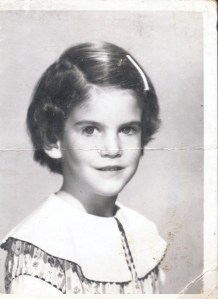
My kindergarten photo.
Well, for me, I think I received all the leftover emotions and feelings of every person born on May 18, 1953 because I have such deep feelings about all that goes on around me. I’m delighted that I’m sensitive, yet I’m aggrieved as well.
How does this trait manifest itself in my life?
I can’t readily clear my mind when disturbing global or local events occur because I’m wondering how those affected are doing.
How are the survivors of a mass murder handling the mundane task of waking up each morning and putting one foot in front of the other?
How does a mother carry on after burying her child who was killed in the same car accident she was in when, through no fault of her own, a semi-truck lost its brakes and careened into her little Volkswagen?
How can anyone claim victory when a bomb takes out some enemy insurgents, and in doing so, innocent men, women, and children lose their lives?
I know I’m no different than you. I’m certainly not special; many people experience feelings deeply. But sometimes for me, it gets in the way of rational behavior, manifested in the following way:
When I say something to someone, I rethink and rethink, and rethink yet again whether or not I said it the right way, or with the right voice.
Or knowing that I’ll be having an important conversation with someone, I might even practice saying what needs to be said prior to offering my thoughts to someone else – and God help me, sometimes I even write it down.
Arrrggggh! That was certainly something I inherited from my father – God rest his soul. In my eyes, my father had the quintessential talent of preparing his words in such a way as to make the greatest positive impact on others. Regrettably, it’s that attention to detail that sometimes gets in the way of spontaneity.
And sometimes, even when I’m convinced that what I’ve done or said is correct, I’m still very hard on myself, feeling that I’ve done or said something wrong, even when what I was trying to do was something right.
Maya Angelou has a wonderful saying that Oprah Winfrey often borrows:
“When you know better, you do better.”
Which I’ll take a step further:
When you do the best you can – with what you know – you’ve done the best you can.
I’ll take comfort in that statement and continue to be the sensitive, somewhat paranoid, person that I am. For the most part it has worked for me, but more importantly, I hope it has worked for others.
The senior care industry is a dangerous maze wherein even the well-educated and well-intentioned providers of care fail to put any “care” in their caregiving. Whether at an assisted living facility or at home with private care, the path of least resistance is oftentimes the one taken and the accompanying attitudes reflect such feelings: “Man, I just gotta get over this shift! These people are driving me crazy!” “I know, I’ll just stick her in front of the TV while I catch up on my Facebook posts/soap operas.”
Don’t worry everyone – I’m not saying that there are NO ethical, compassionate caregivers, there definitely are – but attention must always be focused on those who don’t provide stellar care because the vulnerable amongst us are at the mercy of their care people. Those hidden in a private home are the most susceptible. Why? Because there are very few sets of eyes observing the day-to-day happenings. At a facility, the existence of ongoing traffic – family members, visiting ministries, long-term care ombudsmen/advocates – provides some sort of monitoring that a private home does not and can not provide.
The attached article – link above – is quite thorough. Please take the time to review it.
A five and a half minute portion of Beethoven’s Ode to Joy performed as a flash mob in Europe. Please take the time to watch this You Tube video – turn up your speakers – and get ready to feel better about your day.
When I played the video my crazy computer paused the video in several sections. If that happens to you, simply move the progression of the video up a couple seconds and it’ll continue.
A fellow Blogger, Frangipani Singaporenicum, submitted an excellent article, “Mom is Back,” about the hurdles experienced when her mother traveled by airplane back home after a visit with one of her daughters. Frangipani’s siblings weren’t fully aware of the breadth of their mother’s disease so they thought that the mother would be in good hands at the airport because they had arranged for an airport escort to get the mother to her airplane destination.
Unfortunately, what could go wrong did go wrong. “Frangipani’s” mother has mixed dementia, Alzheimer’s and vascular dementia, and found herself in unfamiliar surroundings when she became separated from the airport employee – a stranger in the mother’s eyes – who was supposed to assist her. Getting lost in an unfamiliar environment is something that comes quite naturally to those with any type of dementia. And as often happens when a person is lost, we try to get un-lost. That attempt brought her mother to another airline terminal where a kind gentleman, noticing her distress, found the assistance she needed to get on the correct plane at the right time.
Those of us who have children – and please bear with me while I make this comparison – know how easily a child can wander away from our purview. We make a quarter turn at the grocery store to get a box of cereal off the top shelf and “POOF!” our child is nowhere to be found. I’m very familiar with this feeling because it happened to me many years ago when my adventurous daughter wandered away – causing me near cardiac arrest – and was subsequently prevented from exiting the grocery store by a Good Samaritan grandmother who knew better than to let my daughter run out into the parking lot. “But I only turned away for a second!” That’s all it takes.
So too can a person with dementia wander away because of something that attracted him; or more likely, with your back to him, he didn’t recognize you any more and walked away to try to find you. “But how can I keep my eye on him at all times?” You just have to.
SOME TIPS OF THE TRADE.
(Photo credit: Wikipedia)
Public restroom challenges. If you or your loved one needs to use the bathroom, find one of the family bathrooms that now exist in many public places so that your environment is controlled, and everyone’s needs are met. Don’t think for a second that you can say to your husband, “George, you stay here while I run into the ladies’ room. I’ll just be a minute.” Be prepared to call security when you come out of the ladies’ restroom because in George’s mind, you disappeared, and the time frame of a minute means absolutely nothing to him. And forget about sending your husband into the mens’ room by himself to meet his potty needs. You’ll be waiting, and waiting, and waiting, and he just a) may not do his business; and b) may not come out on his own. If no family bathrooms are available, stand at the entrance to the public restroom and announce yourself: “Woman entering with husband who needs assistance!” You’ll find that those within will cover up what needs covering and not call security on you.
Medic Alert (Photo credit: Nikita Kashner)
Medic-Alert jewelry. The Alzheimer’s Association strongly recommends purchasing a Medic-Alert/Safe Return device which provides 24/7 emergency response service. At least if your loved one gets lost, they will be reunited with you sooner. This service is available in 50 countries, and in 140 languages. The service speaks for itself so please check the link attached to research the many benefits of this membership service that, quite frankly, brings priceless peace of mind and provides a healthy dose of safety for your loved one.
Now they see you – now they don’t. The examples cited above would not be complete if I didn’t add a personal experience from my days of being my father’s primary long-distance caregiver. My dad lived in a Continuing Care Retirement Community (CCRC) in Southern Oregon. When first diagnosed with Alzheimer’s he was very functional and remained in the assisted living apartment on campus that he had shared with his wife prior to her death in January 2007.
I stayed at a nearby hotel when I visited my father but spent most of the day with him on outings and/or spending time with him in his one-bedroom, one-bathroom apartment. At one point during an apartment visit, I announced to him that I was slipping into the bathroom, 10-feet away, and would be just a minute or two.
I was glad to have locked the bathroom door because partway during my “sit” dad was frantically jiggling the doorknob from the bedroom side of the door shouting, “Irene! Where are you?! Are you o.k.? What’s going on?!!” I was less understanding at the time and returned my own crazed shout of “Dad!!! Leave me be! I’m just going to the bathroom!!!” Knowing what I know now, I would have exited the bathroom and apologized for frightening him, and made every attempt to make him feel safe again. As Oprah Winfrey often says, “We do better when we know better.”
This unintended “peek-a-boo” event proved to me that my father did not have an understanding of the passing of time, but more importantly, that if he couldn’t see me, I wasn’t there. Back to the example of children, but this time, you’re the child.
You’re at play in your bedroom, having just left your mommy gleefully singing in the kitchen while she did the dishes. Your dolls are lined up on your bed, you’re engaging them in discussion, and all of a sudden you notice that mommy isn’t singing any more. You toddle out to the kitchen, and mommy isn’t where you left her!!! “Mommy! Where are you?! Mommy – I’m scared!!! Help me Mommy!!!!!” Your mother steps out of the adjoined laundry room and calms you down – “Irene, I was just five feet away; I didn’t go anywhere, I’m right here!” You run into your mommy’s arms and feel safe again.
Alzheimer’s and other dementia are very unpredictable diseases. What can be predicted, however, is that the onus will always rest on us to compensate for our loved one’s challenges. As I’ve mentioned in previous articles addressing dementia, we have the ability to adjust to the diseased person’s reality; not the other way around. It’s hard work for us, but it’s an impossible task for them.
A businessman was dining at a fancy restaurant and – so the story goes – met Lee Iacocca (extremely successful President & CEO of the Chrysler Corporation from 1978 to 1992 and considered the 18th-greatest American CEO of all time.)
“Mr. Iacocca,” he gushed, “the American business hero! I’ve studied your career, and any success I’ve had comes from emulating you. Would you do me a favor? I’m with some colleagues. Please come by my table, say ‘Hello, Harry,’ and let me introduce you. It would mean so much to me.”
Iacocca agreed. He waited for the man to sit down and then walked towards his table.
“Holy smoke!” cried one of Harry’s friends. “It’s Lee Iacocca, and he’s heading this way!”
“Hello Harry!” Iacocca said. “Introduce me to your friends.”
Harry looked at him blankly, “Come back later, Lee,” he said. “Can’t you see we’re trying to have some lunch!”
Kind of like the movie “Network” in the iconic scene where the actor Peter Finch, as Howard Beale, says, “I’m as mad as hell and I’m not gonna take this any more!”
(Photo credit: Wikipedia)
What is often left out from that quote is the statement made just prior, “I’m a human being. My life has value.” I think some spouses in their 50’s through their 80’s decide that after decades of a somewhat dissatisfying, or perhaps an abusive, marriage they realize that they have a whole lifetime ahead of them and decide that they deserve better. In an article from the AARP June 2012 Bulletin, one of the reasons for a late-in-life divorce centers around the fact that longer lives mean more years with an incompatible spouse. And even though the overall divorce rate in the United States has decreased since 1990, it has doubled for those over age 50.
Jay Lebow, a psychologist at the Family Institute at Northwestern University says, “If late-life divorce were a disease, it would be an epidemic.”
Wow!!!! I had no idea! I’m fortunate in that my second marriage at the age of 47 is still one in which I am very happy now twelve years later. There are those, however, with whom I am acquainted who stick to the dictum of “in sickness and in health, until death do us part” even through an abusive relationship (verbal, physical or otherwise) and, because they’ve been in it for the long haul, e.g., 30 plus years, they feel that they have no choice but to stay.
Why do those with abusive spouses – both male and female – cling to their marriage?
As I mentioned above – one reason is certainly the commitment to vows that were made at the height of a romantic relationship. And there are other reasons. An excellent therapist with whom I am acquainted who leads support groups for the abused told me that over the years, as abuse has prevailed in the household, the one being abused adjusts to each added level or intensity of abuse and becomes acclimated to each added degree. Added to this unwarranted commitment to their abusive spouse, they fear the unknown, even though it may bring about an abuse-free life. And without the help of good friends and powerful resources, a spouse in an abusive relationship may not have the tools that will give them sufficient confidence to make a decision that will benefit them the remainder of their life.
Divorcing later in life can often result in less time to recover financially, recoup losses, retire debt, and ride the ups and downs of the economy.
Some Baby Boomers out there have relished the security that their spouse or significant other has provided them in the form of financial stability. They’re thinking that perhaps it’s worth putting up with this person with whom I am incompatible to guarantee a comfortable enough life until one of us dies. Well – certainly that is a factor – but I personally believe that an individual’s life contains far more value than any bank account can provide. If someone is feeling devalued in their relationship, they have short-changed the remainder of their life. And if someone truly craves, absolutely longs for greater self-worth, nothing will stop them from satisfying that need. I guess you have to look at the options and determine if you’re willing to go with it:
living in a mortgage-free home without financial concerns with someone who tears you down, or renting a one-bedroom apartment with thrift store furnishings, that frees you from a relationship that has prevented you from being your true, and valued self.
But who will take care of me in my old age?
A 2009 National Alliance for Caregiving/AARP survey found that 66% of caregivers were female, with women providing on average 22 hours per week vs. 17 hours for males. In a divorce situation, “older men may make out better financially than women, but they don’t fare so well at finding someone to take care of them when they’re older. They often don’t have alternative care networks the way women do,” says Andrew Cherlin, a sociologist at Johns Hopkins University. When asked who they will turn to when they’re older, single men often cite paid help – a pricey and somewhat difficult option to find. Some older divorced people have children or other family members who can assume the caregiving role, but not everyone does.
Gray divorce is occurring and there are certainly many factors to consider. I guess I’m of the belief that a bad marriage is not better than living alone. Whether you’re a Baby Boomer – or of any other generational group – only you can decide what you’re willing to sacrifice in order to obtain your sense of personal value. As far as I know, we’ve only been given this one life. This is not a dress rehearsal and there are no do-overs.
Don’t you dread being on a commercial flight when the person next to you starts up a lengthy conversation? Here’s one that has a bit of humor tied in with it:
Striking up a conversation with the attractive woman seated beside him on a coast-to-coast flight, a would-be Romeo asked,
“What kind of man attracts you?”
“I’ve always been drawn to Native American men,” she replied. “They’re in harmony with nature.”
“I see,” said the man, nodding.
“But, then, I really go for Jewish men who put women on a pedestal, and I can rarely resist the way Southern gentlemen always treat their ladies with respect.”
“Please allow me to introduce myself,” said the man. “My name is Tecumseh Goldstein, but all my friends call me Bubba.”
The June AARP Bulletin had a brief piece on the fixtures of our every day life that either have already gone by the wayside or will do so in our lifetimes.
How many of you still have the following items as functioning items in your household or in your day-to-day living?
Answering Machine: a machine that records phone messages either on tape or digitally that is NOT a voice mail service with your home phone.
Home phones: many younger than Baby Boomer age are dispensing with their home phones and relying 100% on their cell phones. In most households that equates to at least two telephone numbers per household. I know it works for all of our adult children, but we’re still holding onto our land line – along with our cell phones of course.
Phone books: the internet and Smart Phones, have taken the place of this yellow book for the most part. I was in my car dealership getting my oil changed the other day and a customer walked up to the receptionist and asked her, “Do you have a phone book?” The look on her face summarized it all for me; it seemed to say: “Is this guy for real?!!!”
Printed encyclopedias. Research now-a-days can be done on-line (computer, tablet, phone) and, quite frankly, is far more accurate and up-to-date than volumes of books whose content is so very limited.
Rolodex. Every e-mail program has a Contacts function with ease of updating being a real bonus. I remember holding onto my Rolodex at work, even though I had also put info into my computer’s Contacts file, just in case I needed it. I dumped the Rolodex a couple months later.
3″ floppy disks (Photo credit: Wikipedia)
Floppy discs & drives. Most people under 21 don’t know what this storage device is. Confession: when cleaning out my home office the other day I got rid of an unused box of those antiquated and limited storage items.
Film!!!!! Again, cleaning out my home office I found a roll of unopened Kodak 35mm film. I didn’t throw it away, however, because THAT is a collector’s item!
Analog clocks. All of my decorative clocks in my house contain numbers that go around a square or round face – you remember those don’t you? Many children now-a-days are only accustomed to the digital clock and can’t tell time without it.
Stationary & note cards. For me this is the most grievous vanishing fixture in my life. I will NOT stop sending letters and cards by snail mail – unless of course the postal service vanishes before I’m six feet under.
A white toilet paper roll (Photo credit: Wikipedia)
Toilet paper – WHAT!!!!! AARP reports that eventually, toilet paper will be replaced by toilet-seat bidets that will wash and dry at the touch of a button. Please say it isn’t so!!!!! Maybe they figure the wash & dry could add an additional benefit that would make us smile? I still don’t like the idea.
How many of you are now using items that you swore you’d never allow into your household just a decade ago? And what are you holding on to?
Please take the time to view the video, especially those of you who don’t think you have 13 minutes in which to be entertained by humor that might make a difference in your mood and/or your behavior today.
I wish the best for all of you on this first full day of Summer 2012.
What a terrific article provided in the above link from the “Taking Care of Mom and Dad” blog site. The information provided in this article is valuable, and as Kelli mentioned on her blog, it’s not just specific to the state in which it originated, Oklahoma. The information provided is applicable everywhere because let’s face it – every caregiver pretty much needs the same questions answered and this site has many one-size-fits all solutions for all caregivers who are grasping to stay afloat on their caregiving journey.
This same website can also direct you to your own state’s valuable resources by clicking on the applicable section on the Homepage. It’s as easy as that! And don’t we all need something to be easy every once and awhile?
In the past year, I have lost two coworkers to cancer. Just recently another coworker left his job due to – you guessed it, cancer – so he could spend what remaining time he has with his family. These wonderful people were given a death sentence. They had a head’s up as to when their life’s end/deadline would occur.
Because I care for these people, I’ve been grieving and pondering what their remaining days and weeks were like.
What does one do when they leave their doctor’s office after receiving a fatal prognosis and a guesstimate of how much time remains for them? Of course the initial news floors them and their emotions run wild with rawness, sadness, fear, and maybe even extreme anger. But then they get home, hopefully surrounded by at least one loved one, and…then what?
Scrabble game in final stages (Photo credit: Wikipedia)
I know much discussion will ensue of an emotional, practical, and perhaps even legal manner. That goes without saying.
But do you then get out your bucket list and see if any remaining items can be checked off before time runs out?
Or how about a game of Scrabble? Does that seem too mundane and unimportant in light of life’s waning hours?
I’m not trying to be cavalier about this matter and I hope I’m not coming off as insensitive. I’m really troubled by even thinking about having such a prognosis and filling out my remaining days in a valuable way. And again, I’m thinking about my coworkers’ final days and wondering what those days were like for these stellar people. How did they manage?
Personally, I have a very realistic outlook on death – it’s certainly inevitable. I’ve accepted the fact that no one can escape it. And of course I have my preferences on the manner in which I die. For example, if I’m fortunate, I’ll follow in my mother’s footsteps when back on September 24th, 1994, she went to bed none the worse for wear, and never woke up again. Since no autopsy was done, we don’t know the actual cause of death but on this my family can agree – if we have the choice, we’d like to be taken by surprise – in as pain free a manner as possible. If I’ve left no statements unsaid, no deeds left undone, I’d rather not have a calendar in front of me crossing out each remaining day in my life.
How would I fill my days if, like my coworkers, I’m given a death sentence of a finite period of time?
I don’t have the answer, so if by chance you’ve been part of life’s final deadline with a loved one or close friend, what proved valuable to you and your loved one? How did you manage not to think of the remaining time every minute of every day?




 Living: the ultimate team sport