Historically, it’s the adult children who move back into the parents’ home, oftentimes because of financial issues. Apparently that is no longer the sole definition of multi-generational living.
In a USA Today article, Who’s moving in? Adult kids, aging parents, Haya El Nasser writes, “(A)bout one in seven say they already have a ‘boomerang kid’ – an adult child who moves back home – or elderly parent living under their roof.”
This brings about two unexpected events:
The parents who enjoyed their empty nest and started to reestablish themselves as a couple, instead of just as parents, suddenly have an adult living with them who just happens to be the kid they gave birth to 30 years ago; or
The adult child who strove to establish his home with his spouse and their 2.5 kids suddenly have a parent living with them requiring just as much attention, if not more, than the young children they themselves brought into this world.
The USA Today article above focuses on a rising trend towards families deciding to purchase larger homes than they would have previously considered with the anticipation that it would be more economical to have other adult family members living in – and contributing to – the same household. Talk about a paradigm shift! Stephen Melman, director of economic services at the National Association of Home Builders says, “I remember when I was in college, no one wanted to be near their parents.” That thought certainly resonates with me. When I was single in my 20s and early 30s there was no such luxury of renting a place on my own and living-at-home was definitely not an option. At one time I had two roommates so all three of us shared the same bathroom, kitchen and common living space. Inconvenient and not as private as we would have liked? Certainly – but the only way to afford housing and have the ability to put away money for our future was to split costs with other like-minded adults.
A Pew Research report earlier this year showed that “the share of Americans living in multi-generational households is at its highest since the 1950s.” OMG! As a Baby Boomer who was born in 1953, I just have to repeat, “OMG!!!!!”
My focus today is on the caregiving issue – that adult children and/or Baby Boomers find themselves with the added responsibility as caregiver to a loved one. In my article Start your retirement – start your job as a family caregiver I address the caregiving aspect of Baby Boomer retirement which sometimes evolves into multi-generational living. Our quality of life definition tends to change as family caregiving is added to our lives. But it’s a fact of life for many of us and one that very few can escape. But herein lies the problem…
Most of us aren’t prepared for that eventuality. Those of us who are counting the days until retirement kid ourselves into believing that caregiving happens to others, not to us. And our adult children find it difficult to wrap their minds around that type of living scenario whilst in the midst of their hectic career development and ever-changing family dynamics.
So what happens? We find ourselves in an emergent situation that requires immediate action that may not be well-thought out because we don’t have the time to make a well-informed decision. We all know that the worse time to make a life-changing decision is in an emergency. There is a wealth of information available at our fingertips – the worldwide web is replete with helpful resources. Even this website has many articles written on the subject. As you browse through this website’s categories, be sure to enter a search term in the “Search My Site” box located at the right-hand side of each content page.
I’m not suggesting that you finalize plans that might not be implemented until many years down the road – or at all. What I am suggesting, however, is that we all become aware that a) these issues exist and could very well happen in our own lives; and b) we’re going to do what we can now to make wise decisions later.
The attached link, written by a blogger in Singapore, describes his experience as a cab driver when he picked up a woman with dementia who needed to get from Point A to Point B but who lacked the cognitive capacity to effectively do so.
Personally, I think he excelled at compassion and even though he feels he could have done more, I respect him for what he did do. We don’t want to entertain the thought of someone who might have taken advantage of this woman but there are many who would have looked at this situation as an opportunity to exploit her vulnerability.
I congratulate you, Lim James, for showing all of us that goodness exists, and it exists in your soul.
I strongly encourage you to read the above article. Too often physicians with insufficient training on elder-health issues dismiss the early signs of Alzheimer’s or other dementia as simply being age-related developments. Doing so presents the risk of missing the small window of opportunity in which to treat cognitive issues early on, rather than when they have fully taken up residence in a patient.
Sure, there’s nothing yet that prevents or cures the disease, but being able to manage the symptoms early on certainly adds to the quality of life that both the patient, and their loved ones, seek to experience.
For those of you who have taken on the role of advocating for your loved one: when you escort your loved one with early memory loss or confusion to the doctor’s office, do not back down when he/she concludes the symptoms are to be expected due to advancing age. NO! Those symptoms could very well be indicative of disease-related dementia, OR the symptoms could be caused by medication side-effects (blood pressure medication, seizure medication and the like) or other medical conditions, such as urinary tract infection (UTI.)
It’s all about advocacy. Do you go the easy route and take the doctor’s word for it, or do you push for worthwhile diagnostics to rule out any other serious or life-changing causes?
At a certain stage during the course of Alzheimer’s or other dementia, a person can exhibit exit-seeking behavior. It is believed that the person exhibiting this behavior is actually trying to get home, or back to a familiar place, or even seeking a feeling of comfort rather than simply trying to escape from their current location.
This “exiting” can take place just about anywhere, even at the person’s own home – resulting in a dangerous scenario where a wandering vulnerable person could easily fall into any number of horrific situations because of their inability to get back to the safety of their home (be it a personal residence or a long-term care facility.) Exiting behavior also takes place in public places such as grocery stores or shopping malls, movie theaters, airports, and yes, even airplanes at 35,000 feet above the ground. This latter scenario happened on a recent flight I took from Dulles International Airport (DC area) to Seattle International Airport (Seattle, Washington.)
Just a half hour into our five-plus hour flight, a female passenger of approximately 75 years of age became very agitated during our ascent and before the fasten seat belt sign was switched off, she climbed over the passengers in her row, carry-on in hand, screaming all the way to the back of the plane from Row 34. I was seated in Row 35. “Wow, she must really have to use the bathroom!” I thought. A flight attendant tried to get the passenger re-situated in her seat to no avail. Complicating matters was the fact that the passenger was from another geographical continent and not only did she not speak or understand English, it was determined that other passengers who had flown with her from that same continent (not any relation or connection to her) also could not understand a word that she said. In essence, she was speaking gibberish. That was the first sign to myself and the flight attendants, that a) this woman was flying alone; b) she was in severe distress; and c) she most likely had some sort of dementia and was trying to exit her environment. Not an easy task, nor one any of the United Airline employees were about to allow. Read the rest of this entry »
My oh, my – such a difficult subject to broach with a family member when you know that he should put down the car keys and let others do the driving for him. The article linked above from NBC Nightly News is a good source of tips on how to handle this very familiar problem. I address this issue in my article: Driving with dementia: the dangers of denial. Although dementia is usually one of the most talked about reasons for taking away someone’s car keys, there are other reasons that are just as important that must not be ignored:
Age-related slow reaction times;
Medications that might cause dizziness and/or slow reaction time; and
Impaired eyesight and hearing.
Not wanting to hurt a loved one’s feelings should not be the reason to avoid this subject matter. Let’s face it, your loved one’s safety and the safety of absolutely everyone else is at stake here. There are already so many dangers on the road with drivers talking or texting on their cellphones, driving under the influence of alcohol or drugs, doing any number of distracting functions such as eating, personal grooming, changing a tune on your I-Pod, or being distracted by children or dogs in the back seat. Now add someone who is impaired by age or cognitive disease and the risks to others increases greatly.
If you or a loved one are facing this important and difficult step, please read the attached NBC article linked above and also take the time to look at my article, Driving with dementia: the dangers of denial that provides encouragement for how you might take care of this very important matter of safety.
In my opinion, the article linked above paints a clear picture of what the 47 percent might encompass. As with any situation for which we have little understanding or exposure, it’s healthy to see what the flesh and blood of the situation equates to – put a face on it.
Making a generalization that those who don’t pay federal taxes are taking unfair advantage of government handouts seems so inaccurate – I guess that’s what generalizations are: inaccurate attempts (oversimplifications) to state something about which we have no understanding. Just about everyone with whom I associate has gone through difficult times – financial and otherwise – at some time in their lives. Not everyone stays hungry and without the means to get by – as if they would choose to remain that way year after year after year.
The above article introduces us to
a 76-year old woman who works but is not able to pay her electricity bill;
a well-dressed man with a Master’s degree in engineering who needs help with his rent who was very embarrassed to ask for help; and
a woman battling cancer and diabetes at risk of losing a leg.
These individuals are not second-class citizens just because they’re going through a rough patch in life. I don’t consider myself a bad person because in the mid-1980’s I was laid off from my job as a program director at a cable TV company and had to collect unemployment insurance while looking for a replacement job. That time was temporary – as many trying times in life are.
Does this mean that everyone in need of a handout represents the “better angels of our culture?” No, there will always be those who try to bilk the system – heck, the big bankers and financiers did that very recently – and arguably, still are – and they certainly weren’t dining at the downtown food kitchen or struggling to pay their utility bills. We might categorize them as second-class citizens because of their greediness, but I dare say they look vastly different from those portrayed so cavalierly in the political arena during this current election season.
The above video is amazingly dramatic and not just because it’s so well done and the music is so compelling. It’s dramatic because it speaks of facts about Alzheimer’s and other dementia that are hard to wrap your mind around.
Here’s one fact I’ll provide, and then I encourage you to watch this two minute video to increase your awareness of this insidious disease.
The Fact: there are 15 million caregivers currently living in America. If caregivers were the only residents in one of the states in the United States, they would completely populate the state of Illinois – the 5th largest state in the country.
Awareness is key – pass this link on to others so that greater attention is placed on this disease that is the ONLY cause of death among the top 10 causes of death in America without a way to prevent, cure, or even slow its progression.
I didn’t think I would write about this personal experience, but today I realized that in order to fully heal, I need to express myself.
So here I go.
(Photo credit: Wikipedia)
Five months ago, I made a well-thought out and measured decision to leave the religion of my birth. Let me make this perfectly clear: I left a religious organization. My faith is still intact.
I was quite active in the local-area church of that religion: I was a scripture reader; I trained other scripture readers; I started a volunteer chore ministry that served the members of that local church as well as the geographic community in which that church is located; and I contributed financially to both the local-area church and the “Mother” church.
The catalyst for my leaving the religion of my birth was the “Mother” church’s decision to encourage all local churches of that religion in Washington state to hold a political petition signing at each church service on a particular Sunday in April 2012. Each local church was given the option of whether or not to hold this particular petition signing; some churches opted out, many opted in. Therein lies part of the problem.
I firmly believe in the absolute separation of church and state. When I heard that this petition signing was to take place, I approached my local church and asked if they would be participating. “Yes” was their answer, and they did. The issue at hand for me is that once you bring politics into a church’s sanctuary – regardless of the political party, cause, or issue – you taint the worship space that was created for the express purpose of praising God, celebrating the rituals in which we find comfort, and building up the Body of believers who call that local church the home base for their faith.
My “beef” isn’t even with the local church I left. (As a matter of fact I met with the local church leadership to talk about my concerns and my intention to leave and we had a very thoughtful and respectful conversation.) My beef and major concern centers around the hierarchy of leadership that holds onto teachings that I have not supported for quite some time now. The petition signing was merely the catalyst for me to finally be true to myself and the faith in which I clothe myself.
Now the healing that I’m seeking – healing from an unfulfilled expectation. I cared deeply about many of the people with whom I worshiped and I thought the feeling was mutual. You see, after more than ten years of attendance and active participation, I had the expectation that someone would a) notice that I was no longer there; and b) care enough to get in touch with me. Five months after leaving the church I received an e-mail from someone asking if I had left the parish, because this person missed seeing me on Sundays. That e-mail made my day. That e-mail both made me grieve, and rejoice. Grieve – because only one person cared enough to reach out to me. Rejoice – because one person reached out to me and confirmed that I mattered.
The lesson in all of this for me is that it’s not the local church’s fault that I’m hurt from their lack of response to my absence. I erroneously placed my personal expectation onto others – those who didn’t know what I had hoped would happen. I’ve come to believe that “expectation” is simply a fantasy of a personal hope that we try to impose on other people and/or events.
In that respect, the phrase “unfulfilled expectation” is a contradiction in terms. Again, going with my definition of fantasy, the Merriam-Webster dictionary defines fantasy in this manner: the free play of creative imagination. The dictionary also provides an obsolete definition of fantasy as “hallucination.”
So there you have it. I hallucinated what I had wanted to take place – but it wasn’t fact.
Katie Couric is redesigning her news career with a daytime talk show; and Jeff Probst of the “Survivor” television series has done the same. I guess you don’t have to be a normal non-celebrity middle class person to be bored or unsatisfied with life to have an excuse to recreate yourself.
But I’m not the only one who is currently redefining or recreating ones life.
I am personally acquainted with a 79-year old woman, a 64-year old man, and a 63-year old, 59-year old, and 36-year old woman, who are actively pursuing a transition from one chapter of their lives to the next. Personally, I feel that such a pursuit is good for the psyche; it brings a fresh outlook on what we’re still able to accomplish, and, equally as important, might prove beneficial to others as we stretch our wings – and perhaps even our comfort zone – in our efforts to make the most of our talents.
Does this mean that if a person spends decades in the same career they are less evolved or community-focused?
Hell no. I happen to be married to a wonderful man who has been with the same company since he graduated from college more than 30 years ago, and not only is he doing all he can, and then some, in his career, he also reaches out to others for whom his other non-job skills – and there are many – can be used. And boy do we need those dedicated employees in this world who are not only committed to their chosen career path but who also defy the odds – and improve the economic forecast – by staying with the same employer. I’m glad some of you are doing that, and doing it so very well.
I think I can credit, and thank, my limited attention span for the catalyst that keeps me on the look out for that “something else” that might be out there for me to do. Fortunately, most of the reboots I’ve experienced have worked out for the better. Not all of them are money-makers, but I can honestly say that they have all had a more positive than negative impact on the world around me. I’m the only one who has to account for whether or not I’ve been a “good and faithful servant” of this life that I’ve been given and I’m committed to keep trying until I get it right.
I read in the Seattle Times newspaper recently that a dragonfly, in its nymph stage, lives in the water for up to four years while it is growing & developing. When it finally emerges from its skin, it only lives a few months.
I know there are other insects who have an even briefer adult life, but this substantial insect caught my attention for one specific reason – although its post-nymph life is brief, it goes for the gusto during its brief time on Planet Earth.
(Photo credit: Wikipedia)
It’s believed that dragonflies have existed on Earth for approximately 300 million years – wow! – that’s older than us humans!!! I guess they’ve had a great deal of time to learn how to make their individual lives count. As nymphs, growing & developing under water, a special appendage on their head helps them to spear their food – small fish, other insects, yum! When full grown and ready to emerge, the dragonfly climbs out of the water, sheds its skin, and waits for its wings to dry before getting down to business.
By the time their wings are developed, they are considered full-grown adults and have only a few weeks remaining of their lives. Their primary goal during this winged stage is mating – so when you see two dragonflies flying through the air attached to one another, it is almost always a male and female mating. I guess they are able to fly while “distracted” because they can see nearly 360 degrees around themselves at all times – no obstacle will get in the way of these industrious bugs! And I can’t help but state that they present an entirely new definition of the mile-high club.
But this article isn’t really about dragonflies and their mating-in-flight capabilities. It’s about how you and I choose to live our lives because in the grand-scheme of things, our life span is just as short as an insect’s, if not – relatively speaking – shorter.
Considering how old the world is, even if we live to be 100, it’s still a drop in the bucket compared to the years that have preceded us, and the infinity that will carry on after us.
I wrote two articles on this Blog site about making the most of our lives – especially as we near retirement. Retirement Planning – it’s not what you think; and Creating the next chapter of your life explore whether “the rest of our lives” post-retirement will bore us and benefit few; or excite us and benefit many. This topic interests me greatly because I witnessed first hand what an unplanned retirement can look like.
A few months into my father’s retirement, my mother started to complain about my dad’s inactivity – phew, not fun! Before long – and in the midst of great boredom on his part – my father got the hint, climbed off his golf cart, and pursued volunteer opportunities with AARP. You see, he realized within a few months of retirement that he wasn’t satisfied not contributing to the larger community around him. The long and the short of it is that both my mother and father eventually established a state-wide volunteer program to help the elderly and low-income individuals with their annual tax returns. My parents recruited other like-minded retirees, put them through training, and by the time of my parents’ real retirement, this tax-aide program had helped more than a million people in the course of 20 years.
But that was them. That’s what my parents could do and enjoyed doing. We have to discern what an appealing retirement looks like for us. I don’t begrudge anyone a relaxing and enjoyable retirement – I’m all for it – but let’s not waste our previous employment skills by putting them on hold as soon as we leave our J-O-B.
My husband surprised me the other day when he stated that he’s already thinking about what he’ll do when he retires – four years hence. I’m thrilled that he’s already considering his options, and who knows? Maybe we’ll team up and do something meaningful to both of us, just as my parents did many years ago.
A recent NBC Nightly News story focused on the role of caregiving as adult children take on the parental role vacated by their parents.
Imagine, if you can, handling all that you normally do in your hectic life and adding between 20 to 60 more hours to your workload. Haven’t arrived at that point yet? Of this potentiality you can be certain – all signs point to that being in your future. Whether your involvement is characterized by general care for an aging family member, or specialized care for a family member with cognitive decline, caregiving is most likely a task to which you have not devoted much attention.
It is said that 1,200 people per day are diagnosed with Alzheimer’s or other dementia. Let’s re-categorize that statistic: 1,200 caregivers are created every day.
The new ad campaign, a joint project between AARP and the Ad Council, was created to address the impact of family caregiving with the graying of the population. This ad campaign seeks to provide resources for those who are thrust into this role for which they are ill-prepared.
“Although they often don’t identify themselves as ‘caregivers,’ more than 42 million Americans perform some form of consistent care for older or impaired adult relatives or friends, according to a 2009 estimate. It can range from paying bills, to driving Mom to doctor appointments, to more hands-on care such as bathing, and even tasks once left to nurses such as the care of open wounds.”
Taking a walk with my wonderful Dad in 2007.
And as many of us who have been in that caregiving role can attest, ones’ active role goes on and on when behind-the-scenes caregiving occurs, dealing with finance and insurance issues and the like during our alleged “free” time; a time when others are settling down to watch their favorite TV show or to read a good book.
This extraordinary AARP/Ad Council project is broader than another effort that is part of the new National Alzheimer’s Plan that can be found on the federal government’s website, www.alzheimers.gov. But both of these projects address the loneliness inherent with the caregiving task when so many caregivers feel, and become, isolated and adrift in an ocean of frustration and despair.
FINALLY some resources are being directed to the tidal wave of caregiving issues that Baby Boomers face. It may be too little too late, but it’s more than has been available up to this point. My hope is that the generation in which our children live will have sufficient resources to deal with us Baby Boomers because if our children think this caregiving task is going to jump their generation, they’ve got another thing coming to them.
And I apologize ahead of time for what awaits you.
The attached article, from the magazine, Seattle Met, is a stellar example of a therapy that is not medicinal or chemical, nonetheless, it’s a therapy that works. Imagine that – and without drugs???
Frye Art Museum, Seattle, WA (Photo credit: Wikipedia)
Viewing art at a museum and painting to express oneself afterwards. What kind of wackadoodle therapy is that?
It is a very successful therapy – that’s what! Here: Now is an arts enrichment program developed in partnership with the Frye Museum, Elderwise, and the regional Alzheimer’s Association, in the greater Seattle, Washington area.
The above article focuses primarily on the younger onset Alzheimer’s disease scenario, highlighting the experiences of Cathie Cannon and her partner, Sharon Monaghan, the latter who was diagnosed with this life-changing disease. As the author of the article, Ann Hedreen, states
Art – looking at it, talking about, making it – is powerful medicine, one that gives Sharon a way, however fleeting, to live peacefully in the moment, no remembering required. Even in its very name, Here: Now is about living in the moment.
So I’m going to let you discover the healing power of art, as told by those who can explain it far better than I ever could: Cathie and her partner, Sharon.
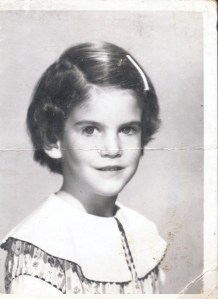
You know how people sometimes say, “I’m tall, because I got all the extra height that no one else got in my family,” or “Everyone else got the smarts in the family – I got what was left over.”
My kindergarten photo.
Well, for me, I think I received all the leftover emotions and feelings of every person born on May 18, 1953 because I have such deep feelings about all that goes on around me. I’m delighted that I’m sensitive, yet I’m aggrieved as well.
How does this trait manifest itself in my life?
I can’t readily clear my mind when disturbing global or local events occur because I’m wondering how those affected are doing.
How are the survivors of a mass murder handling the mundane task of waking up each morning and putting one foot in front of the other?
How does a mother carry on after burying her child who was killed in the same car accident she was in when, through no fault of her own, a semi-truck lost its brakes and careened into her little Volkswagen?
How can anyone claim victory when a bomb takes out some enemy insurgents, and in doing so, innocent men, women, and children lose their lives?
I know I’m no different than you. I’m certainly not special; many people experience feelings deeply. But sometimes for me, it gets in the way of rational behavior, manifested in the following way:
When I say something to someone, I rethink and rethink, and rethink yet again whether or not I said it the right way, or with the right voice.
Or knowing that I’ll be having an important conversation with someone, I might even practice saying what needs to be said prior to offering my thoughts to someone else – and God help me, sometimes I even write it down.
Arrrggggh! That was certainly something I inherited from my father – God rest his soul. In my eyes, my father had the quintessential talent of preparing his words in such a way as to make the greatest positive impact on others. Regrettably, it’s that attention to detail that sometimes gets in the way of spontaneity.
And sometimes, even when I’m convinced that what I’ve done or said is correct, I’m still very hard on myself, feeling that I’ve done or said something wrong, even when what I was trying to do was something right.
Maya Angelou has a wonderful saying that Oprah Winfrey often borrows:
“When you know better, you do better.”
Which I’ll take a step further:
When you do the best you can – with what you know – you’ve done the best you can.
I’ll take comfort in that statement and continue to be the sensitive, somewhat paranoid, person that I am. For the most part it has worked for me, but more importantly, I hope it has worked for others.
The senior care industry is a dangerous maze wherein even the well-educated and well-intentioned providers of care fail to put any “care” in their caregiving. Whether at an assisted living facility or at home with private care, the path of least resistance is oftentimes the one taken and the accompanying attitudes reflect such feelings: “Man, I just gotta get over this shift! These people are driving me crazy!” “I know, I’ll just stick her in front of the TV while I catch up on my Facebook posts/soap operas.”
Don’t worry everyone – I’m not saying that there are NO ethical, compassionate caregivers, there definitely are – but attention must always be focused on those who don’t provide stellar care because the vulnerable amongst us are at the mercy of their care people. Those hidden in a private home are the most susceptible. Why? Because there are very few sets of eyes observing the day-to-day happenings. At a facility, the existence of ongoing traffic – family members, visiting ministries, long-term care ombudsmen/advocates – provides some sort of monitoring that a private home does not and can not provide.
The attached article – link above – is quite thorough. Please take the time to review it.
A fellow Blogger, Frangipani Singaporenicum, submitted an excellent article, “Mom is Back,” about the hurdles experienced when her mother traveled by airplane back home after a visit with one of her daughters. Frangipani’s siblings weren’t fully aware of the breadth of their mother’s disease so they thought that the mother would be in good hands at the airport because they had arranged for an airport escort to get the mother to her airplane destination.
Unfortunately, what could go wrong did go wrong. “Frangipani’s” mother has mixed dementia, Alzheimer’s and vascular dementia, and found herself in unfamiliar surroundings when she became separated from the airport employee – a stranger in the mother’s eyes – who was supposed to assist her. Getting lost in an unfamiliar environment is something that comes quite naturally to those with any type of dementia. And as often happens when a person is lost, we try to get un-lost. That attempt brought her mother to another airline terminal where a kind gentleman, noticing her distress, found the assistance she needed to get on the correct plane at the right time.
Those of us who have children – and please bear with me while I make this comparison – know how easily a child can wander away from our purview. We make a quarter turn at the grocery store to get a box of cereal off the top shelf and “POOF!” our child is nowhere to be found. I’m very familiar with this feeling because it happened to me many years ago when my adventurous daughter wandered away – causing me near cardiac arrest – and was subsequently prevented from exiting the grocery store by a Good Samaritan grandmother who knew better than to let my daughter run out into the parking lot. “But I only turned away for a second!” That’s all it takes.
So too can a person with dementia wander away because of something that attracted him; or more likely, with your back to him, he didn’t recognize you any more and walked away to try to find you. “But how can I keep my eye on him at all times?” You just have to.
SOME TIPS OF THE TRADE.
(Photo credit: Wikipedia)
Public restroom challenges. If you or your loved one needs to use the bathroom, find one of the family bathrooms that now exist in many public places so that your environment is controlled, and everyone’s needs are met. Don’t think for a second that you can say to your husband, “George, you stay here while I run into the ladies’ room. I’ll just be a minute.” Be prepared to call security when you come out of the ladies’ restroom because in George’s mind, you disappeared, and the time frame of a minute means absolutely nothing to him. And forget about sending your husband into the mens’ room by himself to meet his potty needs. You’ll be waiting, and waiting, and waiting, and he just a) may not do his business; and b) may not come out on his own. If no family bathrooms are available, stand at the entrance to the public restroom and announce yourself: “Woman entering with husband who needs assistance!” You’ll find that those within will cover up what needs covering and not call security on you.
Medic Alert (Photo credit: Nikita Kashner)
Medic-Alert jewelry. The Alzheimer’s Association strongly recommends purchasing a Medic-Alert/Safe Return device which provides 24/7 emergency response service. At least if your loved one gets lost, they will be reunited with you sooner. This service is available in 50 countries, and in 140 languages. The service speaks for itself so please check the link attached to research the many benefits of this membership service that, quite frankly, brings priceless peace of mind and provides a healthy dose of safety for your loved one.
Now they see you – now they don’t. The examples cited above would not be complete if I didn’t add a personal experience from my days of being my father’s primary long-distance caregiver. My dad lived in a Continuing Care Retirement Community (CCRC) in Southern Oregon. When first diagnosed with Alzheimer’s he was very functional and remained in the assisted living apartment on campus that he had shared with his wife prior to her death in January 2007.
I stayed at a nearby hotel when I visited my father but spent most of the day with him on outings and/or spending time with him in his one-bedroom, one-bathroom apartment. At one point during an apartment visit, I announced to him that I was slipping into the bathroom, 10-feet away, and would be just a minute or two.
I was glad to have locked the bathroom door because partway during my “sit” dad was frantically jiggling the doorknob from the bedroom side of the door shouting, “Irene! Where are you?! Are you o.k.? What’s going on?!!” I was less understanding at the time and returned my own crazed shout of “Dad!!! Leave me be! I’m just going to the bathroom!!!” Knowing what I know now, I would have exited the bathroom and apologized for frightening him, and made every attempt to make him feel safe again. As Oprah Winfrey often says, “We do better when we know better.”
This unintended “peek-a-boo” event proved to me that my father did not have an understanding of the passing of time, but more importantly, that if he couldn’t see me, I wasn’t there. Back to the example of children, but this time, you’re the child.
You’re at play in your bedroom, having just left your mommy gleefully singing in the kitchen while she did the dishes. Your dolls are lined up on your bed, you’re engaging them in discussion, and all of a sudden you notice that mommy isn’t singing any more. You toddle out to the kitchen, and mommy isn’t where you left her!!! “Mommy! Where are you?! Mommy – I’m scared!!! Help me Mommy!!!!!” Your mother steps out of the adjoined laundry room and calms you down – “Irene, I was just five feet away; I didn’t go anywhere, I’m right here!” You run into your mommy’s arms and feel safe again.
Alzheimer’s and other dementia are very unpredictable diseases. What can be predicted, however, is that the onus will always rest on us to compensate for our loved one’s challenges. As I’ve mentioned in previous articles addressing dementia, we have the ability to adjust to the diseased person’s reality; not the other way around. It’s hard work for us, but it’s an impossible task for them.
Kind of like the movie “Network” in the iconic scene where the actor Peter Finch, as Howard Beale, says, “I’m as mad as hell and I’m not gonna take this any more!”
(Photo credit: Wikipedia)
What is often left out from that quote is the statement made just prior, “I’m a human being. My life has value.” I think some spouses in their 50’s through their 80’s decide that after decades of a somewhat dissatisfying, or perhaps an abusive, marriage they realize that they have a whole lifetime ahead of them and decide that they deserve better. In an article from the AARP June 2012 Bulletin, one of the reasons for a late-in-life divorce centers around the fact that longer lives mean more years with an incompatible spouse. And even though the overall divorce rate in the United States has decreased since 1990, it has doubled for those over age 50.
Jay Lebow, a psychologist at the Family Institute at Northwestern University says, “If late-life divorce were a disease, it would be an epidemic.”
Wow!!!! I had no idea! I’m fortunate in that my second marriage at the age of 47 is still one in which I am very happy now twelve years later. There are those, however, with whom I am acquainted who stick to the dictum of “in sickness and in health, until death do us part” even through an abusive relationship (verbal, physical or otherwise) and, because they’ve been in it for the long haul, e.g., 30 plus years, they feel that they have no choice but to stay.
Why do those with abusive spouses – both male and female – cling to their marriage?
As I mentioned above – one reason is certainly the commitment to vows that were made at the height of a romantic relationship. And there are other reasons. An excellent therapist with whom I am acquainted who leads support groups for the abused told me that over the years, as abuse has prevailed in the household, the one being abused adjusts to each added level or intensity of abuse and becomes acclimated to each added degree. Added to this unwarranted commitment to their abusive spouse, they fear the unknown, even though it may bring about an abuse-free life. And without the help of good friends and powerful resources, a spouse in an abusive relationship may not have the tools that will give them sufficient confidence to make a decision that will benefit them the remainder of their life.
Divorcing later in life can often result in less time to recover financially, recoup losses, retire debt, and ride the ups and downs of the economy.
Some Baby Boomers out there have relished the security that their spouse or significant other has provided them in the form of financial stability. They’re thinking that perhaps it’s worth putting up with this person with whom I am incompatible to guarantee a comfortable enough life until one of us dies. Well – certainly that is a factor – but I personally believe that an individual’s life contains far more value than any bank account can provide. If someone is feeling devalued in their relationship, they have short-changed the remainder of their life. And if someone truly craves, absolutely longs for greater self-worth, nothing will stop them from satisfying that need. I guess you have to look at the options and determine if you’re willing to go with it:
living in a mortgage-free home without financial concerns with someone who tears you down, or renting a one-bedroom apartment with thrift store furnishings, that frees you from a relationship that has prevented you from being your true, and valued self.
But who will take care of me in my old age?
A 2009 National Alliance for Caregiving/AARP survey found that 66% of caregivers were female, with women providing on average 22 hours per week vs. 17 hours for males. In a divorce situation, “older men may make out better financially than women, but they don’t fare so well at finding someone to take care of them when they’re older. They often don’t have alternative care networks the way women do,” says Andrew Cherlin, a sociologist at Johns Hopkins University. When asked who they will turn to when they’re older, single men often cite paid help – a pricey and somewhat difficult option to find. Some older divorced people have children or other family members who can assume the caregiving role, but not everyone does.
Gray divorce is occurring and there are certainly many factors to consider. I guess I’m of the belief that a bad marriage is not better than living alone. Whether you’re a Baby Boomer – or of any other generational group – only you can decide what you’re willing to sacrifice in order to obtain your sense of personal value. As far as I know, we’ve only been given this one life. This is not a dress rehearsal and there are no do-overs.
What a terrific article provided in the above link from the “Taking Care of Mom and Dad” blog site. The information provided in this article is valuable, and as Kelli mentioned on her blog, it’s not just specific to the state in which it originated, Oklahoma. The information provided is applicable everywhere because let’s face it – every caregiver pretty much needs the same questions answered and this site has many one-size-fits all solutions for all caregivers who are grasping to stay afloat on their caregiving journey.
This same website can also direct you to your own state’s valuable resources by clicking on the applicable section on the Homepage. It’s as easy as that! And don’t we all need something to be easy every once and awhile?
In yesterday’s post, a Seattle Police Detective defined elder abuse as:
sexual abuse
physical abuse
financial exploitation
neglect
In Part 6 of Seniors for Sale: Placement perils and successes, Michael Berens, Seattle Times reporter, delves into the senior housing placement industry, focusing on one placement company that placed a client in a Tacoma-area Adult Family Home (AFH) with a history of safety and health violations – elder abuse – even a fatal event, but because the placement company had not done its research, it was not aware of the home’s previous infractions and kept placing unknowing vulnerable adults in the home’s care.
Many of these placement service companies operate state-wide and/or nation-wide, and believe that there is no way that they can help as many people as they do if they are required to visit each and every home/assisted living option available to the public that they are trying to assist. These companies are oftentimes characterized as Bed Brokers – an industry that is growing exponentially without much scrutiny or State controls.
CAVEAT: Just as in every assisted living situation – there are good senior housing options and there are bad senior housing options – so too there exist reputable senior placement companies, and not-so-reputable placement companies.
I personally think that these companies can be helpful to those looking for a senior housing option that suits their, or their loved one’s, needs. I caution those using these agencies, however, to understand that not every option out there is listed with placement companies. If a senior housing company does not choose to be listed with a placement service company, that option will not be offered, even if that particular housing option might be the verybest choice for some families: cost-wise, location-wise, and even service-wise.
In a news update, Michael Berens’ article, State gets tough on referrals for elder care, we see that attention is now being directed at these placement referral companies in the hopes that those they serve – vulnerable adults in need of some sort of daily care – are protected from those companies who are simply aiming to make a profit at the most vulnerable time in an elder’s life.
As I mentioned in previous articles found in my blog category, Senior Housing, there are numerous resources available for those looking for senior housing for themselves or a family member. Please go to that category and type in a search term in the space located on the right-hand side of the page to find the topic that interests you most.
Part 5, of Seniors for Sale: Hiding Harm: the human toll, is one example of the lack of reporting that goes on in some assisted living residential settings – in this case – an Adult Family Home (AFH).
When you watch the video link above, you’ll be shocked at how a particular accident happened – and its after effects on the victim – and you’ll be horrified at how long it took before it was reported to the police.
Perhaps this statistic will provide a partial explanation:
only 16% of all incidents of elder abuse are reported.
The Seal of Washington, Washington’s state seal. (Photo credit: Wikipedia)
Not only are many caregivers not reporting incidents of abuse that occur; surprisingly, family members fail to get beyond the denial stage when they discover that their loved one just might be in danger in the very location entrusted to his/her care. They can’t believe that the caregiving solution they found for their loved one has turned out to be disastrous in every way.
The police investigator for this case states the following:
We don’t tolerate domestic violence, but that’s not always the case with elder abuse.
The final episode of Seniors for Sale will be submitted tomorrow, Saturday.
It doesn’t get much worse than the video attached above. Two suspicious deaths are the focus of this episode of the Seniors for Sale series. The two cases discussed in this video occurred at the same Adult Family Home (AFH), Houghton Lakeview, located in a very swank area of Kirkland, Washington. It goes without saying that this Adult Family Home was shut down.
The Seal of Washington, Washington’s state seal. (Photo credit: Wikipedia)
Family members whose loved ones died at the hands of these caregivers speak out about how the abuse was discovered, and how the State of Washington did, or did not, effectively respond.
One of the family members whose father died at the hands of the caregiver/owner of the Adult Family Home poignantly stated:
It’s unfathomable to realize that we were paying these people to abuse our loved one!
Conviction results (attached) of one of the suspicious deaths was reported by the same Pulitzer Prize winner, Michael Berens, who wrote the series, Seniors for Sale.
What Needs to be Done? is the subject matter of Part 3 of Seniors for Sale. In this episode, the viewer is encouraged to do research about a facility, Adult Family Home or otherwise, prior to considering a move to that senior housing alternative. In my article, “Avoiding the pitfalls of selecting Senior Housing,” I provide helpful resources that everyone can use in order to find out:
if any complaints have been filed against a particular home;
if the State issued any citations, and the nature of those citations;
if the Long-Term Care Ombudsman office received particular complaints and the nature of those complaints.
The Seal of Washington, Washington’s state seal. (Photo credit: Wikipedia)
No one has to go into this housing search blind. Please view the very brief video provided in Part 3 of this Pulitzer Prize winning series by Michael Berens of the Seattle Times, then click on the attached article that I’ve provided for your assistance. Although the links I provided relate to resources in the State of Washington, similar resources exist nation-wide. Check with your State Ombudsman office or Department of Health and Social Services for your State’s equivalent.
The Great Seal of the State of Washington (Photo credit: Wikipedia)
The attached link connects you to Part 2 of 6 of this Pultizer Prize winning series written by Michael Berens of the Seattle Times. Please don’t give up hope. Once all 6 of these episodes have been provided – one per day – I will provide you with story outcomes and repercussions in the Adult Family Home industry in Washington State. Keep in mind – as I indicated in my first submission – although this horrific situation took place in the State of Washington, this type of abuse goes on in other states, and countries as well – whether in group homes, nursing homes, assisted living facilities or similar senior residential settings.
Are there stellar Adult Family Homes (AFHs) in Washington state? Absolutely. But of the 2,900 AFHs in the state, 446 of those were cited for major violations since 2010. The industry certainly was not regulated well enough to avoid such violations. That is changing.
My local newspaper ran an investigative report about the Adult Family Home (AFH) industry in Washington State. Depending upon where you live, a similar assisted living home may be called a Group Home.
The Seal of Washington, Washington’s state seal. (Photo credit: Wikipedia)
In Washington State, no more than 6 residents can live in an Adult Family Home. These “businesses” popped up all over Washington State over the past several years as entrepreneurs realized how much money they could make taking in residents and charging thousands for rent and resident care. At this writing, there are close to 2,900 AFHs in the state. Since 2010, 446 of those were cited for violations of health or safety standards. Caveat: there are many Adult Family Homes that are doing an extraordinary job, but it’s the bad ones that make the Headlines and that’s the way it should be.
June is Elder Abuse Awareness Month. I thought it appropriate to provide Michael Berens’ series, “Seniors for Sale” in six parts this week, but I provide it with a warning that this Pulitzer Prize winning expose can be very difficult to read, and watch. Nevertheless, awareness is key, so I hope all will benefit from his extensive work on this piece. Whether you live in the United States, Singapore, the United Kingdom, or elsewhere globally, abuse occurs world-wide and it’s the vulnerable adults in this world who are its targets.
Seniors for Sale – I provide this link to Part 1 of the series – “Ann.”
I know that all of us want to see an end to Alzheimer’s disease. Many of you have Alzheimer’s or other dementia, and even more of you are helping to take care of your loved ones.
Rarely has there been an opportunity to provide input in such an international forum. This survey can be completed around the world. It is not just intended for one country. The primary topic of the attached survey revolves around the stigma attached to dementia. You will be asked questions about how your loved one is treated, how you are treated as the caregiver for your loved one, etc. Your responses are entirely anonymous. You will not be asked to provide your name, nor a physical address, nor your e-mail address.
I hope you’ll consider filling out the online survey. It was VERY quick, so you need not spend a lot of time on the survey.
In an earlier article,“Retirement planning – its not what you think,”I talked about the planning required to have a quality of life after retiring from one’s job that relies on spending your time in a way that pleases you, and benefits others.
My closest friend, Sophia (not her real name), is in her 80th year of life and for the seven years that I’ve known her, Sophia has struggled with boredom, but not just boredom per se. Sophia wants to matter; she wants to make a difference; she wants to contribute to the world around her. In a recent e-mail to me, Sophia said:
“There are too many active Seniors roaming around the coffee shops and Malls wondering what to do next. Even my friend Walter, at age 97, felt a sense of accomplishment yesterday when he washed all the bed linens and remade the queen bed – this done using his walker, back and forth.”
(Photo credit: Wikipedia)
Sophia epitomizes the bored retiree that I discuss in my article, “Voices of the bored retirees.” We often think that when we retire we’ll be satisfied with being able to golf whenever we want; sleep in as long as we want; work in the garden whenever we like, and read all the books we’ve stacked up, but not had the time, to read. My father was one of those retirees who longed for the opportunity to be on the golf course as often as he wanted. A month post-retirement, he was bored with it all.
Another quote from my friend Sophia: “I really believe that much that we call Alzheimer’s is just a simple lack of interest in remembering what no longer matters. There is definitely a veiled space that occurs now and then when it is either too painful to remember, or not worth it to try. This, in addition to physical pain and boredom, can reach a kind of black hole.”
I know my friend very well, so I know that she doesn’t support that type of Alzheimer’s reasoning, but what she said really resonated with me. Too often we focus too much on what doesn’t matter, and far too little on what can matter greatly in our remaining years. Gerontologist S. Barkin believes that we have a responsibility to actively walk through our retirement (or Baby Boomer) years:
“What do we want to do for the remaining time in our life? We all should be mining our experiences and the wisdom therein to help with our present, and our future paths.”
Most of us, even when we’re enjoying the relaxation we so richly deserve in our retirement, truly strive to create a new purpose for our life. We want a reason to get up in the morning. We strive to contribute to the community around us.
Does the retirement age need to be raised in order for that to occur? Or can we be just as effective, and less bored, by cultivating a lasting purpose after we’ve entered the long sought-after retirement phase of our lives?
In a NY Times piece, Testing a Drug that may stop Alzheimer’s Before it Starts, it was announced that a drug, Crenezumab, is set to be tested early next year on families who carry the single genetic mutation for Alzheimer’s – people who are genetically guaranteed to suffer from the disease years from now but who do not yet have any symptoms. Most of the 300 participants for this study will come from one extended family of 5,000 members in Medellin, Columbia who have been horrifically affected by this disease throughout their extended family.
This Colombian family’s story is presented in an astonishing video within the article’s link above. For decades, these family members started showing Alzheimer’s symptoms in their mid-40’s and the progression was so rapid that they advanced to full-blown dementia by the age of 51. The effects on a society, and a family’s dynamics, is eye opening to say the least. Let’s face it, in this video when a Colombian pre-teen is shown feeding his father, the role reversal is unmistakable.
The Study’s 300 family member participants will be years away from developing symptoms – with some being treated as young as 30 years old – but the hope is that if this drug forestalls memory or cognitive problems, plaque formation, and other brain deterioration, scientists will have discovered that delay or prevention is possible.
This drug trial has a long road ahead of it, but the study will be one of only a very few ever conducted to test prevention treatments for any genetically predestined disease. In an Alzheimer’s world where very little good news is forthcoming, it’s nice to see even a slight glimmer of hope.
This article is a delight to read. It describes one family member’s perception of having been “chosen” to be the caregiver for his grandmother. As a result of that choice, he developed a product that can be, and is, used widely in assisted living and dementia care units. What a terrific outcome for everyone!
Thank you “Let’s Talk About Family” fellow-blogger for nominating me for the Versatile Blogger Award. That’s the kind of feedback I like! More importantly, everyone should check out her Blog because her insights into the ups, and downs, of caring for parents is very insightful and well worth following.
I have been so blessed by the input I receive from the many Blogs that I follow. I’m going to use this opportunity to make some nominations as well! (I could list many, many more, but to begin with at least, I’ll list just a few that always stand out to me.) First of all the steps that the nominees need to take to award others who are worthy of singling out:
Thank the person who nominated you for an award;
Copy & paste the award logos in your blog, as well as in the sections devoted to your nominations, below;
Be certain to link the person who nominated you for an award; in my case, you’ll see that I’ve linked “Let’s Talk About Family” when I thanked her for nominating me;
Nominate your own choices for awards;
Place links to their Blogsites so that others can view their fine work;
Say a few things about yourself so that others understand a bit more as to where you’re coming from – and where you’re going:
My first name is Irene and I live in the Seattle, Washington area.
I’m a Baby Boomer who loves to share knowledge about the challenges, and delights, of being in this age group.
My working background of the past 20 years includes being a paralegal in law firms as well as for corporations; an Executive Assistant and Office Manager for a senior housing company; a Business Manager in an assisted living/dementia care facility; an Alzheimer’s Association caregiver support group facilitator; and a certified long-term care (LTC) ombudsman for the county in which I live.
I became a LTC ombudsman in 2008, thereby leaving the senior housing industry, because in my mind one can never do enough for the vulnerable adults who live in long-term care residential facilities. In order to assure that vulnerable residents experience a dignified existence and a high quality of life, I had to switch sides and become their advocate.
I will always try to write something about which I am familiar and that I have also experienced. I’m not an expert, but my goal is to always provide input that I hope will prove valuable to others.
My mother died in 1994 and from 2004 thru 2007 I was the primary long-distance caregiver for my father who lived in an assisted living community’s dementia care unit.
Now onto the award nominations!
Versatile Blogger Awards:
Day by Day with the Big Terrible A (Alzheimer’s, of course.) This blog is very reader-friendly. This blogger is a wife who is taking care of her husband. Her mini-entries very clearly reflect the struggles she, her husband, and her family face but she also makes room to celebrate the little victories that sometimes are hidden within the caregiving struggle. I think all of us can find comfort in this woman’s efforts, and her ability to describe those efforts deserve 5 Stars!!!
My Simple C.com. This blog is an online community that seeks to connect professional caregivers with family caregivers. The resources and suggestions are quite good and are provided without the intent of selling anything. Virginia Lynn Rudder works for a company called Simple C, but she clearly has a goal of providing information in an easy to read, comprehensive, and supportive manner.
Elder Advocates. Lark E. Kirkwood experienced something that no one should ever have to experience. A guardianship was put in place limiting access to her father who was suffering from Alzheimer’s disease, and who has subsequently passed on. Please visit her site because she provides many valuable resources relating to a prevailing problem for vulnerable adults: elder abuse & fraud.
BEAUTIFUL BLOGGER AWARD.
Flickr Comments by FrizzText. This Blogger really knows how to take a photo and knows how to find them so that we can take a break in our very busy days and simply enjoy his view on our world. Please make a point of stopping by and you’ll be representing one of the more than 100 countries that partake of his Blog site.
Putting together an extended vacation to a tropical paradise? EXHILARATING!
Figuring out how to help mom and dad with their increasing care needs? UNEXPECTED!
(Photo credit: Wikipedia)
A recent National Public Radio (NPR) Story: Preparing for a Future that includes Aging Parents addresses the unexpected, and the unplanned for. Whether because we’re kidding ourselves or we really believe it, we oftentimes can’t imagine our parents as anything but the energetic, robust, independent mom and dad with whom we grew up. And if we don’t live near them, we’re falsely sheltered in our assumption that mom and dad are doing just fine; at least they were the last time we saw them during the Holidays! If we’re honest with ourselves, however, we’ll admit that our infrequent visits with the parents shock us greatly as we notice a bit of feebleness in their manner, because as the above story states, “time does what it does.”
Surprisingly, only 13% of some 4,000 U.S. workers surveyed for the 2011 Aflac WorkForces Report considered that the need for long-term care would affect their household. We love to live blissfully ignorant, don’t we? We have so many of our own stresses and pressures associated with running our family household, we’re just not going to entertain having to be on-point with our parents’ needs as well. Guilty!
Taking a walk with my Dad.
I became a long-distance caregiver in the Seattle, Washington area for my father who lived in an all-inclusive facility called a Continuing Care Retirement Community (CCRC) in Southern Oregon. The first eight years he lived there were worry free because my father was one of those robust parents who was on the path towards living to a ripe old age. He did live to a ripe old age, dying at the age of 89, but from the age of 84 until his death, Alzheimer’s invaded our family’s peaceful existence, and I found that even as a long-distance caregiver, I was on-point 24/7.
Caveat: my parents had purchased long-term care (LTC) insurance so none of us three offspring were financially responsible for my father’s care. But anyone who has been a caregiver for a loved one knows that care isn’t always equated to monetary expenditure. In my case, the constant need to travel to Southern Oregon to monitor his care and be the designated (self-designated) sibling best equipped to coordinate his care with the facility’s staff, lead to my decision to temporarily leave my career, which was, coincidentally, one in the long-term care housing industry. By the way – the answer was not to move him up to the Seattle area. His financial investment in this CCRC up to that point rendered that an untenable option.
Even though I absolutely relished this opportunity to give back to my father – and I truly did – it was very difficult on my household and me. My health temporarily suffered. Everything I did revolved around being available for my father and hopping on a plane at a moment’s notice. I lived in a five year period of dreading the ringing of my home phone or mobile phone because it most likely meant that something needed tending. And getting home and finding NO voicemails in our phone system was cause for celebration.
But enough about me.
Are you prepared for the eventuality of attending to your parents’ care or are you already on that journey?
Or maybe you are already caring for a spouse with medical or cognitive needs. How are you managing that difficult task?
Let us hear from you. Not talking about it won’t make it go away. It’s time to face the piper and be as prepared as we can for the inevitable.
Think of a moving/relocating experience you’ve had with all of its inherent tasks of purging of items, packing what remains, and leaving all that is familiar as you move into uncharted territory. In your new neighborhood you’re starting all over again to find: new friends; a new supermarket with the best deals; perhaps the best school(s) for your children; a new church; and new ties to the community. Not exactly an enjoyable experience. It took you some time to adjust to your new community and feel that you fit in, didn’t it?
Now imagine doing the same thing as someone who is at least 70 years old with failing health, no family nearby, and perhaps with a compromised cognition level. Vulnerable adults move into a long-term care (LTC) housing environment because of a condition, or combination of conditions, that make living independently no longer an option. Because of this disruptive move, another disorder – adjustment disorder – makes their move a perilous one.
A loss of context in a new environment. In my work as an advocate for vulnerable adults, I had the privilege of hearing a wonderful speaker, George Dicks. At the time, Mr. Dicks supervised the Geriatric Psychiatry Service clinic at Harborview Medical Center in Seattle, WA. He was also a contracted instructor for the University of Washington, teaching courses on Gerontology, Psychiatric Consultation, and Mental Health. He emphasized that residents living in nursing homes and assisted living facilities struggle to look for context within their new environment. For example, context is hard to come by when your daily bath occurs at 2:00 in the afternoon instead of in the morning or evening as was the case prior to the move. And forget about finding comfort in routine because the demands on LTC staff are such that caring for numerous residents on their shift can’t possibly assure a routine on which the residents can rely.
Just providing care doesn’t mean that a staff person is caring. Everyone who moves into a long-term care facility will have difficulties, but those who are cognitively impaired face an especially arduous adjustment. As I previously mentioned, staff are hard pressed to provide individual care to their residents, and oftentimes are poorly prepared to handle the disorders that walk through the door. Just getting through their daily shift is troublesome so trying to learn the habits and routines that are so vital for quality of life of the resident with dementia is a very time-consuming task.
(Photo credit: Wikipedia)
Quite frequently, the only contact a staff person has with a resident is when they are making demands of that resident: “time to take your medicines Mrs. Jones;” “let’s get that soiled clothing changed Mr. Smith;” “open your mouth Mrs. Clark so I can feed you.” Providing for basic needs is not providing care. Why? Because the staff are requiring something of the resident. There is no connection. When a staff person interacts with a resident, absent a provision of care, that’s a better definition of care.
How to lessen the effects of adjustment disorder. Those living in a long-term care housing situation oftentimes feel as though they left all their power, and all of their basic human rights, at the door. They are constantly surrounded with reminders of their condition – all those other residents who look as lost and helpless as they do – and it seems that the only time anyone pays attention to them is when someone is demanding something of them in the form of providing some sort of assistance with their care needs. If every staff person spent just five minutes of non-task-oriented time with each resident during their shift, those residents just might start feeling better about themselves.
Walk with a resident for a few minutes by simply accompanying them in the hallway and reassuring them along the way.
Play music the residents like in the common areas and in their rooms – and don’t assume that you know what they like to hear. Take the time to find out what gets their feet tapping.
When you walk past a resident, greet them, smile at them, just as you would if you were in a social environment instead of a clinical environment. Again, do so even when you’re not providing a care service. Your friendly, heart-felt greeting may just make their day.
Start a dialogue with residents that allows them to open up to you about who they are; what their lives were like prior to arriving at the facility. If you need to jot down some of their stories so you’ll remember them later, do so and continue the dialogue the next time you see them. Wouldn’t it be a pleasant surprise to a resident when you asked them, “Tell me more about your grandson Charlie. He seems like a real character!” Wow – you were actually listening, and it shows. Now you’re connecting with the resident.
If you are a staff person in a long-term care facility, can you put your grandma or grandpa’s face on your patients/residents faces thereby having a greater incentive to connect with those receiving your care? Or if that doesn’t work for you, do what you must in order to add an element of care to those you serve. Just because you’re helping the resident perform a task, doesn’t mean that you’re providing the care that they really need.

 This “exiting” can take place just about anywhere, even at the person’s own home – resulting in a dangerous scenario where a wandering vulnerable person could easily fall into any number of horrific situations because of their inability to get back to the safety of their home (be it a personal residence or a long-term care facility.) Exiting behavior also takes place in public places such as grocery stores or shopping malls, movie theaters, airports, and yes, even airplanes at 35,000 feet above the ground. This latter scenario happened on a recent flight I took from Dulles International Airport (DC area) to Seattle International Airport (Seattle, Washington.)