Click on the link above to read about one man’s journey from spousal caregiver to professional coach of those who are caring for loved ones with Alzheimer’s or other dementia.
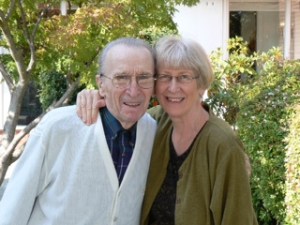
My hero – my father: 1918 – 2007
During my time of caregiving, (my father died in 2007 from complications relating to Alzheimer’s disease) I oftentimes sought out the advice of anyone I could get my hands on who might a) lighten the emotional load I was carrying; b) lead me in the right direction when looking for next steps in the caregiving process; and c) let me cry a river as I pondered whether I was doing enough for the one for whom I provided care.
Way back when I was enmeshed on my caregiving journey, I was not aware that this type of coaching service was available – perhaps it wasn’t. What speaks volumes to me is that the prevalence of Alzheimer’s and other dementia is such that more and more people seem to be adrift and searching for that beacon of light that might pull them safely to shore.
One thing I know for sure, however, is that if it takes a village to raise a child, it certainly takes at least that when trying to take care of a cognitively challenged parent, spouse, sibling, partner, or friend.
Lately I’ve read various blog posts mentioning that employees of long-term care (LTC) facilities are routinely disregarding the rights of their residents. What’s that you say? You didn’t know that when these older folks walked through the doors of a facility, thus giving up their cherished long-term independence, they actually gained rights that they never had before? Here’s some information that will benefit you and your loved ones. I’ll explain by way of providing a few examples:
Charlie moves his mother into a facility and the head of Health and Wellness strongly suggests that he not visit her for awhile so she can adjust to living in a different environment.
WRONG! If mom wants her son to visit her, Charlie should ignore the “advice” of the H&W employee and visit mom as often, and as long, as he and his mom wishes. Logic: What do you think benefits mom most? The calming presence of her son who has been the only constant in her life, or the absence of any person or thing that would lessen the feeling of abandonment in a strange environment?
June, who is confined to a wheelchair, is forced to go to an activity by facility staff. Apparently June’s family has asked staff members to make sure that June gets out of her room and socializes with other residents. On this particular day June would rather stay in her apartment and watch game shows on television.
Who wins this argument? June should because it’s her life, and neither staff, nor family, can force her to do anything. Logic: Doesn’t someone who’s lived at least 7 or 8 decades have the right to make decisions that are important to her? Yes – and that right is protected by law. Legal implications: June is reliant on others to transport her to and from places, therefore when she’s taken to the activity room against her wishes, the law considers that action as physical restraint because she is “stuck” in the activity room and in her chair, and not able to physically move herself elsewhere on her own steam. Additionally, the facility is guilty of coercion – forcing June to do something she doesn’t want to do.
George joins his buddies in the dining room for lunch and orders a chili dog and a Bud Lite. When the meals for him and his buddies are served, George’s chili dog has been pureed and his beer has been substituted with a glass of iced tea.
Dilemma: The server tells George that his doctor ordered a pureed diet because George almost choked on a roll at a nearby restaurant and he risks aspirating on his food. The server then tells George, and anyone within hearing distance, that his doctor also said George should not drink alcohol because of his diabetes.
Rights infractions: The server talked about a medical condition in front of his buddies by mentioning two medical conditions: George’s choking hazard and his diabetes. That’s a violation of his privacy rights. George is aware of the choking incident – and he is also aware that alcohol may not be such a good idea because of his diabetes – but he is making an informed decision to eat and drink what he wants, knowing all the risks involved. Solution: Oftentimes facilities are worried about liability in these types of situations – very understandable. To resolve such a concern, all that is needed is to conduct a “care conference” in which the health & wellness director, George, and perhaps his doctor by phone, discuss the risks inherent with George’s decisions. They can easily discern that George has weighed the pros and cons and that although he acknowledges that doctor’s orders have been issued, George decides to disregard said orders. Care conference notes should indicate the gist of the discussion; perhaps everyone in attendance signs their name agreeing that what is written in the notes accurately reflects the points covered in the discussion, and then everyone should be happy and no lawyers need to be involved.
I strongly suggest that you contact the long-term care ombudsman in your state should you have any inkling that your loved one’s rights are being neglected. Visit the National Ombudsman Resource Center (NORC) and join with them to advocate for your loved one. Everyone deserves to be treated with dignity, and certainly all of you would agree that all people should have a satisfying quality of life regardless of ones’ age and residential environment.
Final thought: put yourself in your loved one’s position … what would you want done on your behalf?
Submitted by Boomer98053, a retired Certified Long-Term Care Ombudsman.
Syndicated columnist Leonard Pitts Jr. had an Opinion piece in the January 19, 2014 Seattle Times Sunday newspaper. His article focuses on the cruelty that comes out of the mouths of people who feel they are obligated to point out the obvious to others. During and after her appearance on the Golden Globes, the exceptional 30-year old actress, Gabourey Sidibe, became the target of many anonymous, and sometimes identified, Twitter trolls who decided to remind her that she’s fat. One Tweet said she looked like the Globe in the Golden Globes; another stated that she missed the hour glass look by 10 hours.
Leonard Pitts questions when and how did this type of truly sadistic personal meanness become acceptable, even common place? “Everybody’s got something…some physical or emotional blemish measuring the distance from you to perfection.” So why do we think it’s any of our business to criticize someone else’s imperfection? Doing so is an act of judgment of someone about whom we know very little.
When us kids would say something cruel about someone, my dad would offer the following: “It’s too bad that everyone isn’t as perfect as us.” Point taken.
What happened to what Mr. Pitts calls “home training” that is supposed to teach us that there are just some things you don’t say to – or about – people in a public forum? Are these grown adults mimicking the behaviors from their upbringing, or did they just decide on their own to cut people to pieces, not caring a wit about the harm such cutting banter will have on the recipient?
Bullies – all of them.
Whether our “something” is shaped like the emotional scars of abuse, an eating disorder, physical or developmental disabilities, bad teeth, or a nose that is too big, too fat,or too small, no one has a right to inflict hurt on us by their words. Does hurting someone with words serve to downplay our own imperfections and/or personal issues? Does a person actually feel better after they’ve called someone a tub of lard, or uglier than sin, or dumber than a doornail?
I’ll leave you with Nobel Peace Prize winner, Eli Wiesel’s statement during an interview with Oprah Winfrey a couple years back. May it be a challenge to me, and a challenge to you.
As a human race, we must choose between: the violence of adults, and the smiles of children; the ugliness of hate, and the will to oppose it; inflicting suffering and humiliation on our fellow man, and offering him the solidarity and hope he deserves for naught.
Even in darkness, it is possible to create light and encourage compassion. Every moment of our life is essential; every gesture is essential. Our role in life is to give an offering to each other.
The Seattle Times newspaper has a Saturday column, Faith & Values, that spotlights a variety of religious denominations. One week there might be an article by a Catholic priest, another week, from a Rabbi, another, an Imam from the Islam faith. On Saturday, January 11th, the one who submitted her article is a minister with the Northwest Ministry Network (Assemblies of God), Jodi Detrick.
Ms. Detrick quotes several of the more well-known scriptures from the Bible that focus on hope, one of which is: “But hope that is seen is no hope at all. Who hopes for what they already have?” Romans 8:24
In my experience, I’ve found that there are many messages of hope out in the universe, and not all of them come from a spiritual text. Take Astronaut Mark Kelly’s response to Diane Sawyer on ABC’s 20/20 program a couple years ago. When talking about his wife Gabrielle Gifford’s chances for recovery from a gunshot wound to her brain, Diane Sawyer suggested that he was holding out too much hope for his wife’s successful recovery from the bullet’s onslaught. His response:
“You can’t have too much hope! That’s not practical!”
Isn’t that the truth? How limiting it would be to portion out a wee bit of hope, but not invest fully in that state of being. “In other words, it’s OK to be filled with anticipation for things that seem way out of sight and out of reach … Uncertainty is where hope does its best work,” says the columnist Jodi Detrick. Two years after the 20/20 interview, Gabrielle Giffords is doing “miraculously” better and she would argue that her day-to-day life is very complete, and very worthwhile. Thank goodness neither she, nor her husband, gave up hope!
“Hope outlasts disappointments. Not everything we hope for, happens, it’s true … Unrealized expectations can be an open door to new possibilities – options we hadn’t previously considered.” Jodi Detrick again. I agree with her statement because I’ve experienced those other possibilities. I’ve certainly couched my hopes and dreams to look a certain way, only to discover that the options I hadn’t previously considered managed to transform my hope into something better than I could have imagined.
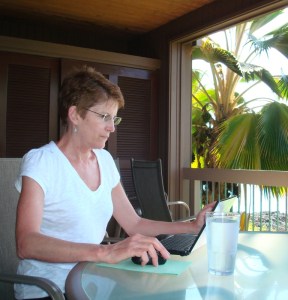
Writing while on vacation a couple years ago.
Interestingly enough, the first hope that Jodi Detrick mentioned when she listed the types of dreams that hopeful people think about, was writing a book. I happen to be writing a book about the effects of Alzheimer’s on family caregivers and the ones for whom they are providing care – a project I started on December 29th, 2012. In the year since then, my novel has been through numerous edits – some of a substantive nature, and many that were grammar related. The mission for my book has always been to put a personal face on Alzheimer’s disease; to expand on the impressive, yet horrific, statistics on this fatal condition by making it more personal, and therefore more real.
One of my first “friendly editors” happens to have the same name as the protagonist in my book, Colleen. When Colleen read the very first draft of the very first 150 pages of my book, her first question was, “Who is your reader?” I insisted then, and I insisted for the past year, that my reader is the current or former caregiver, or the soon-to-be-caregiver who will find themselves amongst the millions of family members caring for a loved one with Alzheimer’s or other dementia. “But does the caregiver have time for the luxury of reading a novel? Or does the caregiver even want yet something else that reeks of the challenges they are currently facing?”
Crap. Of course not. But I kept on structuring the novel in my original – and stubborn – way. My second friendly editor was a coworker who was dying of cancer. Dennis wanted me to hurry up and finish my book so he could read it – “before it’s too late.” I gave him what I had. A week later I met with him and one of the constructive suggestions he gave me was, “You should be considering this novel as a textbook.” My response: “Dennis, I’m not writing a textbook. I’m not even writing non-fiction. I chose fiction as the genre because I don’t have any sophisticated initials that signify astute knowledge, such as: MD, PhD, MSW (Masters of Social Work), and the like.”
Dennis responded, “I do have a MSW and I think your novel should be required reading for medical professionals and others directly involved in Alzheimer’s care.” I continued writing, thinking that a textbook might be a secondary use for my novel, but it would primarily be a vehicle that provides hope and promise for those intimately involved on the Alzheimer’s disease journey. (Didn’t I tell you I can be a little stubborn?)
Fast forward ten months. I had lunch two weeks ago with a friend of mine, Gwen, and a woman who lives in the same apartment building as she. This woman, Liz, works for a company that provides a remarkable early-detection testing and monitoring system for those suspected of having mild cognitive impairment. I’m not here to promote the company, I’m merely providing the background of the person I met.
My friend, Gwen, brought up the fact that I was writing a novel about Alzheimer’s with a focus on the caregiver and patient journey. Immediately, Liz suggested that the founder of her company, who among other qualifications, has a PhD in Clinical Psychology, should read my manuscript. The Curriculum Vitae for each member of this company’s scientific advisory board contains more initials after their names than letters in the alphabet. These professionals know their stuff and most of it focuses on Alzheimer’s and other dementia.
I insisted that if the founder were to read my manuscript, Liz had to pave the way and do so without putting any pressure or sense of obligation on this very busy doctor. She met with him and that afternoon, Liz e-mailed me his contact information. Phew! Very long story, short, he is now in possession of the first 150 pages (the much revised version which I printed and overnighted to him) and he is taking it with him on vacation. What?!
Indeed, what? Also – what does this mean? Can I throw all caution to the wind and have even greater hopes that he and/or his advisory board will provide valuable input so that my manuscript carries more credible weight? Can I also wonder if my manuscript’s exposure to these professionals may segue into what my now deceased friend, Dennis, suggested it should be? Required reading? Whoa! The institutions of higher learning to which these professionals are attached, to name a few, are: Duke University Medical Center, University of Washington (Seattle) Medical Center and Memory Disorder Clinic, Stanford University School of Medicine, and UC San Diego School of Medicine.
I know what you’re thinking. “Aren’t you getting way ahead of yourself Irene? You could be setting yourself up for a huge disappointment.” My response to that is: Haven’t you heard? Hope outlasts disappointments.
Forgive me, if you will, because I am going to start this blog piece by quoting some of the lyrics from Katy Perry’s song, Roar. You may not have heard of this popular singer or if you have, you may not follow her career, but one of her songs resonated with me and challenged me, so thus begins a few of the lyrics:
I used to bite my tongue and hold my breath; scared to rock the boat and make a mess, so I sat quietly, agreed politely. I guess that I forgot I had a choice; I let you push me past the breaking point; I stood for nothing so I fell for everything.
When was the last time you swayed in the wind of other people’s opinions and fearing ostracism, you swayed in silence even though you disagreed with those opinions being expressed around you? What did that feel like?
You held me down, but I got up, already brushing off the dust. You hear my voice, you hear that sound, like thunder gonna shake the ground; you held me down, but I got up; get ready ’cause I’ve had enough. I see it all, I see it now…
How long did it take to break the hold that your silence had on you? How much time passed before you got up and let your “you-ness” shine forth amongst the crowds – whether those crowds consisted of strangers or close loved ones? What did it take for you to divert from the ebb and flow of popular opinion and launch your own?
I got the eye of the tiger, a fighter, dancing through the fire; ’cause I am a champion and you’re gonna hear me roar. Louder than a lion, ’cause I am a champion and you’re gonna hear me roar.
Break out of the prison where your stifled opinions have placed you.
The purpose of this open-ended article is to encourage some personal internal dialogue wherein you answer the above questions for yourselves and discern whether or not you’ve been stifling beliefs or opinions that define the essence of who you are, but which you’ve held to yourself because you don’t want to rock the boat.
What are you waiting for? The author, Eckhart Tolle would say that Now is all you have. You can’t go back and correct the past; it doesn’t exist anymore. You can’t rely on there being a future. All you have is the present moment, so do yourself a favor and stop denying who you are, and what you believe in. Take it from someone who knows – you’ll like and respect yourself a whole lot more when the real you starts living.
More Alzheimer’s patients finding care far from home | Nation & World | The Seattle Times. This article looks at the direction in which Alzheimer’s care may be shifting. There are currently 44 million Alzheimer’s patients globally with 135 million projected by 2050. Even now, Western spouses and family members are faced with an insufficient supply of qualified nurses and facilities, while other countries provide cheaper – and to some minds, better – care for those suffering from an illness for which very few effective treatments have been developed, and that is always fatal.
(Photo credit: Wikipedia)
The treatment center that is the major focus of this Associated Press article is located in Thailand – the Baan Kamlangchay center. Additional elder care options in other countries are mentioned, such as the Philippines, Eastern Europe, Spain, Greece, and Ukraine. Cost is the driving force of those who are “exporting” (not my word) the elderly to these foreign countries. One gentleman from Switzerland brought his 65-year old wife to Baan Kamlangchay because the monthly cost for her Alzheimer’s care ($3,800) is a third of what he would pay in his own country and he states that the staffing ratios are far better, and the activities more engaging. In the Philippines, care is offered to Americans for $1,500 to $3,500 a month, compared to the average of $6,900 for a private room in a skilled nursing facility in the United States, according to the American Elder Care Research Organization.
Cost shouldn’t be the only consideration, however, when moving a loved one into Alzheimer’s or dementia care – and that applies to every country in which that care is available. What are the training requirements for those who will be providing this disease-specific care for your loved one? What type of governmental or social service oversight is in place to protect and advocate for the rights of those patients who can not advocate for themselves? The latter question becomes extremely relevant when the patients’ families are not around to observe care on an ongoing basis. In the previous paragraph I mentioned the man who brought his 65-year old wife from Switzerland to Thailand for care. He is now faced with the very difficult decision of perhaps leaving his wife of 41 years in the facility, and returning to Switzerland to carry on the rest of his life.
That’s a decision unbearable in its emotional implications.
What are your thoughts? Are you willing to become an expatriate should this medical need present itself in your life?
I addressed some of the issues of Driving under the influence of dementia in an article I wrote in November 2013. Back then I hadn’t planned on writing a Part 2 for this article, but after a couple local incidents involving DUI of dementia, I must provide the following.
Yesterday afternoon in a suburb of Seattle (in Bellevue), an 89-year old woman with early stage Alzheimer’s left her house for her normal daily routine of going to her favorite pancake house, then to several retail locations. She never returned home last night and as of today, she is still considered missing. I hope the outcome of her case is better than that of another elderly person with Alzheimer’s who also went on a brief errand, but never came home. (Update as of 12/28/13 6:45 pm: this woman was found safe approximately 16 hours after she first left her home. She was found 20 miles away from home. Unfortunately, she wandered 20 miles away from her normal driving area.)
On Saturday, December 21, 2013, Joseph Douret left his Seattle area home (in Issaquah), to grab dinner. He was reported missing the next day by his wife who stated that he never came home the previous evening when he left to grab some dinner for the two of them. Mr. Douret, who was suffering from Alzheimer’s, was found dead in his vehicle on Christmas Eve. Police indicated that he appeared to have died of natural causes.
Taking away the keys to a vehicle – or getting rid of the vehicle as need be – are both very difficult tasks, but these are tasks that must take place if a loved one with dementia still has access to their automobile. “But he/she is only driving a few blocks to pick up a couple items; there’s no way he/she will get lost.” Unfortunately, what should be a routine drive can become a death journey because nothing is routine for the person with a brain addled by dementia. Nothing looks normal or familiar; the anxiety ratchets up several notches; panic sets in; and the countdown begins for that person’s last hours of life on earth. Even if the person is eventually found safe, he or she will have endured a very uncomfortable time emotionally and physically. The positive outcome of that incident, however, is that it will most likely be the catalyst that spurs people on to remove all driving options from their loved one.
Please make the decision today to take action and do the responsible thing on behalf of the person with Alzheimer’s or other dementia.
I’ve made a few edits to this article that I wrote in April of 2012. I’m re-blogging it because I know that the Holiday season may be joyful for the multitudes, but that is not always the case for everyone. I’m thinking of the reader who simply wishes this season would end and that a new year would begin…a new start that might herald in a smidgeon of much-needed peace. This one’s for you.
Do you find peace within the circle of your family; or does meditation or prayer, an inspirational book, or music fill your soul? Wherever the source – how do you keep that peace from slipping away?
Certainly when we’re exposed to sorrowful or earth-shattering news, any semblance of peace and calm seem to disappear, such as: acts of terrorism – both domestic and abroad; heartless school shootings; bigotry and hatred; and even devastating illness. How many times has your armor been pierced by such circumstances?
Too many to count. So how do we find peace amongst the chaos?
We can find peace in many small ways – probably the easiest way to do so is to acknowledge the beauty that surrounds us. It doesn’t matter whether you’re a creationist or an evolutionist, the beauty you see is the same. It’s always refreshing when I walk through my local plant nursery,
A recent NY Times article, On Dying After Your Time, poses many topics for discussion that must be addressed. I knew before I even started to read the article that readers will have varying opinions on the matter of extending life beyond its appointed time to die. These opinions will be based on ethics, biases, age of the reader, and religious beliefs, to be sure, but another factor that comes into play is the personal experience of each reader.
My father and my sister-in-law, both of whom have died from Alzheimer’s in the past five years.
If the reader has watched a loved one perilously balanced in limbo with a ravaged-by-disease body and/or mind, that reader might lean towards declaring that too much is being done to artificially prolong life. In the past five years of my life, I have watched both my father and my sister-in-law die from Alzheimer’s. Who they were at the end of their lives didn’t come close to resembling who they were pre-disease. If the reader has had no experience with this aspect of life and death, that reader may feel more comfortable with the decision to throw every treatment possible at the patient with the goal of allowing that person to live as long as humanly – or scientifically – possible.
One of the issues presented in the NY Times article is the fact that as we live longer, there is an increase in the amount of chronic illnesses – a fact that certainly stands to reason. “This rise in chronic illness should also give us pause about the idea, common to proponents of radical life extension, that we can slow aging in a way that leaves us in perfectly good health…The evolutionary theory of senescence [growing old; biological aging] can be stated as follows: while bodies are not designed to fail, neither are they designed for extended operation.”
The author of the NY Times article is an 83 year old man who closes out the piece by stating, “We are not, however, obliged to help the old become indefinitely older. Indeed, our duty may be just the reverse: to let death have its day.”
If you haven’t yet formed an opinion on the matter of life-extension at all costs – I encourage you to do so before it’s too late. Life and death decisions are best made well in advance of the necessity of such decisions.
I just supported Tribute Page. The attached link takes you to a page that spotlights a strong teenager who never let her brain cancer diagnosis bring her down.
Olivia Wise was diagnosed with cancer in 2012. She and her parents knew that this diagnosis could be a death sentence and even though she fought against the cancer, she never gave in to its antics.
When this young woman received the news that there were no more treatments available to her, she recorded a cover of Katy Perry’s song, “Roar” and on the same day, in that same recording studio in September of this year, she sang a song that she wrote at the age of 11 called, “Simple Girl.” Both songs are amazing in their import – especially if you consider the fact that Olivia had to struggle for each breath needed to complete each song. Both songs can be purchased on ITunes at 99 cents each.
The goal of recording “Roar” was that she wanted her family and friends to be left with her voice, singing a song that depicted who she was. She chose not to be identified as the cancer that ravaged her body. Olivia wanted people to remember her as a tiger, a fighter, and a champion. She wanted her loved ones to hear her roar long after she left this earth.
You can’t open a newspaper these days without reading about budget cuts to Federal, State, and City services. Memos are flying around these offices demanding across the board reductions or else!
The State of Washington figured out a way to save more than one million dollars and its Department of Social and Health Services is the brainchild of this impressive savings coup: deprive those with developmental disabilities the required services mandated by law that help them to function better in society. The required services include physical and occupational therapy, personal-care training, speech therapy, guided behavioral norms, job skills, and recreation.
Two dozen developmentally disabled residents of Lakeland Village in Spokane, Washington – a state and federally funded long-term care facility – were denied these services for two years – most likely causing irreparable damage to these residents. Let’s see – two dozen residents for two years – how many times was the law broken as a result?
41,231 times
How did they pull it off? They moved a couple dozen residents from the intermediate-care facility of Lakeland Village into its nursing facility which is cheaper because that part of the facility does not have to provide the specialized services that the developmentally disabled residents need. The relocated men and women received excellent medical care – most of which wasn’t called for – but they were deprived of all the quality-of-life services they needed most. This violation of federal law means that the facility received federal funds in error – funds that were meant to cover legally mandated services at the facility.
When the investigation was launched and DSHS was told to provide documentation for the time period in question, there was little evidence that the specialized services had been provided. In response, DSHS stated, “We didn’t make good documentation, or indeed, we didn’t provide some of them (documents).” It is thought that the reason the paperwork wasn’t found, is that it doesn’t exist.
The State tried to cut its budget by $1 million by fraudulently withholding required care services. The investigation continues while it is estimated that the federal government will penalize the State of Washington/the Department of Social and Health Services in the amount of $16 million.
(Photo credit: Wikipedia)
But you and I already know that the biggest price has already been paid by the disposed of human beings.
What were you doing when President John F. Kennedy was shot? (West Coast Pacific Time for that was 10:28 a.m.)
What did you feel as a result of his assassination – either right then and there and/or the days and weeks following?
John F. Kennedy in the Oval Office. (Photo credit: Wikipedia)
I was in my 5th grade classroom at St. Bede the Venerable elementary school in La Canada, California, when suddenly, the school’s public address system came on in our classroom, broadcasting what appeared to be an urgent radio message. The Principal of the school gave no preamble to the radio broadcast, it simply became suddenly audible in our classroom. When I was able to focus, as a fifth grader, on what was being said, I recall hearing “The President of the United States has been shot; John F. Kennedy was shot during a motorcade in Dallas, Texas and is not expected to live.” (Or words to that effect.)
My teacher, Sister Mary Fahan told us kids to put our heads down on our desk and pray. It seemed so startling to me – it was a heavy moment for which us fifth graders didn’t have 100% understanding, but the young boys and girls in my classroom felt the heaviness of the moment anyway. Many of us were crying at the words coming forth over the speakers in our classroom – urgent and shocking words that stuttered from the radio announcer’s mouth.
School was dismissed and when my sister, Mary, and I were picked up by our mom, we climbed into her red and white 1957 Chevy Bel Air Nomad station wagon and joined our tears and fears with those of our mother’s.
Then for the remainder of November and into early December, it seemed as though the only story being covered on our little black and white (somewhat brown and white) television screen were the news updates and somber funereal activities inherent with the death of a President.
I recall that after I recovered from the initial shock of the incident, the impatience of a nine-year old took over due to the bombardment of constant television coverage that echoed around the walls of our house. I yearned for normalcy, and for me that meant a return to TV episodes of Lassie reruns and new episodes of My Three Sons. Perhaps what we experienced during that 1963 tragedy is not unlike what the children of the 9/11 era felt when their lives were invaded by the tragedy that marks their young lives.
Unfortunately, there seem to be enough horrific world events going on that each and every generation’s children will have memories about which they will reflect as they enter their older years; just as us Baby Boomers reflect on November 22, 1963 and all the other tragedies that have invaded our lives since then.
It’s the not-so-new DUI that is becoming as rampant as are the increased incidences of Alzheimer’s disease in the world.
Are you enabling someone in your family by not having the difficult, yet necessary, conversation about driving safety? “She only uses the car to drive to the grocery store, eight blocks away.” Oh, is that all? Well then, nothing could possibly happen that might harm/kill her or harm/kill another innocent driver or pedestrian, or child on his bicycle zooming out of a driveway and into the street. Right?
In the attached article, Driving with dementia: the dangers of denial, I go into detail about the hazards inherent with driving under the influence of dementia, so I won’t repeat its content here, but I encourage you to take the time to give it a look-see. I’m readdressing this issue because of what I witnessed today:
A car making an unsafe switch of lanes, barely missing the huge SUV in front of which she maneuvered her car;
Then I witnessed this SUV – certainly not understanding the circumstances surrounding this affront to his driving – quickly passing the woman and doing the same to her as had been done to him – abruptly changing back into her lane with nary a few inches to spare between his back bumper and her front bumper;
Now I’m behind the impaired driver who stops suddenly at an intersection (we have the green) and she puts her left hand turning indicator on, only she’s not in the left hand turn lane – she’s in the through lane and she’s risking a multiple-car pileup by her actions. I could not move to the left or right to avoid her so I laid on the horn and fortunately, she proceeded straight ahead, not making her left turn;
Further down the road she managed to get into the left-hand turn lane and as I passed her, I clearly saw an impaired and confused woman in her 70’s who appeared unaware of where she was or where she was going.
I was in no position to follow her to assure that she was okay, but I did throw up a prayer that she would get safely to where she needed to be – without harm to anyone else as well – and that her family or someone close to her would do what was necessary to take away her car keys.
Denial about this issue doesn’t solve anything. Please make the decision today to remove the keys from a person who absolutely should not be driving because of his or her dementia.
I am very pleased to say that I am a subscriber of the only Seattle newspaper still in print – the Seattle Times. This newspaper writes and publishes varying opinions on local and global issues – even when one journalist disagrees with his or her fellow journalists or – dare I say – the Editors of the paper. A timely example of freedom of the press was displayed during the showdown between the aerospace machinists unions representing Puget Sound Boeing machinists (blue collar workers) and the higher-up Boeing management who replaced Seattle with Chicago as their ivory tower home base in the year 2001.
(Photo credit: Wikipedia)
Washington State Governor, Jay Inslee, asked for – and received – a special legislative session to present a bill that would award Boeing with delightful tax incentives to entice the company to continue the practice of building their airplanes in the greater Seattle area, a/k/a the Puget Sound region. This bill was passed but was contingent on the machinists agreeing to an extension of their current union contract period from 2016 to the year 2024. Additionally, the newly revised contract would not come close to resembling the current contract that both the machinists and the Boeing executives agreed upon when signed a few years back. If the union membership would vote “Yes” on this newly devised contract, Boeing would keep the 777X in Washington forever more. If the machinists voted “No” on the contract, Boeing leadership would approach other non-local Boeing sites – those not in Washington State. Now why would this Washington business want to give their work to another state’s economy? It’s all about the unions, baby.
Boeing leadership, and the major shareholders of Boeing stock, are sick and tired of machinists and engineers caring about – and fighting for – their rights regarding employee benefits. Shifting work to non-union locations means that the company doesn’t have to deal with the petty demands of their dedicated workers who are just trying to make a decent living now, while building a decent retirement for later. One of the major take-aways of the newly crafted contract is the cessation of the machinist’s pension plan, replacing it with a traditional 401(k) savings plan. Go ahead and say it – many people are thinking the same thing you are: “Shit! Companies all over the United States are ending employee pensions and cutting back. You SOB Boeing machinists should stop your whining and just be glad that you have a job!”
On November 11, 2013, the Seattle Times editorial staff printed their opinion of what the machinists should do: Vote Yes for the Boeing 777X. I encourage you to read the attached article because the Editors no doubt speak for a certain percentage of their readership who believed that the machinists should give up their current contract and take on a new contract – let’s call it Machinists’ ContractX. Danny Westneat’s “Squeeze play” opinion piece attached at the top of my article, speaks for a different percentage of the newspaper readership – many who work for Boeing – but also those non-Boeing people who understand that when employees are told to sacrifice and cut back on their benefits for the good of the company – everyone in the company should be a part of that sacrifice.
Let’s look at the facts and you can decide if the executives are sacrificing to the same extent as their employees. Boeing has been racking up profits with its stock exhibiting impressive numbers. When the markets closed on Monday, November 18th, the stock price was $138.36 per share. “If Boeing’s CEO, Jim McNerney, retires right now, he will get $265,575 a month. That’s not a misprint: The man presiding over a drive to slash retirement for his own workers, and for stiffs in the rest of America, stands to glide out on a company pension that pays a quarter-million dollars per month.” See Anguish many of us understand, by Danny Westneat dated 11/9/2013.
At play here are many emotions and opinions – both in the newsroom and in our living rooms. On the one hand, people are saying that the machinists ruined it for Washington State by not agreeing to replace their current contract in 2016 with the hastily revised one. This new contract came about as a result of the Governor and his legislators getting into bed with the Boeing executives and some of the machinist union leaders, to discuss in private what they felt was best for their employees. As a result, the squeeze was indeed put on the machinists and now they are being blamed for Boeing’s decision to look elsewhere for airplane production that would have provided guaranteed work for current – and future – Boeing employees in the Puget Sound region.
Let’s get back to the disgruntled people who say that Boeing employees should just be glad that they have a job. Boeing employees are highly skilled workers, and historically they have been paid salary and benefits commensurate to their skills – as is the case with Boeing engineers – many of whom have been with the company for decades. All the salary and benefit details were agreed upon by Boeing management and Boeing laborers at the beginning of their current contract – the contract for which the terms don’t expire until 2016. If the machinists voted “Yes” on the newly proposed contract, they would have eight years’ worth of financial takeaways for which they weren’t prepared at the 2016 contract end.
Based on what had been legally agreed upon, these employees had been managing their present lives and gearing up for their future lives, when all of a sudden they were presented with a different financial formula than the one promised in the contract upon which they based these financial plans. Then the rug was pulled out from under them and the people pulling the rug were those who will bank monthly pension amounts of approximately $300,000 at today’s rate. Where’s the sacrifice baby? What am I missing? Don’t forget, the aforementioned amount is just the pension amount – there are many other richly held benefits held by the executives. And even if $300k per month was all the compensation each executive were to receive in retirement, that’s $3,600,000 a year. Shouldn’t that leave some sacrificial wiggle room?
But the article I set out to write is about Freedom of the Press and the wonderful ability for one newspaper to express conflicting views while still being able to retain their jobs. Newspapers and other periodicals would do well to model the Times so that the reading public can read conflicting journalistic opinions in order to arrive at their own opinions on hotly contested subject matters…
Bloomberg Businessweek posted a provocative article, Sex Among Dementia Patients Spurs Call for Policies, that will no doubt get the attention of professionals, and family members alike. The attached article is well-worth the read, and I have a few comments of my own to add.
(Photo credit: Wikipedia)
I acknowledge that sexual activities most likely occur in every long-term setting out there. Consenting adults – even those with varying degrees of dementia – need touch and physical connection. I think it’s fabulous that in spite of the limitations brought about by cognitive impairment, human beings still maintain the desire to give affection, and receive affection. In some instances, affection may simply be expressed with hand holding or sitting next to someone, hip-to-hip. Or perhaps a hug and a kiss are involved. All of these actions are perfectly innocent without harm as long as all touching is consensual.
Some residents may express their need to give and receive affection with more intimate sexual activities, so if both parties are willing and able, I think intimacy is an important part of their well-being.
What about those patients who are already married to someone else?
(Photo credit: Wikipedia)
It takes an understanding and flexible spouse or partner to overlook the intimate activities of their cognitively impaired loved one. The commitment made between the two parties years ago is a commitment that still resides within the deep recesses of that person’s being – but it’s a commitment that can not be drawn upon and reaffirmed because of memory impairment. (I think it’s important to not assume that adulterous motivations are in play here.) Marriage itself may be a concept that is no longer understood by the patient, and as is oftentimes the case – the visiting spouse exists as a friendly visitor, not the wife or husband that the patient used to know.
I can’t predict how I would feel if similar circumstances came my way in the future – my husband and I have not fallen into the cognitive impaired category – yet. And you don’t have to agree with what I’ve stated above. The sentiments I have provided come from my own personal beliefs, and from the perspective of having both worked in long-term care in my past, and having had family members who have lived in long-term care housing.
One last thing: As dementia care specialist Teepa Snow stated in the attached article, “No matter what you do, somebody’s going to see you as wrong.” The issues of sex and intimacy touch many personal, religious, and ethnic biases and beliefs. There are no completely right or completely wrong answers. I’m simply thrilled that the long-term care industry has stopped pretending that geriatric sex isn’t happening, and that they are no longer treating it as a taboo subject. I take comfort in that fact.
Life as a Caregiver and Dealing With Stress Caring for Aging Parents – AARP. The attached article, written by Dr. Nancy Snyderman, chief medical editor for NBC News, shows us that even doctor-caregivers are not immune from the stress brought on by caregiving. A year after Nancy and her siblings moved their parents to live near her, Dr. Snyderman became “one of almost 44 million U.S. adults caring for an older friend or family member.”
My dad and I, five years before I became his caregiver; seven years before he died from Alzheimer’s.
Statistics show that caregivers tend to patients who are loved ones, an average of 20 hours each week – many times on top of part-time or full-time employment. Before long, Dr. Snyderman came to the realization that she had forgotten to check in on how she was doing. She gained weight, she slept only a few hours a night, and she experienced burnout – not unlike what many of us have felt as caregivers – or former caregivers – for family members.
In my article, Caregiver: put on your oxygen mask first, I address the importance of caring for yourself first, and the patient second. “No way,” you say, “my mom/dad/spouse come first; they need me!” You’re absolutely correct – they do need you, but if you get sick or disabled, you can’t be there for them. That’s why you need to place the oxygen mask on yourself first, and then on the person for whom you are providing care.
Most of us learn the hard way. We get burned out and emotionally or physically incapacitated, and then we start taking care of numero uno. Do yourself – and your loved one – a favor. If you’ve been ignoring the signs of stress that are enveloping you, stop being such a hero and start taking care of yourself. You will benefit from such care, and so will your loved one.
U.S. President Barack Obama meeting with Speaker of the House John Boehner during the debt ceiling crisis in 2011. (Official White House Photo by Pete Souza”) (Photo credit: Wikipedia)
So our elected officials – those who claim to represent us – seemed to have been playing games the entire length of the partial government shutdown while countless U.S. citizens were out of work and the economy lost $24 billion amid a cloud of uncertainty and unease. Here are a few quotes from late in the day, October 16, 2013:
Jay Carney, White House press secretary: “There are no winners here.” John Boehner, speaker of the House: “We fought the good fight. We just didn’t win.”
Those comments reminded me of a Joe South song. What follow are some snippets of the lyrics:
Oh the games people play now. Every night and every day now. Never meaning what they say now. Never saying what they mean…
And they wile away the hours in their ivory towers, till they’re covered up with flowers, in the back of a black limousine…
People walking up to you singing glory halleluiah, and they’re tryin to sock it to you, in the name of the Lord…
Look around tell me what you see. What’s happening to you and me. God grant me the serenity to remember who I am. Because you’ve given up your sanity, for your pride and your vanity. Turns you sad on humanity, and you don’t give a damn.
The biggest loss for Americans is their respect for their lawmakers. Senator Chuck Schumer of New York agrees, “It was not America’s finest moment.”
Within a half hour of the finalization of the U.S. government deal, I received a phone call from one of the political parties, asking for a monetary donation to assure that there will be better representation of that party in Congress during the next election cycle. I abruptly stopped the caller, “You’re asking me today of all days to give money to one of the U.S. political parties? I’m disgusted with both parties right now, so for you to ask for my money within minutes of the U.S. funding agreement being finalized, is extremely bad timing.” Then I hung up.
I’m ashamed of these knuckle heads for simply kicking the can down the road, instead of working together to come up with a lasting solution that will benefit their constituents – constituents who can not afford to play their silly games.
“Oh we make one another cry, break a heart then we say goodbye. Cross our hearts and we hope to die, that the other was to blame.” The Games People Play, by Joe South.
Ms. Froma Harrop’s Opinion piece, linked above, challenges all of us Baby Boomers to not surrender to the other groups coming up in the generational ranks.
Are you done at 61? Closing the door at 64? Barely alive at 75? Or are you skipping to my Lou at 82?
Come on everyone – don’t throw in the towel! As Ms. Harrop said in her Opinion piece, “there’s nothing noble about declaring oneself out of the game, whatever the game is.” I’m not saying that us Baby Boomers and older don’t have age-related changes – of course we do – but that doesn’t mean that nothing remains for us in the years ahead. In my recent blog article, A surprising fete by a Baby Boomer! I complained about a Florida reporter’s characterization of something that a 55-year old woman was able to accomplish – even at her advanced age. Click on the link to my article to get the full gist of my whining diatribe.
Circa 1960’s: my dad running a marathon in his late 50’s.
I am not advocating that you suddenly decide to beat 64-year old Diana Nyad’s swimming record, unless, of course you feel like doing so. I am advocating, however, that you explore what you’re able to do and capitalize on it. Start a new business, volunteer for organizations that you support, or just keep working at your current job as long as you still want to. Who’s stopping you? My former father-in-law turned 90-years old on September 18, 2013, and he still plays tennis and is still working at his commercial real estate development company. If Jimmy were to stop working, he’d probably collapse and die on the spot. Why? Because he enjoys being active and productive. So should you.
Don’t let the younger folks – anyone less than 50-years old – have all the fun! You can have fun too! I turned 60-years old this past May. I’ve always been an active person exercise-wise but most of that centered around taking lengthy neighborhood walks and gentle hikes. My exceptional and persistent daughter, Erin, decided I could do more. She purchased six sessions of Bar Method classes for each of us and presented it as my birthday/Mother’s Day gift. “It’ll be fun! Once you get there, I know you’ll love it.”
My daughter (the Bar Enforcer), me in the middle, and my sister Mary.
Very presumptuous on her part, but she was right! After six sessions, Erin dropped out (she has other mind-boggling exercises that she does) but I continued with the program. The biggest lesson that I learned through this process is that I can do more than I thought I could do. Bar Method is extremely difficult, but it’s not impossible. After the first six lessons, I was able to conclude that a) it didn’t kill me; b) it didn’t disable me; and c) I kicked ass! That’s right – I kicked ass. I am in a class of mostly 20-50 year olds, and I not only keep up, but sometimes I outlast the younger students. I go to class once a week and two to three additional times a week I exercise to the Bar Method DVDs at home – courtesy of my husband who installed a ballet bar in our exercise room. Thanks hubby!
If you lack confidence, go find some! If you’re hesitant to go it alone, find someone else with your same interests, and go for it together.
You are not done yet. To quote Ms. Harrop, “Every age group brings something to the party. And for every generation, the party’s not over until it’s over.”
I wrote the article below with an exhilaration that threatened to carry me into the air and cradle me on Cloud 9.
Donning silly glasses and cozying up to a bottle of bubbly that remains unopened.
Since that time, the children in Washington, D.C. have been battling it out on the playground, most not playing fairly, and all of them holding strong to an agenda that appears to be designed to promote their party, rather than their constituents.
I wondered aloud, “If thousands of national parks are closed, 100’s of thousands of employees are furloughed, and service members’ families are being robbed of benefits, what luck does the Alzheimer’s research money have of remaining designated for that cause?”
So I wrote an e-mail to the National Institutes of Health and asked them this very question. What follows is the automated response I received:
Due to the absence of either an FY 2014 appropriation or Continuing Resolution for the Department of Health and Human Services, no one is available to respond to your message. If you require immediate attention, please contact NIH Service desk at 301-496-HELP or via web http://itservicedesk.nih.gov/support.
Asked and answered.
September 25, 2013
NIH logo (Photo credit: Wikipedia)
In today’s news, the National Institutes of Health (NIH) announced that grants for research to discover therapies for Alzheimer’s disease have been awarded in the amount of $40 million from the Office of the NIH director, and $5 million from the National Institute on Aging.
In all the reading that I’ve done, I’ve discerned that the magic words when it comes to finding treatment and/or a cure, are “clinical trials.” The new funding of $45 million will advance the current research being initiated in the form of clinical trials, thereby offering hope to all of us who live long enough to be at risk for acquiring this disease.
The attached article appeared in the September 27, 2013 edition of The Seattle Times newspaper, and provides the public with information about a traveling exhibit, developed by the American Anthropological Association that inspires us to consider not just what race is, but what it is not. By the way, I changed the title of my article after fellow blogger, www.letstalkaboutfamily.wordpress.com commented on my article – see below.
The central message of the exhibit is that what we call races are not separate genetic or biological groups, but distinctions created by people, oftentimes to mistreat or isolate those they regard as different from themselves…But those distinctions come from emotion and prejudice, not science.
The writer of the article, Jack Broom, states: “In the enlightened Pacific Northwest of 2013, it may be tempting to think of racism as a thing of the past, or something that happened elsewhere.”
I live in a suburb of the Seattle area and have no doubt that racist thoughts run rampant through my local society – oftentimes with a fervency that should shock the sensibilities of everyone. I know I was shocked when I recently experienced the following:
I’m out to lunch with a female friend who characterized “oriental” people as being very abrupt. I told her that I took offense to her statement for several reasons: 1) I was pretty sure the term ‘oriental’ was replaced by the word, ‘Asian’ a long time ago; 2) how can she so readily characterize billions of people using one word: abrupt; and more importantly, 3) my daughter (biological, born in Anchorage, Alaska, whose dad, my ex-husband, is Chinese, born and raised in Hawaii) is half Caucasian and half Chinese and if push came to shove, she might be characterized as looking Asian. My friend’s response: “Really? I thought Megan (not her real name) was American?” God help us all.
How does one respond to that? Well, I did, but I’d like to keep this article G-rated.
Second example: my husband and I are in the market for a new bed so I did some preliminary in-store research last week at a nearby store that specializes in mattress sets. I told the salesman that I was looking for a fairly firm mattress so he proceeded to point out various mattresses for me to lay on so I could test the different degrees of firmness.
The last mattress he showed me was very firm. When I laid down on it, I told him that we wouldn’t be comfortable on such a firm mattress. His response: “That’s the mattress the Asians buy. For some reason, all my Asian customers buy that firmness. Must be a cultural thing.”
Ugh – I walked out.
The writer summed up what visiting this installation at the Pacific Science Center might show us: “…the exercise helps make the point that dividing people into groups may tell more about the people doing the dividing than those being categorized.”
The attached video, just 3 minutes long, showcases how very personal Alzheimer’s and other dementia are to those involved. The toll on the patient – measurable, as you will see in this Shapiro family video.
The toll on the family – especially those caring for a member with the disease – beyond measure. Imagine taking care of someone who has lost his or her faculties, who can no longer express themselves verbally, and who has become a shell of his former self. Can you imagine it?
Imagine you must, because I sincerely believe that the only way people will stand up and take notice and do something about this disease, is to wear the mantle of a loved one with the disease, and/or the mantle of the beleaguered caregiver.
If you can help monetarily, please do so: www.alz.org.
If you can help within your community to relieve the stress of a caregiver with whom you are acquainted, that support is equally as needed and valuable.
Whatever you do, please do something to make a difference.
That’s what happened to the woman who is the subject matter of the attached article by Danny Westneat of the Seattle Times newspaper.
1951: Marian Dahoney, a newly employed worker at an insurance company in downtown Seattle, opens her first and only bank account at the institution located within her company’s building. Name of the bank: Seattle First National Bank, later called Seafirst, a wholly owned subsidiary of Bank of America. These days, we all know the bank as megalithic Bank of America.
(Photo credit: Wikipedia)
2013: Now 85-years of age, with no steady income, other than her monthly social security check and a small retirement amount from her now-deceased husband’s employment at Rainier Brewing Company, Bank of America is penalizing her for not having very much money. The Advantage for Seniors account that she currently funds with her fixed income will be charged a maintenance fee of $25/month unless she keeps a balance of at least $5,000. Danny Westneat calls those fees hidden taxes on the poor.
Marian is of the generation that believes that customer loyalty and commitment means something. She could have jumped ship many years ago as other financial institutions provided incentives for new customers to walk the plank onto their boat, but she stayed with Bank of America for 62 years – feeling good about her commitment to one banking institution for her entire adult life.
Not anymore. Marian is being forced to pull her funds (she has less than $5,000 in the bank, otherwise she would not have received a letter notifying her that the bank would be charging her $25 per month in maintenance fees) and she is searching for a new banking institution that will show her some integrity by waiving minimum balance fees. Imagine the efforts required of this 85-year old woman to go through the process of abandoning ship. For you and I – it would be an inconvenience – for Marian, it’s a major effort.
Marian Dahoney thought that her 62-years of loyalty to Bank of America would have counted for something. Nope! It counts for nothing, because Bank of America is too busy nickle and dimeing those who are just trying to put a couple meals on the table each day in a house or apartment they hope not to lose, while paying monthly utility bills to maintain the house’s heat, electricity, and water.
Shame on you Bank of America – and any other financial institutions – for penalizing the poor for not having enough money to somehow keep your businesses afloat.
My father and my sister-in-law, both of whom have died from Alzheimer’s disease in the past five years.
According to the World Alzheimer’s report:
If dementia were a country, it would be the world’s 21st largest economy, ranking between Poland and Saudi Arabia. In the year 2010, the total world cost for caring for the dementia population was $604,000,000,000 (billion).
By 2050, in the United States alone, the costs for caring for the dementia population will be: $1,200,000,000,000 (trillion). That’s more than 1,000 x $1 billion.
Are you thinking of making any charitable contributions to a worthwhile organization before the end of the year?
and I’m as mad as hell about the millions of crimes that it has gotten away with.
Alzheimer’s and other dementias are unfair to the one diagnosed and to all those involved in that person’s life. The unfairness unfolds with the worst day of that person’s life – diagnosis of a disease for which there is no cure – therefore it is always fatal – and it is a disease where little progress has been made in treatment options.
Let me introduce you to two fabulous people who are no longer with us because this disease killed them. Yes, Alzheimer’s murdered them.
My hero – my father: 1918 – 2007
My father, Don, was born in 1918 in Toronto, Canada. He married my mother, Patricia, and they had three children. They became U.S. citizens in the late 1940’s/early 1950’s. My father was an extremely distinguished, courteous, humorous, and dedicated family man. He received his Alzheimer’s diagnosis on June 3rd, 2005 and I was there by telephone conference, having attended his initial neurological evaluation a couple weeks earlier. He died at approximately 12:10 a.m. on October 13th, 2007.
Nancy, an adoring daughter-in-law to my father, seated in front of her.
My sister-in-law, Nancy, was diagnosed with mixed dementia just a few months after my father died. Nancy was born in 1942 in Quincy, Massachusetts. She graduated from UCLA with a degree in flute performance and used those skills in many venues throughout her life. Nancy had three children from her first marriage – children of which she was very proud. Nancy was an extremely talented interior designer, opening her own design business in 1987 – the same year that she married my brother, Don. Nancy died from mixed dementia, that also included Alzheimer’s, at approximately 11:05 a.m. on July 4th, 2012. Just two and a half months later, my brother and sister-in-law would have celebrated their 25th wedding anniversary.
Saturday, September 21st, 2013 is World Alzheimer’s Day. One in every three seniors dies with Alzheimer’s or other dementia. If you do not die from Alzheimer’s, you die with it. From Alzheimer’s Association 2013 Facts and Figures.
Won’t you consider making a monetary donation in the hopes of capturing this murderer?
U.S. website for the Alzheimer’s Association: www.alz.org
Other countries have their own dedicated websites as well. Please find those sites through any search engine you would normally use, and let’s slap the cuffs on this criminal disease.
“Mr. Desonier, I think you can stop scheduling an annual colonoscopy from this point forward. You’ve been very diligent about this aspect of your health care for many years, but at your age, I think this procedure provides inconvenience and discomfort that you can do without.”
My dad was 84-years old when his gastroenterologist made that declaration. I never thought I’d say this, but that gastroenterologist is my hero. My father had one suspicious colonoscopy a decade or so earlier, and was advised to undergo that test every year to be certain that no cancer was present. If you’ve ever undergone this test – and you should have a baseline one after the age of 50 or earlier if you’re symptomatic – you’ll understand when I say that I’d rather have a root canal than have my colon flushed and probed every year. Here’s TMI for you: I’m 60 and had my first exam of that sort seven years ago and passed with flying colors. I’m on the ten-year plan so I have a couple years left before I hop on that table again. But I digress.
The above article will shock you to your senses as to how incentivized doctors are to keep prescribing outlandish medical procedures on their elderly patients. Most, but not all, such procedures benefit medical professionals and facilities and provide no benefit to the patients that undergo such procedures. Here’s a quote from the above article that is sickening in its implications:
(Photo credit: Wikipedia)
Medicare spends a quarter of its $551 billion annual budget on medical treatment in the last year of life. A third of Medicare patients undergo surgery or an intensive-care-unit stay in their final year (of life.)
The author’s 80-year old father had a “stroke-blasted” body and underwent the surgical procedure of having a pacemaker installed to correct a slow heartbeat that gave him no health problems. Medicare paid $12,500 for that procedure. Her father’s family doctor didn’t approve of the cardiologist’s decision to perform that surgery. Medicare would have only paid that doctor $54 for a medical consultation with the family to weigh the pros and cons of such a procedure.
What’s the lesson here? There needs to be a greater focus on slow medicine in the form of palliative care, rather than fast medicine that dictates quick consults and immediate – and oftentimes drastic – medical intervention that robs the elderly patient of living on his own terms, and dying when its the body’s time to do so.
The above public service announcement shines a spotlight on a disease that will affect you one way or another:
My father died of Alzheimer’s 10/13/2007. I’m on the left – it could happen to me; my brother is on the right, it could happen to him.
You may receive an Alzheimer’s diagnosis or I may receive an Alzheimer’s diagnosis
A loved one of yours may receive an Alzheimer’s diagnosis and you’ll be his or her caregiver
A good friend of yours; a neighbor; a coworker may receive an Alzheimer’s diagnosis
The point is – just as all of us know someone who has had, or currently has, cancer – all of us have some sort of connection to someone who has Alzheimer’s or other dementia.
None of us is immune to this disease that steals a person while their heart is still beating.
When your children attained the age wherein having “The Talk” about sex and other scary things became unavoidable, you simply jumped in and winged it – wanting to explain as much to your kids as they needed to know but trying not to lend any encouragement towards participation in said scary things. Didn’t you feel better once you checked that “To Do” item off your child-rearing list? I know I did.
My father in mid-stage Alzheimer’s.
“The Other Talk” is that which you need to have with your adult-sized children, regardless of how uncomfortable you – or your children – are about topics such as: illness, death, and finances. Acccckkkkk!
My mother and my daughter, circa 1977.
Or perhaps it’s the other way around. The adult children are broaching these difficult topics with their parents in the hopes that said parents will do something about these unavoidable issues. Regardless of who is on the receiving end of these discussions, they should be considered mandatory in every family.
Consider this scenario: Dad is dying of cancer and in a coma. Your mother has already passed on, and you have no idea what your dad wants. His cancer is inoperable and he’s having more and more difficulty breathing and he hasn’t had any nourishment by mouth since he went into a coma. Does he want breathing assistance? Does he want intravenous liquids and nourishment? Does he want pain medication to help him through the extreme pain that cancer causes, even if the medication hastens his death?
What’s a son or daughter to do? Wing it?
Let’s look at another scenario: Mom is in the advanced stages of Alzheimer’s and is unconscious more than she is conscious. There is no reversal possible of the debilitating effect this disease has had on her body: her doctor tells the family that their mother’s ability to swallow is greatly compromised, her breathing is becoming more and more labored, and she has shown no interest whatsoever in food or liquids. Her body is in the active stages of dying.
In this scenario, dad is still living and cognitively competent and he has told the family and your mother’s doctor that he wants every single measure possible to be employed to keep his bride of sixty-five years alive. You, however, have a copy of your mother’s living will/advanced health care directive – as does your father – which contains conflicting wishes to those of your father. Your mother wants no extraordinary measures employed – not a respirator, not a gastric feeding tube, no intravenous nourishment, nothing except for medication that will make her as comfortable as possible as she leaves this world. When your mother was fully aware and cognitively healthy, she had her wishes incorporated into a legal document, determined to take the responsibility of making such decisions out of her loved ones’ hands.
What’s a son or daughter to do? Follow mom’s wishes.
What a gift that is – carrying out your loved one’s wishes when she is no longer able to verbalize them. It would still be a gift if mom’s wishes were clearly spelled out that she wanted everything done to keep her alive as long as possible. The point is not what was decided that is important – it’s that the decision had already been made – a decision that remained in the hands of the patient/family member.
Both of my parents gifted me and my two siblings with documented specific wishes for their life and death. My mother unexpectedly died in her sleep on September 24th, 1994 at the age of 77 – something she had wished and hoped for her entire life – who doesn’t? My father died on October 13th, 2007 at the age of 89 from complications of Alzheimer’s and cancer. There was no guessing when it came to the time when us three adult kids rushed to his bedside. He was comfortable in his death, and we honored him by following his wishes for no intervention. Did I want my dad to die? God no. I wanted him to live forever; but none of us gets to do that, so I’m glad that my father was allowed to take his last breath and leave this world his way.
A fellow blogger whom I greatly respect, wrote the above article that tells a story of aging, loneliness, intuition, and follow through.
There is a holiday celebrated on September 28th called National Good Neighbor Day. In the above linked story, a good neighbor noticed that she hadn’t seen one of her neighbors in awhile, so she acted on her concern. The story that unfolds could be a made-for-TV drama! Concern drew her to investigate and her gut wouldn’t let her turn away.
I think all of us need to trust our gut more frequently, which I learned for myself back in July. I’ve attached an article I wrote on that experience called – coincidentally – Trust Your Gut.
No one is an island, entire of itself; every man is a piece of the continent. – John Donne
Those of you in business of any type whether medical, construction, retail, food or travel industry, or any of the thousands of business types out there:
What are you doing to retain your customers?
The following incident occurred more than two years ago and serves as a good illustration of failed customer retention.
I moved to a suburb of Seattle in 1997 and became a client/patient of a local chiropractor. This Doctor of Chiropractic knew all there was to know about me structurally because she treated me for fourteen years. One of the issues of which she was keenly aware was my cervical spine (neck) discomfort. After much deliberation and procrastination, I finally decided to have it surgically treated. I had discussed my treatment options with my chiropractor at length throughout my time as her patient and she concurred that I might very well benefit from the C5/C6 disc replacement and fusion.
Xray of cervical spine – not mine (Photo credit: Wikipedia)
One week before my surgery I attended my chiropractic appointment and upon my departure that day I was wished well with the goal of returning for treatment once my neck fusion was completely healed.
Fast forward one year. During that year of healing I did not receive a phone call, nor did I receive a card; I received nothing resembling any indication that they valued my previous fourteen years of patronage. So I did something about it.
I wrote a very kind but professional letter expressing my disappointment in the management of this chiropractic office – a business that consists of one chiropractor and four staff members. I told her that I was offended at having been ignored. Here’s an excerpt from my letter:
I am offended by an apparent disregard for a patient’s longtime loyalty and patronage of your practice. In my mind, I felt that a provider of chiropractic care, which is so much more person-focused than traditional medical care, would value the patient/doctor relationship and reach out to this patient given the length of her patronage. That was not the case, so I have chosen not to resume treatment under your care.
You can be certain that I received a call within days of sending that letter, a call that went to voicemail while I was away from the house. The doctor fell all over herself gushing and oozing with regret while at the same time explaining her reason for doing nothing: “I wanted to protect your privacy.”
Come again? Does that mean you were disrespecting my privacy each time your office called to remind me of the 100’s of appointments I attended for fourteen years? No. You wanted to be certain I would show up. And how does sending a card to my home disrespect my privacy? It doesn’t. The excuse was weak and I stuck to my guns. Businesses need to realize that the least expensive and best marketing strategy involves word of mouth advertising. On the flip side, the least expensive and worst marketing strategy involves word of mouth advertising.
How much money have you lost because you ignored your customers?
Monica Guzman, Seattle Times writer and blogger, is going off the technical grid for a week – thus the article attached above wherein she analyzes our habits and impulses when it comes to us feeling the need to be instantaneously on top of matters. She’s not disconnecting from all technologies – she intends to watch television and might use a real camera – but she’s staying away from “the ones that know me.”
Ah, respite – what a delightful concept. Lots of us Baby Boomers equate respite to receiving some sort of relief from our caregiving tasks. For example, we might be taking care of a parent, sibling, partner, or spouse and we look for every opportunity for a reprieve from our caregiving chores – or at least weshould be. Please see my article Caregiver: put on your oxygen mask first.
Cordless Phone (Photo credit: Wikipedia)
Respite, however, also relates to resisting the compulsion to send someone a Happy Birthday greeting by sending an e-mail, or going to the honoree’s Facebook page, or sending a Tweet on the person’s Twitter feed – and instead, deciding to call that person for a conversation that lasts longer than it takes to type a 140 character greeting. OMG, MIK? (Oh my god, am I kidding?)
No – I’m serious. I could make it harder on you – and myself – by suggesting that we send a birthday card that would require us to purchase, write, post, and drop the card through the slot of a postal box. I think that would be a great idea, mind you, but that’s not what I’m proposing.
Rejoice in the fact that Facebook reminded you of that person’s birthday. (I know that you received sufficient notice not to miss that person’s birthday because truth be told – that’s how I remember many of my acquaintances’ birthdays each year.) But please resist the urge to send an instantaneous electronic greeting. Think of yourself – I know you can – and think of what it feels like to receive fun mail, such as a birthday card, or simply a “there’s no reason for this card” card. You liked that feeling – didn’t you? Now I want you to also think about how it feels when someone calls you to personally wish you happiness – just you and the person that called you. That’s a one-on-one attention connection.
Drop a note, make a call, but leave the 140 characters for some other important message, like:
I had a glazed doughnut and a cup of coffee for breakfast then washed my hair and can’t do a thing with it! Isn’t that just the worst thing ever?
Go ahead and count – there’s 140 characters there.

 Dilemma: The server tells George that his doctor ordered a pureed diet because George almost choked on a roll at a nearby restaurant and he risks aspirating on his food. The server then tells George, and anyone within hearing distance, that his doctor also said George should not drink alcohol because of his diabetes.


 I addressed some of the issues of Driving under the influence of dementia in an article I wrote in November 2013. Back then I hadn’t planned on writing a Part 2 for this article, but after a couple local incidents involving DUI of dementia, I must provide the following.


 Are you enabling someone in your family by not having the difficult, yet necessary, conversation about driving safety? “She only uses the car to drive to the grocery store, eight blocks away.” Oh, is that all? Well then, nothing could possibly happen that might harm/kill her or harm/kill another innocent driver or pedestrian, or child on his bicycle zooming out of a driveway and into the street. Right?






 Living: the ultimate team sport