Quality of Life
What’s in a name?
 What’s in a name? Turns out, quite a bit. We have all been on the receiving end of name misspellings – whether our first name or our surname. Countless times since my 2000 marriage, my surname has been spelled Olsen. Fortunately, when our name appears in print, oftentimes such misprints are easy to correct and life blissfully carries on. But what about after our life has ended?
In my home-based gym, I have been exercising as of late to a Netflix series, Finding God, hosted by Morgan Freeman. What attracted me to the series was the fact that no one religion is spotlighted, rather, many beliefs are presented, and that pleases me to no end.
Today’s episode discussed the topic all of us wish we knew more about:
What happens after we leave this life; is there such a thing as eternal life?
Sorry, I don’t have the answer to that question but what I can offer is the following: our name will live on forever. Morgan Freeman went to Thebes, Egypt and received an educational tour of Ramses’ tomb in the Valley of the Kings. (There were several Ramses, this was one of them.) In this tomb, Ramses tried to preserve the memory of his life by writing on the walls and pillars with both a self-body image (a selfie) and the actual writing of his name in the language of his time. He was well aware that many would outlive him but he was also aware that no one lives forever so he’d better make his mark on history while he could.
What about our mark on history? I already know there are more than one Irene Olsons, which is why when I published my book Requiem for the Status Quo, I wrote out my full name, including my middle name, Frances. No doubt I am not the only Irene Frances Olson who ever existed but to my knowledge, I am the only one who wrote this particular novel to honor her father who died from Alzheimer’s disease; I am the only Irene Frances Olson, née Desaulniers then changed to Desonier by her parents in the hopes of others spelling it correctly; the only Irene Frances Olson who birthed Erin Maureen Li Sai Wong Green; the only woman fortunate enough to be named Irene Frances Olson because of her marriage to Jerry Olson; I am also the only Grammo to her grandson, Lucas…and so on and so forth. Who I am as Irene Frances Olson is different from every other person similarly named because who I am is a result of how I have lived my life and how I continue to live my life.
My name is very important because it is attached to the me who is trying to make a difference everywhere she goes.
No one else is me, so I choose to make sure I inspire memories in others that will carry from one generation to the next. Fortunately, I don’t have to be famous in order for that to happen. All that is necessary is that the me that is attached to my version of Irene Frances Olson is memorable in a positive way.
This Week’s Good News!

Generation Z could teach all the rest of the existing generations a thing or two. Like in this story that makes inclusion the norm. My heart is full of good vibes with this delightful good news story.
Life’s Chapters
 I am not a writer, I happen to be a woman, mother, spouse, sister, grandmother, aunt, and a friend who has tried her hand at writing. I wrote a novel, Requiem for the Status Quo, to honor the father for whom I provided care when he had Alzheimer’s disease – a disease that took his life on October 13, 2007. I didn’t set out to be a novelist – arguably, I’m really not a novelist at all – but I knew it was imperative that I do something important for future Alzheimer’s caregivers and to use whichever vehicle was needed to accomplish that something. For me, it was writing a book.
Then what? What else could I possibly do to magnify the impact I set out to make regarding the disease that takes everyone it settles on, and forever changes the family members associated with its victims?
What I did was join AlzAuthors, a digital and community platform that uses the art of storytelling to light the way for those impacted by Alzheimer’s disease, to advance understanding of the disease, and to lift the silence and stigma of Alzheimer’s and other dementias. As a newly published author and a survivor of dementia caregiving, I was extraordinarily impressed – and still am – with the organization founded by three daughters of Alzheimer’s who sought a place of refuge and resources for their own caregiving journeys.
Then a funny thing happened – one of those founders asked me to join the management team of five, an invitation I gladly accepted, and with the guidance of a business consultant, who just happens to be my own daughter, AlzAuthors went from being a growing community of authors to a 501(c)(3) non-profit organization.
Then something else happened: although not serious, my health took a debilitating turn that now requires me to step back from my AlzAuthors responsibilities. Only the patient knows what she can handle, and what I know is that my focus needs to be on my health, as well as on the precious family that means so very much to me. I am still an AlzAuthor and I very much support AlzAuthors’ non-profit mission, but I will do so from a slightly removed distance.
Of this I am certain, and I quote Pico Iyer when I state:
In an age of acceleration, nothing can be more exhilarating than going slow.
In an age of distraction, nothing is so luxurious as paying attention.
In an age of constant movement, nothing is so urgent as sitting still.
I completed another novel with a message I feel is of great importance that I will publish later this year. Currently, however, I have more important matters on which to spend my time and energy.
Now is my time for sitting still – focusing on me, and focusing on my family. That is the latest chapter I am writing for my life, hoping to get it right, once and for all.
This Week’s Good News!
Leave it to Reno, Nevada to figure out how to use dance to benefit those with cognitive impairment. This story spotlights a wonderful dance club that is making a grand impact on the lives of those with dementia and their loved ones.
The encouraging truth about children’s hearts!
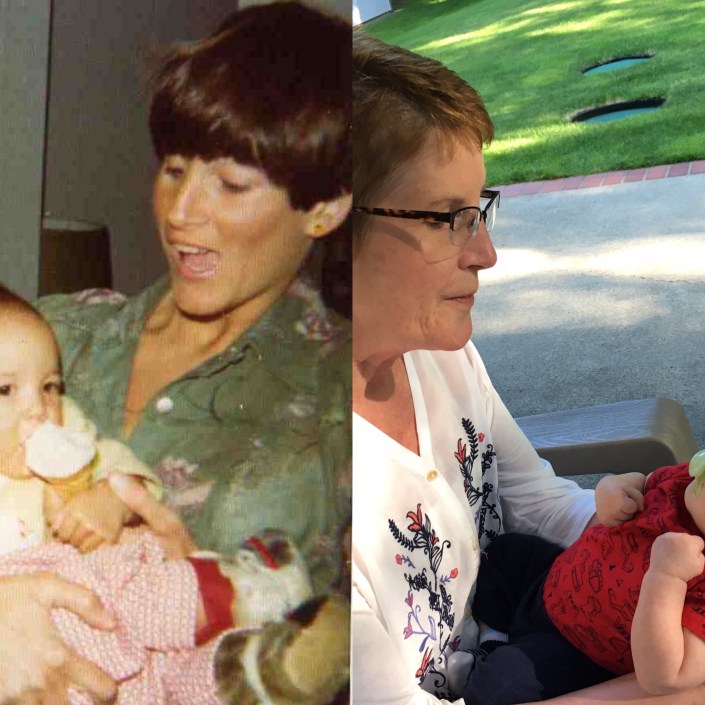
Since my grandson turned 3 months old, my husband and I have had the delight and privilege of providing child care for him a few days a week. As I’ve said to anyone who will listen, being a grandparent is one of the most cherished roles I have ever taken on.
Before Lucas had a presence in my life, however, I became a mother to a little girl who has become one of the most astonishing, loving, and giving people I have ever known. Other than the normal worries parents adopt while their children are growing up, Erin never caused any drama or heartache from the day she was born. But it’s only since I became a grandmother that I have faced the truth of how beautiful a child’s heart is – how honest and generous are their expressions of love. Don’t get me wrong, when I was a very young mother I appreciated the precious person that was my daughter, I became thrilled at every adorable development in her life, I felt that being a mother was – and is – my highest calling, but now as a considerably older mother and grandmother, I am freshly aware of a young child’s ways of expressing that love.
My husband and I can be playing outside with our 2+ year old grandson when all of a sudden he will stop what he is doing and run to one of us with his arms open wide and launch himself at his Grampa; then he will turn toward me, Grammo, and run and launch himself at me, with the tightest huggies and kissies available on this earth. Or out of nowhere, regardless of where we are or what we are doing, Lucas will walk up to one or both of us and say, “Kiss Grammo, Kiss Grampa” and we do just that. The honesty of a child’s behavior is mind-blowing to me – there is no pretense and no calculated manipulation. Certainly, that will come later as it did for all of us, but right now, that type of behavior does not exist. If one or both of us grandparents do something Lucas deems as funny, he’ll endearingly say, “Oh, Grammo. Oh, Grampa” and the smile on his face when he says that melts my heart over, and over, and over again. What a gift this little 2.9-year-old child is to us.
I am so grateful that I have been freshly exposed to the joy-infusing love of a child’s heart. What an extraordinary Valentine’s Day gift that is to me in my mid-60s of life.
This Week’s Good News!
This delightful story out of Oregon shows the lengths a grandparent will go to spend time with his grandchildren and make their school days just a bit brighter. I know you’ll enjoy the wonderful connection he has with his young ones.
This Week’s Good News!
A five-year-old in San Diego, CA was concerned about school lunch debt incurred by those households not able to keep up with their children’s lunch expenses. Wait until you see how she set out to rectify this ongoing problem that occurs in so many school districts. What a great story to start February’s weekly good news!
This Week’s Good News!
One thing I’ve learned over the years is that regardless of how many differences appear to separate us from others, those differences disappear when kindness is at the forefront of all that we do. This next Good News story will really float your boat.
This Week’s Good News!
Living a life with no regrets would be the kind of good news we all would be willing to celebrate. You will be saddened, but encouraged, by this WWII veteran’s story. Please take the time to honor him and his family with your time.
This Week’s Good News!
It is so easy to take the comfort of our Home Sweet Home for granted, even when so many, through no fault of their own, have nowhere to live: homeless on the street or living in their vehicle, there are countless numbers of fellow human beings who have no home to call their own. This story about a school bus driver will warm your heart. Let us all be careful not to judge those whose stories we know nothing of.
This Week’s Good News!
Happy New Year! May 2020 see kindness, love, and abundant health as your portion!
If I tried to describe the story that makes up the first Good News story of the year, I would fail miserably. Please click on this link to both read, and listen, to proof that miracles happen, and because they do, we should never give up hope.
This Week’s Good News!

This story out of Nova Scotia, Canada will warm your heart. There are angels everywhere, and this guardian angel proves it when he helps an elderly neighbor.
Merry Christmas everyone!
May Comfort and Joy be Your Portion

Thank you to all who have chosen to keep in touch over the many years I have hosted this blog.
Please stay safe during the Holidays and take some time for yourself as we plod toward a New Year!
This Week’s Good News! a few days late…
Lending a hand when needed is something at which customers at a Birmingham, Alabama Waffle House excelled. I am certain one particular employee at this eating establishment had the experience of a lifetime during his work shift. I sure do love good news like this.
The limited value of worrying.
 Your parent is diagnosed with Alzheimer’s disease or other dementia and as their biological child you wonder, “Will that be my fate?”
An article of mine, Me Worry? Not on your Life was recently published on the CogniHealth website, a company that in partnership with Alzheimer Scotland, developed a caregiver aid for those – especially family members – providing care for a loved one with Alzheimer’s disease or other dementia.
I chose the topic of whether or not dementia might be passed along to biological family members because as a daughter who witnessed the decline of her father as a result of dementia, I certainly had an opinion on the matter. Does one need to worry their entire life about the chance of acquiring Alzheimer’s disease?
I hope you will read my article that while transparent and painfully clear, also provides many rays of hope and encouragement for those in similar circumstances.
At the very least, I am certain you will come away with a clearer understanding of how little value worry contributes to ones’ life.

This Week’s Good News!
As someone who relies on books to provide carefree, enjoyable quality time in my life, I really appreciate a story based out of Chicago, that focuses on libraries and their book-return policy. Just wait until you read this one!
This Week’s Good News!
A young girl in the UK wants Crayola Crayons to improve its ecological footprint in her country. Check out her extraordinary efforts here. She is amazing!
This Week’s Good News!
Chad Kollman knows how to make lemonade out of lemons. The thing is, he doesn’t even consider that he’s been served a heaping portion of lemons, even though the casual observer might conclude that to be the case. Enjoy this story that is certain to brighten even the darkest of your days.
Meet Sue Anne W. Kirkham, author of Loving Zelda – A Stepdaughter’s Caregiving Journal

by Sue Anne W. Kirkham
How it all began:
It was late October when my husband, Jack, and I showed up at my father and stepmother’s townhouse to walk their two dogs—a duty we’d taken on several months earlier, after they announced they no longer felt up to the task. At 84, my father suffered from respiratory and circulatory problems; at 81, my stepmother showed early signs of dementia, with some Parkinson’s-like tremors erupting, just to keep things interesting. I was determined that they not be forced by these circumstances to give up their pets. On this day, Dad greeted us at the door with another shocker. “We have to move into assisted living.” No hello. No how ya doin? Just this stark declaration.
Dad and Zelda had always been younger than their years in every respect. He continued his career as a psychologist into his late 70s, and the warm, witty, delightful woman he married in 1972 had always been active and ready for a new adventure. Each enjoyed absorbing hobbies, and they eagerly traveled the globe together for most of their 32-year marriage.
As Jack and I herded the pups that chilly autumn day, I remained troubled by the prospect of a radical change in lifestyle for my beloved father and stepmother. So I hatched a plan: leave my dreary clerical position and devote myself to lightening their load and injecting some sparkle back into their lives. I would carve out a new weekday vocation as companion/housekeeper/social director/exercise coach/assistant cook.
I kept a journal from Day One as, over the next 18 months, Zelda suffered incremental losses of mental acuity. Less noticeably, my father’s COPD was cranking toward a dramatic climax that none of us anticipated. While I focused on finding enough fingers to plug the ever-multiplying holes in the home-front dike, Dad’s staunch self-sufficiency propelled him through his own physical deterioration. Meanwhile, I watched Zelda—former organizer of Fourth of July kitchen band marches—fade into confusion. To be at her side through the slow, agonizing loss of her Self would prove to be the most affecting experience of my life. It soon became clear that the course I was chronicling was strewn with striking contrasts: moments of high hilarity and wrenching despair; snapshots of the struggle for dignity in the face of decline; arcs of mood between fear and optimism, gratitude and resentment. Hobbling my efforts to navigate these troubled waters was the crushing blow of friends and family members challenging my motives, questioning my trustworthiness.
This enterprise had much to teach me about life and death, human limitations, faith, and endurance. The struggle, as they say, was real. But the joys and rewards were every bit as genuine.
Why I wrote about it:
As my time with Dad and Zelda ended, a fresh commitment shaped my mission: I had been seeking a book topic I felt passionate about. This was that subject. I would share our experiences, unique amidst all the universal similarities, to promote understanding and support others confronting the challenge of caring for those who once cared for us. I chose the memoir format because, as dementia robbed Zelda of her voice, my journal became the story; it painted a complete and authentic picture for readers. Memoir also allowed for the interweaving of family history, a fleshing out of characters, and a means of affirming through narration the individual’s continuing worth, untainted by the loss of physical and cognitive abilities.
ABOUT THE AUTHOR
 Sue Anne Kirkham is a freelance writer who blogs atwww.yourrecipesforlife.com. She has published print articles on aging and family relations as well as online profiles of inspiring everyday heroes, and essays on health-conscious living and the peculiarities of contemporary culture.
FOLLOW THE AUTHOR:
FOLLOW THE AUTHOR:
Author website: www.lovingzelda.com
Author Facebook page: @LovingZeldaCaregiving/
Twitter: @SueAnneKirkham1
LinkedIn: Sue Anne Kirkham
This Week’s Good News!
This story out of Ashton, Maryland is sure to pull at your heartstrings. A pound dog was saved just in time to become a very welcome resident of a senior living residence. So much joy abounds in this story – I thought it would be the perfect Good News to close out the month of October.
This Week’s Good News!
There is a science to being kind, and UCLA in California has set out to prove it! They opened up the world’s first Research Institute on the Science of Kindness, which I’m sure you’ll agree is something the world needs right now. Check it out for yourself!
12 years ago seems like yesterday
 Twelve years ago today, my father died from complications of Alzheimer’s disease. That morning I had received a call from the memory care unit where Dad had lived for several years. The nursing manager of that unit said if I wanted to see my father again before he died, I should come as soon as possible. (I had spent a week with him the month before and knew that his prostate cancer would most likely hasten his death.) I first called my husband at work to let him know I would find a flight from Seattle, WA to Medford, OR and be gone…for how long? I didn’t know. Then while on the phone with my brother and sister, I booked my flight online with a tentative return, threw the very minimum of clothing in an overnight bag, and headed to SeaTac International Airport.
If you have read my novel, Requiem for the Status Quo, you’ve pretty much read the account of what transpired for me at my father’s bedside; some of the happenings that day/evening were altered, but the gist of what transpired are contained in Chapters 41 & 42.
Upon my return to Seattle, my energy level was depleted yet still on alert. When you have a loved one with a debilitating disease, a state of alertness is the norm – the status quo of constantly being in a state of emergency, if you will. You keep waiting for the phone to ring with the latest development – such as it did for the last time on October 13, 2007 – but that phone number’s appearance on my Caller ID had ceased.
What hadn’t ceased was the business of dying – all the financial and estate matters one cannot ignore – but because of my father’s diligence and organization leading up to his Alzheimer’s diagnosis, much of what I needed to do on behalf of his estate and us survivors, was readily dispatched in the months that followed my father’s death.
But the “now what?” of life post-caregiving was front and center for me. Initially, I wanted absolutely nothing to do with anything having to do with dementia. I continued to financially support my local Alzheimer’s Association and participated in one more Walk to End Alzheimer’s, but that was it. Then my heart called and I became an Alzheimer’s Association caregiver support group facilitator and shortly thereafter, I entered the world of long-term care advocacy by becoming a Washington State LTC ombudsman, both of which I did for five years.
Then my heart spoke to me again, this time it said, “How about writing about your experience as Dad’s caregiver?” I ignored that thought until I no longer could – it wouldn’t leave me alone! I dragged out all of Dad’s records and my numerous journals, sat at my dining table, and over many months’ time, outlined how I would honor my father’s journey and my family’s experience within the pages of a book that might benefit others.
That was five years after my father’s death. My book was published five years later.
Now twelve years after the end of my father’s Alzheimer’s journey,
my book still manages to make its way into the hands of those who need it.
If you, or someone you know, needs encouragement and a renewed sense of hope,
please make your way to your favorite bookstore, or find it right here.
Blessings to you today, and always.

This Week’s Good News!
When restaurants see a need and meet that need, I get goosebumps and want to spread the good news of such good deeds. Wait until you read this story that shows the value in not ignoring another person’s hunger.
This Week’s Good News!
I love it when children extend a hand to those in need. This story spotlights an Arkansan youngster and her mother who made a difference in the lives of many children who don’t have something most of us take for granted: shoes.
This Week’s Good News!
I’m returning to 35,000 feet for this story of a retiring pilot’s glorious send-off by passengers. You will be wonderfully entertained by what you hear.
This Week’s Good News!
The kindness of neighbors is front and center in this week’s Good News story. A young boy’s patriotism is honored and nurtured in one particular West Hartford, Connecticut neighborhood. Delightful, truly delightful.
September is World Alzheimer’s Month

In celebration of the many former and current family caregivers in the world, and in honor of their loved ones with Alzheimer’s or other dementia, AlzAuthors has released the eBook of Volume II of Alzheimer’s & Dementia Caregiving Stories. The introductory price is only $1.99. Be sure to get your copy now!
This Week’s Good News!
I absolutely love seeing a variety of age groups doing something grand for others. We all have the same number of hours in a day and choosing to use a few of those hours to benefit others can go a long way toward improving our little corner of the world. I hope this story about a very industrious young man who lives not far from me, impresses you as much as it did me.
This Week’s Good News!
Generosity and selflessness abound in this family that lives in the northern part of Western Washington. This story will blow your mind and provide a clear definition of what it means to be a family.
This Week’s Good News!
Last week’s good news spotlighted a couple in their 100s who got married to live happily ever after in their remaining years. This week’s post spotlights the wedding industry again but shines the light on an unexpected flower girl who nailed her flowery performance!
 Living: the ultimate team sport