The attached 7 minute film depicts a positive take on being an adult child-caregiver for ones mother. The same could have been filmed of a spouse-caregiver because the message is the same.
Please make every effort to watch this film straight through without distraction. I believe you will conclude – as I did – that what is depicted is beautiful beyond measure.
There is no denying that caregiving is extremely difficult. But there are certain opportunities inherent with the task that create a link between the carer and the one being cared for that might not have been possible without dementia’s onset.
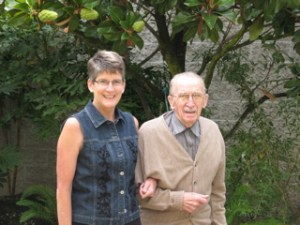
One of many walks my father and I took.
As the adult daughter most involved with my father’s care management, I can conclude that through all the difficulties of his Alzheimer’s journey, there was a certain richness to our relationship that might not have existed without the intrusion of Alzheimer’s in his and my life. I would have preferred that he had never suffered and died from this disease – don’t get me wrong – but I’m grateful for the deeper relationship that resulted from it.
I feel blessed to have been on the caregiving journey with my father. And my, oh my, do I still miss him.
More Alzheimer’s patients finding care far from home | Nation & World | The Seattle Times. This article looks at the direction in which Alzheimer’s care may be shifting. There are currently 44 million Alzheimer’s patients globally with 135 million projected by 2050. Even now, Western spouses and family members are faced with an insufficient supply of qualified nurses and facilities, while other countries provide cheaper – and to some minds, better – care for those suffering from an illness for which very few effective treatments have been developed, and that is always fatal.
(Photo credit: Wikipedia)
The treatment center that is the major focus of this Associated Press article is located in Thailand – the Baan Kamlangchay center. Additional elder care options in other countries are mentioned, such as the Philippines, Eastern Europe, Spain, Greece, and Ukraine. Cost is the driving force of those who are “exporting” (not my word) the elderly to these foreign countries. One gentleman from Switzerland brought his 65-year old wife to Baan Kamlangchay because the monthly cost for her Alzheimer’s care ($3,800) is a third of what he would pay in his own country and he states that the staffing ratios are far better, and the activities more engaging. In the Philippines, care is offered to Americans for $1,500 to $3,500 a month, compared to the average of $6,900 for a private room in a skilled nursing facility in the United States, according to the American Elder Care Research Organization.
Cost shouldn’t be the only consideration, however, when moving a loved one into Alzheimer’s or dementia care – and that applies to every country in which that care is available. What are the training requirements for those who will be providing this disease-specific care for your loved one? What type of governmental or social service oversight is in place to protect and advocate for the rights of those patients who can not advocate for themselves? The latter question becomes extremely relevant when the patients’ families are not around to observe care on an ongoing basis. In the previous paragraph I mentioned the man who brought his 65-year old wife from Switzerland to Thailand for care. He is now faced with the very difficult decision of perhaps leaving his wife of 41 years in the facility, and returning to Switzerland to carry on the rest of his life.
That’s a decision unbearable in its emotional implications.
What are your thoughts? Are you willing to become an expatriate should this medical need present itself in your life?
I addressed some of the issues of Driving under the influence of dementia in an article I wrote in November 2013. Back then I hadn’t planned on writing a Part 2 for this article, but after a couple local incidents involving DUI of dementia, I must provide the following.
Yesterday afternoon in a suburb of Seattle (in Bellevue), an 89-year old woman with early stage Alzheimer’s left her house for her normal daily routine of going to her favorite pancake house, then to several retail locations. She never returned home last night and as of today, she is still considered missing. I hope the outcome of her case is better than that of another elderly person with Alzheimer’s who also went on a brief errand, but never came home. (Update as of 12/28/13 6:45 pm: this woman was found safe approximately 16 hours after she first left her home. She was found 20 miles away from home. Unfortunately, she wandered 20 miles away from her normal driving area.)
On Saturday, December 21, 2013, Joseph Douret left his Seattle area home (in Issaquah), to grab dinner. He was reported missing the next day by his wife who stated that he never came home the previous evening when he left to grab some dinner for the two of them. Mr. Douret, who was suffering from Alzheimer’s, was found dead in his vehicle on Christmas Eve. Police indicated that he appeared to have died of natural causes.
Taking away the keys to a vehicle – or getting rid of the vehicle as need be – are both very difficult tasks, but these are tasks that must take place if a loved one with dementia still has access to their automobile. “But he/she is only driving a few blocks to pick up a couple items; there’s no way he/she will get lost.” Unfortunately, what should be a routine drive can become a death journey because nothing is routine for the person with a brain addled by dementia. Nothing looks normal or familiar; the anxiety ratchets up several notches; panic sets in; and the countdown begins for that person’s last hours of life on earth. Even if the person is eventually found safe, he or she will have endured a very uncomfortable time emotionally and physically. The positive outcome of that incident, however, is that it will most likely be the catalyst that spurs people on to remove all driving options from their loved one.
Please make the decision today to take action and do the responsible thing on behalf of the person with Alzheimer’s or other dementia.
I’ve made a few edits to this article that I wrote in April of 2012. I’m re-blogging it because I know that the Holiday season may be joyful for the multitudes, but that is not always the case for everyone. I’m thinking of the reader who simply wishes this season would end and that a new year would begin…a new start that might herald in a smidgeon of much-needed peace. This one’s for you.
Do you find peace within the circle of your family; or does meditation or prayer, an inspirational book, or music fill your soul? Wherever the source – how do you keep that peace from slipping away?
Certainly when we’re exposed to sorrowful or earth-shattering news, any semblance of peace and calm seem to disappear, such as: acts of terrorism – both domestic and abroad; heartless school shootings; bigotry and hatred; and even devastating illness. How many times has your armor been pierced by such circumstances?
Too many to count. So how do we find peace amongst the chaos?
We can find peace in many small ways – probably the easiest way to do so is to acknowledge the beauty that surrounds us. It doesn’t matter whether you’re a creationist or an evolutionist, the beauty you see is the same. It’s always refreshing when I walk through my local plant nursery,
A recent NY Times article, On Dying After Your Time, poses many topics for discussion that must be addressed. I knew before I even started to read the article that readers will have varying opinions on the matter of extending life beyond its appointed time to die. These opinions will be based on ethics, biases, age of the reader, and religious beliefs, to be sure, but another factor that comes into play is the personal experience of each reader.
My father and my sister-in-law, both of whom have died from Alzheimer’s in the past five years.
If the reader has watched a loved one perilously balanced in limbo with a ravaged-by-disease body and/or mind, that reader might lean towards declaring that too much is being done to artificially prolong life. In the past five years of my life, I have watched both my father and my sister-in-law die from Alzheimer’s. Who they were at the end of their lives didn’t come close to resembling who they were pre-disease. If the reader has had no experience with this aspect of life and death, that reader may feel more comfortable with the decision to throw every treatment possible at the patient with the goal of allowing that person to live as long as humanly – or scientifically – possible.
One of the issues presented in the NY Times article is the fact that as we live longer, there is an increase in the amount of chronic illnesses – a fact that certainly stands to reason. “This rise in chronic illness should also give us pause about the idea, common to proponents of radical life extension, that we can slow aging in a way that leaves us in perfectly good health…The evolutionary theory of senescence [growing old; biological aging] can be stated as follows: while bodies are not designed to fail, neither are they designed for extended operation.”
The author of the NY Times article is an 83 year old man who closes out the piece by stating, “We are not, however, obliged to help the old become indefinitely older. Indeed, our duty may be just the reverse: to let death have its day.”
If you haven’t yet formed an opinion on the matter of life-extension at all costs – I encourage you to do so before it’s too late. Life and death decisions are best made well in advance of the necessity of such decisions.
It’s the not-so-new DUI that is becoming as rampant as are the increased incidences of Alzheimer’s disease in the world.
Are you enabling someone in your family by not having the difficult, yet necessary, conversation about driving safety? “She only uses the car to drive to the grocery store, eight blocks away.” Oh, is that all? Well then, nothing could possibly happen that might harm/kill her or harm/kill another innocent driver or pedestrian, or child on his bicycle zooming out of a driveway and into the street. Right?
In the attached article, Driving with dementia: the dangers of denial, I go into detail about the hazards inherent with driving under the influence of dementia, so I won’t repeat its content here, but I encourage you to take the time to give it a look-see. I’m readdressing this issue because of what I witnessed today:
A car making an unsafe switch of lanes, barely missing the huge SUV in front of which she maneuvered her car;
Then I witnessed this SUV – certainly not understanding the circumstances surrounding this affront to his driving – quickly passing the woman and doing the same to her as had been done to him – abruptly changing back into her lane with nary a few inches to spare between his back bumper and her front bumper;
Now I’m behind the impaired driver who stops suddenly at an intersection (we have the green) and she puts her left hand turning indicator on, only she’s not in the left hand turn lane – she’s in the through lane and she’s risking a multiple-car pileup by her actions. I could not move to the left or right to avoid her so I laid on the horn and fortunately, she proceeded straight ahead, not making her left turn;
Further down the road she managed to get into the left-hand turn lane and as I passed her, I clearly saw an impaired and confused woman in her 70’s who appeared unaware of where she was or where she was going.
I was in no position to follow her to assure that she was okay, but I did throw up a prayer that she would get safely to where she needed to be – without harm to anyone else as well – and that her family or someone close to her would do what was necessary to take away her car keys.
Denial about this issue doesn’t solve anything. Please make the decision today to remove the keys from a person who absolutely should not be driving because of his or her dementia.
Bloomberg Businessweek posted a provocative article, Sex Among Dementia Patients Spurs Call for Policies, that will no doubt get the attention of professionals, and family members alike. The attached article is well-worth the read, and I have a few comments of my own to add.
(Photo credit: Wikipedia)
I acknowledge that sexual activities most likely occur in every long-term setting out there. Consenting adults – even those with varying degrees of dementia – need touch and physical connection. I think it’s fabulous that in spite of the limitations brought about by cognitive impairment, human beings still maintain the desire to give affection, and receive affection. In some instances, affection may simply be expressed with hand holding or sitting next to someone, hip-to-hip. Or perhaps a hug and a kiss are involved. All of these actions are perfectly innocent without harm as long as all touching is consensual.
Some residents may express their need to give and receive affection with more intimate sexual activities, so if both parties are willing and able, I think intimacy is an important part of their well-being.
What about those patients who are already married to someone else?
(Photo credit: Wikipedia)
It takes an understanding and flexible spouse or partner to overlook the intimate activities of their cognitively impaired loved one. The commitment made between the two parties years ago is a commitment that still resides within the deep recesses of that person’s being – but it’s a commitment that can not be drawn upon and reaffirmed because of memory impairment. (I think it’s important to not assume that adulterous motivations are in play here.) Marriage itself may be a concept that is no longer understood by the patient, and as is oftentimes the case – the visiting spouse exists as a friendly visitor, not the wife or husband that the patient used to know.
I can’t predict how I would feel if similar circumstances came my way in the future – my husband and I have not fallen into the cognitive impaired category – yet. And you don’t have to agree with what I’ve stated above. The sentiments I have provided come from my own personal beliefs, and from the perspective of having both worked in long-term care in my past, and having had family members who have lived in long-term care housing.
One last thing: As dementia care specialist Teepa Snow stated in the attached article, “No matter what you do, somebody’s going to see you as wrong.” The issues of sex and intimacy touch many personal, religious, and ethnic biases and beliefs. There are no completely right or completely wrong answers. I’m simply thrilled that the long-term care industry has stopped pretending that geriatric sex isn’t happening, and that they are no longer treating it as a taboo subject. I take comfort in that fact.
Life as a Caregiver and Dealing With Stress Caring for Aging Parents – AARP. The attached article, written by Dr. Nancy Snyderman, chief medical editor for NBC News, shows us that even doctor-caregivers are not immune from the stress brought on by caregiving. A year after Nancy and her siblings moved their parents to live near her, Dr. Snyderman became “one of almost 44 million U.S. adults caring for an older friend or family member.”
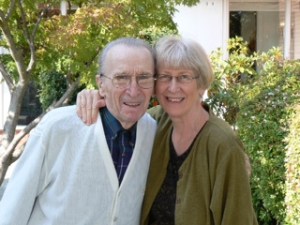
My dad and I, five years before I became his caregiver; seven years before he died from Alzheimer’s.
Statistics show that caregivers tend to patients who are loved ones, an average of 20 hours each week – many times on top of part-time or full-time employment. Before long, Dr. Snyderman came to the realization that she had forgotten to check in on how she was doing. She gained weight, she slept only a few hours a night, and she experienced burnout – not unlike what many of us have felt as caregivers – or former caregivers – for family members.
In my article, Caregiver: put on your oxygen mask first, I address the importance of caring for yourself first, and the patient second. “No way,” you say, “my mom/dad/spouse come first; they need me!” You’re absolutely correct – they do need you, but if you get sick or disabled, you can’t be there for them. That’s why you need to place the oxygen mask on yourself first, and then on the person for whom you are providing care.
Most of us learn the hard way. We get burned out and emotionally or physically incapacitated, and then we start taking care of numero uno. Do yourself – and your loved one – a favor. If you’ve been ignoring the signs of stress that are enveloping you, stop being such a hero and start taking care of yourself. You will benefit from such care, and so will your loved one.
I wrote the article below with an exhilaration that threatened to carry me into the air and cradle me on Cloud 9.
Donning silly glasses and cozying up to a bottle of bubbly that remains unopened.
Since that time, the children in Washington, D.C. have been battling it out on the playground, most not playing fairly, and all of them holding strong to an agenda that appears to be designed to promote their party, rather than their constituents.
I wondered aloud, “If thousands of national parks are closed, 100’s of thousands of employees are furloughed, and service members’ families are being robbed of benefits, what luck does the Alzheimer’s research money have of remaining designated for that cause?”
So I wrote an e-mail to the National Institutes of Health and asked them this very question. What follows is the automated response I received:
Due to the absence of either an FY 2014 appropriation or Continuing Resolution for the Department of Health and Human Services, no one is available to respond to your message. If you require immediate attention, please contact NIH Service desk at 301-496-HELP or via web http://itservicedesk.nih.gov/support.
Asked and answered.
September 25, 2013
NIH logo (Photo credit: Wikipedia)
In today’s news, the National Institutes of Health (NIH) announced that grants for research to discover therapies for Alzheimer’s disease have been awarded in the amount of $40 million from the Office of the NIH director, and $5 million from the National Institute on Aging.
In all the reading that I’ve done, I’ve discerned that the magic words when it comes to finding treatment and/or a cure, are “clinical trials.” The new funding of $45 million will advance the current research being initiated in the form of clinical trials, thereby offering hope to all of us who live long enough to be at risk for acquiring this disease.
The attached video, just 3 minutes long, showcases how very personal Alzheimer’s and other dementia are to those involved. The toll on the patient – measurable, as you will see in this Shapiro family video.
The toll on the family – especially those caring for a member with the disease – beyond measure. Imagine taking care of someone who has lost his or her faculties, who can no longer express themselves verbally, and who has become a shell of his former self. Can you imagine it?
Imagine you must, because I sincerely believe that the only way people will stand up and take notice and do something about this disease, is to wear the mantle of a loved one with the disease, and/or the mantle of the beleaguered caregiver.
If you can help monetarily, please do so: www.alz.org.
If you can help within your community to relieve the stress of a caregiver with whom you are acquainted, that support is equally as needed and valuable.
Whatever you do, please do something to make a difference.
My father and my sister-in-law, both of whom have died from Alzheimer’s disease in the past five years.
According to the World Alzheimer’s report:
If dementia were a country, it would be the world’s 21st largest economy, ranking between Poland and Saudi Arabia. In the year 2010, the total world cost for caring for the dementia population was $604,000,000,000 (billion).
By 2050, in the United States alone, the costs for caring for the dementia population will be: $1,200,000,000,000 (trillion). That’s more than 1,000 x $1 billion.
Are you thinking of making any charitable contributions to a worthwhile organization before the end of the year?
and I’m as mad as hell about the millions of crimes that it has gotten away with.
Alzheimer’s and other dementias are unfair to the one diagnosed and to all those involved in that person’s life. The unfairness unfolds with the worst day of that person’s life – diagnosis of a disease for which there is no cure – therefore it is always fatal – and it is a disease where little progress has been made in treatment options.
Let me introduce you to two fabulous people who are no longer with us because this disease killed them. Yes, Alzheimer’s murdered them.
My hero – my father: 1918 – 2007
My father, Don, was born in 1918 in Toronto, Canada. He married my mother, Patricia, and they had three children. They became U.S. citizens in the late 1940’s/early 1950’s. My father was an extremely distinguished, courteous, humorous, and dedicated family man. He received his Alzheimer’s diagnosis on June 3rd, 2005 and I was there by telephone conference, having attended his initial neurological evaluation a couple weeks earlier. He died at approximately 12:10 a.m. on October 13th, 2007.
Nancy, an adoring daughter-in-law to my father, seated in front of her.
My sister-in-law, Nancy, was diagnosed with mixed dementia just a few months after my father died. Nancy was born in 1942 in Quincy, Massachusetts. She graduated from UCLA with a degree in flute performance and used those skills in many venues throughout her life. Nancy had three children from her first marriage – children of which she was very proud. Nancy was an extremely talented interior designer, opening her own design business in 1987 – the same year that she married my brother, Don. Nancy died from mixed dementia, that also included Alzheimer’s, at approximately 11:05 a.m. on July 4th, 2012. Just two and a half months later, my brother and sister-in-law would have celebrated their 25th wedding anniversary.
Saturday, September 21st, 2013 is World Alzheimer’s Day. One in every three seniors dies with Alzheimer’s or other dementia. If you do not die from Alzheimer’s, you die with it. From Alzheimer’s Association 2013 Facts and Figures.
Won’t you consider making a monetary donation in the hopes of capturing this murderer?
U.S. website for the Alzheimer’s Association: www.alz.org
Other countries have their own dedicated websites as well. Please find those sites through any search engine you would normally use, and let’s slap the cuffs on this criminal disease.
“Mr. Desonier, I think you can stop scheduling an annual colonoscopy from this point forward. You’ve been very diligent about this aspect of your health care for many years, but at your age, I think this procedure provides inconvenience and discomfort that you can do without.”
My dad was 84-years old when his gastroenterologist made that declaration. I never thought I’d say this, but that gastroenterologist is my hero. My father had one suspicious colonoscopy a decade or so earlier, and was advised to undergo that test every year to be certain that no cancer was present. If you’ve ever undergone this test – and you should have a baseline one after the age of 50 or earlier if you’re symptomatic – you’ll understand when I say that I’d rather have a root canal than have my colon flushed and probed every year. Here’s TMI for you: I’m 60 and had my first exam of that sort seven years ago and passed with flying colors. I’m on the ten-year plan so I have a couple years left before I hop on that table again. But I digress.
The above article will shock you to your senses as to how incentivized doctors are to keep prescribing outlandish medical procedures on their elderly patients. Most, but not all, such procedures benefit medical professionals and facilities and provide no benefit to the patients that undergo such procedures. Here’s a quote from the above article that is sickening in its implications:
(Photo credit: Wikipedia)
Medicare spends a quarter of its $551 billion annual budget on medical treatment in the last year of life. A third of Medicare patients undergo surgery or an intensive-care-unit stay in their final year (of life.)
The author’s 80-year old father had a “stroke-blasted” body and underwent the surgical procedure of having a pacemaker installed to correct a slow heartbeat that gave him no health problems. Medicare paid $12,500 for that procedure. Her father’s family doctor didn’t approve of the cardiologist’s decision to perform that surgery. Medicare would have only paid that doctor $54 for a medical consultation with the family to weigh the pros and cons of such a procedure.
What’s the lesson here? There needs to be a greater focus on slow medicine in the form of palliative care, rather than fast medicine that dictates quick consults and immediate – and oftentimes drastic – medical intervention that robs the elderly patient of living on his own terms, and dying when its the body’s time to do so.
The above public service announcement shines a spotlight on a disease that will affect you one way or another:
My father died of Alzheimer’s 10/13/2007. I’m on the left – it could happen to me; my brother is on the right, it could happen to him.
You may receive an Alzheimer’s diagnosis or I may receive an Alzheimer’s diagnosis
A loved one of yours may receive an Alzheimer’s diagnosis and you’ll be his or her caregiver
A good friend of yours; a neighbor; a coworker may receive an Alzheimer’s diagnosis
The point is – just as all of us know someone who has had, or currently has, cancer – all of us have some sort of connection to someone who has Alzheimer’s or other dementia.
None of us is immune to this disease that steals a person while their heart is still beating.
When your children attained the age wherein having “The Talk” about sex and other scary things became unavoidable, you simply jumped in and winged it – wanting to explain as much to your kids as they needed to know but trying not to lend any encouragement towards participation in said scary things. Didn’t you feel better once you checked that “To Do” item off your child-rearing list? I know I did.
My father in mid-stage Alzheimer’s.
“The Other Talk” is that which you need to have with your adult-sized children, regardless of how uncomfortable you – or your children – are about topics such as: illness, death, and finances. Acccckkkkk!
My mother and my daughter, circa 1977.
Or perhaps it’s the other way around. The adult children are broaching these difficult topics with their parents in the hopes that said parents will do something about these unavoidable issues. Regardless of who is on the receiving end of these discussions, they should be considered mandatory in every family.
Consider this scenario: Dad is dying of cancer and in a coma. Your mother has already passed on, and you have no idea what your dad wants. His cancer is inoperable and he’s having more and more difficulty breathing and he hasn’t had any nourishment by mouth since he went into a coma. Does he want breathing assistance? Does he want intravenous liquids and nourishment? Does he want pain medication to help him through the extreme pain that cancer causes, even if the medication hastens his death?
What’s a son or daughter to do? Wing it?
Let’s look at another scenario: Mom is in the advanced stages of Alzheimer’s and is unconscious more than she is conscious. There is no reversal possible of the debilitating effect this disease has had on her body: her doctor tells the family that their mother’s ability to swallow is greatly compromised, her breathing is becoming more and more labored, and she has shown no interest whatsoever in food or liquids. Her body is in the active stages of dying.
In this scenario, dad is still living and cognitively competent and he has told the family and your mother’s doctor that he wants every single measure possible to be employed to keep his bride of sixty-five years alive. You, however, have a copy of your mother’s living will/advanced health care directive – as does your father – which contains conflicting wishes to those of your father. Your mother wants no extraordinary measures employed – not a respirator, not a gastric feeding tube, no intravenous nourishment, nothing except for medication that will make her as comfortable as possible as she leaves this world. When your mother was fully aware and cognitively healthy, she had her wishes incorporated into a legal document, determined to take the responsibility of making such decisions out of her loved ones’ hands.
What’s a son or daughter to do? Follow mom’s wishes.
What a gift that is – carrying out your loved one’s wishes when she is no longer able to verbalize them. It would still be a gift if mom’s wishes were clearly spelled out that she wanted everything done to keep her alive as long as possible. The point is not what was decided that is important – it’s that the decision had already been made – a decision that remained in the hands of the patient/family member.
Both of my parents gifted me and my two siblings with documented specific wishes for their life and death. My mother unexpectedly died in her sleep on September 24th, 1994 at the age of 77 – something she had wished and hoped for her entire life – who doesn’t? My father died on October 13th, 2007 at the age of 89 from complications of Alzheimer’s and cancer. There was no guessing when it came to the time when us three adult kids rushed to his bedside. He was comfortable in his death, and we honored him by following his wishes for no intervention. Did I want my dad to die? God no. I wanted him to live forever; but none of us gets to do that, so I’m glad that my father was allowed to take his last breath and leave this world his way.
A fellow blogger whom I greatly respect, wrote the above article that tells a story of aging, loneliness, intuition, and follow through.
There is a holiday celebrated on September 28th called National Good Neighbor Day. In the above linked story, a good neighbor noticed that she hadn’t seen one of her neighbors in awhile, so she acted on her concern. The story that unfolds could be a made-for-TV drama! Concern drew her to investigate and her gut wouldn’t let her turn away.
I think all of us need to trust our gut more frequently, which I learned for myself back in July. I’ve attached an article I wrote on that experience called – coincidentally – Trust Your Gut.
No one is an island, entire of itself; every man is a piece of the continent. – John Donne
Dehydration and Dementia. The attached article is a very thorough look at the importance of hydration in the elderly, and how to assure that a person with dementia – who may no longer feel the thirst response and/or does not know how to express his or her thirst – is properly taken care of.
(Photo credit: Wikipedia)
My husband and I went for a hike last summer during which we encountered a gentleman who I would guess was in his early 80’s. It was a warm, muggy day and my husband and I each had a 20 oz. bottle of water for our 3-mile hike. The gentleman was reviewing his hiking map and we stopped to chat with him about the fork in the road and which path lead where. “Sir, do you have a bottle of water that you can drink while on your hike today?” “No – not needed; I have a thermos of coffee waiting for me back at my car.” “I wonder, sir, with it being so hot and humid, if you might benefit from taking one of our bottles of water. I would be happy to give you one we’ve not used yet so you’ll be comfortable.” “That’s very kind of you, but I’ll be fine.”
So he went on his way but I told my husband I wasn’t comfortable with this fellow being on his own and could we please follow him at a distance to make sure he gets back to his vehicle. And so we did – and he returned to his vehicle, and no doubt partook of his thermos of hot coffee. Not very refreshing.
(Photo credit: Wikipedia)
Although hot coffee and tea certainly contain water as part of their preparation, straight water – or even fruit juice – are a better option because of their lack of caffeine. Years ago, when I would visit one of my aging family members, you could always count on him holding that quintessential cup of coffee in his hand throughout the day. Regardless of the weather – no glass of water reached his lips – except perhaps when he took his daily vitamins or medications. This message is directed to those who provide care for the elderly, those who have older family members, and perhaps this message is also directed towards you. Drink good ol’ H2O. It doesn’t have to be packaged in a fancy bottle, you don’t have to purchase it, it’s always available at the touch of the nearest faucet, and you can access 100% water faster than making a pot of coffee.
What are you waiting for? Go get a glass of refreshing water!
Fellow blogger, Don, talks about his caregiving journey with his wife in which he swore off getting sick because – quite frankly – he couldn’t afford to be sick when his caregiving duties required that he be healthy and available 24/7.
One could argue that just being worried about getting sick might make one sick, but fortunately, that was not the case for Don. Having read many of his articles, it appears that he knew what was required of him as a caregiver – the same thing that is required of all of you who are still on your caregiving journey: assemble a team, spread out the duties, and seek emotional and physical support in whichever form you need.
First and foremost, please read Don’s article attached above. After you have done so, I hope the three articles below will also prove beneficial towards providing direction on how one might assure a successful medical and mental health caregiving journey. When you take care of yourself, you’ll be better equipped to take care of your loved one.
The attached article, written by a blogger in the UK, is straight-forward and thought provoking – it should be.
I live in Washington state, and I am glad that Death with Dignity is a legal option assuming all the legal requirements are met. This is a very personal subject matter, as is the choice that individuals will make to seize the opportunity, or to reject the opportunity. There is definitely a separate element of this option when the law is utilized for those with dementia. When is someone still capable of making the decision?
A non-profit in my state, Compassion & Choices of Washington, is an excellent resource for materials and information. They have even developed an Alzheimer’s Disease and Dementia Mental Health Directive – a first-of-its-kind directive that allows people – while still competent – to document their wishes related to who will provide their care, where care will be provided, how it will be financed, how to deal with difficult behaviors that may arise, and many other matters that both caregiver and patient face. Bless all of you who face this horrific disease that has no effective treatment, and certainly no cure.
I’m attaching the above article from a fellow blogger. He, like so many of us, find it difficult to fathom how anyone would take advantage of a vulnerable human being. The very unsettling fact, however, is that incidents of abuse of the elderly occur and are far too common.
Whether the abuse is instigated by family members upon the elderly in the privacy of their home, or by “professionals” in long-term care settings such as assisted living facilities, nursing homes, or group homes – it happens. Oftentimes such incidents go unchecked for months, or years, and are discovered only when a death occurs, or when someone with a conscience steps forward and complains to the authorities. Those being abused either don’t have the ability to complain or they fear that doing so will make matters even worse for them.
Worse? Residents fear that if they complain, they’ll be thrown out of the place in which they live – the place in which they receive the abuse. I know that you and I are quick to say, “Fantastic! What a great relief that would be if the person no longer lived with his or her abusers!” We say that because we have not experienced what they have experienced; we have not heard the threats and vicious statements directed towards these vulnerable human beings. These violated human beings don’t understand that abhorrent behavior is not normal because it’s all they’ve known.
These are older human beings who at one time were innocent children showing up on their first day of school; worried teenagers fretting over what to wear to the prom; young adults heading off to college and/or a career; husbands and wives, moms and dads … people just like you and me. Now they’re nothing but broken, barely alive bodies who have been treated worse than a junk yard dog.
Alzheimer’s Disease: Your Questions Answered | PBS NewsHour. We need all the help we can get in order to make well-informed decisions about any caregiving journeys that might occur in our future. The attached article shows a snapshot of one adult daughter’s 24/7 caregiving journey with her mother.
Perhaps you’re saying that you don’t anticipate your parents requiring any caregiving assistance in their frail years (perhaps your parents have already passed so no need exists there.) Do you have any siblings? close friends? a significant other? If you answered “yes” to any of those designations, the possibility exists that you will be called upon – or you’ll volunteer – to be of assistance to someone who needs help with their activities of daily living (ADLs).
Taking care of a loved one is no easy task. It doesn’t matter how much you love the person, your patience and your abilities will be tested. I truly admire the subject of this PBS article. Rebecca Wyant is the full-time caregiver and guardian of her mother, Mary Wyant, who was diagnosed with Alzheimer’s at the age of 65. Mary moved in with her daughter in 2006, is now 74 years old, and Rebecca is in her seventh year of personally providing her mother with full-time care.
How does Rebecca do it? She thought she was prepared for the task but soon discovered that finances, and creative ways of managing her mother’s care, are dwindling resources. With that said, however, Rebecca states that she is the only person who can provide the care that she can. She agrees that professionals could provide the care, but absolutely no one could possibly care for mom as Rebecca can. That part of the video disturbs me a bit, and I’ll tell you why.
Dad, myself and one of his caregivers.
I was an Alzheimer’s Association caregiver support group facilitator for several years and heard the voiced concerns of those daughters, sons, and spouses, who carried a great deal of guilt on their shoulders for not being able to keep up with the care of their loved one. They did provide the care initially, and then found their abilities wanting – and their health declining. They eventually made the very difficult decision to place their loved one in an assisted care setting.
Here’s the story of “Constance” and “Robert.” Constance first came to my support meeting at the age of 80 having already taken care of Robert at home for the previous three years since his diagnosis. Constance’s health started to decline due to lack of sleep – Robert’s dementia had no respect for the clock. Added to that dilemma was the fact that she had no existence outside of her house. She was trapped! Her friends abandoned her, all the social activities in which she had participated fell by the wayside, but she refused to move her husband into an assisted care setting, even though she felt they had the finances to support such a move – many do not and have no choice but to provide 100% of the care. “No one can take care of Robert like I can. I would never do that to him – placing him in someone else’s care. That’s my duty as his wife; a duty I take seriously.”
Fast forward one year later, and Constance had no choice but to place Robert in an adult family home with five other residents; it was either that, or she would have been forced to relinquish her caregiving role because, quite frankly, she ran the risk of dying before Robert. Once she relocated Robert to a care home, the well-trained staff provided all the assistance Robert needed, and Constance could now have the sole role of being his wife. She visited him almost daily until the day he died one year later.
Constance admitted that she wished she had moved Robert to the adult family home earlier than she had because she realized that being a committed wife didn’t have to include caregiving that risked her own health. She relished her reprised role as his loving wife when she visited him – none of the other care staff could fulfill that role but her – and the staff did what they do best, providing all the care her husband needed.
This is the nugget I want you to come away with from my above commentary: guilt and obligation are normal emotions that might prevent you from making decisions that may very well be in your best interests and those of your loved one. Please believe that allowing someone else to take care of your loved one does not equate to you shirking your familial duties. It does, however, tell me that you know your limits, and you know what is best for your personal situation in the long run. Additionally, it shows that you value your long-standing role as a daughter/spouse/partner/sibling, more than any new role as a care provider. There’s something to be said about retaining your given role in a relationship.
Caveat: as I indicated above, finding affordable care outside of ones home is no easy task, and you may have no choice but to provide the needed care for your loved one. But if you are able to find trusted family or friends who can “spot” you from time to time so that you can enjoy a needed time of respite, please do so. You’ll be far more able to carry out your caregiving task if you take care of yourself first. See my article: Caregiver: put on your oxygen mask first.
Fellow blogger, Kathy, has been struggling with the challenge of living her life without her mom who died from pancreatic cancer several years ago. In the About section of her Blog, Kathy says: “On 12/4/2007 my dad said four words that would forever change my life. ‘Mom has pancreatic cancer.’ I lost my mom to this dreaded disease 348 days later.”
Learning how to live in the present while still mourning a death can be a very difficult matter. Oftentimes we have the need to keep a person’s memory alive by reliving the journey that lead up to the death; ruminating over the whirlwind of activity after the death; and getting stuck right there – either not willing to go beyond that, or simply not having the ability to do so.
The following are very valuable statements: “You’ll get over the sadness eventually. It’ll eventually hurt less. But you have to get beyond where you are, because that’s what your mother would have wanted.”
Those are very true and worthwhile words, but if we’re not ready to hear them, they provide little benefit – at least initially. Am I faulting the person making those statements when he or she did? Absolutely not. What I am saying, however, is that when we’re ready to truly hear those words, we will. We’ll then be able to believe those words, and we’ll be able to practice those words. It’s like having one of those moments that Oprah Winfrey calls, “An aha! moment.” That’s what appears to have happened to Kathy.
Has this ever happened to you? An acquaintance pours her heart out to you; asks for encouragement, advice, etc. and you provide compassion, suggestions, beautiful nuggets of advice, etc., and weeks, or months go by, wherein the acquaintance appears to be stuck in their dilemma, evidently ignoring your well-meaning words, and then – out of the blue – your friend calls you…(you fill in the blanks as to the situation – in this example, the person in need had been having relationship struggles)
Irene, you’ll never believe what just happened! You know I’ve been in a funk because of my relationship challenges, right? Just the other day I poured my heart out to someone on the bus and she suggested I do the following…
It turns out that this bus stranger told her exactly what you told her two months ago. Are you offended? Of course you are – it’s happened to me and I’ve wanted to say, “Well duh – where have I heard that advice before?” The key isn’t whose advice finally got through to her; the key is that the good advice finally got through to her. Time for me to swallow my pride, tamp down my ego, and celebrate this friend’s good news.
Lightbulb Moment (Photo credit: Wikipedia)
Kathy – I celebrate with you that the right words came at the right time for you, and you are now able to take steps towards living in the present. You’re learning how to celebrate your mother while still missing her greatly. Three cheers for Denise for saying what she did when she did, and three cheers for you for having the ears, and a good and ready heart, to hear it.
The last Father’s Day that I spent with my dad, Don Patrick Desonier, occurred on June 17th, 2007. That year had been a definitive year in my father’s decline from Alzheimer’s so I didn’t need to be prescient to know that his time to escape the disease was drawing nigh. (Additionally, it didn’t help that his inoperable prostate cancer had decided to grace his body – like it needed something else to assault it.) I would normally not leave my husband to his own devices on Father’s Day – he’s a terrific dad and deserves to be spoiled – but I knew his adult daughters would give him his due so I left our Redmond, Washington home and flew down to Medford, Oregon for this mid-June celebration with my dad.
We enjoyed a subdued Father’s Day breakfast in the memory care unit’s dining room. My father didn’t eat all that much but he seemed to enjoy the ritual of sitting with his fellow memory-impaired friends as smiles and congratulations circled the table.
Walking with Dad in 2007.
Those of you who are familiar with a memory care unit of an assisted living facility are also acquainted with the dearth of engaging activities therein, especially when your loved one can no longer participate in a meaningful way. Because of that dilemma, I always took my father “off campus” to take a walk at a nearby park. Mind you – his ability to ambulate was hindered, but we usually managed to walk the full perimeter, as we did that day. June in Medford, Oregon is H-O-T, but like many older people whose inner thermometer doesn’t seem to be working at full power – my father was dressed in a long-sleeved heavy cotton shirt buttoned right up to the neck, and an old standby wool cardigan – one of his faves.
Part way through our walk, I somehow convinced dad to at least take off his sweater, and to enjoy some hydration from the bottled water I always carried with me. Shortly thereafter, two 20-something year old men on bicycles approached on the path in our direction; they slowed down and before they passed us one of them uttered, “Happy Father’s Day, Sir!” Dad wasn’t quite aware of what they said but I reiterated their greeting, “Dad, they said Happy Father’s Day to you – isn’t that nice?” “Yes, Irene, it really was.”
Fast forward to June 16th, 2013; this adult daughter still remembers, and cherishes, the random act of kindness by those young men. It made my day in June 2007, and it’s made my day ever since. I’ve never forgotten your greeting, given to an old man who had certainly experienced many Father’s Day events in his 89 years. Thank you – bike riders at Hawthorne Park, on Main Street, Medford, Oregon. I hope you will always be on the receiving end of timely acts of kindness.
You are my heroes because you are ordinary people who did the ordinary right thing on June 17, 2007, making my dad’s last Father’s Day an extraordinary time.
Or perhaps while sitting in the easy chair next to your bed, you tried your very best to ignore the urge to purge … but you couldn’t wait any longer for someone to assist you so you let it all out, leaving you in a shameful way, sitting in a mushy pile of excrement while a stream of urine puddled at the base of your chair.
Welcome to the life of a vulnerable adult living in a nursing home. From coast to coast across the United States skilled nursing facilities (SNF) are filled with adults needing the greatest amount of assistance with their activities of daily living (ADLs) – toileting is one of those ADLs.
The following true scenarios occurred recently at a nursing home in a Seattle suburb, and at a similar facility in a suburb of San Francisco.
(Photo credit: Wikipedia)
A man who is fully reliant on mobility assistance pushed the call button near his bed to register a need for assistance. In this case, he needed to go “Number 1” and “Number 2” and had the audacity to require assistance while the staff was busy attending to other residents’ needs – but not his needs. When a staff person finally entered his room an hour later, she did so to simply indicate that she didn’t have time to take him to the bathroom so he should just go in his pants.
A woman equally as vulnerable needed the assistance of a staff person upon waking in the morning and – knowing that breakfasts were brought around to the rooms at 7 a.m. – the 91 year old started to press her call button at 6 a.m. hoping to have her morning pee prior to the arrival of her breakfast tray an hour later. That “luxury” was one that would not be afforded her; instead, a caregiver brought a breakfast tray to this patient in the seven o’clock hour and when the patient asked if she could receive help to the toilet prior to eating her breakfast, the employee told her to just go in her pants because no one had time to help her at that moment.
I can’t help myself – here’s another incident: A staff person helps a woman to the toilet first thing in the morning. The woman who is clothed in a lightweight nightgown finishes using the toilet and is ready to receive assistance back to her bed – but lo’ and behold, the staff person forgot to place the call button within close reach of the patient so she is not able to alert someone of her desire to go back to bed. Enough time has passed that by this time the patient is shivering and screams for help – screams that went unnoticed for a quarter hour. In desperation this elderly woman somehow managed to lean far enough forward to push over a metal trash pail which she then kicked repeatedly until someone finally arrived to see what all the commotion was about.
These stories don’t paint a very pretty picture do they? They depict a low quality of life that no one deserves.
What does Quality of Life mean to you?
Eating at fine dining establishments?
Having a clothing wardrobe that rivals the catwalks of Paris?
Driving in a luxury vehicle that provides amenities previously only found in limousines?
For most of us, quality of life boils down to leading a dignified existence in which we are allowed to take advantage of the basic necessities of life. For me, those necessities should include a safe living environment, sustenance, the inclusion of loving family and friends in my life, the freedom to make choices about matters that are important to me, and being on the receiving end of respectful behavior from those with whom I come in contact.
The most vulnerable among us should expect no less than those basic necessities, but “the system” isn’t working to guarantee those basics. Try to imagine, if you will, your own grandparent, parent, spouse, partner, or other family member in any one of the above scenarios. How comfortable are you with that type of day-to-day existence for them? You’re not comfortable at all – as a matter of fact you’re feeling a bit uneasy about this whole subject matter. I’m sorry to place doubt in your mind about the care your loved one is receiving but I’ll just bet that you need to get out of the comfort of denial you’ve been enjoying and into the eye-opening role of resident advocate.
Lack of caring = lack of care. Nursing home management is a tough job to do correctly, but I know it’s possible because there are some reputable and well-run facilities out there – not perfect by any means, but fairly acceptable. So yes, some nursing facilities employ stellar care staff but there are also those employees who just don’t give a damn. “I go to work. I go home after work. I get paid. What more do you want from me?” Caring – that’s what we want. You’ve chosen to work in this particular type of environment so don’t act like you didn’t know what you were getting into. Withholding proper care for those who have no recourse but to depend upon you is not only unfair, but it’s illegal. And how about answering these questions about your own aging prospects: Do you think you’ll somehow skip the journey into old age? Do you not realize that you too will be as old as the patients whose care is entrusted to you? What type of care will you hope to receive? Does it resemble any of the scenarios I’ve illustrated above – or are you under the impression that you’ll be at a “Champagne and Chandelier” type of place where you’ll be waited on hand and foot?
Not gonna happen.
This article just scratches the surface of the sub-standard care that can be found in nursing facilities. I only mention the toileting issue because it’s been front and center in my experiences with some of my acquaintances lately. One place to start getting some positive traction where these matters are concerned is the National Long-Term Care Ombudsman Resource Center where you’ll find links to advocacy programs in your state. Call those local representatives and report any concerns you may have about how your loved one is being cared for, or not cared for, in their nursing facility, assisted living facility, or group home.
If you act on behalf of your loved one, you’re also acting on behalf of everyone else in the facility because trust me – your mom isn’t the only one being neglected on her nursing home floor.
I’m thrilled about the above Blog article that just happens to have been posted today, my 60th birthday! There is a lot of substantive content in my fellow blogger’s posting: a link to a New Yorker Magazine article by Rebecca Mead, titled A Sense of an Ending; Phillip Toledano’s photographs of dementia; and, of course, the Blogger’s own contribution to the topic. The aforementioned blogger, Kathie Ritchie, maintains an exceptional blogsite, http://www.mydementedmom.com.
I hope you’ll visit all of the above – and be better off as a result.
I’ve attached the above article from a fellow blogger because I know for a fact that music memory stays with a person, perhaps longer than any other memory. I’ll give you one personal example that proved this fact for me. There are other encouraging examples readily found on the Internet, but because my family experienced this phenomenon first hand, that’s what I’ll talk about, ever so briefly.
Nancy and my father
My sister-in-law Nancy lived a life that was steeped in artistic activities. She was a well-known and respected interior designer and she was a flautist. A flautist is one who plays the flute. (I’m providing that definition because the sound of the word “flautist” sounds like an uninvited body function to me.) But I digress.
Nancy enjoyed her music involvements on a small and large scale. In the early 80’s, she met my brother during a local production of South Pacific – a production in which my brother acted, and for which my sister-in-law provided the music accompaniment. Fast forward to the year 2012. I gladly helped my brother out by taking Nancy on outings – sometimes to art museums, sometimes to music events. Regardless of the outing, I always made sure that my vehicle’s radio was tuned to the classical music station. I knew Nancy would enjoy it, and I also knew that even after being diagnosed four years earlier with mixed dementia, Nancy would be able to identify the orchestral or operatic pieces being broadcast.
Although I grew up appreciating the classics, the only pieces I can accurately identify are those often-played symphonies such as Beethoven’s 9th Choral Symphony, or Vivaldi’s Four Seasons. Nancy, on the other hand, could pick out the lesser known arrangements and could identify, with pinpoint accuracy, the conductor and the soloist for that particular piece, e.g. Leonard Bernstein; Yo Yo Ma. It saddened me to hear the hesitation in Nancy’s voice when she would speak up while sitting in the passenger seat, making the musical identifying remark but always questioning whether she had done so accurately. “I think that’s Mozart” or “I think that’s Yo Yo Ma playing his cello. I think it is.” Even before the piece was identified on the radio I would assure Nancy, “If you say that’s Yo Yo Ma, by God, it is Yo Yo Ma.”
And she was right – and she was affirmed that she still had a handle on Handel, or Mozart, or Sibelius. Yep – she never lost her abilities. What a delight, and what a pleasant interlude during an illness that took her life on July 4th, 2012 at the age of 69. One thing I know for sure, however, is that from Nancy’s viewpoint right now, she’s enjoying her favorite opera each time Wagner’s “The Ring Trilogy” is played around the world. Nancy doesn’t need season tickets anymore; she has a front row seat.
A recent article by Jim Fitzgerald of the Associated Press focuses on a few electronic methods that might relieve some of the struggles experienced by caregivers who try to balance their frantic personal lives with the oftentimes emergent needs of their loved ones. For the purposes of my article, I am only looking at the type of monitoring put in place by a family member to check on an elderly person’s well being; primarily a family member with Alzheimer’s or other dementia.
Beleaguered caregivers getting help from Apps is an eyeopening look at how Smartphone Apps, and other electronic devices, can provide some sort of relief to lessen the caregiver’s load. Many of those who are long-distance caregivers, such as I was for my father several years ago, might benefit from being able to monitor their family member’s safety and well-being from a distance.
But does such monitoring invade the loved one’s privacy? Of course it does; but I guess one could say that the benefits outweigh the disadvantages of such monitoring. Or do they? What comes to my mind is the elderly person’s gradual loss of independence – an aspect of life that many of us would equate to being a requirement for our own quality of life. But I digress.
At best, I think electronic monitoring serves as a stop-gap or interim measure of caregiving before hands-on care is put into place. The Pillbox App keeps a very tentative watch on whether or not a loved one – say a parent – has taken his medication properly. If the parent does not have compromised executive function, it’s certainly easy to “fake it” so that the daughter can feel as though all is well ten miles away. In reality, however, medication mismanagement might be taking place, carried out by the parent.
(Photo credit: ell brown)
The Alzheimer’s Association Comfort Zone program requires that a loved one wear a GPS device at all times so that family members can monitor their comings and goings throughout the day. The system is of no benefit if the person doesn’t wear the pager; and if the person has dementia, there’s a strong likelihood of that happening. I’m being the devil’s advocate here, simply pointing out that the system is only as good as the cooperation required to use it. HOWEVER, and this is a demonstrative HOWEVER, it appears to be a very worthwhile system that provides numerous benefits. Other than taking away ones right to privacy, it definitely serves as a safety net for when mom, dad, spouse, or other loved one, are heading into trouble.
I’m skeptical of Comfort Zone but I’m also its fan. I’ve linked the Comfort Zone website above so that the reader can determine if such a system is worthwhile in his or her situation. My skepticism comes about because I wish more attention and financing would be spent on a cure for Alzheimer’s and other dementia so that these current monitoring methods become a thing of the past. A world without Alzheimer’s sounds just as desirous as a world without cancer, or MS, or Lou Gehrig’s disease, to name a few. More disease control financing = more cures.
One final word: I’ve already experienced two family members with Alzheimer’s and all the caregiving migraine headaches associated with those experiences. So please know that I’m a proponent of worthwhile practices that ease the caregiver’s burden. Unfortunately, there is absolutely no fail safe method out there that will give caregivers true peace of mind. Even placement in a long-term care facility is not a 100% guarantee that mom, dad, sis, or gramps will receive the best care possible. I’m sorry to burst your bubble – but it’s true.
Perhaps you read the brief title of my article and before delving into its content you’re wondering: The morning after a night of drinking? The morning after doing something regretful – perhaps synonymous with the previous question? The morning after a horrific news event?
None of the above. In the attached article, a fellow blogger writes about his experience of waking up the day after his wife passed away; a day in which he felt the full impact of the loss of his wife and the cessation of his role as her caregiver – his identity for so many years.
Unless, and until, you experience this type of blurry identity, you can’t fully understand the feeling. Those of you who devoted any amount of time caring for a loved one prior to their death understand all too well the emptiness and lack of purpose that oftentimes follows the end of the caregiving journey.
I was the long-distance caregiver for my father after he was diagnosed with Alzheimer’s disease. He lived in a memory care unit of a Southern Oregon continuing care retirement community (CCRC) while I commuted from Seattle by plane, by telephone, and by 24/7 worrying and thinking. By choice, I left my full-time job and for the next four years, dedicated my time to managing his care and being the primary on-site visitor. Many of you worked full-time at your “real” job while being a caregiver for a loved one and I respect and honor you for somehow juggling all of those responsibilities. I knew my limitations, however, and reached that limit quite early in the process. The emotional and physical toll of caregiving was more than I was capable of handling on top of my other job, so with my husband’s blessing and encouragement, we did without my financial contributions while I carried on as my father’s care person.
After my father’s October 13, 2007 death at the age of 89, I returned to Seattle having spent the last hours of my father’s life at his bedside; then several days wrapping matters up with the funeral home; with the bank trustee, and with the facility in which he had lived for close to thirteen years. Although there would be many weeks of tying up loose ends upon my return home to the Seattle area, I was effectively unemployed – laid off from a job to which I was extraordinarily committed. As the blogger in the attached article mentioned – those in this position wake up the day after, and the day after the day after, feeling as though they have lost their purpose. Additionally, the identity which defined them for several years no longer applies.
Grieving and re-purposing our lives can take place during this time, a process which may take months or years; a process that is as individual and unique as ones fingerprint. As the blogger wrote in his article, he appears to be transitioning in a way that utilizes his years of being the primary caregiver and advocate for his wife. He’s recreating his working life; reshaping it to fit the caregiver role in which he flourished. Like this blogger, I too quite naturally segued into employment positions in which I could continue on the path that I had started years earlier with my father: elder advocacy, Alzheimer’s Association volunteerism, and most recently, putting all of those past and present experiences down on paper in the form of a novel.
But that is not necessarily the norm. Some of you may have felt the need to totally disassociate from anything remotely related to the caregiving or care managing roles. I understand that decision and I agree 100% that it’s the right thing for you to do. Again – how we recover and/or regenerate after the caregiving experience is a distinctive aspect of our ongoing lives. What we do have in common, however, is that we have all experienced the morning after the end of our caregiving journey. Whether we’re relieved, angered, aggrieved, or a combination thereof – the morning after is unavoidable.
In closing, I want to celebrate you – the caregiver heroes who are ordinary people, who did the ordinary right thing, at an extraordinary time. You are a hero to many, and you are a hero to me.
Keep in mind that although he writes about our elderly parents (those over age eighty), the principles he puts forward apply equally to a spouse or partner, sibling, or good friend. If you are invested in a loved one’s well-being, please consider reading this book. Bear with me as I provide a lengthy quote that characterizes this physician’s concerns:
Families must come to appreciate that “medicalized” care is very different in nature and cost from the personal health support and hands-on caring so essential for your parent. In reality, our American medical system is best at managing acute crises and supplying excellent specialized elective procedures – joint replacements, organ transplants, eye improvements, cosmetic changes – all modern technological wonders.
As for the more ordinary and common management and support of elders and families dealing with chronic problems of aging and slow-moving diseases, our medical care system has not done so well. Some elderly patients are fruitlessly subjected to what some critics now call “death by intensive care … “
Now let’s put ourselves into the shoes of a vulnerable adult sitting in an examination room waiting for the almighty doctor to walk through the door. Answer this question for me: When was the last time you personally felt rushed during a doctor’s visit for yourself? (Mine occurred last week – but I digress.) Many of us think faster than the vulnerable adult, are able to keep track of what the doctor is saying, and have sufficient cognitive awareness to discern the doctor’s recommendations or treatment options. Dr. McCullough wonders how an elderly person could possibly be treated effectively during a fifteen-minute office appointment by a doctor who peers into a computer screen, barely acknowledging the presence of the patient. How can that physician possibly treat the complexities of an elder’s needs if he/she is not fully engaged in examining the patient? Most often, the elder patient will not volunteer information that is not in direct response to a doctor’s insightful inquiries. They are of a generation that does not question a medical professional – “after all, they have the medical degree, not me.” The elderly patient may exit the exam room having not even discussed his or her medical concerns – simply because the doctor didn’t give her an opportunity to do so.
Dr. McCullough emphasizes how important it is that each vulnerable patient have a “Circle of Concern” – a group of people that provides steady support and insight into the patient’s needs. That group may consist of immediate family members, friends, neighbors – anyone dedicated to providing an “active, extended advocacy partnership” that will not only attend to the patient’s technical needs, but also the emotional and human needs that are perhaps in need of greater attention.
My article, Caregiving: The Ultimate Team Sport, promotes a similar type of caring, using the analogy of a team’s various members, and their collective roles on the team. Each person has a skill that supports the other team members’ skills. The Circle of Concern serves this same purpose.
Perhaps we should all consider how we would like to be treated by others if/when we become dependent upon their contributions to our quality of life. Dr. McCullough offers this snippet of Tibetan wisdom: Make haste slowly.
Not all decisions are emergent ones. Isn’t a person’s quality of life worth stepping back so that appropriate, “guided” decisions can be made? Rushed judgment should not take the place of carefully considered care. As Dr. McCullough states, “Time to begin to ask for more time. Short of a crisis, don’t be rushed.”
Being a mind reader would greatly benefit every parent of a newborn baby, and all caregivers of those with Alzheimer’s or other dementia. The article attached above, by Blogger Kathy Ritchie, is a thoroughly relatable article that is raw in its presentation, but wreaking with truth because of that rawness.
(Photo credit: Wikipedia)
Reading Kathy Ritchie’s article I was instantly reminded of a line from the television series, Up All Night, wherein new parents, played by Will Arnett and Christina Applegate, fail miserably in their efforts to get their infant daughter Amy to fall asleep and stay asleep. They try everything they can think of to address the baby’s distress: diaper changing, giving her a bottle, reading stories, making funny faces – you get the drill. In desperation, Will Arnett finally says to his infant daughter, “We’re on your side!”
When you can’t force understanding on someone you’re taking care of, you wing it or you pull every trick out of every “How To” book written on this task of caregiving. Yet more often than not, even with all the resources available at your fingertips, you make little headway in your attempts to meet the emergent needs your loved one presents to you. Or what works one day (or hour) may not work the next day. Why? Because Alzheimer’s and other dementias are very unpredictable diseases; and people with dementia are unique individuals, equally as unpredictable. There is no one formula for how to respond to any given situation.
As Kathy states in her article, “You have to work very hard to find the funny.” I think many of us, given the choice, would settle for finding all the right answers and do without finding the funny – but the funny incidents are a great addition to ones day.
Caregivers of the world – you are not alone and if you need someone to tell you what a great job you’re doing, I’m telling you right now – YOU’RE DOING A GREAT JOB!!!
Your journey is filled with speed bumps and ruts in the road, but you continue on that path anyway because of your commitment to your loved ones. After all, they had no choice in the matter when they ended up with Alzheimer’s or other dementia. You’re both innocent victims.

 I addressed some of the issues of Driving under the influence of dementia in an article I wrote in November 2013. Back then I hadn’t planned on writing a Part 2 for this article, but after a couple local incidents involving DUI of dementia, I must provide the following.
 Are you enabling someone in your family by not having the difficult, yet necessary, conversation about driving safety? “She only uses the car to drive to the grocery store, eight blocks away.” Oh, is that all? Well then, nothing could possibly happen that might harm/kill her or harm/kill another innocent driver or pedestrian, or child on his bicycle zooming out of a driveway and into the street. Right?






 Living: the ultimate team sport