Community outreach
This Week’s Good News!

A mum in the UK devised an ingenious way for her toddlers to still be able to play with the next-door neighbors’ toddlers. Check out this story!
This Week’s Good News!
The domesticated animals among us want to help out too! Check out this story to see how the Dog-tor took care of frontline workers!
The Surge of Knowing Everything About Everyone
Many of us have too much time on our hands; some of us use it wisely; some of us, recklessly.
I won’t go on and on in this post, I merely want to point out that we can’t possibly know all we need to know about a person without spending time with them, listening to them, and learning the life story that brought them to this very moment in history. Yet in social media comments*, I see judgments and declarations being made about people whom the commenter can’t possibly know well enough – or at all – to make such statements. A formerly buff man suffering from Covid-19, posts before and after photos of his decimated body and commenters declare the reason he looks so different is that he hasn’t been able to take his steroids for weeks. JUDGMENT MADE WITHOUT KNOWLEDGE OF THE PERSON INVOLVED. A story about a frantic mother looking for her child who wandered away from home is castigated by a stranger on social media who declares the mother probably had something to do with the child’s disappearance. DECLARATION POSTED FOR ALL TO SEE WITHOUT INTIMATE KNOWLEDGE OF THE CIRCUMSTANCES OR THE PEOPLE INVOLVED.
Bullying on the internet has been around for quite some time and it is always unfair and ugly. With so much time on our hands and with such uncertainty filling everyone’s days, why add to the stress and fear by publicly berating perfect strangers by entering unfounded and unfair statements? Can’t we instead treat others in the way we also want to be treated? Imagine you are one of the individuals in the above stories, already devastated and at the lowest time in his/her life, and being berated and demeaned by callous and hurtful comments?
We can’t possibly know all we need to know about strangers to make intelligent statements about them.
And even if we did know enough, why post such harmful ugliness for all to see?
*I make a point of not scrolling through comments on posts – but when coming across an article of interest, several comments are always visible.
This Week’s Good News!
For this week’s story, you don’t even need to click on an attached story, such as I provide each week. Instead, my good news has to do with something that happened to me.
The other day, I went on what I call my Square Block Walk (SBW). When my husband isn’t feeling like taking a walk or has just come in from working in the yard, I take off on a very fast one-mile trek. When doing so this particular time, I passed by a neighbor (he purchased my husband’s Honda Civic for his daughter a couple years ago.) This neighbor was on his riding lawn mower in his front yard; we waved at each other and I continued on. He turned off his mower and asked me, “Is your husband okay?” I stopped in the street, “My husband?” To which he responded, “Yeah, I’ve seen you walking by yourself a few times, haven’t seen your husband with you, and I was worried.”
I almost started crying. “Thank you very much for asking. He’s fine, but sometimes I take walks by myself. But it’s so kind of you to ask – you noticed something different in my routine and you showed enough interest to ask. That means the world to me.”
I hope my neighbor’s act of kindness towards me improved your day as much as it did mine!
This Week’s Good News!
Good deeds abound around the world as proved in this story that focuses on ten such deeds. I know you will enjoy the good news that fills this post.
This Week’s Good News!
This week’s story focuses on a 99-year-old gentleman who raised over $3 million for hospital workers by doing something all of us simply take for granted. Enjoy!
A community mindset

The current worldwide crisis appears to have torn us apart instead of drawing us together. This pandemic is not a respecter of persons: people of all political leanings, beliefs, ethnicities, and locations are its victims. A virus that has taken many thousands of innocent lives is at fault and there is no way to spin that news in a positive way. It has been said that a house divided against itself cannot stand – certainly appearing in the Bible and quoted often in such a time as this. When we come across a person who falls down on the sidewalk and is bleeding, we don’t ask them what political party, religion, or belief structure they favor. If a vehicle accident occurs while we’re out on the road, we don’t poll the victims to determine whether they are of the same political leanings or beliefs as ourselves before we call 911. No, we let compassion rule our actions and we step in to meet the need.
My prayer is that we recognize our fellow-citizens’ needs and set aside our differences and judgments for the good of all. Let’s aim to lessen the massively wide and deep divisions that are threatening to permanently separate each other from each other.
Let’s be more we-minded instead of me-minded. Equal compassion in equal measure to one and all.
Please?
This Week’s Good News!
Here’s another story about surplus food not going to waste. This Ohio stadium treated their First Responders to a feast!
This Week’s Good News!
Restaurants are closed; planned events are canceled…what is one to do with all that unused food? Give it away, of course. Check out this heartwarming story.
This Week’s Good News!
One outcome of imposed social distancing is that many Livestream videos are available, including this one that gives us several delightful opportunities to watch animals be cute!
This Week’s Good News!
Oh, my. This next story is pure poetry…I’m not kidding! From one country to another, goodness abounds, even in the midst of extraordinary difficulty.
This Week’s Good News!
Pretty sure we’ve all lived long enough to realize that during difficult and widespread tragic times, the best, and the worst, in human nature surfaces. Well, this being a Good News story, I will of course spotlight the best in human nature, and here it is in this brief story…and I’m not fooling!!!!!
My Beautiful Mother’s Legacy
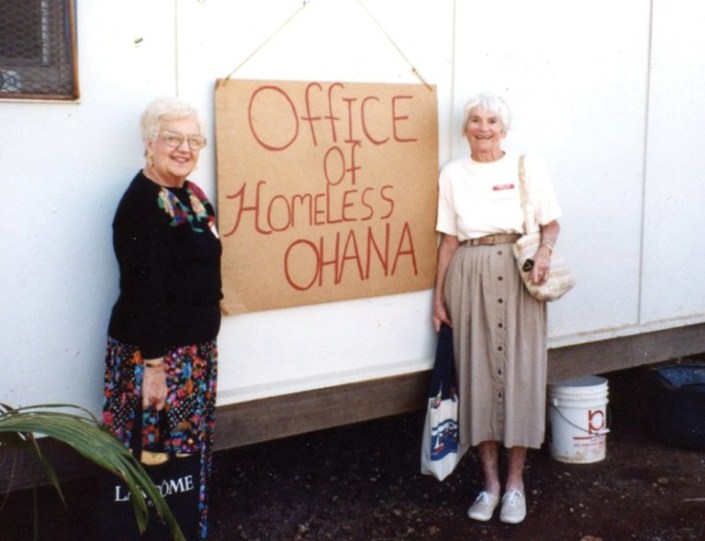 Julie Braig on our left; my mother on our right, in beige.
My mother, Patricia Constance Conroy Desonier, left my world far too early: September 24, 1994. She was an extraordinary mother, spouse, grandmother, musician, and activist.
As a member of the Honolulu Chapter of the Catholic Women’s Guild, she and other community-minded women spearheaded a ministry to benefit the homeless on the areas of Oahu most populated by those affected by the inability to maintain a roof over their heads. In this article the many charitable works of the Guild were spotlighted, including the efforts my mother and another member, Julie Braig, completed, centered in Nanakuli, Hawaii.
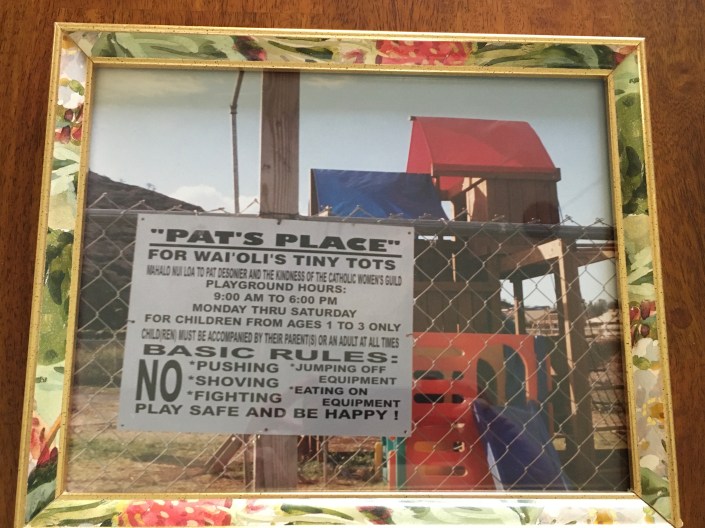
They created an Office of Homeless Ohana (Ohana meaning family) where individuals and family members could set up a mailing address so they could send off applications and resumes to acquire meaningful employment and/or receive mail from other loved ones, have a place to shower, receive meals, and gather as a community; playground equipment was even secured and installed so children could play and live just like those who had a home to return to each day.
My family lived 30 miles away from where this shelter existed, and my mother’s abilities were limited because of severe rheumatoid arthritis that plagued her since she was a teenager, but my mother and Julie made the trip week in and week out to help those who needed someone in their corner during a rough time in their lives. My mother taught me many things about charity and living a full life. Here are a few of her maxims:
- Don’t assume everyone lives as comfortably as you do. Life can change in an instant;
- Give of yourself in any way you can;
- When in physical pain, just remember: you can be active and hurt a bit more, or you can stay at home and do nothing and still hurt, nonetheless.
Thank you, Mom, for being such an influence on my life, my family’s life, and the lives of so many who never met you. I love you, and I miss you terribly.
Social Media in the time of Covid-19


Roofing Neighbor responded by saying the work was being done because of leaks that were disrupting family life and causing an unsafe environment for their family of five. It was indeed an emergent, rather than an elective, roof repair.
Angry Neighbor and Roofing Neighbor went back and forth and back and forth while those following the stream excoriated Angry Neighbor for being such an )&*?+^$%^&#% to the tune of 47 comments by the end of the day. I happened to notice that Angry Neighbor and Roofing Neighbor had stopped commenting way before that time so they had obviously removed themselves from the fray.
The next day, there were 137 comments, none from Angry and Roofing Neighbor, but comments nonetheless from uninvolved people still ticked off at Angry Neighbor’s rudeness in bashing his next-door neighbor.
What is this all about?
It’s about fragile psyches angered and worried about the state of our country and our world in the time of Covid-19. Sure, such social media harassing and bullying has been going on for quite some time now, but I have to believe it has worsened because of how vulnerable all of us feel.
A dog backed into a corner lashes out at perceived threats.
We are all backed in a corner right now with no proven safe way out. Most of us are doing our part in trying to contain a menace that threatens our very existence and that of our loved ones, but thus far, no relief is on the immediate horizon. We are petrified, and instead of treating each other with kid gloves, some of us are kicking others when they are down, a practice that need not happen. Instead…
As a human race, we must choose between:
- the violence of adults, and the smiles of children;
- the ugliness of hate, and the will to oppose it;
- inflicting suffering and humiliation on our fellow man, and offering him the solidarity and hope he deserves for naught.
Even in darkness, it is possible to create light and encourage compassion. Every moment of our life is essential; every gesture is essential. Our role in life is to give an offering to each other. – Nobel Peace Prize Winner, Elie Wiesel
This Week’s Good News!
Generation Z could teach all the rest of the existing generations a thing or two. Like in this story that makes inclusion the norm. My heart is full of good vibes with this delightful good news story.
This Week’s Good News!
Leave it to Reno, Nevada to figure out how to use dance to benefit those with cognitive impairment. This story spotlights a wonderful dance club that is making a grand impact on the lives of those with dementia and their loved ones.
This Week’s Good News!
You can’t take it with you, that’s for sure, but this 105-year-old Seattle woman took it to a whole new level. She lived a simple life and ended up with $10 million left unspent…she found a wonderful use for every last dollar. Such a wonderful story.
This Week’s Good News!
This heartwarming story out of the UK shows the generosity of a gentleman who noticed something amiss, did something about it and absolutely made someone’s day. Check it out.
This Week’s Good News!
This delightful story out of Oregon shows the lengths a grandparent will go to spend time with his grandchildren and make their school days just a bit brighter. I know you’ll enjoy the wonderful connection he has with his young ones.
This Week’s Good News!
A five-year-old in San Diego, CA was concerned about school lunch debt incurred by those households not able to keep up with their children’s lunch expenses. Wait until you see how she set out to rectify this ongoing problem that occurs in so many school districts. What a great story to start February’s weekly good news!
This Week’s Good News!
One thing I’ve learned over the years is that regardless of how many differences appear to separate us from others, those differences disappear when kindness is at the forefront of all that we do. This next Good News story will really float your boat.
This Week’s Good News!
Living a life with no regrets would be the kind of good news we all would be willing to celebrate. You will be saddened, but encouraged, by this WWII veteran’s story. Please take the time to honor him and his family with your time.
This Week’s Good News!
So many in this world suffer unbearable loss; I do not know how such losses are reconciled, or how one survives such a loss without losing one’s soul. A young mother in Wisconsin lost her baby boy, shortly after his birth. The generosity she exhibited after her loss absolutely floored me.
This Week’s Good News!
It is so easy to take the comfort of our Home Sweet Home for granted, even when so many, through no fault of their own, have nowhere to live: homeless on the street or living in their vehicle, there are countless numbers of fellow human beings who have no home to call their own. This story about a school bus driver will warm your heart. Let us all be careful not to judge those whose stories we know nothing of.
This Week’s Good News!
Happy New Year! May 2020 see kindness, love, and abundant health as your portion!
If I tried to describe the story that makes up the first Good News story of the year, I would fail miserably. Please click on this link to both read, and listen, to proof that miracles happen, and because they do, we should never give up hope.
This Week’s Good News!

This story out of Nova Scotia, Canada will warm your heart. There are angels everywhere, and this guardian angel proves it when he helps an elderly neighbor.
Merry Christmas everyone!
May Comfort and Joy be Your Portion

Thank you to all who have chosen to keep in touch over the many years I have hosted this blog.
Please stay safe during the Holidays and take some time for yourself as we plod toward a New Year!
This Week’s Good News! a few days late…
Lending a hand when needed is something at which customers at a Birmingham, Alabama Waffle House excelled. I am certain one particular employee at this eating establishment had the experience of a lifetime during his work shift. I sure do love good news like this.
This Week’s Good News!
As someone who relies on books to provide carefree, enjoyable quality time in my life, I really appreciate a story based out of Chicago, that focuses on libraries and their book-return policy. Just wait until you read this one!

