Whether you follow the “It takes a village” concept – or simply believe that our lives can be positively enhanced by others – you most likely believe, as I do, that two is better than one; three is better than two; four is better than three . . .
Mind you, I am perfectly capable of accomplishing many things for which I require very little – if any – assistance. But when I attempt to do something that may benefit from others’ participation, I’m open to it.
Ariel and Shya Kane, authors of several books, including Practical Enlightenment have the following to say about not going it alone. I quote verbatim from their chapter “You Can’t Do it Alone”:
Independence and freedom are the background upon which many of our lives are played. So we may not be making use of our support system of friends around us because we’re locked into an unexamined need to prove we can do it alone . . .
Having someone to talk to, to share ideas with, to support you in going for excellence and not quitting on yourself is a rare gift. When you are feeling down and it all seems too hard to continue, those are the moments that a community can support you in rediscovering well-being. It’s easy to get discouraged. Life is full of disappointments, but when you realize you’re not traveling that road alone, you can keep going.
The simple point I want to make today, however, is that I believe we need to make a concerted effort to pull away from the Me, Myself, and I paradigm and adopt an Us outlook. Doing so opens up so many healthy possibilities:
we’ll be more aware of the needs around us;
conversely, we’ll be more inclined to accept help when offered;
we’ll be giving others – friends and strangers – an opportunity to exercise their strengths in the midst of our weaknesses;
we’ll build community where previously none existed;
we’ll release positive energy into our little portion of the universe, rather than infect that same space with selfishness, hatred, and bitterness.
It’s virtually impossible to be a violent person – in actions or in words – if we’re practicing what is listed in the above bullet points. If we truly live our lives outwardly, we’ll create a binding strength that will make us stronger as individuals, while also creating an indestructible civilization that can stand up against anything that gets thrown in its path. I certainly can’t say the same for the Me, Myself, and I method of existence.
No. I alone can not do it. No one can.
The sooner we realize that fact, the better off we’ll all be.
The other day, I discovered something about myself and about the way of kindness.
It’s really easy to be kind when life is going grand.
The kindness gene resides within me, just as it does in you if you feed it and let it flourish. What I can say for myself is that at the very least, my intentions are pure.
With that said, however, when I’m feeling far less than 100%, I have to work hard at not letting others be on the receiving end of that less-than-whole person I’ve become. I’ve had a lousy night of sleep? Ugh, I must rein in my struggles and not take it out on the receptionist at the doctor’s office or the supermarket employee. I sincerely don’t want to be responsible for ruining someone else’s perfectly, gloriously healthy, well-slept day. (Gawd, I’m envious of those who have been given the gift of sleep.) All it takes is one look, one word – or the omission of a word – to spew miserableness onto someone else.
Kindness is a way of life for me, but sometimes it threatens to take a break from the norm, and that’s when it’s needed the most in the world. You see, I’m not the only person who has less-than-stellar days. I’d be self-centered to think I’m the only person the world takes a dump on now and again. Everyone in this world is vulnerable – everyone – and far too many are on the brink of giving up. We are all in this together, in good times and in bad.
This will be a very short post to encourage you to be who you are. Although I am only mentioning three aspects of being (two of which that are personally applicable to me) I think we can all agree that as individuals, we have the right to express ourselves and be ourselves in the best way possible to live authentically. It’s really the easiest task you can fulfill: TO BE YOU.
If you express yourself by what you wear or by the color of your hair, that to others may seem out of the norm: Continue to express yourself in that manner.
If, like me, your language is sometimes what is considered “swearing like a sailor”: Continue to swear like a sailor, taking into consideration sensitive young ears that aren’t ready to hear such words or in circumstances that just about everyone would consider inappropriate. I trust you to choose your audience with care as I do when swearing mightily like a sailor when I feel circumstances warrant such expletives.
And finally, but perhaps the most important of all, at least to me:
If you tend to care deeply about and for others, a caring that can cause you to lose sleep or peace of mind from time to time, or perhaps your caring is considered going overboard to some: Continue to care deeply because if each of us can improve our little corner of the world, maybe each and every corner of the world will eventually be kinder than it was before we started caring so deeply.
Whatever you do, please be you.
Love who you love. Love your neighbor as yourself. Spread kindness to your neighbor.
We don’t have to live a long life to have difficult episodes that we want to move on from and forget. We escape those times and are better off as a result. We are so relieved to be done with those times but guess what? We aren’t done with them.
Case in point: my father died from Alzheimer’s complications October 2007; I was the primary person involved with managing his care. A few months after Dad died, another family member was diagnosed with dementia and the caregiving journey started all over again, but my experience with Dad helped with my sister-in-law’s disease journey. And now years after she died, I find my experience still coming into play to benefit others, because let’s face it, dementia is alive and well in our world, in our cities, and in our neighborhoods. It is still difficult to draw upon my previous personal experiences from which I thought I had escaped, but it is affirming to know that because I had those experiences, others can be helped.
Whether past experiences center around health issues, relationship issues, financial devastation, or any number of not so great life experiences, we all learned something from them, and because we learned something from them, others can be guided through their own similar circumstances.
If you are able, let your own life lessons become those from which others can benefit. But if you struggle to resurrect those hard learned lessons due to the difficulty of doing so, I support you in stepping away because only you know what you can handle while still supporting your own mental health.
I recently had a doctor’s appointment on a Friday. After the Medical Assistant called my name, I followed her down the hallway to the exam room. I asked how her day was going, and she mumbled a response that didn’t sound too positive. My response, “Well, at least it’s Friday and tomorrow starts your weekend.”
“That’s no better.”
Oh. I apologized and restated my encouragement, saying that I guess sometimes work can be a healthy escape from what awaits us at home.
I learned at least two things that day:
Sometimes reaching out to others can appear to fall flat
Not everyone has a welcoming and peaceful home life
But I don’t regret reaching out to the Medical Assistant with kindness because maybe, just maybe, my presence as her patient inserted a welcome glimmer of friendship into her day. Some glimmer attempts can certainly fall flat, but I am also quite certain that just the opposite can be true.
This second post of 2026 proposes that every day be treated as if one does a New Year.
I am going to try to provide you with wisdom that might help you get a good start on 2026, and every day you’ve been given. Here’s what Dr. Bernie Siegel has to say in his book 365 Prescriptions of the Soul:
How can you possibly have a new year? You are the same person, and the world doesn’t start again with a clean slate just because a calendar page has been turned. Your troubles don’t miraculously disappear. Your life was anything but new when you awoke on the first day of this year; it was simply a way of measuring the passage of time. Why make such a fuss over it?
I guess it’s because we like new starts. There’s something refreshing about having the opportunity to start all over again. Not unlike second chances, I treat the commencement of a new year as an opportunity to do better. Unless you’re perfect, you too like the idea of a fresh start.
But instead of relying on 365 days to do better, I can do better in the next minute. Right now, I can do better. I can think of and speak more kindly towards others and myself. I can promote a healthier lifestyle and make plans to construct a better me and a better world, so why take all 365 days of the year to do so?
I have the chance to live my best life now, and so do you. To borrow another quote from Dr. Bernie Siegel, here’s some encouragement to make a new year more palatable.
When every evening is New Year’s Eve and every day you awaken to is New Year’s Day, you are living life as it was intended.
That makes sense to me, so you know what? I’m gonna get right on it!
I am not trying to be dramatic, controversial, or disturbing. Nope! This is just how I am when a new year is peeking around the corner. It’s all I can do NOT to hang up next year’s home office wall calendar in October when I first purchase it. I force myself to wait until at least the day before the new year before doing so.
Guaranteed, I won’t wait that long this year.
Don’t get me wrong, I do this calendar page turning every month of the year so that by the time there are a couple days remaining in the month…FLIP! There’s a new month’s calendar page to grace my wall. Does that mean I don’t live in the present? Probably. But for me, it’s a comfort to look ahead and hope for the best.
I think the above sentiment is appropriate when hoping for a better new year, both globally and locally. It works for me; I hope it works for you.
Why does it take bravery to be kind? Because sometimes we have to reach out to someone when doing so feels uncomfortable; uncomfortable because offering a kindness that might be rejected would be embarrassing. Or perhaps the intended recipient might take offense at the gesture, thereby cancelling out the kindness meant to be shared.
That’s where intuition comes into play.
The other day, the employee who checked our groceries at our neighborhood store wore a pin that indicated she was a US Air Force veteran. That was when my intuition started to buzz. I asked how her Holidays were going, and she said her son, who is on active US military duty, wouldn’t be coming home for Christmas this year. That really got my intuition buzzing…CORRECTION…my intuition was jumping around in my body.
As a member of a local botanical garden that has an extraordinary Holiday light display throughout the gardens in December, I had two free passes in my wallet. I asked “Laurie” if she was familiar with the gardens’ annual light display. Boy, was she. Her face lit up. I pulled out the passes and handed them to her. “Would you like to go this year?” She started to cry, saying she and her husband wanted to go, but it didn’t seem possible this year. She looked me in the eyes and, through her tears, said, “This means so much to me.” Let me tell you, it meant a great deal to me as well.
I have been working on amping up my bravery. As a matter of fact, BRAVERY is my word for 2026. I am very glad I was able to exercise my bravery muscles to go along with the kindness I felt compelled to extend at the grocery store.
My encouragement to everyone is just this: trust your gut.
And talk about trusting your gut, please enjoy this prime example of where bravery and courage come into play. It’s quite a dramatic piece from an extraordinary blog I follow, Boomer Banter.
My two novels are available in eBook format for practically free and are very affordable in paperback.
Requiem for the Status Quo is a work of fiction based on real events in which I was personally involved, and it effectively portrays the role family caregivers play in caring for loved ones with Alzheimer’s and other forms of dementia.
A Jagged Journey, also fiction, addresses the attitudes you and I exhibit and witness in a world that should allow for diversity and differing beliefs.
My sister, Mary, was born 8 months before me; my parents adopted her after my mother suffered three miscarriages. As sometimes happens, before the ink was dry on the adoption papers, my mother became pregnant with me. Yay me!!!
Suffice it to say, being so close in age, my sister and I grew up together, sharing the same experiences and often the same friends. We are still very close, even though we don’t live in the same state.
Several years ago, after our mother and father had passed away, my sister located her birth mother, met her, and had a few occasions to get together with her and her other daughters, even though her birth mother lived in eastern Canada and my sister resides in California.
Because I erroneously believed I would have all the time in the world to thank my sister’s biological mother for placing Mary up for adoption, I missed out on that opportunity because Cathy died a few years after my sister first connected with her.
Cathy’s decision to provide the best possible home for my sister was an extraordinary gift for which I wanted to express my gratitude. Still, I procrastinated and never told Cathy what a blessing her first daughter is to me. In my recent history, this is by far the biggest regret I harbor in my heart.
Being kind to yourself is most definitely a serious matter. You deserve to be treated with the same gentleness you would treat others for whom you care.
If the Holidays are starting to get to you, do what is needed to bring some calm and control back into your life, even if that means disappointing others. Again, you matter just as much as those you might have to disappoint, so I would advise you to try a little kindness toward yourself, a kindness you so very much deserve.
And if you’re doing absolutely well right now and can exercise some outward gentleness, check in on individuals who might need a reminder that they matter and that someone was thinking of them. You don’t have to make a huge effort – especially if doing so depletes your own reserves – but a phone call, a text, or a hello in passing – could mean the difference between making their day and not.
What a terrific statement that is, isn’t it? This statement was made twice in my presence the other day. The first time was when I said it to the grocery store checker that morning, an employee who was stretching her back and then leaning on the check stand. I asked her, “Has it already been a day for you?” To which she responded, “You have no idea how long it has already been.” I told her I was sorry and that I hoped she got relief soon, then I said,
I appreciate you, I really do.
Later that same day, I was at a medical office, having turned in some paperwork to the front desk employee who then said the following to me,
I appreciate what you have done, thank you so much.
I felt acknowledged, and I felt like my presence mattered to her. I felt present.
One definition of appreciation is:
Recognition and enjoyment of the good qualities of someone or something.
Wow. That must be why the grocery employee expressed her pleasure with my statement earlier that day and why I felt so present and worthwhile during my very brief encounter with medical staff a few hours later.
Please extend your appreciation to others as you go through your day today. You just might save that person from having the worst day of their life.
Have world events impacted you in such a way that you feel things are hopeless?
Are you overwhelmed to the point that you say to yourself, What could I possibly do to make a difference?
The answer is:
You can make a difference because kindness overcomes all.
My last post addressed the negative power of words. I sincerely believe that random acts or words of kindness can make a difference in the world in which we live. There are so many negative and hurtful words being thrust into our universe; can’t we please try to balance out that hurt with words of encouragement, recognition, and nourishment?
Yes, nourishment. In all our daily interactions—whether via social media or in person—we can nurture the hurt that exists all around us. Our words, our smile, and our actions may just change someone’s life forever. Haven’t you been on the receiving end of that type of transformative nourishment? Didn’t it feel good? Didn’t it fill the emptiness within you that hungered and thirsted for confirmation that you matter, that you aren’t a failure, that you have potential?
Let’s revisit how that felt and commit to quenching the thirst of each person with whom we come in contact, whether virtually or in person.
Syndicated columnist Leonard Pitts Jr. wrote an Opinion piece in a January 2014 Seattle Times newspaper edition that focused on the cruelty that comes out of the mouths of people who criticize the physical differences that exist in people. His column focused on people’s cruel words that made fun of a very successful actress whom they deemed to be overweight.
The columnist questioned when and how this type of truly sadistic personal meanness became acceptable, even commonplace. And may I just say that in the year 2025, such meanness flows from the mouths of those in political office, seemingly sanctioned because of the position held by the word abuser. Why do we think it’s any of our business to criticize someone else’s supposed imperfection? Doing so is an act of judgment of someone about whom we know very little.
Dad & I, circa 2000. When us kids would say something cruel about someone, my dad would offer the following: “It’s too bad that everyone isn’t as perfect as us.” Point taken.
Mr. Pitts asked what had happened to what he called “home training” that is supposed to teach us that there are just some things you don’t say to or about people in a public forum?
Whether our “something” is shaped like the emotional scars of abuse, an eating disorder, physical or developmental disabilities, bad teeth, or a nose that is too big, too fat, or too small, no one has the right to inflict hurt on us with their words.
Let us all adopt Nobel Peace Prize winner Elie Wiesel’s statement made during an interview with Oprah Winfrey many years ago. May it be a challenge to all of us.
As a human race, we must choose between: the violence of adults, and the smiles of children; the ugliness of hate, and the will to oppose it; inflicting suffering and humiliation on our fellow man, and offering him the solidarity and hope he deserves for naught.
Even in darkness, it is possible to create light and encourage compassion. Every moment of our life is essential; every gesture is essential. Our role in life is to give an offering to each other.
I recently read a book on Stoicism, Reasons Not To Worry, and the author, Brigid Delaney, concluded that her goal most days is to be tranquil, rather than happy, because “Happiness…is often a fleeting emotion that seemingly comes and goes on a whim…”
So if your response to my post’s question does not fall into the category of happiness, please don’t feel as though you’re in a bad state of being. You are not; after all, as the author also states, “…tranquility, although a less exciting state, is more constant, acting like a slow-release drug that keeps me stable and content throughout the day.”
So I ask you, what’s not to like about stability and contentment?
Dr. Bernie S. Siegel provides some wisdom for our day from his 365 Prescriptions for the Soul book. The following is provided verbatim:
Parade of Life
Forget past mistakes. Forget failures. Forget everything except what you are going to do now, and do it. – William Durant
Life is a parade. Sometimes we march along and realize we have passed by what we were looking for. What do we do? Stand there and drop out of the parade? March on with regrets? Feel bad about how we looked or that everything we wanted was on the wrong side of the street? It’s passed! Forget it and march on!
Sometimes our parade isn’t so pretty, and the crowd isn’t interested in us. If we drag everything we have passed with us, we will destroy the present. We have no future when we live in the past.
We even talk about past lives. Whether you believe in them or not, the same principle applies. If you are living a past life, you are destroying your present one. In therapy, people come to understand why they are acting the way they are and how the past is affecting them. They learn to let go, move on, and not sit in the same classroom year after year. They graduate and commence a new life.
To conclude, I, Irene Frances Olson, have this to say about Dr. Siegel’s comments:
The good news is that we can learn from our past, both the good and the bad, but if we stay cemented in the past and don’t move on? That parade Dr. Siegel talks about? It’ll pass us by.
I don’t know about you, but I don’t want to get left behind.
Our weekly grocery store has made it through thick and thin, which of course includes the pandemic that closed down so many businesses and saw employees leaving their place of employment in droves, so much so, that retail operations are now struggling to staff their stores appropriately. Many long-time employees stay committed to their work, wanting the salary, of course, but also wanting the retail operation to survive.
The other day, in response to my comment about the cute smiley face health mask our grocery checker was wearing, this long-time employee told us that a “secret shopper” was brought into the store to monitor its employees and this shopper told management that “Jane” didn’t smile when he went through her checkout stand. Jane shows up for all her shifts, does a stellar job, and the lack of a smile becomes punishable?
As difficult as it is to fill retail shifts, I would think the lack of a smile at any given time, whether momentary or ongoing, isn’t an offense worth reporting to management. I think it was unfortunate that this employee was reprimanded. We are in your corner, Jane. May peace and prosperity be your portion.
I am 72 years old. Up until my 60s, I looked forward to every birthday, but when I was about to turn seventy, all bets were off. The good news is, I now know why.
My mother died at the age of 77, which, come on now, isn’t old. My mother’s cause of death doesn’t at all reflect my health status. Mom had three health conditions that adversely affected her quality of life for many, many years. I don’t have any of those conditions, but when I turned 70, I saw my life as one that was hanging in the balance.
Over the past couple of years, I have reconciled to the fact that I do not fear that I will die as Mom did. Nope! But I still don’t like being in this particular decade of my life. Perhaps I will get over it, and, quite frankly, I hope I do, because feeling averse to this decade is counterintuitive to living in the moment, which is what I truly endeavor to do. If you read last week’s post, you know that I’m trying to do better at living and accepting my age. But it’s not always an easy task, is it? But “easy” isn’t what I’m demanding out of life either; rather, I simply want to refine my ongoing attempt to accept what is.
And there you have it, unapologetically me in a nutshell.
In light of the way life has unfolded in the world as of recently, I have endeavored to discover a way of surviving the day-to-day tedium, and it appears I have done so for myself. It is not a religion, with its set orthodoxies and rules; rather, it is a way of living that is extremely pliable:
Stoicism
I now provide for you the principles found in this philosophy that – quite frankly – seem worthy of our attention. This list comes directly from the book, Reasons Not to Worry – How to Be Stoic in Chaotic Times, by Brigid Delaney.
Acknowledge that you can’t control much of what goes on in your life.
See that your emotions are the product of how you think about the world.
Accept that bad things are bound to happen to you from time to time, just as they do to everyone else.
See yourself as part of a larger whole, not an isolated individual; part of the human race, part of nature.
Think of everything you have as not your own, but simply on loan, that one day will be taken back.
And that is all I have to say to you this week because it is not I who says it, but the Stoics themselves.
Do you feel as though you don’t visit your loved one often enough at the long-term care (LTC) facility in which they live? Try to acknowledge that guilt is a feeling that may not necessarily reflect an accurate reality of how attentive you are towards your loved one.
The local caregiver.
In my past Alzheimer’s Association work, many caregivers expressed their concerns that they were not doing enough for their loved one who lived in a LTC facility. Even when a caregiver visited Mom several days a week, the caregiver still felt guilty for not making more of an effort to be there for her.
Guilt is a valid feeling, but the feeling of guilt may not accurately reflect what is going on. Let’s face it, most of us are hard on ourselves. The old adage, “we’re our own worse critic” came about resultant from generations of people who unfairly beat themselves into the ground.
At a gathering I attended several years ago, a woman expressed how guilty she felt for not visiting her mother more often than she thought appropriate. Another person, also a caregiver, suggested that this person ask herself whether or not she felt she was doing the best she could in this situation. “If you are, then perhaps your feeling of guilt is based on emotion rather than reality.” Whether five visits a week or one visit a month – if that’s the best a person is able to do, then it’s sufficient.
Caregivers simply need to cut themselves some slack. Even when the loved one they’re visiting has no concept of the passage of time and is not able to discern whether they’ve been visited as recently as the last hour or as long ago as last year, caregivers still berate themselves for not being there more frequently.
Caveat: I need to add that even if your loved one doesn’t a) recognize you, and b) can’t quantify the passage of time, you are still a wonderful addition to that person’s life. No staff caregiver can take your place when it comes to providing a loving presence for your Mom who lives in a facility. Just being there with a smile, a hug, and speaking words of compassion can do wonders towards brightening Mom’s day.
The long-distance caregiver.
One of many walks my father and I took around his facility
My biggest role as a caregiver was that which I performed long distance for my father who lived in a dementia unit in a Southern Oregon assisted living facility. I felt like I was doing something truly valuable for him while I was there but as soon as I boarded the plane for Seattle the guilt enveloped me. Usually, the first night of my return was spent crying because I felt I had been impatient with him, or I acted flustered when I had to answer a question that my father had already asked me no less than two dozen times prior. I relived every moment of my visit, criticizing this and that about what I did, or didn’t do. I was a wreck. I had to talk myself into believing that dad did have a good time and dad was genuinely happy to see me, and by golly, I didn’t do that bad of a job as a caregiver daughter.
I could then relax knowing that he was being well-cared for in my absence; my visits augmented that care, and I could rest on that fact rather than falling back on my guilt. The NY Times article, Being There and Far Away sheds some light on the long distance caregiver’s experience. I hope you’ll take the time to read the article as I believe it will touch on some topics that all caregivers may experience.
As I mentioned in my Blog entry, Deathbed Promises and How to Fulfill Themtake a deep breath and shed the mantle of guilt you’re wearing. It doesn’t do you any good and it gets in the way of you being the best caregiver you can be. Cut yourself some slack and don’t be so hard on yourself.
Mary Oliver is well-known for her poetry. Although I am not normally a lover of poetry, I do love this one that seems to encourage us to find and celebrate joy, regardless of what is going on around us. I hope you enJOY this brief poem of hers.
Don’t Hesitate
If you suddenly and unexpectedly feel joy, don’t hesitate. Give in to it.
There are plenty of lives and whole towns destroyed or about to be.
We are not wise, and not very often kind. And much can never be redeemed.
Still, life has some possibility left. Perhaps this is its way of fighting back, that sometimes something happens better than all the riches or power in the world.
It could be anything, but very likely you notice it in the instant when love begins.
Anyway, that’s often the case. Anyway, whatever it is, don’t be afraid of its plenty.
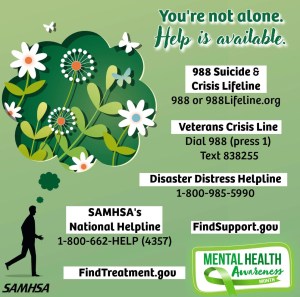
I would venture to say that 100% of us humans have some sort of mental health anomaly. In the Oxford dictionary, anomaly is defined as something that deviates from what is standard, normal, or expected.
A broken leg is an obvious malfunction: obvious to everyone who observes the cast that is worn or the crutches that are employed to hobble around. But what about what is going on in our brains? It is certainly true that certain behaviors are equally as detectable as a broken limb, but I believe the majority of us have degrees of anomalies of which only the individual affected might be aware. And we get up every morning hoping to crawl out of what that might mean for us: depression, anxiety, or fear of this, that, or the other.
The thrust of this brief post is two-fold:
to encourage those who suffer to seek beneficial support, and
to beseech others to be kind-hearted to those in need of your compassion.
To be sure, it is difficult to know what is going on in the emotional background of people we encounter so it is a very good practice to interact with others without passing judgment. I would very much appreciate being on the receiving end of a nonjudgmental encounter so it behooves me to extend that same courtesy to those who cross my path.
May we all practice acceptance and compassion towards ourselves and towards others.
Perhaps in addition to the above poster, this site would also be a helpful resource for all of us: NAMI
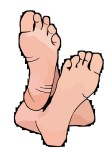
Some time ago, I came to the realization about how many places my almost seventy-two year old feet have taken me. I’ve lived in the following US states: California, Hawaii, Alaska, and Washington. I’ve traveled to the following countries: Canada, Mexico, France, Scotland, and the UK. (I know, that’s not a lot of places but just the same, my feet took me there and back!)
Sometimes our feet take us to geographical places; other times they take us to and through life experiences – not all of which are easy or pleasing. But those gnarled toes and fallen arches manage to carry us where we need to be and will continue to do so until they can’t.
A few years ago, I came to a place of acceptance of my body resulting in gratitude for everything it has endured and managed to survive. That may not seem like a monumental achievement to some, but for me, it most definitely has been. My body’s challenges and your body’s challenges may not be identical but there isn’t a person around that doesn’t have them – bodies or challenges – and we’re still here!
I HAVE SURVIVED THE LESS THAN ENJOYABLE BODY FOIBLES 100% OF THE TIME AND HAVE LIVED TO WRITE ABOUT IT!
Wow! And because I have evidence that such successes have occurred, when I’m in the midst of seemingly insurmountable medical, physical, or emotional challenges, I can look forward to getting to the other side of them to add yet another success to my growing evidentiary list.
Our lives never follow a straight path. We make turns, we leap or crawl over speed bumps and roadblocks, and when needed, we take breaks along the way while battling the insistent urge to just give up. More often than not, however, we keep going; we move forward, one step at a time, hoping for the best.
A Jagged Journey, is a novel that follows the pothole-filled lives of disparate characters between the ages of seven and seventy-seven who are far from perfect and for the most part, are not hesitant to admit it. Set in the Pacific Northwest of the United States, the diversity inherent within that region is front and center and will have readers laughing and crying in equal measure.
Laughing because the youngest character, Sammy, is a kick-in-the-butt delight when his honesty comes through loud and clear, challenging every adult with whom he comes in contact to sit up and pay attention.
And crying, because readers will see themselves in the imperfect childhoods that can find adults sinking or swimming in their grown-up years.
My novel was written for anyone eighteen years and older. Within its pages, readers will find loving friendships and relationships that will challenge even the hardest of hearts to open up to the many joys that life has to offer.
Although my second novel does not have the same focus as Requiem for the Status Quo with its’ storyline filled with the caregiver and loved one’s journey with Alzheimer’s and other dementia, you will always find that element in every novel I write, including this latest, A Jagged Journey.
What a privilege it is to love someone and be loved by them. There’s a reason why there are so many dating/relationship services out there: we crave connection, and happily-ever-after is a worthy goal to pursue.
I’m fortunate that my current 29-year relationship (married for 25 of those 29) quite naturally fell into place. Girl meets boy on a blind date set up by a dating site; girl and boy decide to get together for another date, and…the rest is history!
No one disputed my choice of a partner with whom I held hands, smooched in public, and eventually enjoyed full intimacy. That is not always the case, whether a partner is of a different race, financial standing, or of the same gender identity. I experienced racial hatred when I married my first husband who is Chinese American. As a newly married couple, we walked hand-in-hand on a weekend outing in an Eastern Washington town where we were verbally accosted by a woman who shouted, “Thou shalt not mix races! You are an abomination to God!” I veryunpolitely told her off and went on my way with my husband, enjoying the love we had already shared for more than eight years. That was 50 years ago, and I am still negatively affected by it. Many are harassed and abused in a similar manner because of the love they share with someone, harassment that takes many forms.
In the early 90s, I was privileged to work at a progressive Seattle law firm where one of my coworkers, a woman, was in a relationship with another woman. The two of them had certainly experienced discrimination but expressed that for the most part they had been fortunate. I asked my coworker how she and her partner had met. “Susan is who I fell in love with and she with me. It’s all about who you fall in love with.” That made sense to me and still does.
What also makes sense is living one’s truth and genuineness about who you are as an individual, and with whom you choose to share your life. Being who you are with someone else is rife with hurdles, regardless of your gender, but truly there is no other way to be. No ifs, ands, or buts – being safely and securely transparent in a relationship is a gift! What a privilege it is to live honestly, not having to pretend to be someone else, not living a cloaked identity just to be accepted by others.
I experience that freedom, and wish that same freedom for everyone seeking connection, love, and happily-ever-after.
There are 26 letters in the English alphabet and what I find amazing is that those 26 letters make up all the words we could ever want to write in our lifetime. I find that such an endearing fact!!!
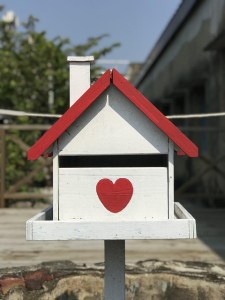
But you wanna know what I REALLY love? Sending greeting cards to people.
Okay, true confessions time: I am a card-a-holic. Yes, I am! I love sending cards to people for noteworthy occasions or for no occasion whatsoever. Why do I do that? Well, it’s a passion of mine, but also, I have to believe that any day I can improve someone’s life with snail mail that lands in their physical mailbox, is a good day.
And who doesn’t want to gift someone with a good day?
Trust me when I say, I know that texting and writing emails is a more efficient way of getting ones’ message across, but is it always the best way? No, I don’t think it is. The tactile experience of someone slicing open an envelope to receive my greeting excites the heck out of me! I send more cards than I receive but that doesn’t stop me from sending at least one card a week to someone, and what also doesn’t stop me is the ever-increasing price of postage because seriously people:
Can you put a price tag on happiness? Nope, you cannot.
I hope that my own country’s postal service never goes out of business, and I am doing my best to support it by purchasing the stamps it sells and giving the employees something super worthwhile to do: improving someone else’s day by delivering a card!
So, there you have it. I am grateful for the English alphabet that was created centuries ago so I could stand at a greeting card counter – like I did the other day – and carefully choose future tactile experiences that many someones will receive in their postal mailbox.
I SURE DO LOVE WHAT JUST 26 LETTERS OF THE ALPHABET CAN DO FOR OTHERS!
Marcus Aurelius stated a good thing in this particular meditation, but boy is it difficult to comply with such wisdom. Am I right?
Negative matters and thoughts can really color our view of what’s going on around us but because of that negativity, I guess it’s far more beneficial to only give them their minimum due and then shift our focus to more positive happenings. After being on this earth for more than 71.5 years, I can state without hesitation that while yucky stuff is going on left, right, front, and center, positive stuff is equally as present…although not always recognizable. In a post last month, You Can Never Have Too Much Hope, I suggested that hopelessness is not a desired state of being. It’s a brief post I hope you will click on.
That is where hope comes in – an emotion that just might provide clarity when all the lines of decency seem blurred.
How well do you know the person who bags your groceries on a weekly basis? I am here to encourage you to engage with staff you see every week because the rewards to you, and the staff, are immeasurable.
The other day my husband and I said goodbye to our favorite grocery bagger, “Steven.” We saw Steven every week for a few years, and each time we did so – and after a certain measure of trust was established between customer and staff person – Steven opened up more and more to us. We shared grandchild stories while he shared tidbits about his hobbies and his later in life dating adventures.
But the other day, just a couple days before he moved across the country to help out his daughter in her hardware store business, he honored us by walking our groceries out to our car and then opened up like never before when I asked him how long he had worked at that Redmond, Washington area grocery store. His response floored us.
Steven revealed that he started working at the store six years ago, a couple years after he had survived, and been rehabilitated from, a brain aneurysm that didn’t quite stop him dead in his tracks. As a 50-something year old adult, he had to learn everything from scratch. Prior to this severe medical event, Steven was a professor of industrial engineering at a Washington university. Now he bags groceries, which, let me tell you, is a noble profession, especially during all the pandemic and other world events that pitted frontline workers in the midst of disarray and uncertainty.
My husband and I were shocked by his revelation given that we didn’t detect anything medically abnormal about this now 60-something year old gentleman. We never knew about the challenges he endured and overcame; we simply enjoyed our weekly interactions with him and quite frankly, felt those interactions were the highlight of each week’s mundane shopping trips. We were not looking forward to his planned move out of the state.
Opening up and being transparent with others is a vulnerable thing to do and shows a strength that many do not possess.
Once our groceries were loaded into our vehicle we visited with Steven some more and when it was time for him to head back into the store, the three of us exchanged goodbye hugs. We will miss this valuable connection but are happy that the state of Indiana will now get to benefit from this stellar human being we had come to know.
How many times in a lifetime are we asked: How are you?
How many times have we answered: Fine.
How many times has that not been a true statement? Probably lots and lots of times.
We don’t always feel fine, and when I say “feel” I don’t just mean the physical or medical definition of fine. How about emotionally? How about the complicated psychological aspects that are tied in with how each of us is handling life as it presents itself to us?
Our confidence or lack thereof. Our sense of safety or danger in any given hour of every day. Our ability to cope when coping feels like the least practiced skill available to us.
I would suggest that each of us check in with those individuals within our sphere of influence: spouse or partner, neighbor, coworker, and friend, so that we assure the person we are querying that we really want to know and that they can be as transparent as they are comfortable being.
When we get in the practice of honestly inquiring about each other, it is my hope that our responses will be equally as honest so that dialogue, true dialogue will take place.
I hope that you are fine, but if you’re not, it’s okay to say so.

 It’s virtually impossible to be a violent person – in actions or in words – if we’re practicing what is listed in the above bullet points. If we truly live our lives outwardly, we’ll create a binding strength that will make us stronger as individuals, while also creating an indestructible civilization that can stand up against anything that gets thrown in its path. I certainly can’t say the same for the Me, Myself, and I method of existence.
 The other day, I discovered something about myself and about the way of kindness.
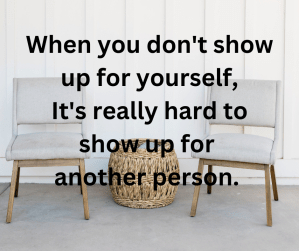 This will be a very short post to encourage you to be who you are. Although I am only mentioning three aspects of being (two of which that are personally applicable to me) I think we can all agree that as individuals, we have the right to express ourselves and be ourselves in the best way possible to live authentically. It’s really the easiest task you can fulfill: TO BE YOU.
 We don’t have to live a long life to have difficult episodes that we want to move on from and forget. We escape those times and are better off as a result. We are so relieved to be done with those times but guess what? We aren’t done with them.
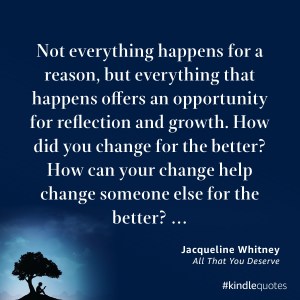 If you are able, let your own life lessons become those from which others can benefit. But if you struggle to resurrect those hard learned lessons due to the difficulty of doing so, I support you in stepping away because only you know what you can handle while still supporting your own mental health.
 I recently had a doctor’s appointment on a Friday. After the Medical Assistant called my name, I followed her down the hallway to the exam room. I asked how her day was going, and she mumbled a response that didn’t sound too positive. My response, “Well, at least it’s Friday and tomorrow starts your weekend.”
 This second post of 2026 proposes that every day be treated as if one does a New Year.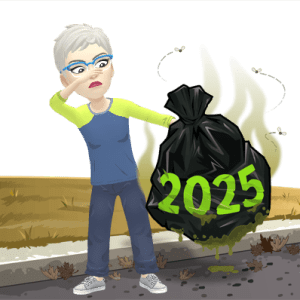


 Because I erroneously believed I would have all the time in the world to thank my sister’s biological mother for placing Mary up for adoption, I missed out on that opportunity because Cathy died a few years after my sister first connected with her.
 What a terrific statement that is, isn’t it? This statement was made twice in my presence the other day. The first time was when I said it to the grocery store checker that morning, an employee who was stretching her back and then leaning on the check stand. I asked her, “Has it already been a day for you?” To which she responded, “You have no idea how long it has already been.” I told her I was sorry and that I hoped she got relief soon, then I said,
 Have world events impacted you in such a way that you feel things are hopeless?
 Yes, nourishment. In all our daily interactions—whether via social media or in person—we can nurture the hurt that exists all around us. Our words, our smile, and our actions may just change someone’s life forever. Haven’t you been on the receiving end of that type of transformative nourishment? Didn’t it feel good? Didn’t it fill the emptiness within you that hungered and thirsted for confirmation that you matter, that you aren’t a failure, that you have potential?
 So if your response to my post’s question does not fall into the category of happiness, please don’t feel as though you’re in a bad state of being. You are not; after all, as the author also states, “…tranquility, although a less exciting state, is more constant, acting like a slow-release drug that keeps me stable and content throughout the day.”
 Life is a parade. Sometimes we march along and realize we have passed by what we were looking for. What do we do? Stand there and drop out of the parade? March on with regrets? Feel bad about how we looked or that everything we wanted was on the wrong side of the street? It’s passed! Forget it and march on!

 In light of the way life has unfolded in the world as of recently, I have endeavored to discover a way of surviving the day-to-day tedium, and it appears I have done so for myself. It is not a religion, with its set orthodoxies and rules; rather, it is a way of living that is extremely pliable: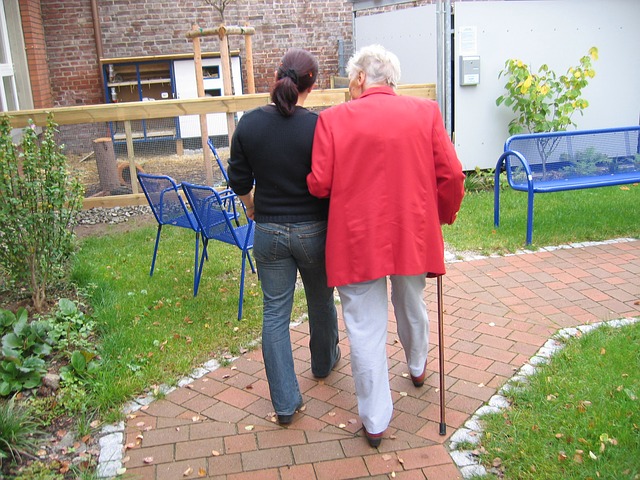

 Mary Oliver is well-known for her poetry. Although I am not normally a lover of poetry, I do love this one that seems to encourage us to find and celebrate joy, regardless of what is going on around us. I hope you enJOY this brief poem of hers.
 Joy is not made to be a crumb.

 To be sure, it is difficult to know what is going on in the emotional background of people we encounter so it is a very good practice to interact with others without passing judgment. I would very much appreciate being on the receiving end of a nonjudgmental encounter so it behooves me to extend that same courtesy to those who cross my path.
 And my feet will take me there.
 Our lives never follow a straight path. We make turns, we leap or crawl over speed bumps and roadblocks, and when needed, we take breaks along the way while battling the insistent urge to just give up. More often than not, however, we keep going; we move forward, one step at a time, hoping for the best.
 What a privilege it is to love someone and be loved by them. There’s a reason why there are so many dating/relationship services out there: we crave connection, and happily-ever-after is a worthy goal to pursue.
 But you wanna know what I REALLY love? Sending greeting cards to people.
 I hope that my own country’s postal service never goes out of business, and I am doing my best to support it by purchasing the stamps it sells and giving the employees something super worthwhile to do: improving someone else’s day by delivering a card!
 That is where hope comes in – an emotion that just might provide clarity when all the lines of decency seem blurred.
 How well do you know the person who bags your groceries on a weekly basis? I am here to encourage you to engage with staff you see every week because the rewards to you, and the staff, are immeasurable.
 How many times has that not been a true statement? Probably lots and lots of times.
 Living: the ultimate team sport