Do you feel as though you don’t visit your loved one often enough at the long-term care (LTC) facility in which they live? Try to acknowledge that guilt is a feeling that may not necessarily reflect an accurate reality of how attentive you are towards your loved one.
The local caregiver.
In my past Alzheimer’s Association work, many caregivers expressed their concerns that they were not doing enough for their loved one who lived in a LTC facility. Even when a caregiver visited Mom several days a week, the caregiver still felt guilty for not making more of an effort to be there for her.
Guilt is a valid feeling, but the feeling of guilt may not accurately reflect what is going on. Let’s face it, most of us are hard on ourselves. The old adage, “we’re our own worse critic” came about resultant from generations of people who unfairly beat themselves into the ground.
At a gathering I attended several years ago, a woman expressed how guilty she felt for not visiting her mother more often than she thought appropriate. Another person, also a caregiver, suggested that this person ask herself whether or not she felt she was doing the best she could in this situation. “If you are, then perhaps your feeling of guilt is based on emotion rather than reality.” Whether five visits a week or one visit a month – if that’s the best a person is able to do, then it’s sufficient.
Caregivers simply need to cut themselves some slack. Even when the loved one they’re visiting has no concept of the passage of time and is not able to discern whether they’ve been visited as recently as the last hour or as long ago as last year, caregivers still berate themselves for not being there more frequently.
Caveat: I need to add that even if your loved one doesn’t a) recognize you, and b) can’t quantify the passage of time, you are still a wonderful addition to that person’s life. No staff caregiver can take your place when it comes to providing a loving presence for your Mom who lives in a facility. Just being there with a smile, a hug, and speaking words of compassion can do wonders towards brightening Mom’s day.
The long-distance caregiver.
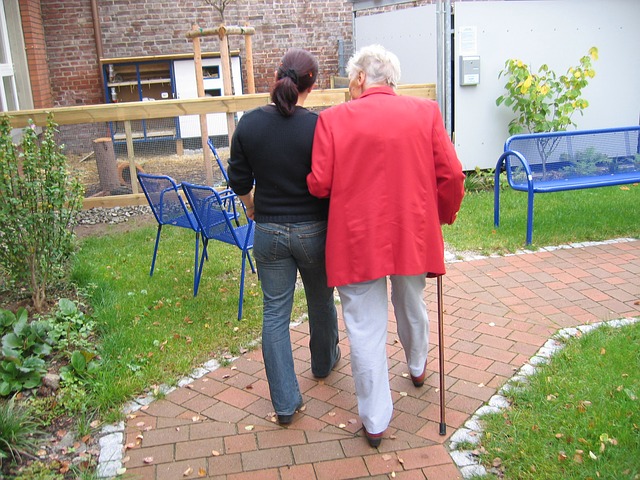
One of many walks my father and I took around his facility
My biggest role as a caregiver was that which I performed long distance for my father who lived in a dementia unit in a Southern Oregon assisted living facility. I felt like I was doing something truly valuable for him while I was there but as soon as I boarded the plane for Seattle the guilt enveloped me. Usually, the first night of my return was spent crying because I felt I had been impatient with him, or I acted flustered when I had to answer a question that my father had already asked me no less than two dozen times prior. I relived every moment of my visit, criticizing this and that about what I did, or didn’t do. I was a wreck. I had to talk myself into believing that dad did have a good time and dad was genuinely happy to see me, and by golly, I didn’t do that bad of a job as a caregiver daughter.
I could then relax knowing that he was being well-cared for in my absence; my visits augmented that care, and I could rest on that fact rather than falling back on my guilt. The NY Times article, Being There and Far Away sheds some light on the long distance caregiver’s experience. I hope you’ll take the time to read the article as I believe it will touch on some topics that all caregivers may experience.
As I mentioned in my Blog entry, Deathbed Promises and How to Fulfill Themtake a deep breath and shed the mantle of guilt you’re wearing. It doesn’t do you any good and it gets in the way of you being the best caregiver you can be. Cut yourself some slack and don’t be so hard on yourself.
Irene, thank you for speaking to this very important topic. It is so common with caregivers. I recall when I was caring for my wife, Nancy when she was in memory care, I frequently questioned whether I was spending enough time with her. This, despite the fact that I was working full-time, and managing her care.
We do the best we can and that’s all we can do. Your observations are spot on🙏

 Living: the ultimate team sport
May 19, 2025 at 8:29 am
Irene, thank you for speaking to this very important topic. It is so common with caregivers. I recall when I was caring for my wife, Nancy when she was in memory care, I frequently questioned whether I was spending enough time with her. This, despite the fact that I was working full-time, and managing her care.
We do the best we can and that’s all we can do. Your observations are spot on🙏
LikeLiked by 1 person